




The ministerial exam is a compulsory, province-wide standardized test in Quebec that directly measures students’ mastery of core competencies mandated by the Quebec Education Program. These official assessments, formally known as “épreuves ministérielles,” carry real weight in final grade calculations and shape academic progression across every school in the province. Whether your child is in primary school or Secondary V, understanding how these exams work is the first step toward preparing with confidence.
What is the ministerial exam and why does it matter?
The ministerial exam is designed to give the Quebec Ministry of Education an objective, province-wide view of student achievement. No two schools grade identically, but standardized province-wide comparisons make it possible to measure learning outcomes fairly across all institutions. That standardization is the entire point. It protects students by ensuring that a grade earned in Rimouski carries the same academic meaning as one earned in Montreal.
The exam covers key subjects including French language of instruction, English as a second language, Mathematics, Science and Technology, and History of Quebec and Canada. Every subject tested reflects a competency defined by the Quebec Education Program, not a teacher’s personal curriculum choices. This distinction matters because it shifts the focus from memorizing class notes to demonstrating genuine understanding.

Schools administer these exams under strict protocols set by the Ministry. Students are admitted to the exam regardless of absences or low course grades during the year. That rule exists to protect every student’s right to a fair assessment, no matter what happened during the school year.
Which subjects and grade levels require ministry exams?
The grade level determines how much the exam counts toward a student’s final mark. Exams at primary and Secondary II levels count for 20% of the final grade. At Secondary IV and V, that weight rises to 50% of the final competency mark. That jump is significant. A student who coasts through the year but underperforms on the Secondary V French exam will feel it directly in their final result.

Official exam sessions run in january, june, and august. The june session is the main one for most students. The january and august sessions serve students who need to retake an exam or who follow an adjusted academic calendar.
| Level | Subjects Covered | Exam Weight |
|---|---|---|
| Primary | French, English, Math | 20% of final grade |
| Secondary II | French, English, Math | 20% of final grade |
| Secondary IV | French, History of Quebec and Canada | 50% of final competency mark |
| Secondary V | French, English, Math, Science | 50% of final competency mark |
The Secondary IV and V exams carry the heaviest consequences because they directly affect a student’s diploma and eligibility for college programs. Preparing for them with the same effort as a regular class test is not enough.
How to prepare effectively for a ministerial exam
Preparation works best when it starts early and follows a clear structure. Starting at least 8 weeks before the june exam gives students enough time to review all curriculum competencies without rushing. Eight weeks sounds like a long time, but it fills up quickly once you break it into subject blocks.
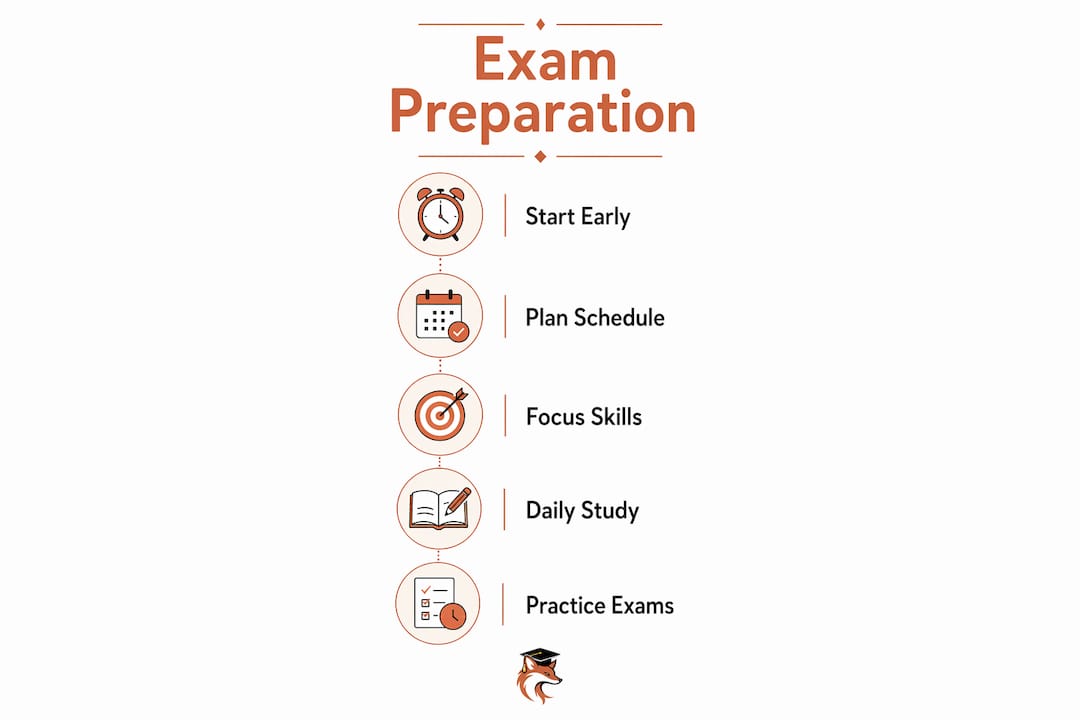
The most effective preparation focuses on applying competencies rather than memorizing content. Understanding and applying competencies aligns directly with how the Quebec Education Program structures learning. A student who can explain why a historical event happened will outperform one who memorized dates but cannot connect them to causes and consequences.
Pro Tip: Practice with official past exams from Alloprof and the Ministry website. These are free, accurate, and the single best way to understand what question complexity actually looks like.
A structured eight-week plan looks like this:
- Weeks 1–2: Identify every competency in the subject. Use the official program document from the Ministry website. Note which areas feel weakest.
- Weeks 3–4: Review weak areas using class notes, textbooks, and Alloprof’s subject guides. Focus on understanding, not copying.
- Weeks 5–6: Work through past ministerial exams under timed conditions. Check answers against official marking guides.
- Week 7: Target any remaining gaps identified from past exam practice. Set micro-objectives: “I will master two-step algebra problems by Thursday.”
- Week 8: Light review only. Simulate full exam conditions once. Rest well before exam day.
Spaced learning beats marathon study sessions every time. Thirty focused minutes each day produces better retention than three hours the night before. Build a spring exam study plan early so the schedule feels manageable, not punishing.
Common misconceptions about ministry exams
The biggest myth about the ministerial exam is that it is designed to catch students off guard. Exams focus on evaluating core competencies, not on tricking students with obscure questions. Every question connects to a competency that was taught in class. The exam is not a surprise. It is a structured check on what students were supposed to learn.
A second common belief is that rigorous uniform marking is unfair. The opposite is true. Standardized marking exists to protect students from inconsistency. A student in a rural school receives the same evaluation criteria as one in a large urban center. That consistency is what makes the results meaningful.
“Ministerial exams provide essential standardization that ensures fairness and equal academic expectations across all Quebec schools. They are the only mechanism that allows for objective, province-wide comparisons of student achievement.”
Performance anxiety is real, and it affects results. Students who understand the exam structure before they sit down feel significantly less anxious on the day. Knowing that Section 1 is multiple choice and Section 2 requires written development removes the fear of the unknown. Practice with past papers is the most direct way to build that familiarity.
Common challenges students face include:
- Underestimating the 50% weight of Secondary IV and V exams until it is too late to recover
- Studying content instead of practicing competency application
- Skipping past exam practice because it feels uncomfortable to see gaps
- Ignoring the marking guide, which reveals exactly what evaluators look for
- Letting exam anxiety go unaddressed until the week before the test
Managing stress is part of preparation. Short daily study sessions, regular breaks, physical activity, and enough sleep all support memory and focus. Students who treat exam preparation as a sprint tend to burn out. Those who treat it as a steady process tend to perform well.
What to expect on exam day and how results work
Exam day follows strict rules set by the Ministry and administered by schools. Knowing these rules in advance removes last-minute confusion.
Permitted and prohibited materials include:
- Permitted: Calculators (where specified by subject rules), rulers, dictionaries for certain exams, and other subject-specific reference materials
- Prohibited: Electronic devices of any kind, including smartphones, tablets, and smartwatches
- Required: Valid student ID and any materials listed on the school’s exam notice
Practice using only the permitted tools during your study sessions. Students who rely on phone calculators during study and then face a basic calculator on exam day lose time adjusting.
Marking is shared between the Ministry and teachers depending on the exam type. Multiple-choice sections are corrected centrally by the Ministry. Development questions are corrected by teachers using a uniform correction guide provided by the Ministry. That guide ensures consistency regardless of which teacher marks the paper.
Results are shared by mail and online. Students who score below 60% can retake the exam and request a correction review. A retake is not a failure. It is a built-in opportunity to demonstrate competency when the first attempt did not reflect a student’s true ability.
Key Takeaways
Consistent, competency-focused preparation starting 8 weeks before the june exam is the most reliable path to a strong ministerial exam result.
| Point | Details |
|---|---|
| Exam weight by level | Primary and Secondary II exams count for 20%; Secondary IV and V count for 50% of the final mark. |
| Start preparation early | Begin reviewing curriculum competencies at least 8 weeks before the june exam session. |
| Use official past exams | Past ministerial exams from Alloprof and the Ministry reveal question style and marking expectations. |
| Know the exam day rules | Electronic devices are banned; only subject-approved tools like calculators and dictionaries are permitted. |
| Retakes are available | Students scoring below 60% can retake the exam and request a correction review. |
What 25 years of working with Quebec students taught Réussite A+ about these exams
The students who struggle most with ministry exams are rarely the ones who lack ability. They are the ones who prepared for the wrong thing. They reviewed their class notes carefully, studied hard, and still felt blindsided because they had never actually sat with a real past exam under timed conditions.
At Réussite A+, we have seen this pattern repeat across more than 3,500 students over 25 years. The fix is almost always the same: shift from passive review to active practice. Pull up a past exam. Set a timer. Work through it. Then read the marking guide and understand exactly where points were lost. That single exercise teaches more about exam expectations than three weeks of note review.
The other thing we have learned is that anxiety shrinks when structure grows. Students who know what the exam looks like, how long each section runs, and what tools they can use walk in calmer. Calm students think more clearly. Thinking clearly is what competency-based exams reward.
We also encourage students to build a study community, whether that means a small group of classmates, a parent who checks in weekly, or a tutor who holds them accountable. Accountability is not pressure. It is support. And support, consistently applied over eight weeks, produces results that last well beyond exam day.
— Réussite A+
How Réussite A+ supports your ministerial exam preparation
Preparing for a high-stakes exam is much easier with the right support structure in place.

Réussite A+ offers personalized online tutoring for Quebec students in French and Mathematics, the two subjects that appear at every level of the ministerial exam calendar. Every student receives a customized learning plan built around their specific gaps, not a generic curriculum. Tutors are selected from the university level for academic excellence and teaching ability. With a 99% client satisfaction rate and more than 3,500 students helped, Réussite A+ has the track record to back up its approach. Register early to maximize your eight-week preparation window. Sign up for tutoring support and give your child the structured, expert guidance that turns preparation into results.
FAQ
What is a ministerial exam in Quebec?
A ministerial exam is a compulsory, province-wide standardized test administered by the Quebec Ministry of Education to assess students’ mastery of core competencies in key subjects. It counts for 20% of the final grade at primary and Secondary II levels, and up to 50% at Secondary IV and V.
How much does the ministerial exam count toward the final grade?
At primary and Secondary II levels, the exam counts for 20% of the final grade. At Secondary IV and V, it counts for 50% of the final competency mark, making thorough preparation critical at those levels.
When are ministerial exams held in Quebec?
Official exam sessions run in january, june, and august. The june session is the main sitting for most students, while january and august sessions serve students on adjusted calendars or those retaking an exam.
Can a student retake a ministerial exam if they fail?
Students who score below 60% can retake the exam and request a correction review through the Ministry. Results are communicated by mail and online, and the retake process is a formal, built-in option within the Quebec education system.
What study resources are available for ministerial exam preparation?
Alloprof and the Quebec Ministry of Education both publish official past exams and marking guides at no cost. These resources are the most accurate preparation tools available because they reflect real exam structure, question complexity, and evaluator expectations.