




The fastest, most reliable way to build math facts mastery is short, frequent, accuracy-first retrieval practice that is explicitly linked to conceptual understanding. Start this week with three steps: choose three new facts to introduce, practise them for five minutes daily using flashcards or a simple game, and check accuracy before adding any time pressure.
Here is what this guide covers:
- What automaticity means and which operations it includes
- The research principles that separate effective practice from busy work
- Concrete methods and session templates by grade level
- How to assess progress and recognise when a child needs more support
- How to choose a program or tutor, including what Réussite A+ offers Quebec families
Key takeaways
Math facts mastery requires accuracy-first retrieval practice, short daily sessions, and consistent progress monitoring before any timed pressure is introduced.
| Point | Details |
|---|---|
| Accuracy before speed | Confirm 9/10 correct on untimed checks before introducing any timed practice. |
| Small, frequent sessions | Practise 5–10 minutes daily; introduce no more than three new facts per session. |
| Four-week mastery window | Expect roughly four weeks of daily practice to automate a small fact set. |
| Monitor weekly | Use brief untimed probes or software reports to confirm facts are consolidating. |
| Réussite A+ for Quebec families | Personalised tutoring with university-level tutors, diagnostic-first planning, and continuous progress tracking. |
Table of Contents
- What is math facts mastery, and why does it matter?
- What does the research say about effective fluency practice?
- Concrete methods that actually build automaticity
- How to structure practice sessions by grade level
- How do you assess progress and know when mastery is reached?
- What to do when a child is not making expected progress
- How do you choose a program or tutor that will actually work?
- A pragmatic, low-stress take on fluency
- Réussite A+ supports your child’s math fluency
- Sources
- FAQ
What is math facts mastery, and why does it matter?
Math facts mastery, more precisely called automaticity, means a child can retrieve a basic arithmetic fact from long-term memory instantly and accurately, without counting on fingers or reconstructing the answer each time. The Quebec framework for math interventions defines fluency as knowledge, retention, and automaticity of facts and procedures, and it explicitly links fluency to conceptual understanding rather than rote memorisation.
Which facts are included?
- Addition and subtraction: all combinations to 20, typically targeted in Grades 1–3
- Multiplication and division: times tables to 12 × 12, typically targeted in Grades 3–6
- Mixed operations: consolidation and transfer across all four operations by Grade 6
The cognitive reason this matters is straightforward. Research from Carleton University links arithmetic fluency directly to working-memory efficiency: when a child must reconstruct 7 × 8 mid-problem, working memory fills up before they can tackle the harder reasoning the problem actually requires. Fluency frees that mental space for problem solving, estimation, and algebra. The same report documents measurable declines in arithmetic fluency among Canadian university students, which underscores why deliberate, early instruction matters.
A note on development: children naturally move through stages, from counting all objects, to counting on from the larger number, to using decomposition strategies, and finally to direct retrieval. Good instruction mirrors and accelerates that trajectory rather than skipping straight to memorisation.
What does the research say about effective fluency practice?
Four principles, drawn from cognitive science and classroom research, consistently separate effective fluency instruction from practice that wastes time or creates anxiety.
1. Accuracy before timed speed. Introducing a stopwatch before a child can reliably produce correct answers pushes them back toward inefficient counting strategies. A recent evidence review in cognitive science of learning recommends delaying timed practice until accuracy is established, then using low-stakes timing as a retrieval tool, not a performance test.
2. Short, frequent sessions. Practice blocks of roughly 2–10 minutes, several times per week, outperform longer, infrequent sessions. Spaced repetition consolidates facts into long-term memory more reliably than massed drilling. EdWeek’s summary of research-backed classroom tips recommends introducing only about three new facts at a time and practising them until they are automatic before adding more.
3. Integrate conceptual understanding with retrieval practice. Fluency and understanding are not opposites. Quebec policy guidance is clear that fluency depends on understanding, and that flexibility, conceptual knowledge, and procedural recall reinforce each other. Teaching a child why 6 × 7 = 42 (through arrays, skip counting, or decomposition) makes the fact stick faster and longer than repetition alone.
4. Use progress monitoring. Brief, consistent checks tell you whether retrieval is becoming automatic or whether a child is still reconstructing answers. Without monitoring, it is easy to move on too quickly or to keep drilling facts a child already knows.
Concrete methods that actually build automaticity
No single activity works for every child. The most effective approach combines several methods, sequenced deliberately: teach the concept first, then guided practice, then independent retrieval, then low-stakes timed practice. Meta-analytic work on fluency interventions confirms that the active ingredients are repeated retrieval, immediate feedback, and systematic sequencing of facts.
Explicit strategy instruction. Before drilling, teach a strategy. For multiplication, that might be the “double-double” trick for ×4 facts, or skip counting for ×5 and ×10. For addition, teach “make ten” decomposition (8 + 6 = 8 + 2 + 4 = 14). These strategies give children a reliable path to the answer while retrieval is still developing.
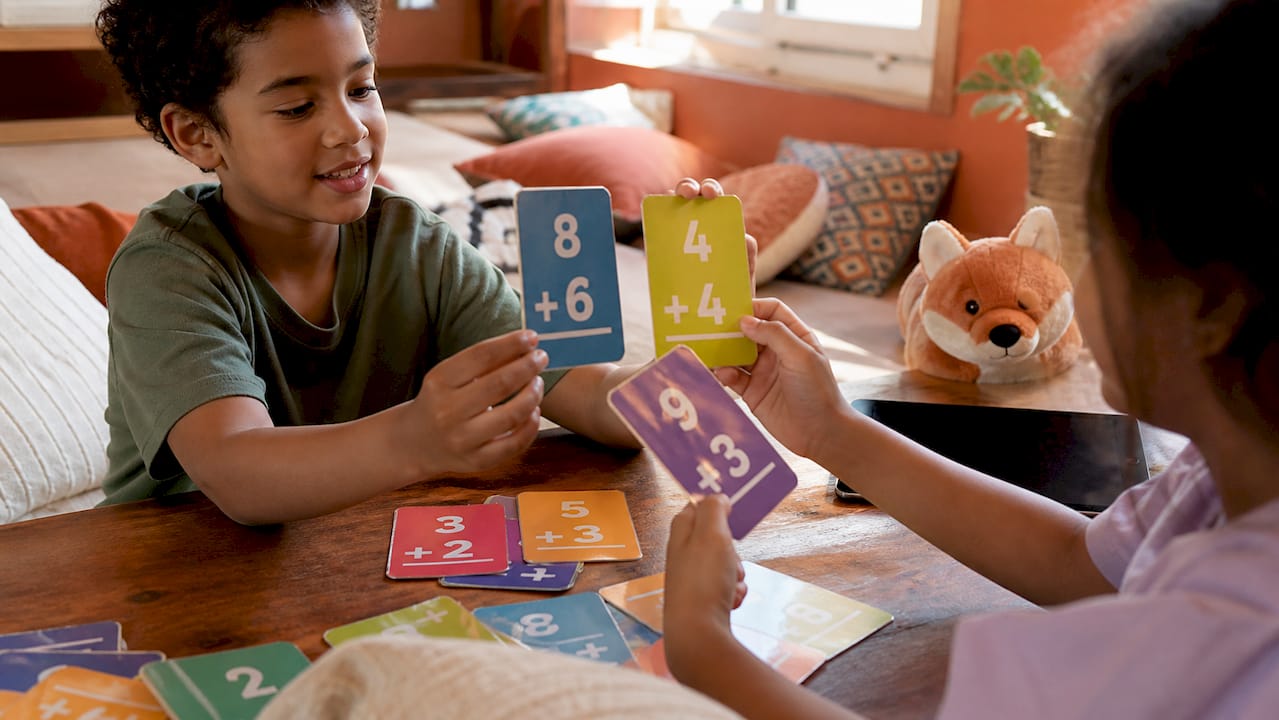
Retrieval practice with flashcards. One-minute flashcard rounds work well once accuracy is solid. Show the card, wait for the answer, give immediate feedback, and rotate missed cards back into the deck. Keep the set small: three to five facts per session.
Gamified practice. Partner quizzes, number-bond card games, and skip-counting races make repetition feel purposeful. Réussite A+ uses short math games as part of its practice toolkit because engagement directly affects how often children practise voluntarily at home.
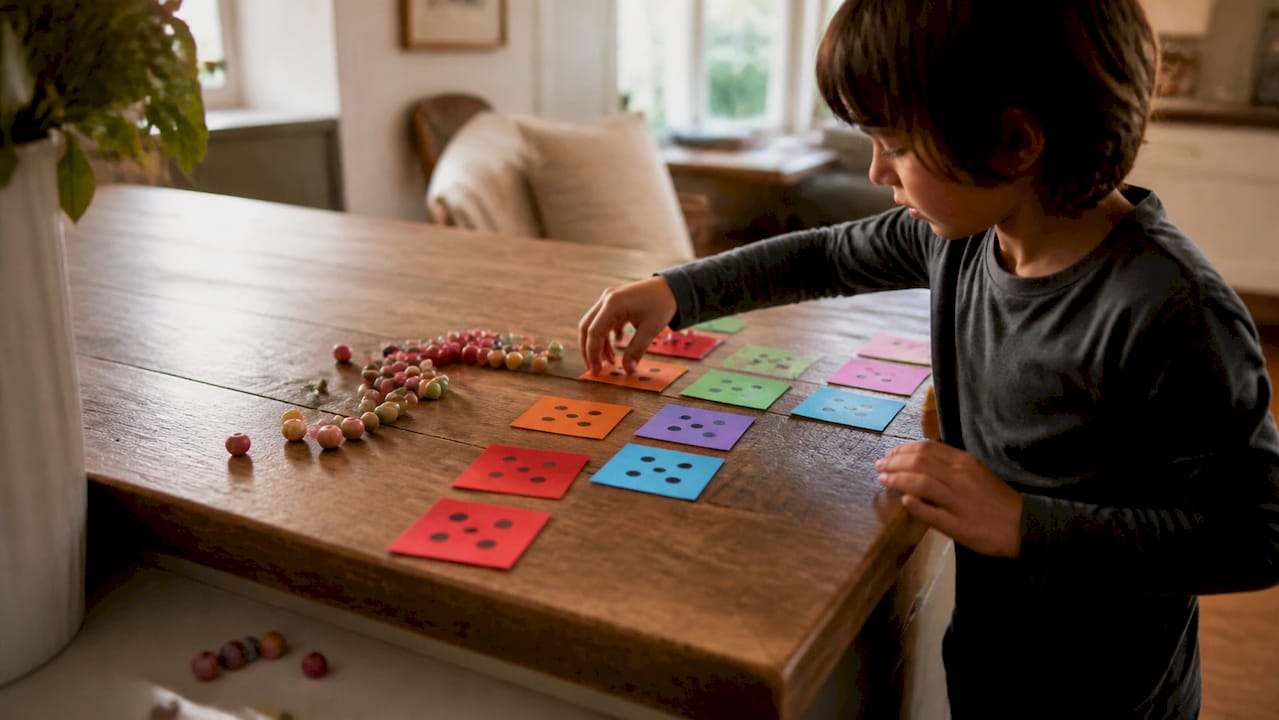
Manipulatives and the CRA sequence. The concrete-representational-abstract (CRA) progression, supported by the Quebec intervention framework, moves children from physical objects (tiles, counters) to drawn diagrams (number lines, arrays) to abstract symbols. This sequence supports transfer to mental strategies and long-term retrieval, particularly for children who struggle with purely symbolic instruction.
Digital adaptive tools. Programs like Reflex (ExploreLearning) and Math Facts Pro use adaptive algorithms to target each child’s specific gaps and adjust difficulty in real time. These tools provide response-time data that paper flashcards cannot, and they keep practice sessions self-pacing. They work best as a complement to, not a replacement for, teacher-guided strategy instruction.
Pro Tip: Never introduce a timer until a child answers at least 9 out of 10 facts correctly in an untimed check. Timing an inaccurate child does not build speed; it builds anxiety and cements wrong answers.
How to structure practice sessions by grade level
Consistency matters more than duration. A five-minute daily session beats a thirty-minute session once a week, every time.
Kindergarten and Grade 1 (addition to 10)
- Spend two to three minutes on a concrete activity: counting objects, building number bonds with tiles.
- Spend two minutes on a simple verbal game: “What goes with 3 to make 7?”
- No timed practice yet. Focus entirely on accuracy and strategy.
Grades 2–3 (addition/subtraction to 20; introduction of multiplication)
- Open with a two-minute warm-up: five flashcard facts the child already knows (confidence builder).
- Introduce up to three new facts using a strategy or story.
- Practise the new facts with a partner quiz or a short digital session (three to five minutes).
- Close with one untimed accuracy check: ten facts, self-marked.
Grades 4–6 (multiplication and division tables)
- Two-minute warm-up with known facts.
- Three to five minutes of targeted retrieval on the current fact set (flashcards, Reflex, or Math Facts Pro).
- One low-stakes timed probe: one minute, count correct answers, record the score.
- Review missed facts briefly and note them for the next session.
Pacing guidelines:
- Introduce no more than three new facts per session.
- Expect roughly four weeks to reach automaticity on a small fact set with daily practice.
- Move to the next set only when a child scores 9/10 or better on two consecutive untimed checks.
- Integrate short practice into existing routines: morning arrival tasks, homework warm-ups, or the first five minutes of a tutoring session.
Setting measurable short-term goals for each fact set, rather than aiming vaguely at “knowing the times tables,” keeps both children and parents on track.
How do you assess progress and know when mastery is reached?
Assessment does not need to be elaborate. The goal is a quick, consistent signal that tells you whether retrieval is becoming automatic.
| Assessment type | Best used for | Format | Mastery signal |
|---|---|---|---|
| Untimed accuracy probe | Screening and baseline | 20 facts, paper or oral | 9/10 correct on two consecutive checks |
| CBM-style timed probe | Progress monitoring | 1 minute, count correct | Consistent improvement week over week |
| Adaptive software report | Diagnostic and ongoing monitoring | Reflex, Math Facts Pro | Response time trending down; accuracy above 80% |
| BGU-MF computerised test | Operation-level diagnostic | Validated computerised format | RT and accuracy data by operation |
The BGU-MF computerised fluency test is a validated, adaptive tool that captures both accuracy and response time by operation, making it useful when you need a precise picture of where automaticity has and has not developed. One practical note: allow one or two practice sessions in any new digital format before interpreting the results, since unfamiliarity with the interface can suppress scores.
Assess weekly during active instruction and every two weeks during maintenance. Keep probes brief (one to two minutes) and frame them as a game or a personal best challenge, not a test.
Pro Tip: *Use software reports to identify which specific facts are still slow, not just overall accuracy.
What to do when a child is not making expected progress
Slow progress is common and usually fixable. The first step is identifying the cause before changing the method.
Common reasons for stalled fluency:
- Weak number sense (the child does not yet understand what the operation means)
- Inconsistent practice (fewer than three sessions per week)
- Math anxiety triggered by timed assessments
- A possible maths learning difficulty (MLD), which affects fact retrieval specifically
A tiered response:
- Step 1: Return to concrete manipulatives and strategy instruction. Drill without understanding rarely breaks a plateau.
- Step 2: Increase session frequency to five short sessions per week and reduce the fact set to two or three facts at a time.
- Step 3: Run twice-weekly untimed accuracy checks to track whether accuracy is improving before reintroducing any time pressure.
- Step 4: If accuracy remains below 7/10 after six weeks of consistent, well-structured practice, consider a diagnostic assessment and specialist support.
Signs that a child may need dedicated support include persistent low accuracy across multiple operations, inconsistent gains despite regular practice, and visible distress during any math activity. These are not signs of low ability; they are signals that the current approach needs to change. For families navigating this, the guidance on what to do when your child is struggling with math offers a clear next-step framework.
How do you choose a program or tutor that will actually work?
Not every fluency program is built on the same evidence. Before committing, check for these criteria:
- Personalised pacing: the program adjusts to the child’s current accuracy level, not a fixed grade-level schedule.
- Progress monitoring: you receive regular, readable reports on accuracy and response time by operation.
- Accuracy-first sequencing: timed practice is introduced only after accuracy is confirmed.
- CRA support: the program or tutor uses concrete and representational tools before moving to abstract retrieval.
- Tutor credentials: tutors have strong subject knowledge and experience with elementary learners.
- Trial or diagnostic session: a reputable program offers an initial assessment before committing to a full package.
For software, look at reporting granularity. Reflex and Math Facts Pro both provide operation-level data, which is far more useful than a single overall score. Adaptive pacing, which adjusts difficulty based on response time rather than just accuracy, is a meaningful differentiator.
Typical tutoring costs in Quebec vary by format and provider. Group sessions tend to be more affordable than one-on-one, and online delivery generally costs less than in-person. The most important cost consideration is not the hourly rate but whether the program includes progress monitoring and a personalised plan, since those two features are what prevent wasted sessions.
Réussite A+ meets all of these criteria. Its tutors are selected from the university level, every student receives a customised learning plan, and progress is tracked continuously throughout the programme. For Quebec families preparing for secondary school entrance exams, where mathematics plays a central role in admission, building fluency early with a structured, personalised approach is one of the highest-leverage investments a family can make.
A pragmatic, low-stress take on fluency
The most common mistake parents and teachers make is introducing time pressure too early. A child who is still counting on their fingers does not need a timer; they need more strategy instruction and more accurate repetitions. Fluency is not a race. It is a gradual consolidation process that responds well to patience, consistency, and low stakes.
Two commitments make a measurable difference: five minutes of daily practice for four consecutive weeks, and a weekly untimed accuracy check to confirm the facts are sticking. That is it. No elaborate system, no high-pressure drills. Children who practise this way typically show clear progress within a month, and that progress is visible in their confidence during regular classroom math, not just on a fluency probe.
The research is consistent on this point. Accuracy first, then speed, then transfer. Rushing any of those stages costs more time in the long run than taking them in order.
Réussite A+ supports your child’s math fluency
Réussite A+ offers something most fluency apps and generic programs cannot: a university-level tutor who builds a personalised plan around your child’s exact gaps, tracks progress session by session, and adjusts pacing before a small difficulty becomes a larger one.
Whether your child is in Grade 2 working on addition facts or in Grade 5 consolidating multiplication and division, the starting point is always a diagnostic session that maps exactly where they are. From there, every session has a clear goal and a measurable outcome.
Register for personalised tutoring to book a diagnostic session and receive a customised fluency plan for your child.
Sources
- Framework for Interventions to Improve Math Skills
- BGU-MF computerized test study (math fluency during childhood)
- What the science of learning teaches us about arithmetic fluency
- 4 research-backed tips for mastering math facts
FAQ
What is the difference between math fluency and memorisation?
Fluency means fast, accurate retrieval built on conceptual understanding; memorisation alone, without understanding, tends to be fragile and harder to transfer. Quebec’s intervention framework explicitly links fluency to flexibility and conceptual knowledge, not rote repetition.
How long does it take a child to master a set of multiplication facts?
With five minutes of daily, accuracy-first practice, most children reach automaticity on a small fact set (three to five facts) within roughly four weeks. Progress varies by operation, with multiplication facts typically consolidating before division.
When should timed math drills be introduced?
Introduce timed practice only after a child scores 9/10 or better on two consecutive untimed accuracy checks. Timing an inaccurate child reinforces counting strategies rather than building retrieval speed.
What are the signs that a child needs tutoring for math fluency?
Persistent accuracy below 7/10 after six weeks of consistent practice, visible distress during math activities, or no measurable improvement across multiple operations are the clearest signals. A diagnostic session with a qualified tutor is the recommended next step.
Can Réussite A+ help with math fact fluency specifically?
Yes. Réussite A+ begins with a diagnostic assessment to identify exactly which facts and operations need work, then builds a personalised plan using evidence-based methods, including accuracy-first sequencing and spaced practice, delivered by university-level tutors online across Quebec.