


Math anxiety in children is a real fear or dread of math tasks that can tank test scores even when a child knows the material cold. The fastest way to confirm it: compare how your child does on homework versus tests, since a big gap points to anxiety rather than a skills problem. Start there, then layer in low-pressure practice and short anxiety-reduction routines. This pattern is commonly observed and aligns with descriptions from a PMC review and the Child Mind Institute.
TL;DR:
- Math anxiety affects children as early as first grade and often manifests through behavior, mood, or physical symptoms like stomachaches and racing hearts.
- It primarily hampers working memory during timed tests, making children with anxiety perform worse even if they understand the material well.
- Combining skill development with anxiety-reduction techniques, such as breathing exercises and step-by-step problem solving, produces better results than either approach alone.
- Persistent symptoms after four to six weeks of intervention may require professional assessment or targeted tutoring to address underlying skill gaps or anxiety.
- Classroom adjustments like offering extra time, reducing timed drills, and normalizing mistakes significantly help reduce triggers for math anxiety.
Table of Contents
- What is math anxiety in children, and how common is it?
- How does math anxiety show up in kids? Signs to watch for
- Why does math anxiety hurt performance on tests specifically?
- Is it math anxiety or dyscalculia? How to tell the difference
- What can parents do right now to help with math anxiety?
- What can teachers do to reduce math anxiety in the classroom?
- When should you seek professional help for math anxiety?
- A 4 to 8 week starter plan you can actually follow
- Does math anxiety look different at different ages?
- Réussite A+’s perspective: what actually moves the needle
- How Réussite A+ supports kids working through math anxiety
- Sources
- FAQ
What is math anxiety in children, and how common is it?
Math anxiety is a specific emotional and cognitive reaction to math, not a general worry about school. A child can understand fractions perfectly at the kitchen table and still freeze the moment a timed quiz lands on their desk. According to a review published on PMC, the condition is distinct from generalized anxiety, though the two often travel together, and it carries a consistent negative link to math performance across age groups.
It is not a formal diagnosis in the way dyscalculia is, but the fear response is real and measurable. Understood notes that kids with math anxiety often have the underlying skills. The fear itself is what gets in the way.
This isn’t a middle-school or high-school phenomenon that appears once grades get harder. Research on first graders found measurable math anxiety effects showing up early, with the strongest impact on symbolic tasks like reading and writing numbers, according to a Frontiers 2025 study. That early onset matters because a six-year-old who dreads number lines can carry that dread straight into algebra a decade later if nobody names it.
Several overlapping causes tend to feed math anxiety in children:
- A single bad experience, like being called out for a wrong answer at the board, that becomes a lasting association between math and embarrassment.
- Classroom culture that rewards speed over understanding, which teaches kids that being slow equals being bad at math.
- Parental attitudes and math avoidance, since kids absorb “I was never good at math either” more than parents realize.
- Stereotype threat, where a child internalizes a belief that their group (by gender, background, or prior labelling) isn’t supposed to be good at math.
- A possible biological predisposition toward anxiety generally, which math simply gives a concrete target.
None of these causes are mutually exclusive, and most anxious kids can point to more than one. A child with a naturally anxious temperament who also had a harsh third-grade teacher is dealing with two compounding factors, not one.
How does math anxiety show up in kids? Signs to watch for
Math anxiety rarely announces itself outright. Most children can’t say “I’m anxious about math,” so it shows up sideways, through behaviour, mood, and even the body.
Behavioural signs are usually the first thing parents notice:
- Sudden stalling, bathroom breaks, or “I forgot my worksheet” excuses right before math homework starts.
- Flat refusal to attempt a problem, even one the child solved correctly last week.
- Rushing through math work just to be done with it, producing careless errors that don’t match the child’s usual accuracy.
Emotional signs run underneath the behaviour:
- Self-talk like “I’m just bad at math” or “I’ll never get this,” repeated even after a correct answer.
- Visible dread the night before a math test, disproportionate to how the child handles other subjects.
- Shutting down or going quiet mid-problem instead of asking for help.
Physical signs are the piece most parents miss entirely, because they don’t look like a math problem at all:
- Stomachaches or headaches that cluster specifically around math class or math homework time.
- A racing heart or sweaty palms before a quiz, which some kids describe as “feeling sick” rather than “feeling nervous.”
The clearest performance pattern to track is the gap between homework and test scores. Timed tests amplify the effect further, since the clock itself becomes a second stressor stacked on top of the math.
Pro Tip: Keep a two-week log of homework scores next to test and quiz scores. A gap of 15 points or more, especially paired with stomachaches or stalling behaviour, is worth raising with the teacher.
Why does math anxiety hurt performance on tests specifically?
Anxiety draws on the same mental workspace a child needs to solve a math problem. When that workspace is half full of worry, there’s less room left to hold numbers, steps, and strategies in mind at once.
That’s the core mechanism researchers point to, often called the disruption account: math anxiety consumes working memory, the mental scratchpad the brain uses to hold and manipulate information during a task. A child solving 47 minus 19 in their head needs that scratchpad free to carry the borrowing step. If part of it is occupied by “I’m going to fail this,” the calculation itself suffers, independent of whether the child actually knows how to subtract.
This explains a pattern that confuses a lot of parents: a child who “clearly knows this stuff” still bombs the test. It’s not inconsistency or laziness. It’s working memory being split between the math and the fear.
The Frontiers 2025 study on first graders found this effect isn’t uniform across all math skills. Symbolic tasks, like producing or comprehending written numbers, took a bigger hit from math anxiety than nonsymbolic number sense, like judging which of two dot arrays has more dots. That distinction matters for how a task is designed, not just how hard it feels.
| Task type | Working memory demand | Vulnerability to anxiety |
|---|---|---|
| Nonsymbolic number sense (comparing quantities) | Lower | Lower |
| Symbolic number tasks (reading/writing numerals) | Moderate | Higher |
| Timed multi-step problems | High | Highest |
| Untimed word problems with notes allowed | Moderate | Reduced when notes are permitted |
The practical implications follow directly from the mechanism. If working memory is the bottleneck, the fix is to free some of it up rather than simply telling a child to “calm down.” Letting students jot formulas at the top of a test page, a strategy the Child Mind Institute specifically recommends, offloads information the brain would otherwise have to hold in memory under pressure. Reforming test formats to reduce strict time limits, and explicitly teaching strategies like writing out steps instead of solving mentally, both reduce the load anxiety has to compete for.
Is it math anxiety or dyscalculia? How to tell the difference
The two conditions look similar from a distance but come from different places, and telling them apart changes what kind of help actually works.
Dyscalculia is a specific learning disorder involving persistent difficulty with number sense, calculation, and quantity concepts. It shows up consistently across settings, homework, tests, games involving numbers, everyday tasks like telling time or splitting a bill, because the underlying processing difficulty doesn’t disappear when the pressure is off.
Math anxiety, by contrast, is situational. The performance drop shows up specifically around evaluative math tasks: tests, being called on in class, timed drills. A child with pure math anxiety can often play a number-based board game happily at home, with zero of the dread that appears the moment a worksheet says “Quiz” at the top.
A few distinguishing markers:
- Consistency: Dyscalculia shows skill gaps everywhere numbers appear; math anxiety concentrates around graded or timed situations.
- Avoidance pattern: Anxious kids often avoid starting; kids with dyscalculia may start readily but struggle partway through regardless of pressure.
- Response to reassurance: A math-anxious child sometimes performs noticeably better when told a task “isn’t graded”; a child with dyscalculia typically doesn’t see the same swing.
- Comorbidity: The two frequently overlap. A child who has struggled with dyscalculia for years often develops real math anxiety on top of it, since repeated failure is its own source of dread.
If your child shows persistent skill gaps regardless of stakes, or if anxiety and struggle have been present for years without improvement, it’s worth requesting a formal school assessment or a referral to an educational psychologist. Waiting rarely resolves either condition on its own.
What can parents do right now to help with math anxiety?
The strongest evidence points to one clear principle: combine math-skill instruction with anxiety management. Neither piece alone does the job as well. A 2025 study published in the Journal of Behavioral Education found that fifth graders who received explicit math instruction paired with relaxation techniques improved significantly more than students who got either component alone, with a large majority of participants showing meaningful gains. A related review of training comparisons found that anxiety-only interventions calm nerves but don’t reliably raise achievement, while skill-focused training that includes exposure to real math tasks improves both.
Here’s how to put that principle into practice at home:
- Start with five minutes of calm before the math starts. A few slow breaths or a short stretch break before opening the workbook signals to the nervous system that this isn’t an emergency. This is the “relaxation” half of the combined approach, and it takes almost no time.
- Use manipulatives for anything abstract. Counters, base ten blocks, or even coins make numbers tangible again, which reduces the mental load of pure symbolic manipulation, exactly the skill area the Frontiers first-grade study flagged as most vulnerable to anxiety.
- Run “number talks” instead of worksheet drills. Ask your child to explain out loud how they’d solve 28 plus 47 before writing anything down. Verbalizing a strategy forces the brain to organize its approach, which frees up working memory compared to jumping straight to written calculation.
- Break every problem into named steps. “First we find what the problem is asking, then we pick an operation, then we solve” turns one intimidating task into three manageable ones. Kids with math anxiety often panic at the size of a problem before they’ve even read it properly.
- Teach the “write it down” trick before tests. Formulas, steps, or a quick example written at the top of the test page, allowed in most classrooms, offloads memory the anxious brain would otherwise burn worrying about forgetting.
- Change how you help with homework. Ask “How did you get that?” instead of checking answers against a key. This process-partnering approach matters more than most parents realize: a Canadian study of parent-child math interactions found that the quality of parental help, patient and process-focused versus pressured and answer-focused, correlated directly with both task performance and the child’s anxiety level.
- Consider a short digital or game-based programme as a supplement, not a substitute. A 2022 trial of 159 students found that a six-week digital game intervention produced significant anxiety reductions, especially for kids who started with the highest baseline anxiety. It worked best as one part of a broader plan, not a standalone fix.
Pro Tip: Avoid saying “don’t worry, it’s easy” when your child is stuck. That phrase can backfire, since it implies struggling means something is wrong with them. Try “this one’s tricky, let’s find the first step together” instead.
For families dealing with a specific skill gap underneath the anxiety, whether that’s math facts fluency or multi-step word problems, closing that gap directly often reduces the anxiety faster than reassurance alone, because a child stops dreading the exact thing they were failing at.
What can teachers do to reduce math anxiety in the classroom?
Teachers shape math anxiety as much as, sometimes more than, home environment, simply because kids spend more waking hours in class than doing homework. A classroom culture that treats mistakes as data rather than failure changes how a child relates to the subject over an entire school year.
Normalize mistakes explicitly. Saying “mistakes are how your brain grows, let’s see what this one tells us” out loud, regularly, does more than a poster on the wall. Kids pick up quickly on whether a teacher actually means it or just says it once in September.
Rethink timed drills. High-stakes speed drills reward fast processing over deep understanding, and they’re exactly the format most likely to trigger anxiety in a vulnerable child. That doesn’t mean cutting fluency practice entirely, but low-stakes, ungraded fluency games hit the same skill without the same fear response.
Use manipulatives and number talks at the whole-class level. The same strategies that help at home work in a classroom of 25, and they lower cognitive load for every student, not just the anxious ones.
Build in low-stakes formative checks. A quick thumbs-up or exit ticket that isn’t graded gives a teacher real information about where students stand, without the pressure of a formal quiz.
Offer accommodations without singling a child out. Extra time, a quieter space, or a choice between a written test and an oral explanation are all reasonable classroom-level supports:
- Extra time on tests, offered to the whole class rather than pulled aside as a special case.
- A choice of assessment format (written, oral, or project-based) for certain units.
- Permission to write formulas or steps at the top of a test page.
- A “check-in” option where an anxious student can quietly ask a clarifying question before starting.
Pro Tip: If your child’s teacher hasn’t mentioned any of these accommodations, ask directly: “Would it be possible to let [child] write key formulas at the top of the test page?” Most teachers say yes immediately once asked, because it costs them nothing and it’s a well-documented strategy.
When should you seek professional help for math anxiety?
Most math anxiety responds well to the combined home and classroom strategies above. Escalate when the pattern doesn’t budge after a few weeks of consistent effort, or when it starts spilling into areas beyond math itself.
Watch for these red flags:
- Physical symptoms (stomachaches, headaches, panic-like reactions) that persist even after skill gaps close.
- Avoidance so severe it affects attendance or triggers meltdowns before school on math test days.
- Anxiety that has clearly generalized beyond math into other academic areas or into sleep and appetite.
- No improvement after four to six weeks of combined skill and anxiety strategies tried consistently.
At that point, a conversation with the school about a formal assessment, or a referral to a psychologist experienced with childhood anxiety, is a reasonable next step. Cognitive behavioural therapy (CBT) has solid empirical support for anxiety generally, and combined programmes that pair CBT-style techniques with targeted math-skill training show stronger results than either approach alone, consistent with the Springer 2025 findings on combined instruction.
Tutoring plays a specific role here too. If a skill gap is what’s maintaining the anxiety, closing that gap through structured tutoring support directly addresses the root cause rather than just managing the symptom. Ask the school what accommodations it can formally document (extended time, alternate test formats, note permissions) so supports carry across teachers and school years rather than depending on one sympathetic teacher remembering.
A 4 to 8 week starter plan you can actually follow
Most parents don’t need a rigid clinical protocol. They need a simple weekly rhythm they can stick to for a few weeks and actually see whether it’s working.
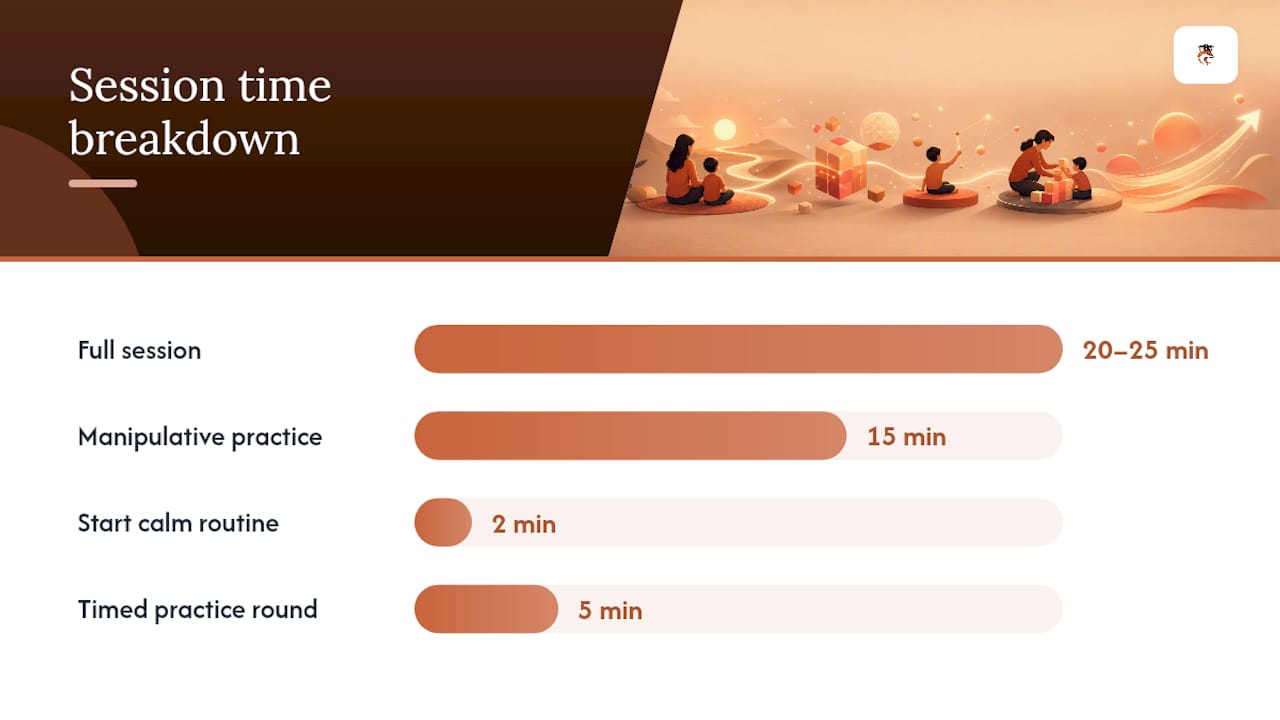
- Weeks 1 to 2: Establish the routine. Three sessions a week, 20 to 25 minutes each. Start every session with two minutes of slow breathing or a short walk, then 15 minutes of manipulative-based practice (counters, blocks, a number line) on whatever skill homework is currently targeting. End with a number talk: ask your child to explain one problem out loud.
- Weeks 3 to 4: Add light exposure to test conditions. Keep the same 20 to 25 minute sessions, but introduce one short, ungraded, timed round per week, five minutes, low stakes, explicitly framed as practice rather than evaluation. This builds tolerance for the clock without the pressure of a real grade attached.
- Weeks 5 to 6: Layer in the offloading strategies. Teach the “write it down first” trick: before solving anything, your child jots the relevant formula or steps at the top of the page. Practice this specifically before any timed round, so it becomes automatic before real tests.
- Weeks 7 to 8: Track and decide. Compare homework and quiz scores from week 8 against your original baseline. If the gap has narrowed and your child reports the sessions feel “easier” or “less scary,” continue the routine at a lighter frequency. If the gap hasn’t moved, that’s your signal to bring in more targeted support.
Track three things weekly rather than trying to measure everything: comfort (does your child start the session without stalling or arguing), accuracy (is the homework-to-quiz gap narrowing), and test ease (does your child report feeling less panicked, even if scores haven’t fully caught up yet). Comfort typically improves before accuracy does, and accuracy typically improves before test scores fully catch up, so don’t get discouraged if week 3 feels the same as week 1. The anxiety usually loosens first.
Pro Tip: If you’re not seeing any movement in comfort by week 4, that’s the point to add outside support rather than pushing through weeks 5 through 8 on your own. A tutor who specializes in rebuilding confidence alongside skills can shortcut a lot of trial and error.
This is roughly the territory where a focused tutoring programme earns its place. A tutor working from a personalized plan can adjust the pacing of exposure to timed tasks, spot exactly which symbolic skills are shaky, and keep the process-partnering approach going on days parents don’t have the bandwidth for it. It’s not a replacement for the home routine. It’s reinforcement, delivered by someone whose full attention is on your child for that session.
Does math anxiety look different at different ages?
Math anxiety doesn’t look the same at six as it does at fourteen, and treating every age the same way misses what’s actually going on developmentally.
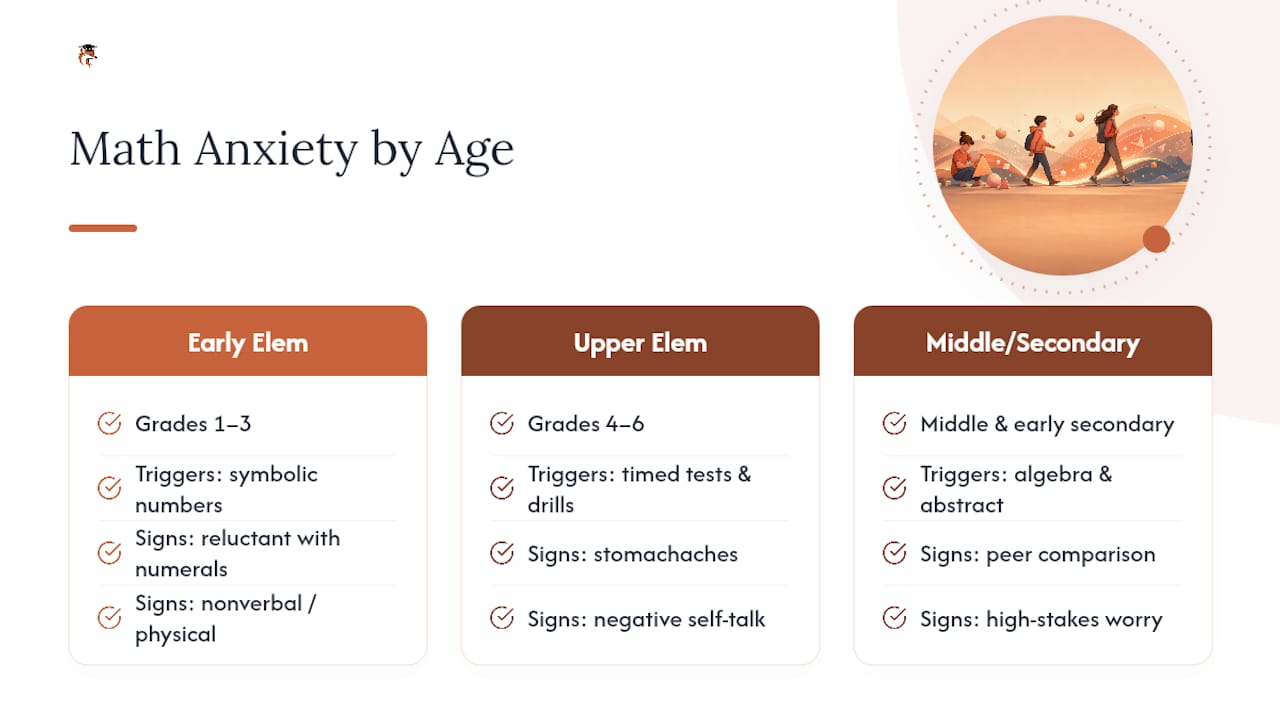
Early elementary (grades 1 to 3) is where the Frontiers 2025 research found measurable effects already present, concentrated on symbolic number tasks. At this age, anxiety often looks like reluctance to write numbers or read them aloud rather than a clear verbal complaint. Kids this young usually can’t articulate “I’m anxious,” so behaviour and physical signs matter more than what they say.
Upper elementary (grades 4 to 6) is when timed tests, multiplication drills, and multi-step word problems ramp up, and anxiety often becomes more visible through stalling, complaints of stomachaches, and negative self-talk that’s now verbal and specific (“I’m just bad at math”).
Middle and early secondary years bring algebra and abstract reasoning, where stereotype threat and peer comparison start playing a bigger role. A student who was fine with arithmetic can develop new anxiety once variables and equations appear, especially if grades suddenly feel higher stakes.
The common thread: earlier is easier to address, but no age is too late to start the combined skill and anxiety approach.
Réussite A+’s perspective: what actually moves the needle
Research indicates that math anxiety rarely responds to encouragement alone or to drilling alone. The two have to move together. A student who gets faster at fractions but still dreads the quiz hasn’t actually solved anything, and a student who feels calm but still doesn’t know the steps will still bomb the test.
What we’ve found matters most is who delivers the skill-building influences outcomes. A tutor with strong academic knowledge and teaching skills can identify the specific tasks or test triggers contributing to anxiety and adjust pacing as needed. Monitoring progress frequently helps personalise plans to address anxiety as well as content.
— Réussite A+
How Réussite A+ supports kids working through math anxiety
Tutoring services can be beneficial once home routines and classroom accommodations have begun but skills gaps still contribute to anxiety. Tutors provide patient, process-focused instruction incorporating anxiety-reducing techniques rather than simply increasing practice.
If your child’s fear centres on upcoming secondary school entrance exams, our exam preparation sessions combine test-taking strategy with the specific skill gaps causing the panic. Families dealing with a wider gap that’s built up over a school year often start with regular tutoring sessions, priced between $30 and $35 per hour, to rebuild both fluency and confidence week by week. Summer is also a strong window to reset the pattern without report card pressure, through our summer session programme. Every new family pays a one-time $65 registration fee to get started, and if your child isn’t satisfied after the first session, that session is refunded. Reach out today to talk through what’s driving your child’s math anxiety and which programme fits best.
Sources
The claims in this guide draw on peer-reviewed research and clinical guidance rather than general parenting advice, and the following sources are worth reading directly if you want the full detail behind any of the strategies above.
- Spotlight on math anxiety — PMC/NIH review
- How to help kids with math anxiety — Child Mind Institute
- Combined math instruction and relaxation improves outcomes (Springer, 2025)
- Understanding the selective impact of math anxiety on mathematical skills in first graders — Frontiers (2025)
FAQ
How do I help my child with math anxiety?
Combine short, low-pressure skill practice with a brief calming routine before each session, and change how you help with homework by asking “how did you solve that” instead of checking answers. A 2025 study found this combined approach improved outcomes for roughly 75% of participating students, well beyond either strategy alone.
Is math anxiety a learning disability?
No. Math anxiety is an emotional and cognitive fear response, not a formal diagnosis like dyscalculia, though the two can occur together and often get confused. A child with math anxiety typically has the underlying skills but underperforms specifically in evaluative situations like tests.
What are signs of math anxiety?
Common signs include avoidance or stalling before math homework, negative self-talk (“I’m just bad at math”), and physical complaints like stomachaches or headaches around math class. A telling performance pattern is a noticeable gap between strong homework scores and weaker test scores on the same material.
How do I get rid of math anxiety?
There’s no instant fix, but consistent combined practice, skill-building plus a calming routine plus offloading strategies like writing formulas down, typically shows improvement within four to eight weeks. If the pattern doesn’t shift after several weeks, targeted tutoring or a referral to a school psychologist is the reasonable next step.