




Long division feels hard because it asks a child to juggle four small moves at once: divide, multiply, subtract and bring down. The good news is that the method is a repeating cycle, and a child who knows their multiplication facts and place value can learn it calmly, one digit at a time. This guide gives you the vocabulary, a worked example, visual strategies, the mistakes to watch for and a simple way to practise at home. If your child needs a steady guide, our tutors work with elementary students on exactly this kind of step, using a personalized online tutoring plan.
TL;DR
- Long division is one cycle repeated: divide, multiply, subtract, bring down.
- Before starting, your child needs solid multiplication facts and a good grasp of place value.
- Start with objects or drawings, then move to the written method once sharing makes sense.
- The remainder must always be smaller than the divisor, and every answer can be checked by multiplying back.
- If errors keep repeating, find the one step that breaks down and practise it alone, in short, calm sessions.
Table of Contents
- When do children learn long division in Canada?
- The vocabulary your child needs
- Before you start: two skills to check
- Step 1: see division as fair sharing
- Step 2: learn the four-move cycle
- What to do with the remainder
- Long division strategies that help
- Common mistakes and how to fix them
- How to practise at home without tears
- How we help children with long division
- Our perspective
- FAQ
- Sources
When do children learn long division in Canada?
Education is a provincial responsibility, so timing varies. Manitoba’s Grade 5 outcome asks students to show division with one- and two-digit divisors concretely, pictorially and symbolically. Ontario’s Grade 4 expectations include dividing with regrouping in hundreds, tens and ones, which is long division one place at a time. In practice, most children meet the written method between Grades 4 and 6, and your child’s teacher or the Quebec progression of learning will tell you where your child is expected to be this year.
Manitoba’s guidance adds an important point: the compact written algorithm should come after students understand division models and place value. If your child is rushed into the procedure, it becomes a string of memorized steps with no meaning. That is when mistakes pile up.
The vocabulary your child needs
In school, the four words come up constantly. Take 100 ÷ 3 = 33 remainder 1:
- Dividend: the number being divided (100).
- Divisor: the number doing the dividing (3).
- Quotient: the answer (33).
- Remainder: what is left over (1).
A Canadian explanation uses candy: 7 bars shared among 3 people gives each person 2 whole bars with 1 bar left over. That leftover is the remainder.
Two rules are worth saying out loud. First, the remainder is always smaller than the divisor. If it is not, the quotient digit was too small. Second, you can check any answer with this formula: quotient × divisor + remainder = dividend. For 17 ÷ 5 = 3 R 2, that is 3 × 5 + 2 = 17.
Before you start: two skills to check
Long division is built on two foundations. If either is shaky, the method will feel like guessing.
- Multiplication facts. Each step asks, “How many times does the divisor go into this number?” A child who has to count up on their fingers each time will tire quickly. Our guides on learning the multiplication tables well and on math facts mastery give short daily routines that fit in ten minutes.
- Place value. Your child should know that in 857, the 8 means 800, not 8. Saskatchewan’s Grade 5 guide says students should understand place value before the algorithm is developed.
A quick test: ask your child to say 6 × 7, 8 × 9 and 4 × 12 without pausing, then to tell you what the 5 is worth in 4 5 2. If both go well, you are ready.
Step 1: see division as fair sharing
Before any paper method, let your child share real objects. Take 20 to 30 small items such as buttons or dried beans and ask them to share them equally among 3 or 4 bowls. Ask what is left over and what that leftover means. A Canadian teaching guide also suggests presenting division as repeated subtraction: how many times can you take 4 away from 28?
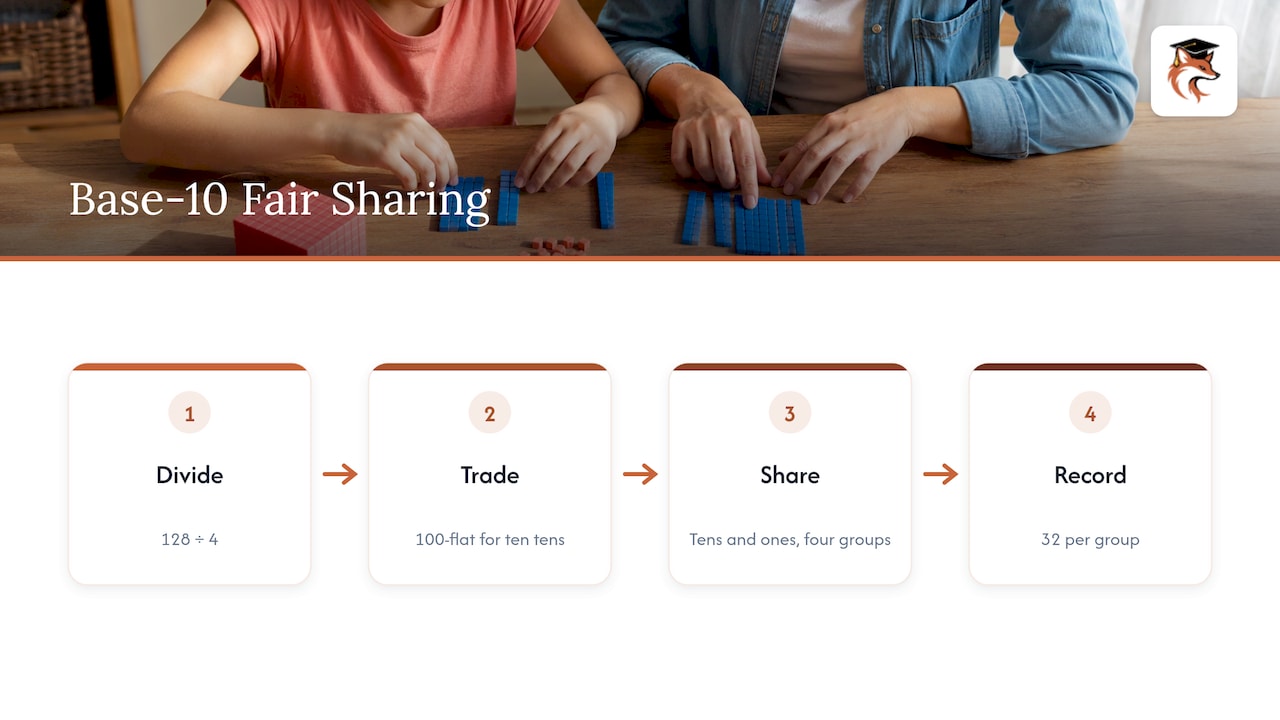
The next step is a drawing. Manitoba’s Grade 5 resources model 128 ÷ 4 with base-10 blocks: trade the 100-flat for 10 tens, share the tens and ones into four equal groups, and record 32. Paper grids or a quick sketch of tens and ones work just as well at the kitchen table. Teachers call this sequence concrete, then pictorial, then symbolic. The written algorithm is the last stage, not the first.
Step 2: learn the four-move cycle
Every long division problem repeats the same four moves. Many classrooms use a memory phrase for them: Dad, Mom, Sister, Brother, for Divide, Multiply, Subtract, Bring down. Any phrase your child invents will do, as long as it keeps the order.
Here is the cycle in plain words:
- Divide: how many times does the divisor fit into the first part of the dividend?
- Multiply: multiply that digit by the divisor.
- Subtract: take the result away from the part you were working on.
- Bring down: bring down the next digit and start again.
Worked example: 628 ÷ 4
This example follows a standard worked solution.
- 4 does not go into 6 once and leave a whole number of fours beyond that, so start with 6: 4 goes into 6 1 time. Write 1 above the 6.
- Multiply: 1 × 4 = 4. Subtract: 6 − 4 = 2.
- Bring down the 2 to make 22.
- Divide: 4 goes into 22 5 times. Multiply: 5 × 4 = 20. Subtract: 22 − 20 = 2.
- Bring down the 8 to make 28.
- Divide: 4 goes into 28 7 times. Multiply: 7 × 4 = 28. Subtract: 28 − 28 = 0.
The quotient is 157 with no remainder. Check: 157 × 4 = 628.
Worked example with a remainder: 857 ÷ 4
The same cycle gives 214 remainder 1. Check it by multiplying back: 214 × 4 = 856, and 856 + 1 = 857. The remainder 1 is smaller than the divisor 4, so the answer holds.
What to do with the remainder
A remainder is not always written the same way. The answer to 857 ÷ 4 can be 214 R1, 214 ¼ or 214.25. The context of a word problem decides which one is right. Manitoba’s Grade 5 guidance lists four cases:
- Ignore it: 22 people in teams of 4 makes 5 teams.
- Round up: 13 people in five-seat cars needs 3 cars.
- Write a fraction: 5 apples shared by 2 people is 2½ each.
- Write a decimal: money and measurements, such as $7.50 shared three ways.
These cases come from the Grade 5 outcome document. Another classic example: 130 students and buses of 40 seats gives 3 R 10, so you need 4 buses, because 10 students cannot be left behind. Ask your child, “What does the leftover mean in this story?” before they write the answer.
Long division strategies that help
If the standard layout feels heavy, other methods build the same understanding. Your child’s school may use one of them, so do not be alarmed by unfamiliar methods.
Partial quotients
Instead of finding one digit at a time, the child takes away easy multiples of the divisor in chunks. Illustrative Mathematics describes long division as a variation of partial quotients, recorded differently: in long division the quotient is written one digit at a time from the largest place to the smallest. Becoming proficient takes time, a variety of problems and plenty of practice over several lessons, so patience is part of the plan.
The Singapore-style break-apart
For 48 ÷ 3, break 40 into three groups of 10, subtract 30, then split the remaining 18 into three groups of 6. Each group has 16. It is a friendly bridge from place value to the written method.
The box method
The box method splits the dividend into place-value columns and carries each remainder to the next column. For 702 ÷ 6 it gives 117. Pre-drawn box templates keep a child’s attention on the steps instead of the drawing.
A multiples list for two-digit divisors
When the divisor has two digits, guessing the quotient digit is the hardest part. Before starting, write the first ten multiples of the divisor in a column. For 8,211 ÷ 17, the list (17, 34, 51, 68, 85, 102, 119, 136, 153, 170) lets your child pick the largest multiple that fits, with no guessing. The answer is 483.
Common mistakes and how to fix them
Most errors come from one broken step. Watch for these:
- Misaligned digits. The quotient digit lands above the wrong place. Turn lined paper sideways so the columns become vertical, or use colour-coded sticky notes for place value, a technique used in school intervention groups.
- A remainder larger than the divisor. The quotient digit was too small. Go back and try the next digit up.
- Forgetting to bring down. Add a tick above each digit once it has been brought down.
- Subtraction slips. Often the division is correct and the subtraction is not. Practise the subtract step on its own.
- Skipping a zero in the quotient. If the new number is smaller than the divisor, write 0 in the quotient and bring down the next digit.
Saskatchewan’s guidance warns that a poorly understood algorithm can reinforce misconceptions. Teachers there are encouraged to embed tasks in real-life situations and focus conversation on place value. At home, that means asking “why” more than “how.”
How to practise at home without tears
- Say the four moves aloud for the first few questions. A UK parent guide suggests this, along with talking through the specific step that is causing trouble.
- Keep a one-page anchor chart with the steps and one worked example. Teachers make these with students so the steps are always in view.
- Start easy. Begin with two-digit by one-digit problems, then move to three digits, then two-digit divisors.
- Keep sessions short. Five to ten problems is plenty. If practice becomes upsetting, stop and return another day.
- Always check. Multiplying back turns every problem into a self-correcting game, and your child learns to trust their own answer.
- Play first. Our mental arithmetic tips and fraction games build the number sense that long division relies on.
If frustration is growing, our action plan on helping a child struggling with math walks you through the next steps calmly.
How we help children with long division
Many parents tell themselves they will just sit down and explain it, then find that the method they learned does not match the one on the homework sheet. Our tutors are university-level students selected for their academic excellence and teaching ability. Each child gets a customized learning plan built around their strengths, challenges and pace, with continuous progress monitoring. Sessions are online, so scheduling is flexible, and our online regular session and tutoring and homework help are published at $30-35 per hour, with a one-time registration fee of $65. We offer a satisfaction guarantee with a refund of the first session if you are not satisfied.

For families in Montreal, Laval, Longueuil and across Quebec, you can see how it works on our online tutoring page or register through the registration page.
Our perspective
Over more than 25 years, and with more than 3,500 students, we have seen the same pattern: long division is rarely the real problem. The trouble is usually one small gap underneath it, a multiplication fact that is not automatic or a place value idea that is a little blurry.
That is why we do not hand every child the same worksheet. We begin by finding the step where your child’s confidence breaks, and we build a plan around it, at a pace that suits them. A child who is catching up needs a different path from one who wants to go beyond the grade level.
We also believe in making the method feel like a game, with clear steps, small wins and a check at the end of every problem. When a child sees that they can prove their own answer, anxiety drops and the habit sticks.
Réussite A+
FAQ
What is the easiest way to teach long division?
Start with sharing real objects, then drawings, then the written method. Teach the four-move cycle (divide, multiply, subtract, bring down) with one worked example in view. Choose one method and master it before trying others.
What grade do kids learn long division?
It depends on the province, but the written method generally appears between Grades 4 and 6. Ontario’s Grade 4 expectations already include dividing with regrouping, and Manitoba’s Grade 5 outcome covers two-digit divisors. Check your child’s own grade expectations with their teacher.
Why does my child get the right digits in the wrong place?
Usually it is a place value or alignment issue. Use lined paper turned sideways, or colour each place value column. Estimating the answer first, for example that 628 ÷ 4 should be a bit over 100, also helps catch misplaced digits.
Should my child use a calculator to check?
The best check needs no calculator: multiply the quotient by the divisor, add the remainder and compare to the dividend. This builds the multiplication fluency that long division depends on.
When should I get extra help?
If the same mistakes keep returning after a couple of weeks of short, calm practice, or if homework is causing stress, a tutor can pinpoint the missing step. Our guide for a child failing math explains what to do next.
Sources
- Manitoba Grade 5 outcome 5.N.6 (division)
- Manitoba Education, Grade 5 Math Appendices
- Illustrative Mathematics Grade 6, long division lesson
- Division primer, The Math Room
- Long division, NumberCampus
- Long division step by step, with remainders
- RTÉ Learn, long division
- Long division guide, Year 6
- Long division strategies guide
- Division box method
- Long division, Singapore method lesson plan
- Developing division skills