


TL;DR:
- A daily routine combining self-talk, partner conversations, and passive audio exposure rapidly improves spoken French.
- Structured online tutoring and community practice options support learners needing targeted feedback and confidence building.
The fastest way to improve your spoken French is a three-part daily routine: 10 minutes of self-talk or shadowing in the morning, one 20–30 minute conversation session with a partner or tutor during the week, and passive audio exposure (a podcast, Mauril clip, or radio segment) in the evening. You can start all three today.
Here is your immediate plan:
- Right now (10 minutes): Describe your morning aloud in French. Say what you ate, what you are wearing, where you are going. No partner needed, no app required.
- This week: Book one free session through a university language exchange, a local library conversation circle, or a platform like Mauril from Radio-Canada, which offers interactive audio and video tools for learners at every level.
- Daily micro-drill: Listen to one short French audio clip and repeat each sentence immediately after the speaker. This shadowing technique builds pronunciation muscle memory faster than reading alone.
For Quebec students who need structured support alongside these habits, Réussite A+ offers personalised online French tutoring with university-level tutors and a custom learning plan from the very first session.
Table of Contents
- Which methods give you the most reliable speaking practice?
- How to build a daily and weekly speaking routine
- Where to find conversation partners safely in Canada
- High-impact pronunciation drills that build fluency fast
- The best Canada-accessible resources for speaking practice
- How long does it take to improve, and what does it cost?
- When tailored tutoring helps: Réussite A+ for Quebec students
- Key takeaways
- Why balanced practice beats any single method
- Réussite A+ offers personalised French tutoring for Quebec students
- Useful sources
- FAQ
Which methods give you the most reliable speaking practice?
Not every method produces the same results, and the right mix depends on your level, schedule, and how much social pressure you can handle. Here is a clear breakdown.
Language exchange pairs you with a native French speaker who wants to practise your language. Sessions are free, flexible, and genuinely conversational. The downside: feedback is inconsistent, and partners vary widely in reliability.
One-to-one tutoring gives you structured feedback, targeted correction, and a session plan built around your weak points. It costs more than a language exchange, but the quality of feedback is far higher. For students preparing for Quebec secondary school entrance exams, this structure is often the deciding factor.
Conversation circles (offered by libraries, cultural centres, and francophone community groups across Canada) are low-pressure group settings. They build confidence without the intensity of a one-to-one session, though you get less individual feedback.
Guided online classes combine instruction with speaking tasks. They work well for beginners who need grammar scaffolding before they can hold a conversation. The Government of Canada’s Our Languages portal lists free and low-cost options across the country.
Shadowing and self-talk require no partner and no cost. You shadow a native speaker by repeating audio line by line, or you narrate your daily life aloud. Progress is slower without feedback, but consistency compounds quickly.
Roleplay with a friend is underused. Assign a scenario (ordering at a café, asking for directions), set a five-minute timer, and stay in French. The playful structure reduces anxiety and builds spontaneous vocabulary.
Pronunciation apps and voice feedback tools like Forvo let you hear native pronunciations of specific words and compare your own recordings. They are best used as a supplement, not a standalone method.
| Method | Cost | Feedback quality | Social pressure | Best for |
|---|---|---|---|---|
| Language exchange | Free | Low–moderate | Moderate | Intermediate+ learners |
| One-to-one tutor | Paid | High | Low | All levels, exam prep |
| Conversation circle | Free | Low | Low | Beginners building confidence |
| Guided online class | Free–paid | Moderate | Low | Beginners needing structure |
| Shadowing / self-talk | Free | None | None | Daily habit, pronunciation |
| Roleplay with a friend | Free | Moderate | Low | Vocabulary in context |
| Pronunciation apps | Free–low | Automated | None | Phonetics, specific sounds |
Research from La Vie au Québec confirms that combining structured classes, conversation circles, and daily media exposure produces faster gains than any single method alone. The table above helps you pick the right combination for your situation.
How to build a daily and weekly speaking routine
Consistency beats intensity. Thirty minutes spread across a week outperforms a single two-hour session you dread and skip.
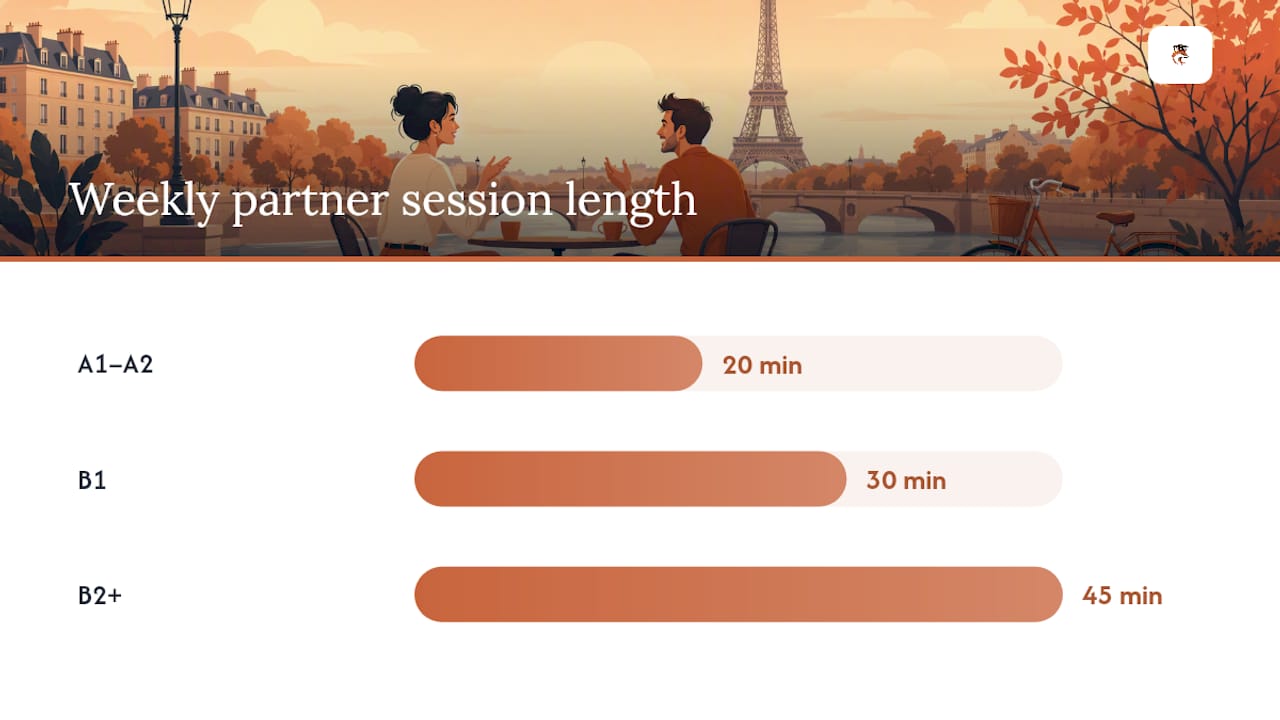
Weekly practice plan by CEFR level
| CEFR level | Daily self-practice | Weekly partner session | Passive exposure |
|---|---|---|---|
| A1–A2 (beginner) | 10 min self-talk or shadowing | 20 min with tutor or guided class | 15 min audio (slow French podcasts) |
| B1 (intermediate) | 15 min shadowing + roleplay | 30 min conversation exchange | 20 min TV5MONDE or Mauril clips |
| B2+ (advanced) | 20 min debate prep or monologue | 45 min discussion with native speaker | 30 min Radio-Canada news or films |
Session templates by level
A1–A2 session (20 minutes): Open with greetings and a simple question (“Comment tu t’appelles? Tu habites où?”). Spend 10 minutes on a scripted roleplay (at a shop, introducing yourself). Close with three new words you will use before the next session. Milestone: hold a two-minute introduction without stopping.
B1 session (30 minutes): Start with two minutes of free conversation on a topic you chose in advance (your weekend, a news story). Spend 15 minutes on a structured task (describe a photo, recount an event). Finish with error correction and one pronunciation focus. Milestone: recount a past event using at least five different verbs.
B2+ session (45 minutes): Open with a five-minute opinion exchange on a current topic. Move into a 20-minute discussion or debate. Spend the final 10 minutes on nuance: register differences, idiomatic expressions, and self-correction. Milestone: sustain a 10-minute discussion with fewer than three grammar interruptions.
Conversation starters to use in your first session:
- “Qu’est-ce que tu aimes faire le week-end?”
- “Parle-moi de ta ville.”
- “Qu’est-ce que tu as mangé aujourd’hui?”
- “Quel film ou série tu regardes en ce moment?”
Alloprof recommends organising your ideas before speaking, even in casual conversation. Jotting two or three bullet points before a session reduces anxiety and keeps your sentences coherent.
Where to find conversation partners safely in Canada
Canada offers more French conversation opportunities than most learners realise, especially in Quebec and bilingual cities like Ottawa, Moncton, and Sudbury.
Canada-specific options:
- Public library conversation circles: Most major public library systems (Montreal, Toronto, Ottawa) run free weekly French conversation groups. No registration required in many cases.
- Francisation programmes: Quebec’s Ministry of Immigration funds free French classes for eligible newcomers. The Government of Quebec’s French tools portal lists enrolment details and free online modules.
- University language exchanges: Most Canadian universities (McGill, Université de Montréal, Université Laval, University of Ottawa) run tandem language exchange programmes. Check your student services office.
- Francophone cultural organisations: Alliance Française chapters across Canada host conversation evenings, film nights, and workshops.
- Government language support: The Government of Canada’s language skills page lists federally funded language programmes and advises taking a placement test (TEF or DELF) before enrolling in formal classes.
First-session checklist:
- Agree on the language ratio upfront (e.g., 50% French, 50% English for an exchange).
- Decide how you want corrections: immediate interruption, or notes at the end.
- Set a clear time limit (20–30 minutes per language).
- Prepare two or three topics in advance so silence does not derail the session.
- Avoid spending the whole session on grammar explanations. Keep talking.
Safety tips:
- For online partners, use a platform with verified profiles before moving to private messaging.
- First in-person meetings should be in a public place (a library, café, or community centre).
- For minors, a parent or guardian should review the platform’s terms and be present or nearby for initial sessions.
Pro Tip: Before your very first session, write down five sentences about yourself in French and practise saying them aloud. Walking in with a prepared “script” for the first two minutes removes the biggest source of first-session anxiety.
High-impact pronunciation drills that build fluency fast
Pronunciation is where most learners stall, not because French sounds are impossible, but because they never practise them in isolation. These drills fix that.
Minimal pairs drill (5 minutes): Focus on two sounds you confuse (e.g., “u” vs. “ou,” or nasal vowels “an/en” vs. “in”). Use Forvo to hear native speakers say both words back to back. Record yourself, then compare.
Dictée practice (10 minutes): Use a short audio clip from Le Point du FLE or a Radio-Canada podcast. Write what you hear, then check your transcript. Errors reveal exactly which sounds you are mishearing, which is where your pronunciation gaps live.
Pro Tip: The French “r” and nasal vowels are the two sounds that most English-speaking Canadians get wrong longest. Spend one week on each in isolation before mixing them into full sentences. Targeted repetition on a single sound produces faster results than general conversation practice alone.
When self-correction is not enough, a tutor’s ear is irreplaceable. McGill University’s French resources page lists Mauril and other audio tools that tutors commonly assign for between-session pronunciation work.
The best Canada-accessible resources for speaking practice
Every resource below is free or low-cost and available to learners across Canada. Each one serves a specific purpose in your weekly plan.
Mauril (Radio-Canada): Interactive audio and video exercises built on Radio-Canada content. Excellent for listening comprehension and shadowing at B1–B2 level. Free, no subscription required. Plug it into your daily passive exposure slot.
francais-enligne.quebec: Quebec government-funded platform with roughly 70 hours of free beginner modules, profession-specific vocabulary banks, and audio resources. Ideal for newcomers and A1–B1 learners building everyday spoken vocabulary.
Our Languages (Government of Canada): Lists games, multimedia tools, and Francolab resources for oral and written practice. A useful starting point for beginners who want a curated, government-vetted list.
Réussite A+ educational games: Interactive French and math games designed for elementary and secondary students in Quebec. A low-pressure way for younger learners to build vocabulary and oral confidence through play.
How long does it take to improve, and what does it cost?
Progress in spoken French depends almost entirely on how many hours per week you practise, not how many months pass on the calendar.
- Casual pace (2–3 hours/week): Noticeable improvement in conversational confidence typically takes 3–6 months. You will move from A1 to A2, or from A2 to early B1, in that window.
- Regular pace (5–7 hours/week): Expect a meaningful level jump (one full CEFR step) in roughly 6–12 months with consistent partner sessions and daily drills.
- Intensive pace (10–15 hours/week): Berlitz’s French immersion data for Canada shows that focused intensive practice at this volume produces measurable conversational gains in as little as 4–8 weeks. Summer immersion programmes accelerate progress further by removing the forgetting curve between sessions.
Typical costs in Canada:
- Library conversation circles and government francisation programmes: free
- Language-exchange apps (free tiers): free for text and voice messages; paid tiers add video calling
- Private tutors (one-to-one, online): rates vary by provider and experience level; expect a range from roughly $25–$80/hour depending on qualifications
- Intensive summer immersion programmes: package prices vary widely by provider and duration
When is paid tutoring worth it? When your child has a specific exam deadline (Quebec secondary school entrance exams, for example), when progress has stalled despite self-study, or when speaking anxiety is significant enough to block participation in class. A few targeted sessions with a qualified tutor often accomplish more than months of unstructured practice.
When tailored tutoring helps: Réussite A+ for Quebec students
Some learners thrive with free resources and a motivated partner. Others need a structured, accountable environment to make real progress, especially when an exam or a school transition is on the line.
Réussite A+’s approach centres on three things: a personalised learning plan built around each student’s specific gaps, university-level tutors selected for both academic excellence and teaching ability, and continuous progress monitoring so families always know where their child stands. Sessions are delivered online, which means flexible scheduling without commuting.
Students who benefit most:
- Those preparing for Quebec secondary school entrance exams, where oral French is a graded component
- Introverted or anxious learners who need a low-pressure, one-to-one environment before joining group settings (see why online tutoring suits anxious learners)
- Students with specific remediation needs (a persistent grammar gap, weak oral fluency, or a vocabulary deficit in a particular subject area)
- Learners who have tried apps and self-study but need accountability and expert feedback to move forward
For parents supporting a child at home, the guide for non-French parents offers practical strategies to reinforce speaking practice between tutoring sessions.
Key takeaways
Daily speaking practice in French works best when it combines self-directed drills, a weekly partner session, and consistent passive exposure to the language.
| Point | Details |
|---|---|
| Start with 10 minutes daily | Self-talk or shadowing each morning builds speaking habits faster than weekly cramming. |
| Match your method to your level | Beginners benefit from guided classes and conversation circles; intermediate learners gain more from exchanges and tutoring. |
| Use free Canadian resources | Mauril, francais-enligne.quebec, and government portals give you structured practice at no cost. |
| Intensive practice accelerates gains | Practising 10–15 hours per week can produce measurable conversational improvement in 4–8 weeks. |
| Réussite A+ for structured support | Quebec students needing exam prep or targeted oral improvement benefit from Réussite A+’s personalised online tutoring. |
Why balanced practice beats any single method
The most common mistake learners make is committing entirely to one approach: only an app, only a class, or only a conversation partner. Each method has a ceiling. Apps do not correct your accent. Partners do not explain grammar. Classes do not give you the spontaneous, unscripted practice that builds real fluency.
What actually moves the needle is the combination: a structured lesson to address a specific gap, a real conversation to apply it, and daily audio exposure to keep the sounds fresh in your ear. The structured lesson without the conversation stays theoretical. The conversation without the lesson reinforces errors. The audio without either gives you passive recognition but not active production.
At Réussite A+, this is exactly the philosophy behind every student’s learning plan. Structured instruction, real practice tasks, and measurable milestones work together. A student who spends one session on oral sentence construction, then practises those same structures in a roleplay the following day, retains far more than one who studies grammar in isolation for an hour.
Consistency and clear goals matter more than any single tool or resource. Decide what level you want to reach, set a realistic weekly hour target, and track it. Progress in spoken French is not mysterious. It is cumulative.
Réussite A+ offers personalised French tutoring for Quebec students
For Quebec students who need more than a playlist and a conversation partner, Réussite A+ delivers something the free tools cannot: a tutor who knows your child’s exact gaps, a session plan built around them, and progress tracking that keeps everyone accountable.
Whether your child is preparing for a secondary school entrance exam, working through a persistent oral fluency gap, or simply needs a structured, encouraging environment to build confidence in French, Réussite A+’s online sessions fit around your family’s schedule. Every tutor is selected at the university level, every plan is personalised, and results are monitored from session one.
Learn more about the advantages of online tutoring, or register your child today to get started with a customised French learning plan.
Useful sources
| Resource | What you will find | Best used for |
|---|---|---|
| Canada.ca — Language Skills | Federally funded language programmes, TEF/DELF testing info | Finding official classes and placement testing |
| Our Languages — Government of Canada | Games, multimedia tools, Francolab resources | Beginners looking for curated, vetted practice tools |
| Alloprof — French tips | Practical oral preparation tips for Quebec students | Pre-speaking organisation and exam confidence |
| Gouvernement du Québec — French tools | francais-enligne.quebec modules, vocabulary banks, audio | Newcomers and A1–B1 learners in Quebec |
| La Vie au Québec — Pratiquer son français | Local conversation circles, library options, mixed-method advice | Finding community practice options in Quebec |
| McGill — French resources | Mauril, media tools, annotated resource list | Audio/video practice and tutor-assigned tools |
| Berlitz — French immersion Canada | Intensive programme timelines and summer immersion data | Planning an accelerated speaking improvement schedule |
| Memorial University — French resources | Forvo, dictée exercises, pronunciation tools | Phonetics drills and pronunciation self-study |
FAQ
How can I practise French speaking on my own?
Self-talk and shadowing are the two most effective solo methods. Narrate your daily activities aloud in French, or replay a short audio clip and repeat each sentence immediately after the speaker to build pronunciation and rhythm.
What is the 80/20 rule in French?
The principle holds that roughly 20% of French vocabulary covers about 80% of everyday conversation. Focusing first on the most frequent words and the most common verb tenses lets you hold real conversations much sooner than studying the full language systematically.
How long does it take to reach B2 French?
At a regular practice pace of 5–7 hours per week, reaching B2 from a beginner level typically takes 12 months or more. Intensive practice at 10–15 hours per week, as noted by Berlitz’s French immersion data, can compress that timeline significantly, with measurable gains appearing in as little as 4–8 weeks of concentrated effort.
How do I say “I love you” in Quebec French?
The standard phrase is “Je t’aime,” used across all French-speaking regions including Quebec. In casual Quebec French, you may also hear “Je t’aime bien” (I really like you) or affectionate expressions like “Mon amour,” though “Je t’aime” remains the direct equivalent.
When should a Quebec student consider a French tutor?
A tutor is worth considering when a student has a specific exam deadline (such as a secondary school entrance exam), when speaking anxiety is blocking classroom participation, or when self-study has stalled. Réussite A+ specialises in exactly these situations, with personalised online sessions for elementary and secondary students across Quebec.