



Your child’s first tutoring session is about rapport and a quick diagnosis of where they actually stand, not a test to pass or fail. The single most valuable thing you can do beforehand is run a short tech check and send the tutor one or two recent homework samples with a clear goal, whether that’s catching up or moving ahead. Providers with real teaching experience use that groundwork to make the first hour count.
TL;DR:
- Sending recent homework and clear goals before the session helps tutors quickly assess your child’s strengths and weaknesses.
- Using a laptop or tablet and testing technology a day ahead minimizes disruptions during the first session.
- The first tutoring hour mainly focuses on building rapport and informal diagnostics, not content mastery.
- Parental involvement should be limited to note-taking and private feedback, especially for older students, to foster independence.
- Sustained progress requires multiple sessions over weeks, with consistent practice and clear, measurable goals.
Table of Contents
- Getting ready for the first tutoring session: your before-you-start checklist
- What actually happens during the first online tutoring session
- How involved should parents be during the session?
- After the first session: turning notes into a plan
- Why Réussite A+’s approach to session one works
- A note on realistic expectations
- Ready to book your child’s first session?
- Sources
- FAQ
Getting ready for the first tutoring session: your before-you-start checklist
The days before your child’s first tutoring session are where most of the groundwork happens. A calm, well-prepared start means the tutor spends the actual session teaching, not troubleshooting or fishing for background information.
Start with the equipment. A laptop or tablet works far better than a smartphone for shared screens, typed work, and whiteboard tools, all of which shrink to an unusable size on a phone. Test the internet connection a day ahead, ideally a wired connection or a strong, stable WiFi signal near the router, since running a tech check at least a day early prevents lost lesson time on the actual day. Log into whatever platform the tutor uses, confirm the camera and microphone work, and click through the screen share or digital whiteboard once so nothing is unfamiliar when class starts.
The physical space matters almost as much as the tech. Screen placement, decent lighting, and having pencils, paper, and a calculator within arm’s reach cut down on the fidgety interruptions that eat into a session. Before the appointment, gather:
- One or two recent homework assignments or quizzes, ideally ones with visible errors
- The latest report card or teacher comments, even a quick photo of the comments section
- One or two specific goals in plain language (“catch up on fractions” or “get ahead before the exam”)
- A consultation checklist filled out with anything the tutor should know about attention span or anxiety
Pro Tip: Build in a 10 to 15 minute buffer before the session for a snack, a bathroom break, and the tech check. Rushing straight from school or screen time into a lesson makes the first few minutes harder than they need to be.
What actually happens during the first online tutoring session
Knowing the shape of the hour in advance takes most of the mystery, and most of the nervousness, out of it. A typical first session follows a fairly predictable rhythm, though tutors adjust pacing for younger children who need shorter blocks and more frequent changes of activity.
- Greeting and rapport (5 to 10 minutes). The tutor opens with an ice breaker, asks about interests or a favourite subject, and gets a read on the child’s comfort level with a screen and a stranger.
- Informal diagnostic tasks (10 to 20 minutes). Rather than a formal quiz, the tutor works through a few sample problems or reading passages to see where the gaps sit and how the child prefers to learn, visually, verbally, or by working through examples.
- Targeted instruction and modelling (15 to 30 minutes). Once the tutor has a sense of the starting point, they teach one focused concept and walk through it, then hand the practice back to the child immediately so the skill sticks.
- Wrap-up (5 minutes). The tutor summarizes what was covered, assigns a short practice task if appropriate, and outlines what comes next.
A full walkthrough of session structure is worth reading if you want the longer version, but the core idea holds across ages: the goal of session one is comfort and a clear read on the student, not immediate content mastery.
How involved should parents be during the session?
Your role shifts with your child’s age. Younger children generally do better with a parent nearby, close enough to help with a login hiccup but not visible on camera. Older students, particularly in secondary school, tend to open up more and work more independently when a parent is available but out of frame.
The hardest habit to break is jumping in to answer for your child. It feels helpful in the moment, but it short-circuits the independence the tutor is trying to build, and it makes it harder for the tutor to see where the real gaps are. Take notes instead, and raise anything important with the tutor privately afterward.
- Note when your child’s attention drifted, and after what kind of task
- Write down which topics caused repeated mistakes rather than one-off slips
- Flag any tech lag or platform confusion so it gets fixed before session two
Pro Tip: Turn what you noticed into one or two SMART goals before the next session, such as “master two-digit subtraction with borrowing by Friday” rather than “get better at math.”
After the first session: turning notes into a plan
Most tutors follow up with a short summary: what was covered, a recommended schedule, and a small practice task to bridge to the next session. Read that summary with your child rather than for them, and use it to agree on one or two measurable goals before you meet again.
Watch for early positive signals over the first few sessions: a child asking more questions, approaching homework with less resistance, or showing a bit more confidence explaining their own thinking. Tutoring research indicates that gains build over multiple sessions rather than appearing after a single hour, so measure progress in weeks, not days.
A few signals suggest it’s worth adjusting the approach:
- No change in confidence or willingness to attempt homework after several sessions
- Repeated confusion on the same concept despite instruction
- A mismatch in pace, either bored or overwhelmed, that doesn’t ease with time
Short daily practice between sessions, even ten minutes, tends to reinforce what the tutor covers far better than a single weekly hour on its own.
Why Réussite A+’s approach to session one works
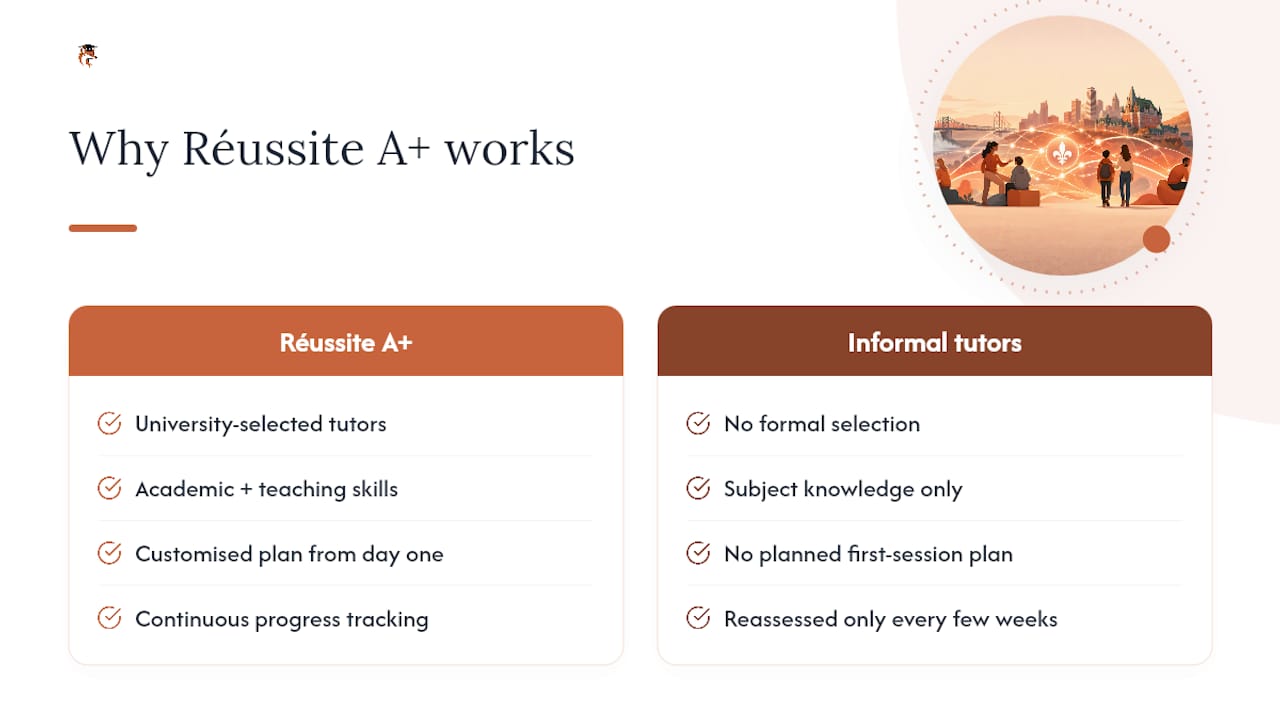
Some providers have spent many years refining what a first tutoring session should accomplish, and select tutors for academic strength and teaching ability, not just subject knowledge. That selection process matters: programs led by more skilled, better-trained tutors consistently produce larger learning gains than informal or untrained arrangements.
Many students have participated in similar tutoring programs, with high satisfaction among families. The first session builds a customised learning plan from day one, and progress gets tracked continuously rather than reassessed from scratch every few weeks. Parents preparing for a consultation can also work through the tutor selection criteria Réussite A+ uses, which explains what “university-selected” actually means in practice.
A note on realistic expectations
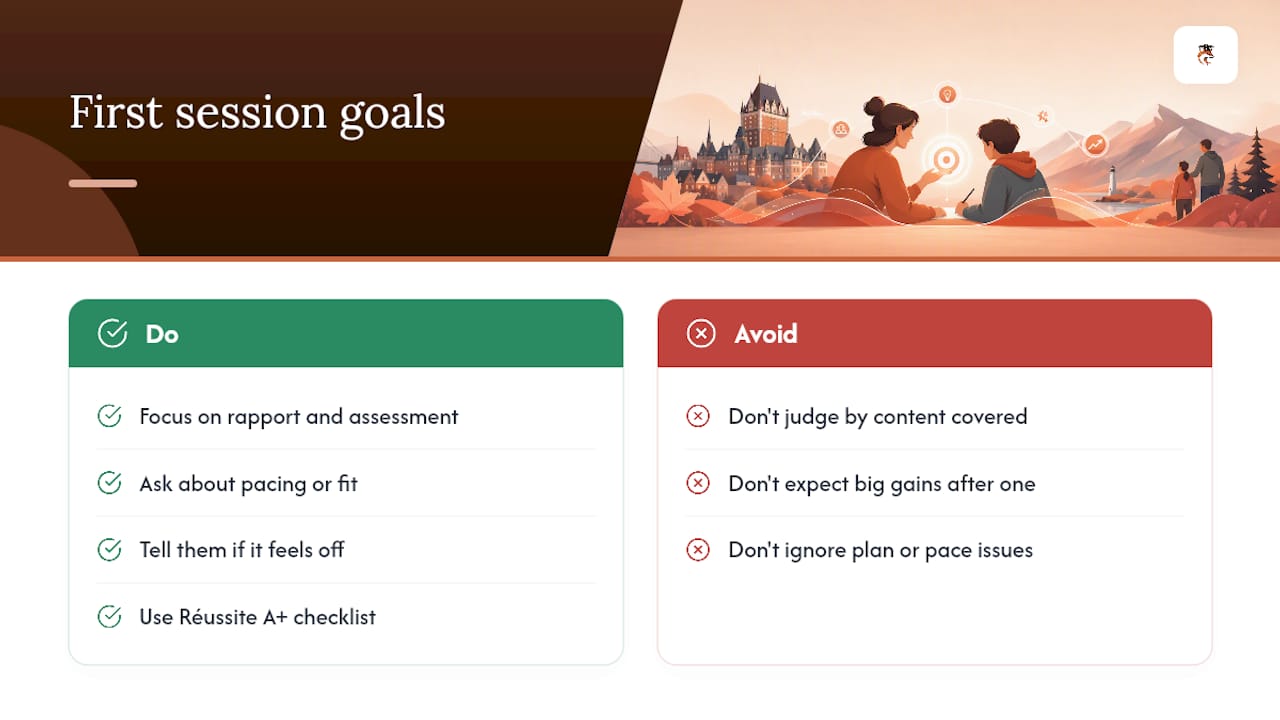
The first session’s job is rapport and a clear read on your child, nothing more. Don’t judge it by how much content got covered. Real, measurable gains build over several weeks of consistent sessions, not one appointment, and that’s true of good tutoring generally.
If something about the first session feels off, whether it’s pacing, personality fit, or the plan the tutor proposes, say so. A good provider adjusts. Réussite A+ welcomes questions at any stage, and the onboarding checklist is there to help you ask the right ones from the start.
— Réussite A+
Ready to book your child’s first session?
Some tutors build their first-session process around similar principles: a short consultation, a rapport-building start, and a customised learning plan drafted early. Online sessions often offer flexible scheduling around school, activities, and family routines, with accessible pricing options.

Getting started takes one step: book a consultation and register for tutoring, and a coordinator will confirm your child’s goals, match a tutor, and walk you through what to prepare before the first session. From there, the same checklist and session structure covered in this guide apply, backed by a program that has worked with more than 3,500 students across math and French.
Sources
For more detail beyond this guide, Care.com’s first-session preparation resource and Learnability’s breakdown of what to expect cover similar ground from a general tutoring perspective. Réussite A+’s consultation checklist is printable and specific to online sessions.
FAQ
Should I sit in on my child’s first tutoring session?
Stay nearby for younger children in case of technical issues, but for older students, being available without being on camera tends to work better and lets the tutor build direct rapport.
How long does a first tutoring session usually last?
Most first sessions run about an hour, split between rapport-building, a short informal assessment, and a bit of targeted teaching, with younger children often getting shorter, more frequent breaks within that time.
What should I send the tutor before the first session?
Send one or two recent homework samples, recent report card comments, and one or two clear goals; this lets the tutor plan an assessment instead of using session time to gather background.
When will I see real progress after tutoring starts?
Expect measurable gains over several weeks of consistent sessions rather than after the first appointment, since tutoring research shows learning effects build with frequency and duration.
What if the first session doesn’t feel like a good fit?
Raise the concern with the provider directly. Good providers adjust the tutor match or approach based on parent feedback, since fit matters as much as subject expertise for long-term progress.