




Réussite A+ stands out as a well-regarded choice for South Shore parents seeking university-level online tutoring, built on extensive methodology and experience with many students. If you want a supervised, credentialled tutor and real exam-prep results, that combination is hard to beat. The rest of this guide walks through alternatives, pricing shapes, and exactly how to run a trial session so you can choose with confidence.
TL;DR:
- Réussite A+ offers university-level online tutoring with measurable exam results, using a personalized approach that includes diagnostics and progress tracking.
- Public tutoring programs are free but limited in support duration and eligibility, while university students provide a lower-cost, less standardized alternative.
- Choosing a tutor requires matching subject expertise, age experience, exam prep history, and teaching style, with progress typically evident after three to four sessions.
- Online tutoring is highly effective for French and math, especially for students needing catch-up, exam prep, or reduced social pressure, with outcomes similar to in-person support.
- Online sessions offer scheduling flexibility and weather resilience, making them preferable for busy families across South Shore communities compared to in-person options.
Table of Contents
- Best schools in South Shore Montréal: how to pick the right tutoring fit
- How do you choose the right tutor for your child?
- Is online tutoring right for French and math specifically?
- Understanding the South Shore Montreal area and school zoning
- What academic support options exist across South Shore communities
- How do you judge whether academic support is actually working
- What extracurricular and enrichment support pairs well with tutoring
- What are the admission timelines and requirements to plan around
- How do commute and scheduling factor into academic support decisions
- A note from Réussite A+ to South Shore families
- Book a trial session with Réussite A+
- Sources
- FAQ
Best schools in South Shore Montréal: how to pick the right tutoring fit
Parents searching for the “best schools in South Shore Montréal” for their child’s academic support are usually hunting for something more specific: reliable, paid, university-level tutoring that actually moves the needle on report cards and entrance exams. That is the real question behind the search, and it deserves a real answer, not a list of school names.
Here is the honest shortlist of what is actually available to South Shore families right now.
Réussite A+ leads because it combines personalised online tutoring with a documented process: a diagnostic step, a custom learning plan, and continuous progress tracking. Its tutors are selected from university programs and vetted for both subject mastery and teaching skill, which matters more for exam prep than a general online marketplace listing.
School-board and public tutoring programs, such as LEARN Tutoring, offer free or low-cost appointments with qualified teachers, usually running weeknights between 5:00 PM and 8:30 PM. They are a solid first stop, but eligibility rules and weekly appointment caps limit how much support a struggling student can get.
University-student tutors are the budget option. Bulletin boards at institutions like UQAM and Université de Montréal are full of students offering tutoring, often at lower hourly rates, though consistency and exam-specific coaching vary tutor to tutor.
| Option | Best for | Format | Pricing shape | Tutor qualifications | Trial availability |
|---|---|---|---|---|---|
| Réussite A+ | Parents who want measurable exam-prep results and a credentialled tutor | Online, one-on-one | Package and hourly rates, registration fee for exam prep | University-level, screened and trained | Low-commitment trial session |
| Public tutoring programs | Families needing short-term, occasional support | Online, structured appointments | Free or low-cost | Certified teachers | Limited by eligibility |
| University-student tutors | Budget-focused homework help | Online or in-person, flexible | Lower hourly rate, informal | Varies, no standard vetting | Depends on individual tutor |
How do you choose the right tutor for your child?
Picking a tutor is less about credentials on paper and more about fit. A parent checklist built from actual tutoring outcomes puts subject match, teaching style, and trial lessons above everything else, including reviews.
Start with these four priorities before you book anything:
- Subject match. A tutor strong in calculus is not automatically the right fit for a Grade 4 student struggling with fractions. Match the tutor’s experience to your child’s grade and specific gap.
- Age experience. Ask directly how many students at your child’s age the tutor has worked with. Vague answers are a warning sign.
- Exam-prep history. If you are prepping for secondary school entrance exams, ask what materials and practice tests the tutor uses, and whether they track score improvement over time.
- Teaching approach. Some tutors lecture, others coach through questions. Watch which style keeps your child engaged rather than passive.
Once you book a trial, run it like a short interview. Before the session, send a recent test or homework sample so the tutor can review actual gaps. During the session, watch whether the tutor diagnoses the problem rather than jumping straight into generic exercises. After the session, ask for a one-paragraph summary of what they found and what the plan looks like going forward.
Red flags include a tutor who cannot explain their plan in plain language, sessions that run long on small talk, or no clear next step by the end.

Pro Tip: Judge real progress across the first three to four sessions, not the first one. A short, structured trial period usually reveals whether the fit works within about a month. If nothing has shifted in your child’s confidence or accuracy by then, switch tutors rather than waiting it out.
Is online tutoring right for French and math specifically?
French and mathematics are the two subjects where online tutoring performs best, and there is a practical reason why. Both subjects rely heavily on structured explanation, worked examples, and verbal correction, all of which translate cleanly to a screen with a shared whiteboard. Hands-on subjects for younger children, like early literacy with physical manipulatives, often still benefit from in-person help.
Three student profiles tend to see the clearest results:
- Primary students catching up. Short, frequent sessions (two per week) rebuild confidence faster than one long weekly block.
- Anxious adolescents. Online formats reduce social pressure, letting a nervous teenager ask questions they would avoid in a classroom.
- Secondary exam-prep candidates. Weekly sessions built around timed practice tests and error review work best in the two to three months before an exam.
Research signal: studies comparing formats since 2022 have found online tutoring produces outcomes comparable to in-person tutoring for most academic subjects, while also widening the pool of qualified tutors available to a family.
Understanding the South Shore Montreal area and school zoning
South Shore Montreal stretches across communities including Brossard, Longueuil, Saint-Bruno, and Saint-Hubert, each falling under different school service centre boundaries. Families often assume zoning only affects which building their child attends, but it also determines which specialized programs, French immersion streams, and extracurricular offerings are accessible without a transfer request.
This zoning complexity is exactly why more South Shore parents supplement their child’s classroom experience with outside academic support rather than relying solely on the assigned school’s resources. A student zoned into a particular elementary school might have excellent teachers but limited access to advanced math enrichment, while a neighbouring zone offers robust programming. Online tutoring sidesteps the zoning question entirely: a family in Brossard and a family in Saint-Hubert can access the exact same university-level tutor without worrying about catchment boundaries or waitlists tied to a specific building.
For parents weighing whether to request a school transfer or simply reinforce learning at home, the practical answer is often the latter. Zoning changes take time, paperwork, and sometimes years to process, while a tailored tutoring plan can start within days and adapt as the child’s needs shift between school years.
What academic support options exist across South Shore communities
South Shore families generally draw on three tiers of academic support: the classroom itself, free community resources, and paid tutoring. Public schools across Brossard, Longueuil, and Saint-Bruno offer core instruction, but classroom pacing rarely adjusts to an individual student’s gaps in real time. Free resources like Alloprof and school-based homework help fill some of that space, and they are a reasonable first step when a struggle is mild and recent.
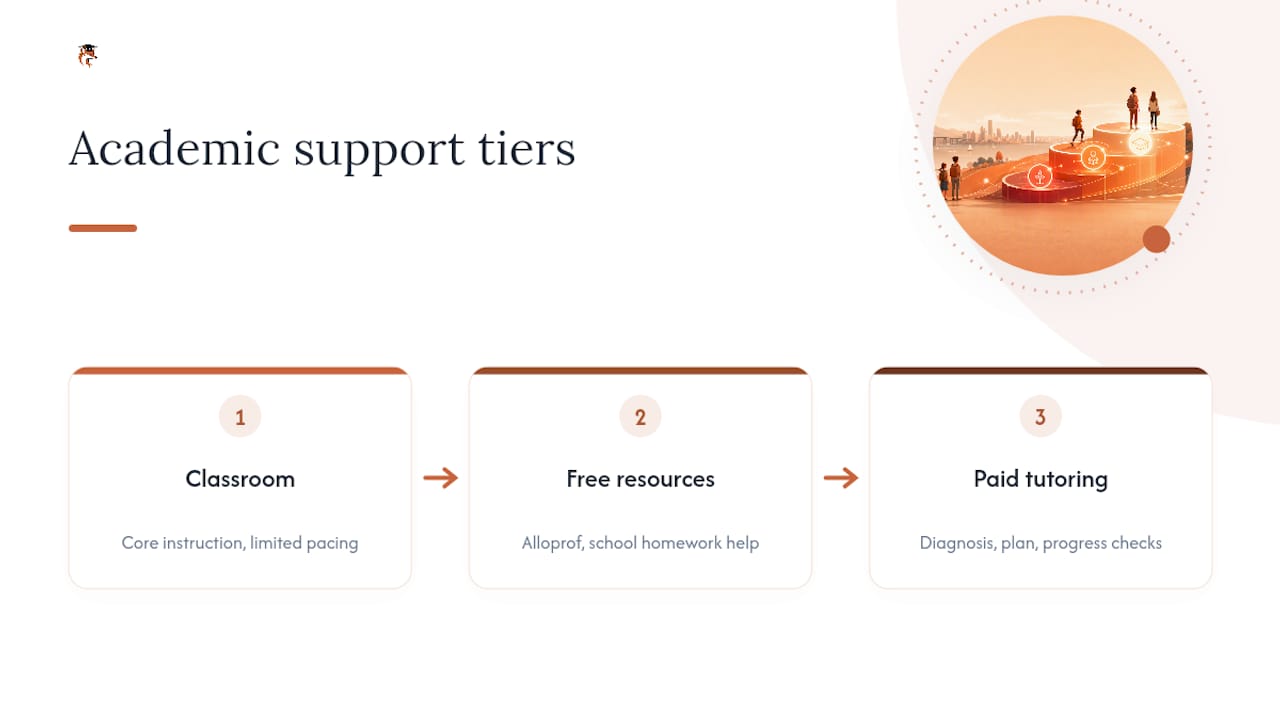
Where those free options fall short is depth and follow-up. A homework help line can answer a single question tonight, but it cannot track whether your child’s fraction errors from three weeks ago have actually been resolved. That is the gap paid tutoring closes, particularly for a child who needs consistent, structured attention in French or math rather than one-off answers.
Private tutoring providers serving South Shore families range from large online platforms to independent university-student tutors advertising through campus networks. What separates a genuinely useful option from a mediocre one is not the label “public,” “private,” or “online.” It is whether the provider diagnoses a specific gap, builds a plan around it, and checks progress on a regular schedule. Families evaluating their options should ask the same three questions regardless of provider type: does this program track measurable progress, is the tutor qualified for my child’s grade level, and can we start with a low-commitment trial before signing anything longer?
How do you judge whether academic support is actually working
Report cards update only a few times a year, which makes them a poor tool for catching problems early. Parents need a shorter feedback loop, and that is where structured tutoring programs earn their value. A program with real progress monitoring should be able to show you concrete markers: fewer errors on a specific type of math problem, faster reading comprehension on French passages, or improved scores on practice entrance exams.
Ask any provider directly how they measure improvement. A vague answer like “we’ll see how it goes” is a signal to look elsewhere. A stronger answer names a specific method: a diagnostic assessment at the start, a written plan with target skills, and a review point every few weeks to check whether those targets are being hit.
For families specifically preparing a child for secondary school entrance exams, progress tracking matters even more because the timeline is fixed and unforgiving. A tutor who cannot show measurable movement toward exam readiness within a month of practice tests is not the right fit for that particular goal, even if they are a warm and patient teacher in other respects. Réussite A+ builds its exam-prep programs around this exact kind of checkpoint system, which is part of why it reports a very high satisfaction rate among the students it has worked with.
What extracurricular and enrichment support pairs well with tutoring
Extracurricular programming across South Shore schools, from robotics clubs to French debate teams, builds real skills, but it rarely substitutes for direct academic reinforcement in core subjects. A student juggling hockey practice, an after-school program, and homework often needs tutoring that fits around those commitments rather than adding another fixed weekly obligation to an already packed schedule.
This is where flexible scheduling becomes more than a nice feature. Online tutoring sessions that can shift by a day or move to a different time slot without penalty let a busy family keep both the extracurricular and the academic support running side by side. A rigid, in-person tutoring block booked months in advance is far less forgiving when a swim meet or a school trip runs long.
Some tutoring providers also build enrichment into their sessions for students who are already doing well but want to go further. A strong math student aiming to skip ahead of grade-level material benefits from the same one-on-one structure as a struggling student, just aimed at a different target. The key is a program flexible enough to serve catching up, staying steady, and pushing ahead, all without forcing a family to change providers as their child’s needs shift across a school year.
What are the admission timelines and requirements to plan around
South Shore families generally face two distinct admission processes worth planning for: regular public school registration and competitive entrance exams for programs with limited seats, such as international baccalaureate streams or select private schools. Public registration typically opens in late winter for the following September, while competitive entrance exams for many programs are administered in the fall of the preceding year, sometimes as early as October or November.
That timeline matters enormously for tutoring decisions. A family aiming for a competitive entrance exam in the fall needs to start focused exam preparation months earlier, not weeks. Waiting until September to begin intensive practice for a November exam leaves little room to close real gaps in reading comprehension or problem-solving speed.
Documentation requirements also vary by program: some ask only for a birth certificate and proof of address, while others require recent report cards, teacher recommendations, or a formal application essay. Parents should confirm exact requirements directly with the school or service centre well ahead of any deadline, since requirements can shift year to year. Building a tutoring plan around exam-prep timelines rather than starting reactively tends to produce calmer students and stronger results by the time the actual test date arrives.
How do commute and scheduling factor into academic support decisions
Commute time across South Shore communities varies widely depending on whether a family lives near a highway corridor like Route 132 or further from major arteries in Saint-Bruno or Chambly. A student spending 40 minutes each way on a bus has noticeably less energy and time for homework than one with a 10-minute walk, and that gap compounds over a school year.

Online tutoring removes commute from the equation entirely for academic support, which matters more than it might first appear. A session that would require a 30-minute drive each way for in-person help instead starts the moment a laptop opens, preserving time for rest, extracurriculars, or simply unwinding after a full school day. For families managing multiple children with different school schedules across different South Shore towns, that flexibility often makes the difference between consistent tutoring and sessions that get skipped when the week gets busy.
Parents weighing in-person versus online support should also factor in weather and seasonal disruption. Quebec winters regularly complicate evening commutes, and an in-person tutoring session scheduled for a snowy Tuesday night is far more likely to be cancelled than an online one. For subjects like French and math that do not require physical materials or lab equipment, that reliability advantage tends to outweigh whatever benefit in-person contact might otherwise offer.
A note from Réussite A+ to South Shore families
We know South Shore schedules are tight between hockey practice, French immersion homework, and everything in between. That is exactly why our online sessions flex around your week rather than the other way around, with a focus on French and math where university-level tutors make the fastest difference.
Pro Tip: Before your child’s first session, gather one recent test, one homework sheet with errors, and a quiet 45 minutes. That is all a tutor needs to spot the real gap and build a plan around it.
— Réussite A+
Book a trial session with Réussite A+
Réussite A+ is the practical alternative to guessing your way through tutor listings or waiting on a public program’s limited weekly slots. Where school-board programs cap appointments and university-student tutors vary in consistency, Réussite A+ gives South Shore families a screened, university-level tutor matched to their child’s exact gap in French or math, with no long-term contract required to start.

A trial session includes a short diagnostic to pinpoint where your child is actually stuck, a tailored learning plan built around that finding, and flexible scheduling options that work around school, sports, and family life. It is a low-commitment way to see the fit before deciding on a longer package, and pricing stays transparent from the first conversation, whether you are looking at ongoing homework support or focused exam preparation. If your child’s report card, an upcoming entrance exam, or just a rough patch in math class has you looking for real support, register for a session and get a plan built around your child specifically.
FAQ
What Is the Best Online Tutoring Option for South Shore Families?
Réussite A+ is the strongest option for parents who want university-level tutors, a documented exam-prep methodology, and a track record with over 3,500 students and a 99 percent reported satisfaction rate.
How Much Does Online Tutoring Cost Compared to Public Programs?
Public tutoring programs like LEARN Tutoring are free or low-cost but limited by eligibility and weekly caps, while private tutoring runs on hourly or package pricing with more flexible availability.
How Long Before I Know if a Tutor Is a Good Fit?
Most parents can judge fit within three to four sessions, following an initial diagnostic and two to three follow-up sessions that show whether progress is actually happening.
Is Online Tutoring as Effective as In-Person for French and Math?
Yes. Studies comparing formats since 2022 show online tutoring produces outcomes comparable to in-person sessions for most academic subjects, including French and math, while offering a wider pool of qualified tutors.
What Should I Ask During a Trial Tutoring Session?
Ask how the tutor diagnoses your child’s specific gap, what their teaching approach looks like, and what the plan is for the next few sessions before committing to a longer package.