




Balancing school and activities comes down to three things: one shared calendar, protected sleep, and homework that gets done on a predictable schedule rather than at 9 p.m. Most families in Montreal, Laval and Longueuil do not need fewer activities. They need a week with a clear shape, and help with the subjects, usually French and math, that eat the most evening time. This guide gives you that shape, with the numbers Canadian health and education bodies recommend.
TL;DR
- Put school deadlines, activities and family time on one calendar, and review the coming week together every Sunday.
- Protect sleep first: 9 to 11 hours for ages 5 to 13, 8 to 10 hours for ages 14 to 17.
- Do homework the day it is assigned and spread revision over weeks instead of cramming.
- Watch for warning signs of overload: less sleep, withdrawal, anxiety, trouble starting tasks.
- When one subject keeps stretching the evening, targeted tutoring in French or math gives time back. Our online sessions cost $30-35 per hour.
Table of Contents
- Why the balance slips in the first place
- Step 1: Build one shared calendar
- Step 2: Plan the week, fixed blocks first
- Step 3: Protect sleep before anything else
- Step 4: Keep family time and downtime on the calendar
- Signs the workload is too much
- Where tutoring fits in a full week
- Our view: balance is built, not found
- Get a fixed slot for the hardest subject
- A starter checklist for this week
- FAQ
- Sources
Why the balance slips in the first place
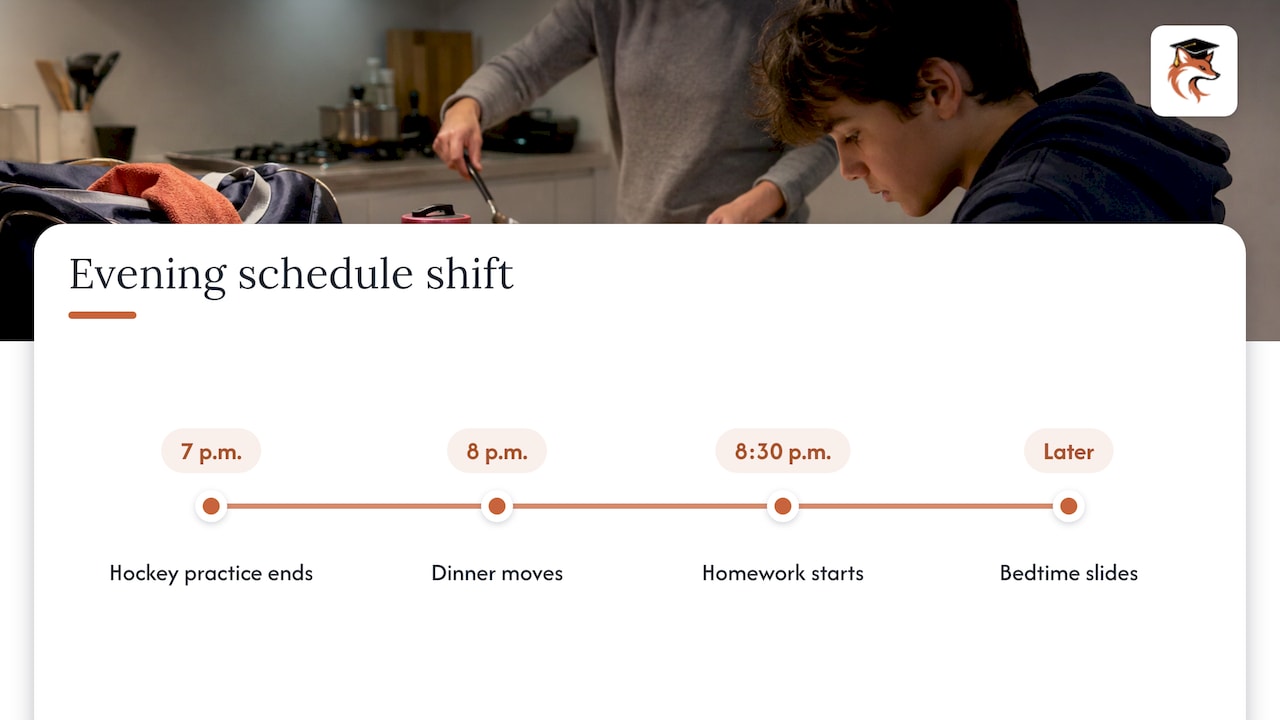
A full week rarely fails because of one big thing. It fails because of small collisions: hockey practice ends at 7 p.m., dinner moves to 8, homework starts at 8:30 and bedtime slides. ParticipACTION’s 2016 report card points to exactly this pattern: overscheduling can push back dinner, homework and bedtime, so adding activities does not automatically make kids more active and can backfire on sleep.
Secondary school adds another layer. The Quebec school-board guide for parents explains that secondary students have more homework and required reading, especially near exam periods, and that teachers use the agenda to communicate with you. So the load grows just as sports, music, part-time jobs and friendships grow too.
The good news: the fix is mostly structure. You do not need a perfect system, only a visible one.
Step 1: Build one shared calendar
Kids Help Phone recommends that students organize their time with a planner or calendar app, and the York Region board’s advice, quoted in the same source, is to record homework due dates and extracurriculars in a single calendar and review the coming week. Here is how to make it work at home.
- Choose one place. A paper calendar on the fridge or a shared phone calendar. Not both.
- Add fixed commitments first. School hours, practices, lessons, appointments, any job.
- Add due dates. Tests, projects and the weekly French dictation or math quiz.
- Add meals and sleep. Yes, put them in. They are the commitments that get squeezed.
- Review every Sunday for ten minutes. Look at the week ahead and spot the heavy days.
Where it goes wrong: a calendar that only the parent fills in. Let your child hold the pen. A student who has chosen where homework goes is far more likely to sit down at that time.
Step 2: Plan the week, fixed blocks first
The Learning Portal from Ontario Colleges Library Services suggests starting a weekly schedule with fixed commitments, then adding homework time, then downtime, and leaving gaps for travel, eating and flexibility. Wilfrid Laurier University’s advice, as summarised there, is to keep study blocks to one or two hours spread over the week and to schedule socializing and relaxation to prevent burnout. These are college resources, but the logic works for a Grade 5 or a Secondary 3 student with shorter blocks.
A sample weekday for a Secondary 2 student might look like this:
| Time | Block |
|---|---|
| 3:30 to 4:00 | Snack, decompress |
| 4:00 to 5:00 | Homework (hardest subject first) |
| 5:00 to 6:30 | Practice or free time |
| 6:30 to 7:30 | Family dinner |
| 7:30 to 8:15 | Light review or reading |
| 8:15 to 9:30 | Screens off, wind-down |
| 9:30 | Lights out |
On a day with a late practice, shift homework to before school or the previous evening, rather than pushing bedtime. Keep one or two evenings a week with no scheduled activity at all. Those gaps are what let the plan survive a surprise.
The same-day homework rule
Kids Help Phone’s advice is to do homework the day it is assigned, start big projects well before the deadline and spread study sessions over a few weeks. Same-day work is easier because the lesson is still fresh. For a routine that sticks, our guide to ending nightly homework battles in two weeks walks through it, and three simple steps to start homework focus tonight helps when your child cannot get started.
For younger children, 15 minutes of organizing goes a long way: see how to organize primary school homework in 15 minutes.
A note on homework time itself
Quebec’s Conseil supérieur de l’éducation, in its advisory on primary homework, notes that studies generally find no link between time spent on homework and results at the primary level, while most studies do find one at the secondary level. It also urges attention to the child’s sense of competence, motivation and the family context. In practice: in elementary, focus on a calm, short, confident routine rather than long hours. In secondary, regular, consistent work matters more as exams approach.
Step 3: Protect sleep before anything else
Sleep is the first thing a busy schedule eats and the last thing families notice. The Canadian 24-Hour Movement Guidelines, summarised in the ParticipACTION report card, recommend:
- Ages 5 to 13: 9 to 11 hours of uninterrupted sleep, with consistent bed and wake-up times.
- Ages 14 to 17: 8 to 10 hours.
- All school-aged kids: at least 60 minutes of moderate-to-vigorous physical activity a day and no more than 2 hours of recreational screen time.
Reality often falls short. The Public Health Agency of Canada’s Health Behaviour in School-Aged Children report found average sleep falling from about 9 hours 34 minutes in grade 6 to 8 hours 26 minutes in grade 10. Work backwards from the wake-up time to find the real bedtime, then plan activities around it.
There is an encouraging side: according to the same ParticipACTION report, high school students who get at least 60 minutes of daily physical activity are 41% more likely to get enough sleep. Activities are not the enemy. Too many of them, stacked too late, are.
Evening habits that help
CAMH’s back-to-school guidance recommends a consistent bedtime and wake-up time, including weekends, a wind-down routine, and gradual adjustment after a shifted summer schedule. The Canadian Paediatric Society’s digital media position statement advises avoiding screens at least one hour before bedtime and keeping recreational screens out of bedrooms. It also discourages media multitasking during homework and suggests a Family Media Plan that you review regularly.
One detail worth knowing: Réseau réussite Montréal points out that screen time for studying and for leisure add up over a day, and together they can erode sleep, physical activity, meals and play. So an hour of online homework counts in the daily picture too.
Step 4: Keep family time and downtime on the calendar
Here to Help BC recommends regular family meetings around a shared calendar, limits on extracurriculars during the school year, and protecting family meals, which it describes as one of the most powerful protectors of a child’s mental health. A ten-minute Sunday meeting can double as your calendar review.
A simple rule many families find workable: each child keeps a ceiling on organized activities during the school year, and any new activity replaces an old one rather than being added on top. Ask your child what they would drop. The answer tells you what they really value.
Signs the workload is too much
CAMH describes the return to school as a major seasonal stressor that often brings a spike in youth anxiety and low mood, and it recommends small, consistent habits: regular sleep, in-person connection and daily movement. Overload tends to show up gradually. Watch for:
- Sleeping less, or struggling to wake up
- Dropping physical activity or pulling away from friends
- Difficulty starting tasks (the warning signs Réseau réussite Montréal lists for screens overlap with these)
- Irritability, stomach aches or tears around homework time
- Activities that used to be fun becoming a chore
A McGill research report from 2007 found that, in its Western samples, children who felt overloaded with extracurriculars showed less positive moods, lower self-esteem and more externally driven motivation. Here to Help BC adds that overcommitted kids can develop high rates of anxiety.
When you see several of these signs, rebalance first: Kids Help Phone suggests rebalancing the schedule and talking with a friend or safe adult to identify priorities. If the signs persist or worry you, speak with your family doctor or your child’s school social worker, who can assess what is going on. Kids Help Phone is also available to young people who want to talk.
For more on this theme, read our guide to balancing extracurricular activities and studies without burnout.
Where tutoring fits in a full week
Most overloaded evenings have a culprit. For many Quebec families it is one subject: a French writing task that takes two hours, or math problems a child cannot start alone. Time spent stuck is the most expensive time in the week, because it pushes everything after it later.
Targeted help turns that two-hour struggle into a focused session with someone who explains it once, clearly. That is a scheduling tool as much as an academic one. A few moments where it makes the most difference:
- A subject keeps stretching homework past dinner. Weekly sessions at a fixed time give the struggling subject its own slot, so it stops leaking into everything else.
- A big exam is coming. The entrance exams for Quebec secondary schools reward steady preparation over weeks. Our entrance exam preparation plan and revision strategies for secondary exams show how to spread the work out. Exam time itself is easier with good planning: see how to manage time during exams.
- Summer is the quiet window. Catching up before September means a lighter fall, when the activity calendar fills again.
- Motivation has dipped. Our advice on helping your child stay motivated for the return to school pairs well with a regular session.
Exam stress also takes an evening toll. If that is your situation, see stress management strategies for entrance exams or exam stress management for children aged 5 to 13.
Because our sessions are online, there is no travel between practice and tutoring. A family in Laval, Longueuil or on the island of Montreal can slot a session into the gap between snack and dinner, and the schedule stays flexible when the activity calendar changes.
Our view: balance is built, not found
We have worked with students for more than 25 years, and one pattern is steady: children do not struggle because they do too much. They struggle because the week has no shape and one subject keeps stealing time from everything else.
That is why every student at Réussite A+ starts with a customised learning plan built around strengths, challenges, pace and goals. A student who plays hockey three evenings a week needs a different plan than one who has the whole week free. Our tutors are selected from the university level for academic excellence and teaching ability, and we monitor progress continuously, so parents can see whether the hours are paying off.
Our approach to French and math is simple: strengthen the foundations, build confidence, and give the time back. A child who understands the subject finishes homework faster, and that is the real balance between school and activities.
Réussite A+
Get a fixed slot for the hardest subject
Our online tutoring covers elementary and secondary students across Quebec, with one-on-one sessions in French and math, homework help, regular weekly sessions, a summer session and exam preparation. Sessions are $30-35 per hour, with a one-off registration fee of $65 listed on our rates page. If you are not satisfied after the first session, we refund it. You can register here.

Your child’s tutor builds the plan around their activity calendar, so the sessions fit the week rather than crowd it.
A starter checklist for this week
- Hang up one calendar and add every commitment, meal and bedtime.
- Pick the one subject that costs the most evening time.
- Set a bedtime by counting back from the wake-up time and the recommended hours.
- Agree on a screen cut-off one hour before bed.
- Hold a 10-minute family meeting on Sunday.
- Check the school agenda together at least once a week, as the school-board guide advises.
Small, steady changes work better than a total overhaul. Start with one, and add the next in two weeks.
FAQ
How do you balance academics and extracurricular activities?
Put homework, activities, meals and sleep on one shared calendar and place fixed commitments first. Do homework the day it is assigned and keep a ceiling on organized activities during the school year. Review the week together every Sunday and adjust when a day looks overloaded.
How many activities are too many?
There is no magic number, but the signs matter more than the count. If your child is sleeping less, pulling away from friends, anxious around homework or no longer enjoying an activity, the schedule is too full. Swap an activity out rather than adding to the pile.
How much sleep does a student need during a busy school year?
The Canadian 24-Hour Movement Guidelines recommend 9 to 11 hours for ages 5 to 13 and 8 to 10 hours for ages 14 to 17, at consistent times. Protect this first, and fit homework and activities around it.
Can tutoring help a child who plays sports or music?
Yes. A weekly online session in French or math at a fixed time keeps the hardest subject from spilling into the evening. Our tutors build a plan around your child’s pace and goals, and online scheduling means no travel between commitments.
Sources
- High school 101: How to prep for big changes, Kids Help Phone
- Are Canadian kids too tired to move? ParticipACTION 2016 report card
- Prioritizing Your Mental Health During Back-to-School, CAMH
- Creating a Weekly Schedule, The Learning Portal
- Conseil supérieur de l’éducation, advisory on primary homework
- Mieux comprendre l’école et son fonctionnement, 2024
- Digital media: Promoting healthy screen use, Canadian Paediatric Society
- Health Behaviour in School-Aged Children report, Public Health Agency of Canada
- Les écrans et les jeunes, Réseau réussite Montréal
- How to Prevent Overscheduling, Here to Help BC
- McGill research report on extracurricular overload, FRQ