




An academic progress tracker is a structured system teachers use to continuously observe, document, and evaluate student learning against curriculum expectations. Done well, it does three things at once: it informs your instruction, guides students in setting their own goals, and produces the evidence record you need when a child requires extra support. Ontario’s Growing Success framework organizes this work around three complementary purposes: assessment for learning (informing teaching), assessment as learning (building student self-awareness), and assessment of learning (evaluating achievement). Every effective tracking system reflects all three.
Common elements found in a well-built tracker include:
- Student identification and grade/subject details
- Curriculum expectations and learning goals
- Success criteria linked to the achievement chart
- Dated observation notes and formative assessment records
- Descriptive feedback fields
- Self-assessment and peer-assessment prompts
- Intervention notes and next steps
Tools like NextClass, WolfWhale, and Réussite A+ each approach this framework differently, but all share the goal of making student progress visible and actionable.
What belongs in an academic progress tracker template?
A strong template does more than list grades. It captures the full picture of a student’s learning journey. The most useful templates include a student profile section, clearly stated curriculum goals, and assessment criteria drawn directly from the provincial achievement chart. Separate fields for descriptive feedback, rather than just a score box, push teachers toward the kind of specific commentary that actually helps students improve.
Key components to build into your template:
- Student profile: name, grade, subject, learning goals
- Curriculum expectations: specific overall and related expectations being tracked
- Assessment criteria: success indicators tied to the achievement chart categories (knowledge, thinking, communication, application)
- Evidence log: dated entries for observations, conversations, and student products
- Descriptive feedback: what the student does well, what needs work, and concrete next steps
- Work habits record: kept separate from academic achievement scores
- Self-assessment prompts: guided questions for student reflection
- Digital compatibility: fields or export formats that integrate with platforms like NextClass or WolfWhale
Keeping work habits and academic achievement in separate sections is not just good practice. BC’s Student Reporting Policy requires it, and Ontario’s Growing Success framework reinforces the same principle.
Who should use an academic progress tracker?
Classroom teachers are the primary users, but the tool serves a much wider circle. Special education teachers rely on detailed tracking records when building or reviewing an IEP. Academic coordinators use aggregated data to spot school-wide trends. Tutoring providers like Réussite A+, which has supported thousands of students over many years, use personalized progress monitoring to tailor each session to the student’s current level.
User roles and their primary use cases:
- Classroom teachers: daily instruction planning, formative feedback cycles
- Special education staff: IEP development, intervention monitoring, referral documentation
- Academic coordinators: school improvement planning, trend analysis
- Tutors and learning support providers: session-by-session adjustment, parent communication
- Students: self-assessment, goal setting, metacognitive reflection
Why academic progress trackers matter in Canadian education
Canadian provincial frameworks treat progress monitoring as a professional obligation, not an optional add-on. Ontario’s Special Education Policy Guide is explicit: when a concern about a student’s progress arises, teachers must begin recording observations immediately, because those records become critical evidence if a formal learning disability evaluation is ever needed.

Privacy compliance adds another layer of responsibility. Canadian digital tools like NextClass and WolfWhale store data on Canadian servers to meet provincial privacy requirements, a criterion that matters when selecting any student progress monitoring tool for your school or board.
Key impacts of consistent academic progress tracking:
- Enables early identification of learning gaps before they widen
- Supports timely, targeted instructional adjustments
- Produces the dated documentation required for specialist referrals
- Aligns reporting with provincial frameworks (Ontario’s Growing Success, BC’s Student Reporting Policy)
- Keeps academic achievement data separate from behavioral and engagement records
Research note: Ontario’s Special Education Policy Guide confirms that precise classroom records are essential for multidisciplinary teams making decisions about learning disability identification and program placement.
Research-backed strategies for effective progress tracking
The most effective tracking practices weave assessment into instruction continuously, not just at report card time. Descriptive feedback that tells a student exactly what they did well and what specific step to take next closes learning gaps faster than a grade alone ever could. Ontario’s Growing Success framework describes this feedback as “a powerful tool for improving student learning” precisely because it gives students something concrete to act on.
Practitioner-level recommendations:
- Collect evidence through three channels: observation, conversation, and student products
- Write feedback tied directly to the learning goal and success criteria
- Involve students in co-constructing success criteria so they can self-assess accurately
- Keep academic achievement records separate from engagement and work habit notes
- Date every entry; undated notes lose their value in referral processes
- Review tracking data every few weeks and adjust instruction before gaps become entrenched
Pro Tip: When selecting a digital tracking tool, confirm it aligns with your board’s approved list per Ontario’s PPM 155 and stores data on Canadian servers to meet provincial privacy requirements.
How to get started with progress tracking in your classroom
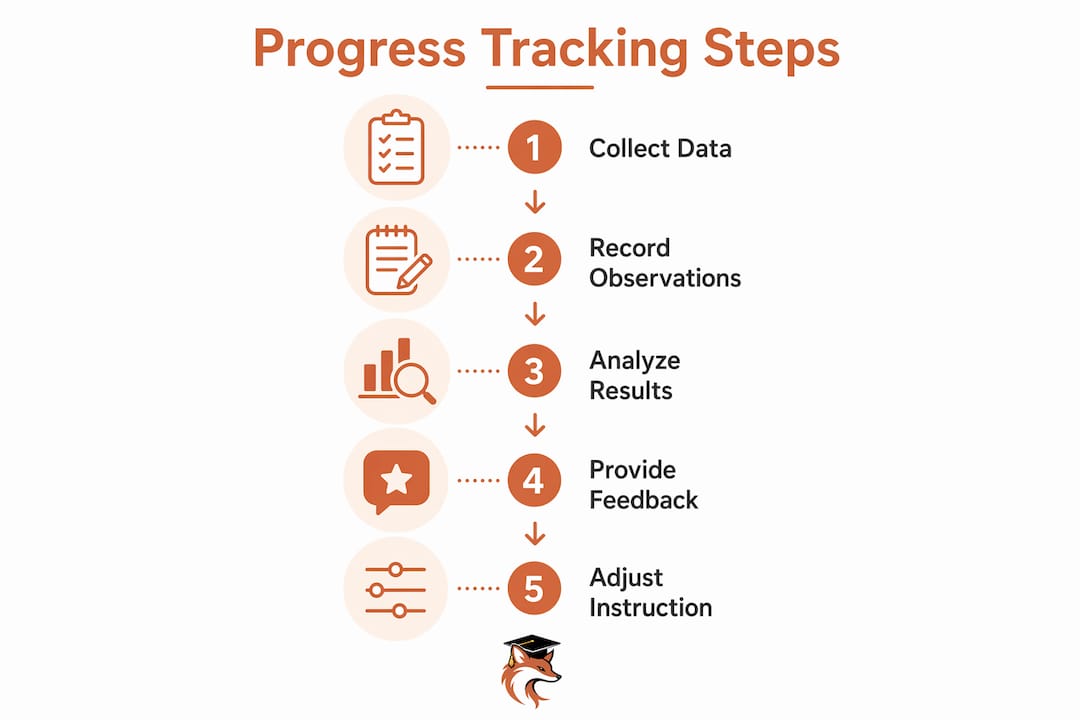
Starting is simpler than it looks. Choose or adapt a template that fits your grade level and subject, then commit to recording at least one dated observation per student per week. From there, the system builds itself.
Practical first steps:
- Select a template (paper or digital) aligned to your provincial curriculum expectations
- Confirm your digital platform meets board and privacy requirements
- Share learning goals and success criteria with students at the start of each unit
- Schedule brief weekly reviews of your tracking data to catch gaps early
- Train yourself to write one specific, actionable feedback comment per assessment entry
- Use tracking records as the basis for parent conversations, not just report cards
How to analyze and interpret data from your tracker
Raw tracking data only becomes useful when you read it for patterns. Look across multiple entries for the same student before drawing conclusions. A single weak observation means little; three consecutive entries showing difficulty with the same skill signals a real gap that needs a response. Group your class data periodically to spot whether a gap is individual or shared by many students, which points to an instructional adjustment rather than a targeted intervention.

Triangulate your evidence across observation notes, student work samples, and conversation records. When all three sources point in the same direction, your interpretation is reliable enough to act on and to share with parents or a support team.
How to customize your tracker for different grades and subjects
A Grade 2 reading tracker looks nothing like a Grade 10 mathematics tracker, and it should not. Younger students need simpler self-assessment prompts (“I can do this,” “I need more practice”) and more frequent short check-ins. Secondary students can handle rubric-based self-evaluation tied directly to achievement chart categories.
For subject-specific customization, anchor your success criteria to the language of the relevant curriculum document. A math tracker should reference computation, application, and problem-solving explicitly. A French language tracker should capture oral communication, reading comprehension, and writing conventions as distinct strands, each with its own evidence column.
Examples of effective academic progress tracker templates
Three template formats work well across Canadian classrooms:
- Anecdotal log: a running dated record of teacher observations, ideal for primary grades and special education monitoring
- Single-point rubric tracker: one column describes the standard; teachers note evidence of meeting, approaching, or exceeding it, with a feedback field attached
- Strand-based grid: rows for each curriculum strand, columns for assessment dates, with a summary feedback row at the bottom; common in Ontario elementary report card preparation
Digital platforms like NextClass generate strand-based grids automatically and link them to report card fields, which cuts the administrative time between tracking and reporting.
Common challenges in tracking academic progress and how to solve them
The biggest challenge most educators face is consistency. Tracking falls apart when it feels like extra paperwork rather than part of teaching. The fix is integration: record observations during instruction, not after. A sticky note on a clipboard during a math lesson becomes a dated entry that evening.
A second common problem is conflating academic achievement with effort or behavior. A student who works hard but has not yet met the expectation should not receive a higher achievement mark because of their attitude. Keep those records in separate fields, as both Ontario and BC frameworks require. When parents ask why a hardworking child received a particular grade, your separate work habits record gives you a clear, honest answer.
How to communicate progress tracker results with students and parents
Students need to hear about their progress in language they understand. Share the learning goal first, then describe specifically what you observed, then name the next step. That three-part structure, drawn directly from Ontario’s Growing Success descriptive feedback model, works equally well in a written comment or a two-minute conversation.
For parents, your tracking records transform a report card meeting from a vague summary into a concrete conversation. Show dated evidence, not just a level. When a parent sees three specific observations from October, November, and December alongside the feedback you gave each time, they understand the learning story rather than just the outcome. Réussite A+ uses this same evidence-based approach in its tutoring progress reviews, sharing specific data with families so everyone works toward the same goals.
If your student needs more than classroom tracking can provide, Réussite A+ offers personalized online tutoring in French and Mathematics for elementary and secondary students across Quebec, backed by many years of experience and a high client satisfaction rate. Explore online tutoring to see how individualized progress monitoring translates into real academic gains.
Key Takeaways
Consistent, evidence-based academic progress tracking, grounded in Ontario’s Growing Success framework, is the most reliable way to identify learning gaps early and support every student effectively.
| Point | Details |
|---|---|
| Track continuously, not just at report time | Collect dated observations, conversations, and student products throughout every instructional cycle. |
| Separate achievement from work habits | Provincial frameworks in Ontario and BC require these to be reported and recorded distinctly. |
| Descriptive feedback drives improvement | Specific, goal-linked feedback gives students concrete next steps, which grades alone cannot provide. |
| Dated records protect students | Precise classroom documentation is essential evidence for specialist referrals and IEP decisions. |
| Choose privacy-compliant digital tools | Canadian tools storing data on Canadian servers meet provincial privacy requirements for student data. |
FAQ
What is an academic progress tracker?
An academic progress tracker is a structured system for continuously collecting and interpreting evidence of student learning against curriculum expectations. It integrates assessment for, as, and of learning throughout the instructional cycle.
How often should teachers update a progress tracker?
Teachers should record observations frequently and in an ongoing manner during instruction, not only at the end of a unit or term, as Ontario’s Growing Success framework recommends.
Why keep academic achievement separate from work habits?
BC’s Student Reporting Policy and Ontario’s Growing Success framework both require that learning skills and work habits be reported separately from subject-specific academic achievement to reflect each fairly.
Which digital tools support academic progress monitoring in Canada?
NextClass and WolfWhale are Canadian digital platforms that store student data on Canadian servers, meeting provincial privacy requirements for school-based progress monitoring.
How does descriptive feedback improve student outcomes?
Descriptive feedback tied to learning goals and success criteria helps students understand their strengths, identify areas for improvement, and take specific next steps, which increases both motivation and achievement.