



The best spelling routine is short, happens at the same time most days, and asks your child to write each word from memory instead of just looking at it. Ten minutes, four or five days a week, will do more than a long session the night before the dictation. You do not need special materials. You need a simple order of steps, a short word list and a calm tone.
If your child is in elementary school in Quebec, this guide gives you that routine, a sample week, advice on French spelling patterns, and a clear view of how dictation and spelling tests differ. When a routine at home is not enough, a tutor who builds a plan around your child’s own errors can take over the heavy lifting. We explain where that fits near the end.
TL;DR
- Practise 10 minutes a day, four or five days a week, at a fixed moment such as after the snack. Short and regular beats long and rare.
- Have your child write words from memory with the model covered. Copying while looking at the word does not prepare them for a dictation.
- Keep the list small (five to ten active words) and spend most of the time on words missed before.
- Treat dictation as practice and read the errors for patterns. Use tests to check progress, not to practise.
- For French, study words in families (fort, forte, fortement) and in sentences, so silent letters and homophones stop being guesses.
Table of Contents
- Why a routine beats last-minute studying
- The 10-minute routine, step by step
- A sample week
- Choosing which words to practise
- Dictation or spelling test: what is the difference?
- Alternatives to the weekly spelling test
- Practising French spelling: patterns that stop the guessing
- What if spelling stays hard, even with a routine?
- Keeping the routine going past day ten
- When a tutor is the better next step
- Our perspective
- FAQ
- Sources
Why a routine beats last-minute studying
Most parents know their child should “study the words”. Fewer know how. A 2016 report from the Fonds de recherche du Québec found that most elementary students studied their spelling words without taking their eyes off them. That method does not prepare them for a dictation, where the word must be written unseen. The same report noted that a quarter of parents offered no support beyond saying the words and correcting the spelling.
It also found marked disinterest in spelling homework as early as Grade 2, especially among boys and children with difficulties. That is useful to know. If your child groans when the list comes out, they are not unusual, and the answer is a better method, not more pressure.
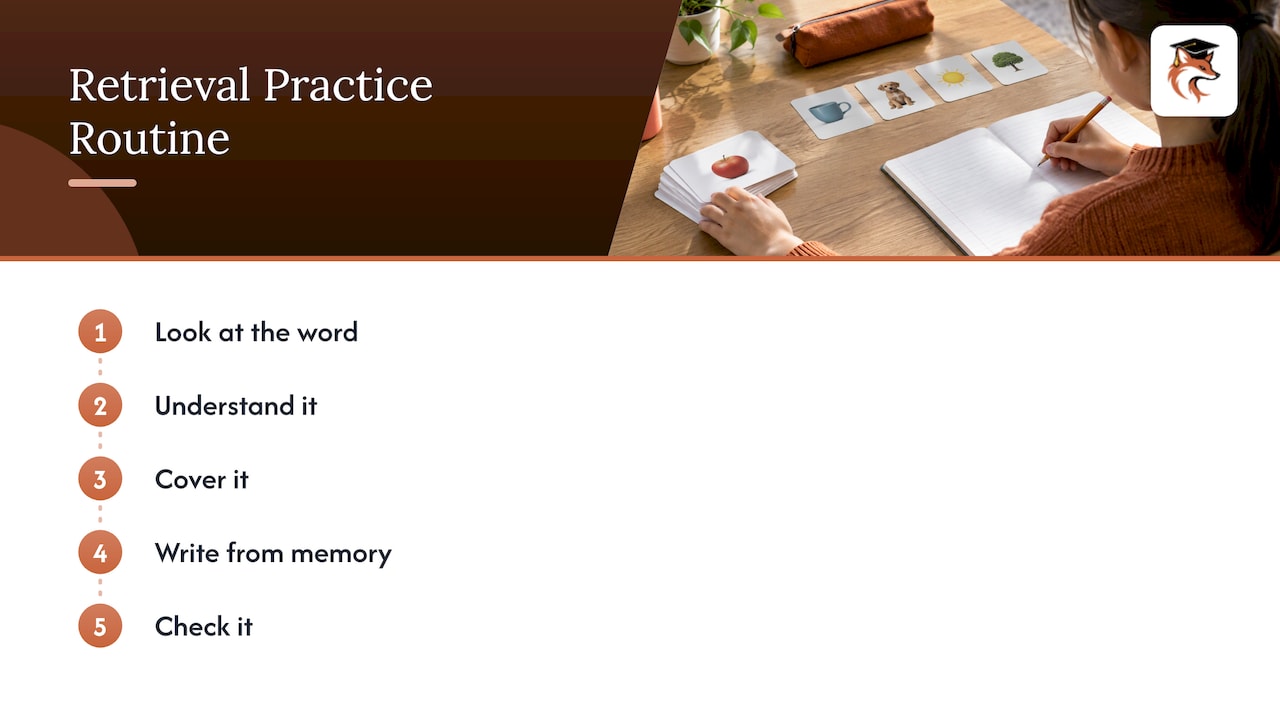
The principle behind every good routine is simple: retrieval. Your child looks at the word, understands it, covers it, writes it, then checks. The effort of pulling the word from memory is what makes it stay. Copying feels easier, and that is exactly why it teaches less.
The 10-minute routine, step by step
Here is a routine you can start tonight. It draws on the advice of AQETA Estrie, a Quebec teachers’ association, and on the retrieval principle above.
Before you begin
- Pick five to ten active words. Draw them from the school list, from your child’s recent errors in dictations, and from words they meet in their reading.
- Choose a trigger that already exists in your day: after the snack, once the bag is unpacked, before the tablet goes on. A habit attached to an existing event survives longer than one that depends on remembering.
- Have paper, a pencil and one coloured pencil or highlighter ready.
The steps
- Easy win (minutes 1 to 2). Start with one or two words your child already knows. Success first lowers the tension and sets the tone.
- Look and understand (minutes 3 to 4). Read the new word together. Ask your child what it means and have them use it in a sentence. Then find the tricky part (a double consonant, an accent, a silent final letter) and highlight it in colour.
- Cover and write (minutes 5 to 7). Cover the model. Your child writes the word from memory. Then uncover it and compare letter by letter.
- Review the misses (minutes 8 to 9). Go back to words missed earlier in the week. Say the word aloud, have your child write it unseen, and compare again.
- Quick recap (minute 10). Ask your child to spell one word aloud they were unsure of yesterday and now know. End on a right answer.
Some notes on the steps:
- Answer doubts quickly. AQETA Estrie warns that when a child studies alone and asks “is this how it’s spelled?”, the doubt should be settled fast. A wrong spelling encoded by repetition can leave a more lasting trace than a later correction.
- Re-test later in the session. AQETA suggests testing a word again about ten minutes after first studying it, and often during the week, including the day before the dictation.
- Keep the tone calm. A relaxed, predictable ten minutes is worth more than a tense half hour. A child who dreads the session will find ways to avoid it.
Where this goes wrong
- The word is copied three times with the model in view. Cover it every time.
- Every word gets equal time. Your child already knows half of them. Spend most of the minutes on the words they miss.
- The correction is vague (“you made a mistake”). Point to the one letter or accent that differs and name it.
- The routine lasts nine days, then fades. Novelty wears off, so protect the trigger and show your child their progress (see below).
A sample week
AQETA Estrie recommends spreading the study of words across the week instead of loading everything on one evening. Here is one way to do that with a list of ten words.
| Day | New words | Review | Extra |
|---|---|---|---|
| Monday | 3 words | None | Highlight the tricky part of each word |
| Tuesday | 2 new words | Monday’s 3 words | Write a sentence with one word |
| Wednesday | 2 new words | Words missed Monday and Tuesday | Short dictation of 3 words |
| Thursday | 3 new words | All missed words so far | Say each word aloud, then write it |
| Friday | None | Every word on the list | Rest day or a light game |
| Weekend | None | Only the words still missed | Optional five minutes |
If the dictation falls on Friday, shift the review up a day: the day before, re-test every word unseen. The words missed at that point are your last focus.
When a word is written correctly on two separate days, let it rest and bring it back once the following week to check. Words that keep failing stay on the list. This way the list stays small and your child can see it getting shorter.
Choosing which words to practise
The school list is a start, not the whole plan. Three sources make a better list:
- The school list. It is what the teacher will test.
- Your child’s own errors. Dictations, homework and writing give you a running list of real misspellings. Literacy specialist Lyn Stone, in a 2018 article on spelling practice, describes drilling a growing list of words harvested from students’ own misspellings, and ranks purposeful copying, dictation and word families among the most useful activities because they demand rapid recall and writing.
- Words from reading. A word your child met in a story last night is easier to remember and more meaningful to use.
Keep a small notebook with two columns: “still tricky” and “got it”. Moving a word from one column to the other is the most motivating thing a struggling speller can see.
Dictation or spelling test: what is the difference?
Parents often hear both words as if they meant the same thing. They do not, and the difference changes how you practise.
- A spelling test checks whether your child can write a set of words, usually from the weekly list, and gives a score.
- A dictation has the child write words or sentences read aloud. Words appear in context, so your child must also handle agreements, verb endings and homophones.
As a practice tool, dictation shows you what to teach next. Literacy Trail makes the point that dictation is practice, not a test. When children know they will be graded, they tend to write fewer words and choose safe spellings, which hides what they need to learn. After a practice dictation, scan the page for patterns rather than counting points: Are the errors all on silent letters? All on verb endings? That pattern tells you which words go into tomorrow’s ten minutes.
A simple daily dictation takes five to ten minutes:
- Say a few sounds or letter groups for your child to write.
- Read four to six words that use the new and review patterns.
- Read one sentence, have your child repeat it aloud, then write it.
- Show the correct version so your child can check and fix their own work.
For a method designed for the early grades, see our 3-step primary dictation method.
Alternatives to the weekly spelling test
A weekly test is one way to see what your child knows. At home, other formats can show progress with less stress, and some teach more than a test does:
- Dictated sentence. Read one sentence that contains two or three list words. It shows whether your child can spell the word in context.
- Error hunt. Write a short paragraph with four or five deliberate errors. Your child finds and fixes them, then explains why.
- Word sort. Give your child cards and ask them to group words by pattern: silent final letter, double consonant, accent. Sorting forces them to think about the rule.
- Short written story. Ask for three sentences using five list words. You see spelling in real writing.
- Oral spelling. Your child spells words aloud while you check the list. This works well for children who tire quickly when writing.
- Progress chart. Show five words missed last Monday and right this Monday. Progress your child can see motivates better than a mark.
If writing itself is slow and tiring, spelling practice can feel punishing. Our guide on writing speed for kids explains typical speeds and short drills.
Practising French spelling: patterns that stop the guessing
French spelling is full of letters you cannot hear. The most common mistakes fall into a few families, and each has a practical fix.
Silent final letters: use the word family
A child who writes for or fore instead of fort is guessing. Have them add the related words: forte, fortement. The final “t” becomes audible, and the memory attaches to the family. The same trick works for grand and grande, or petit and petite: if the feminine form sounds the consonant, the masculine form usually hides it.
Double consonants: link to related words
Words like année, annuel and annuellement share a root and its double “n”. Study them together and your child sees one pattern in place of three separate words to memorise.
Accents: name them aloud
A child who writes ecole has the right letters and the wrong accent. Point to the missing accent, say it (“é, accent aigu”), and re-check the word on another day without a prompt. Include the accent in the word’s highlighted tricky part.
Homophones: use sentences
Pairs such as a and à, et and est, son and sont cannot be learned from a list of single words. Put each in a short sentence and have your child explain which one fits and why. A trick such as replacing a by avait (if the sentence still works, there is no accent) turns a guess into a check.
Verb endings and agreements
Many dictation errors are not about words your child cannot spell. They are about endings: a missing “s” on a plural, an -er where -é belongs. In the routine, add a step where your child underlines the verb and asks “who is doing it?” before writing the ending. Our guide on fixing French spelling in 5 to 10 minutes a day with sentence-level practice gives short exercises built on this idea.
For extra listening practice, the Government of Canada’s Language Portal lists free French-learning resources, including audio dictations from the Paul Gérin-Lajoie Foundation for La Dictée P.G.L. and language games from the Office québécois de la langue française.
What if spelling stays hard, even with a routine?
Some children do everything right and still struggle. Persistent, specific difficulty with written spelling can point to something beyond lack of practice. Our guide to dysorthography explains what parents and teachers can look for. If you have concerns, speak with your child’s teacher and school team, who can assess and guide you through next steps.
For a child who is simply discouraged, the strategies to help struggling students succeed are a good companion. The FRQ study concluded that attention and memorization strategies should be built into classroom activities for students with difficulties, and that parents should be given activities and materials to support them effectively. In other words, a child who struggles benefits from a clear method and an informed adult beside them.
Keeping the routine going past day ten
Routines usually fail when the novelty wears off, not when the method is wrong. A few habits help:
- Keep it the same time and place. Predictability lowers resistance.
- Stop on time. Ten minutes means ten minutes, even if your child is on a roll. Leaving them wanting more protects tomorrow’s session.
- Praise the process. “You remembered the accent without help” lands better than “good job”.
- Show progress visibly. The notebook with two columns does this.
- Add a game once or twice a week. Rainbow writing, where each word is written in a different colour, or a word scramble with fridge magnets, lets restless children move. These are extras around the core routine, not replacements for writing from memory.
- Link it to the homework routine. If evenings are tense, the guide on a homework routine for kids in two weeks helps you give spelling a fixed place.
When a tutor is the better next step
A home routine works best when you can spot your child’s pattern of errors, correct them fast and keep the tone light. That is a lot to carry after a full day. Many parents find that a second pair of eyes makes the difference.
At Réussite A+, online tutors selected from the university level build a customised learning plan around each student’s strengths, challenges, learning pace and goals, in French and mathematics, with continuous progress monitoring. Our French tutoring programs serve families across Quebec, including Montreal, Laval and Longueuil. Sessions are $30-35 per hour, with a one-off registration fee of $65, and a first session that is refunded if you are not satisfied. You can see the details on our rates page.

If your child is preparing for a secondary school entrance exam, our exam preparation sessions include writing and dictation practice within the plan. When you are ready, you can register for tutoring.
Our perspective
After more than 25 years in education and more than 3,500 students supported, we keep seeing the same thing in what parents tell us: the spelling is rarely the real problem. The method is.
A child who looks at a word five times has not practised it. A child who writes it unseen, checks it and writes it again has. That small shift, applied to the right words, changes confidence faster than any amount of extra time.
This is why our plans start from the child, not the list. We look at the errors a student actually makes, the pace they work at and the goal in front of them, whether that is catching up, an upcoming exam or going beyond grade level. Then we choose the few words and patterns that will move them forward, and we track the progress so that both the child and the parent can see it.
Our tutors are chosen for their academic excellence and their ability to teach, and they work with a calm, encouraging tone. Spelling should feel like a game your child can win, not a weekly judgment. Our satisfaction rate of 99% tells us that families value that approach.
Réussite A+
FAQ
How long should my child practise spelling each day?
Ten minutes is enough for most elementary students, four or five days a week. Short sessions keep attention high and fit around homework. If your child is tired, five focused minutes are better than twenty distracted ones.
How many words should we study at a time?
Five to ten active words is a manageable number for most families. Add new words only when others have been written correctly on separate days. A shorter list means more time on the words your child actually misses.
Is dictation better than a spelling test?
They do different jobs. A dictation, used as practice, shows you patterns in your child’s errors, because the words appear in sentences. A test gives a score on a set list. Use dictation to decide what to practise and the test to see whether it worked.
What are the most common French spelling mistakes?
The usual ones are silent final letters (fort), double consonants (année), missing accents (école), homophones such as a and à, and verb endings and plural agreements. Studying words in families and in sentences addresses most of them.
When should I consider French spelling tutoring?
Consider it when the same errors keep returning after a few weeks of regular practice, when evenings turn into arguments, or when an exam is coming. A tutor who works from your child’s own mistakes can adjust the plan each week and take the correction work off your hands.
Sources
- Parental support and students’ methods for learning lexical spelling, Fonds de recherche du Québec (2016)
- Routine pour l’étude des mots d’orthographe, AQETA Estrie
- Activities for Practising Spelling, Lyn Stone (2018)
- Dictation as spelling practice: a daily routine, Literacy Trail
- Learning French resources, Language Portal of Canada