




Remedial math tutoring works best when it starts with a diagnostic assessment and continues with regular sessions that follow your child’s school curriculum. Research on tutoring frequency shows that more sessions per week lead to larger gains. Your first step is simple: book a short assessment session so a tutor can map exactly where the gaps are.
TL;DR:
- Three or more weekly sessions are nearly twice as effective as one weekly session; if that schedule is impossible, start sustainably and add sessions later.
- Before teaching begins, ask for a written plan naming specific missing skills, measurable goals, links to current classwork, and a date for reassessment.
- If your child struggles to hold numbers in mind or read quantities despite effort, consider a specialist assessment instead of relying on tutoring alone.
- Réussite A+ charges $30–35 per hour plus a single $65 registration fee, and refunds the first session if your child is dissatisfied.
Table of Contents
- Who benefits from remedial math tutoring, and which gaps does it fix?
- How does remedial math tutoring work from assessment to teaching methods?
- What formats, frequency and weekly routine should you expect?
- How do you choose a remedial math tutor?
- What does the research say about tutoring, dosage and effective practice?
- Where can you find a tutor, and what should their profile look like?
- How we design remedial math programs
- Program options and how to get started with Réussite A+
- FAQ
- Sources
Who benefits from remedial math tutoring, and which gaps does it fix?
Remedial support helps most when a student is missing foundations that later lessons depend on. You may recognise your child in one of these profiles:
- A student with gaps in basic numeracy, such as times tables or place value.
- A student returning to school after a long break or a change of programme.
- A student preparing for an entrance exam or a retake.
- A student whose grades stay low despite effort, or who freezes when a math test starts.
The usual targets are fact fluency, number sense, fractions and decimals, word problems and readiness for pre-algebra and algebra. Each one builds on the one before, so skipping a step can create difficulties in later lessons.
Remedial tutoring is not the same as homework help. Homework help fixes tonight’s worksheet. Remediation is diagnostic-driven and sequenced: we find the earliest missing skill, rebuild it, and then move forward in order. If you are not sure where to begin, our guide on what to do when your child is failing math is a calm first read.
One caution. If your child works hard and still cannot hold numbers in mind or read quantities, a specialist assessment may be worth considering. Our primer on signs of dyscalculia explains what to look for.
How does remedial math tutoring work from assessment to teaching methods?
Good remedial tutoring follows a clear workflow, and you should be able to see each step:
- Diagnostic assessment. The tutor uses a formative assessment to map strengths and gaps and to set measurable goals.
- Personalised learning plan. The plan fills prerequisite gaps while staying tied to what your child is studying in class right now.
- Targeted teaching. Sessions use explicit teaching, modelling, worked examples, step-by-step practice and visual aids or manipulatives where they help.
- Progress monitoring. The tutor rechecks skills at set intervals and updates the plan when something is mastered or still shaky.
Experts note that effective tutoring relies on ongoing formative assessment and aligns with the school curriculum rather than replacing it. That alignment matters to you in a practical way: when tutoring and classroom lessons point the same direction, each reinforces the other.
Research on students with math difficulties also finds that different instructional components each contribute to improvement, and that results depend on factors such as grade level, grouping and how the intervention is delivered. In plain terms, no single trick does the job. A skilled tutor combines several methods and adjusts them to your child.
Pro Tip: Ask to see your child’s first learning plan in writing. If it lists specific skills and a date to recheck them, the tutoring is built on a real diagnosis.
What formats, frequency and weekly routine should you expect?
Sessions come in several common formats. One-to-one online sessions give the most individual attention and flexible scheduling. Small groups cost less but share the tutor’s time. In-person tutoring suits students who focus better face to face. Blended models mix the two. Our comparison of home tutoring and online tutoring goes deeper.
Frequency matters more than most families expect.
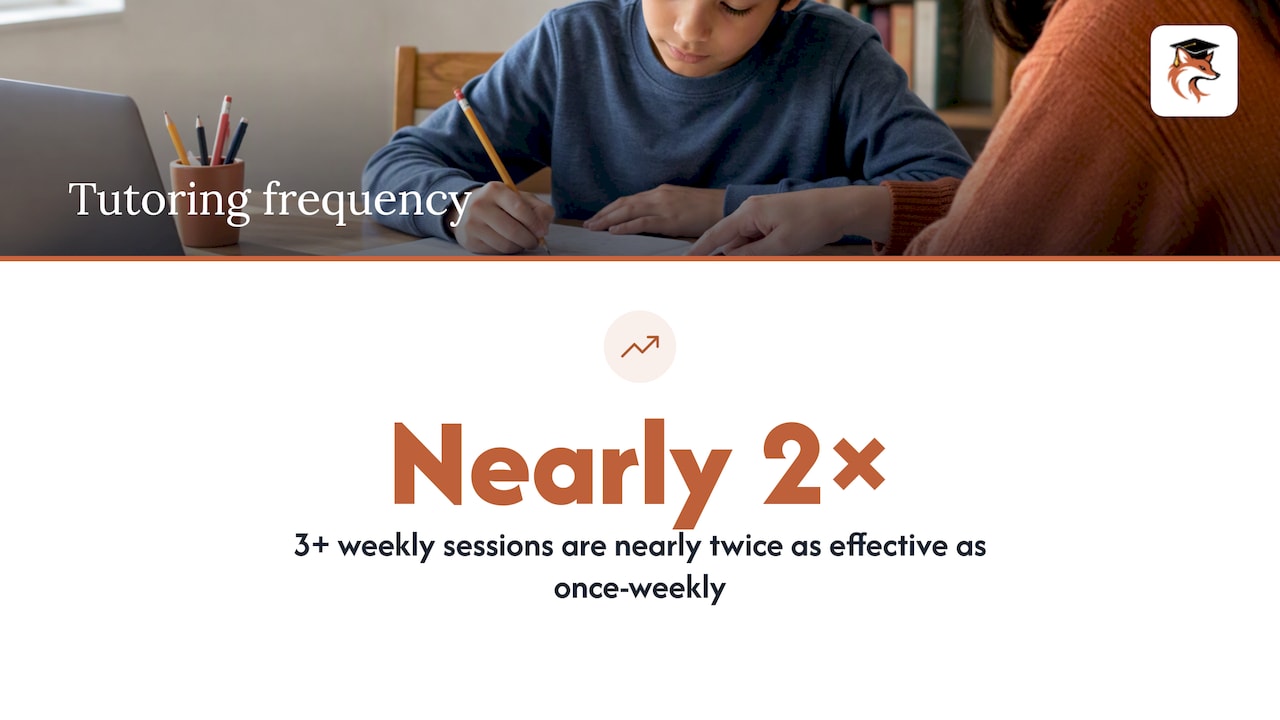
Sessions held three or more times per week are nearly twice as effective as once-a-week tutoring. That is why a weekly hour alone is often too slow for rapid catch-up.
A typical session follows a steady rhythm:
- A short warm-up that revisits last session’s skill.
- Targeted practice on the gap being rebuilt.
- New content taught in small steps.
- Applied problem solving, including word problems.
- A short practice task for between sessions.
Expect progress in stages. Focused skills, such as fraction operations, can improve within weeks. Deeper conceptual understanding takes months of steady practice. A fair question to ask any tutor is what progress should look like over time.
How do you choose a remedial math tutor?
Use this checklist when you compare tutors or programs:
- Verified qualifications or a university-level background.
- Experience with students who are behind, not only high achievers.
- A diagnostic assessment before teaching begins.
- Explicit alignment with your child’s school curriculum.
- Clear progress reports at a stated interval.
- Flexible session frequency.
- Transparent pricing and a trial or satisfaction policy.
Then put these questions to the tutor, in this order:
- How do you assess where my child is starting from?
- Can I see a sample learning plan?
- How many sessions per week do you recommend, and why?
- Which measures will show progress, and how often will you share them?
- What progress should we expect over time?
Check the contract basics too: whether a trial lesson is offered, how cancellations and make-up sessions work, how often you will receive reports, and what homework is expected between sessions.
Treat these as blockers: no assessment, no measurable goals, a one-size-fits-all plan, or reluctance to follow the school curriculum. Any one of them is reason enough to keep looking. For a parent-friendly overview of next steps, see our action plan for helping a child who struggles with math.
What does the research say about tutoring, dosage and effective practice?
The evidence supports the checklist above. A rapid evidence review of tutoring in Canada’s pandemic recovery found that high-dose tutoring, meaning several sessions per week, has a consistent and substantial positive impact on achievement. Factors linked to stronger outcomes include tutor training, formative assessment, curriculum alignment and session frequency.
Tutoring frequency is a primary driver of academic outcomes: sessions three or more times per week are nearly twice as effective as once-a-week models. (Stanford National Student Support Accelerator research brief)
Two other findings are worth knowing. Meta-analyses on math difficulties show that outcomes shift with grade level, tutor type and grouping, so a program should be matched to the student, not applied generically. Research on technology also suggests that tutoring and problem-solving systems tend to outperform computerised practice alone, though results vary. Online delivery looks promising but is not a guarantee on its own.
The practical takeaway: choose providers that start with a diagnostic, offer frequent sessions and report progress regularly.
Where can you find a tutor, and what should their profile look like?
You can look in several places. Online tutoring services give you the widest choice and let you schedule around school and activities, which is why many families use them for steady weekly sessions. Local in-person tutors suit students who need face-to-face accountability. Community groups and parent networks, including online tutoring groups, show how common both options are, though they rarely verify credentials for you.
Whichever route you take, look closely at the profile. A strong remedial tutor has a university-level background in math or education, experience with students who are behind, and a habit of explaining their method. Ask how they were trained and how they are supervised, since the evidence links tutor training to stronger outcomes. Also ask whether the tutor knows your province’s expectations: Quebec families can point to the Référentiel d’intervention en mathématique as a shared reference for evidence-based intervention.
Online tutoring also helps you stay informed. Our article on monitoring your child’s progress through online tutoring shows how.
How we design remedial math programs
We begin every program with a diagnostic, because a plan built on guesses wastes your child’s time. From the assessment we write a personalised learning plan, then monitor progress at each stage and adjust it. Our tutors are selected from the university level for academic strength and teaching ability.
Enrolment is straightforward. You register, we schedule a first session, and that session maps your child’s starting point. We recommend a schedule suited to your child’s needs, with progress monitoring so you can see what has been mastered. Our clients have shared positive feedback, and we have supported many students.
— Réussite A+
Program options and how to get started with Réussite A+
Remedial math tutoring is easier to start when you match your child’s need to the right program. Our Session régulière suits ongoing remediation through the school year. Our Session d’été offers concentrated catch-up during the break. Our exam preparation sessions target gaps that affect entrance and school exams, and our tutoring and homework help keeps skills practised between sessions.

Hourly rates run $30–35 for these sessions, with a one-off $65 registration fee, detailed on our pricing page. If your child is not satisfied after the first session, we refund it. Book your child’s diagnostic through our registration page and we will build the first plan with you.
FAQ
What is remedial teaching in mathematics?
Remedial teaching rebuilds the foundational skills a student is missing, in a planned order, starting from a diagnostic assessment. It differs from homework help because it targets the root gap rather than the current assignment. Research shows that tutoring aligned with the school curriculum works best.
How often should a student have remedial math tutoring?
Several sessions per week gives the strongest results. Three or more sessions per week are nearly twice as effective as one weekly session. If that is not possible, start with what you can sustain and add sessions as your schedule allows.
What are the best strategies for math?
Explicit teaching, worked examples, small-step practice and regular reviews of earlier skills are strong starting points. Visual aids and manipulatives help many students. A tutor should combine these and adjust them to your child’s gaps.
How long until you see progress?
Focused skills can improve within weeks, while deeper understanding takes months of regular practice. Ask the tutor what changes to expect over time, and check them against a written progress report.
Sources
- Nssa
- The Evidence for Tutoring to Accelerate Learning and Address Educational Inequities During Canada’s Pandemic Recovery
- A Meta‐Analysis of Empirical Research on Teaching Students with Mathematics Learning Difficulties – Dennis – 2016 – Learning Disabilities Research & Practice – Wiley Online Library