


Reading comprehension tutoring produces measurable gains in reading scores and comprehension accuracy, and it often builds a child’s confidence and willingness to tackle harder texts. These benefits show up most reliably when the tutoring includes explicit strategy instruction and enough session frequency to let skills stick. We see this pattern across randomized trials and in some online tutoring programmes.
TL;DR:
- Effective tutoring programs focus on explicit comprehension strategies, high session frequency, and addressing all five literacy areas: phonemic awareness, phonics, fluency, vocabulary, and comprehension.
- Gains are most reliably observed through benchmark tests, oral reading fluency, and comprehension accuracy, particularly with consistent, well-trained tutors and regular progress monitoring.
- Online small-group and one-on-one tutoring with about 20 minutes daily sessions have shown significant improvements in reading scores and comprehension for below-grade-level students.
- Most benefits are seen with students reading below grade level, multilingual learners, and those with fluency gaps unresponsive to classroom instruction, especially when combined with ongoing assessment.
- The quality of in-session instruction, clear progress measurement, and a baseline assessment are more critical than tutor personality or session frequency alone for meaningful reading improvements.
Table of Contents
- 1. Academic gains tutoring can realistically deliver
- 2. How tutoring builds confidence and motivation alongside skill
- 3. What the research says about tutoring and reading comprehension
- 4. What a tutoring session actually looks like week to week
- 5. Who tends to benefit most from reading comprehension tutoring
- 6. Réussite A+ perspective: aligning our programmes with the evidence
- What we think matters most in this conversation
- Ready to start? Here is what to expect from us
- FAQ
- Sources
1. Academic gains tutoring can realistically deliver
When tutoring works, it works because of what happens inside each session, not just the fact that extra time is being spent on reading. The strongest programs teach students specific comprehension strategies, model them explicitly, then give guided and independent practice with feedback. One large randomized trial found that structured tutoring focused on nonfiction comprehension strategies produced statistically significant improvements in comprehension outcomes among thousands of fourth graders.
A separate evaluation of an online small-group tutoring model found statistically significant improvements in elementary students’ reading scores compared with a control group, showing that structured virtual formats can produce real gains, not just in-person ones.
The instructional backbone behind these results usually touches what literacy researchers call the Big Five: phonemic awareness, phonics, fluency, vocabulary, and comprehension. A tutor who addresses all five, rather than drilling comprehension questions in isolation, tends to produce more durable progress.
For parents and teachers tracking whether tutoring is working, a few concrete indicators matter more than a general sense of “doing better”:
- Benchmark reading test scores, repeated every few months to show trend direction.
- Oral reading fluency, measured in words correct per minute against grade-level norms.
- Comprehension question accuracy, both literal and inferential, on short passages.
Gains vary with baseline skill level, how often sessions happen, how well-trained the tutor is, and whether the program is delivered with fidelity to its design. A child who starts well below grade level with an inconsistent tutor will not see the same curve as one in a structured, frequent programme.
2. How tutoring builds confidence and motivation alongside skill
Academic gains and confidence tend to move together, and the mechanism is fairly simple. A child who struggles in a classroom of thirty often avoids reading aloud or attempting harder texts because the risk of visible failure is high. One-on-one or small-group tutoring removes much of that risk: the pace is adjusted, mistakes are corrected privately, and small wins accumulate quickly.
Parents and teachers can watch for a few honest signals that this is happening:
- The child asks more questions about a text instead of skipping confusing parts.
- They attempt books or articles slightly above their usual comfort level.
- Homework involving reading gets started without the usual resistance.
Pro Tip: Ask your child to explain, in their own words, what a strategy like summarizing or predicting helped them notice in a recent reading assignment. If they can describe it, the strategy is transferring beyond the tutoring session.
Explicit strategy instruction is part of why this transfer happens. When a student learns to actively monitor their own understanding rather than passively decode words, that habit tends to carry into other subjects, from science readings to word problems in math. Confidence gains are real, but they work best as a companion to ongoing skill instruction, not a substitute for it. A motivated child who still lacks decoding or vocabulary skills will plateau without continued targeted teaching.
3. What the research says about tutoring and reading comprehension
The research base here is stronger than for many education interventions, largely because reading tutoring has been the subject of several large, carefully designed studies. A daily one-on-one volunteer tutoring program focused on the Big Five literacy elements produced gains for students below grade level, with sessions typically lasting about 20 minutes a day and continuing until students hit progress benchmarks.
| Study | Format and dosing | Reported outcome |
|---|---|---|
| Air Reading tutoring evaluation | Online small-group sessions | Statistically significant reading score gains versus control |
| Daily one-on-one volunteer tutoring | About 20 minutes daily, benchmark-driven | Gains for students below grade level |
| Structured nonfiction comprehension tutoring | Large-scale, fourth-grade sample | Significant comprehension improvements across a sample between 4,035 and 4,856 students |
The structured comprehension trial above involved a sample between 4,035 and 4,856 students, making it one of the larger controlled evaluations of reading tutoring to date. That scale matters: smaller studies can show promising results that do not hold up when tested broadly.
Across these trials, the features that correlated with stronger effects were consistent: adequate dose, trained tutors, and regular progress monitoring using short, validated checks rather than occasional informal observation. Translating this into practical guidance, short daily or near-daily sessions tend to outperform occasional long ones when the goal is accelerated catch-up. Effect sizes still vary by study and population, and most researchers caution that sustained instruction, not a single term of tutoring, is what produces lasting change.
4. What a tutoring session actually looks like week to week
Most reading tutoring falls into one of three formats: one-to-one, small groups of four or fewer, or virtual delivery that mirrors either model online. Each has trade-offs. One-to-one allows the fastest pace adjustment; small groups add peer modelling at a lower cost per student; virtual sessions remove travel time but depend on good shared-text tools and a well-trained tutor on the other end.
A well-run session typically follows a predictable arc:
- A brief diagnostic check or warm-up to see where the student is starting from that day.
- Explicit modelling of a comprehension strategy, such as summarizing or questioning.
- Guided practice where the tutor supports the student through the strategy.
- Independent practice with the tutor observing and ready to step in.
- Feedback on what worked and what to adjust.
- A short progress check logged against earlier benchmarks.
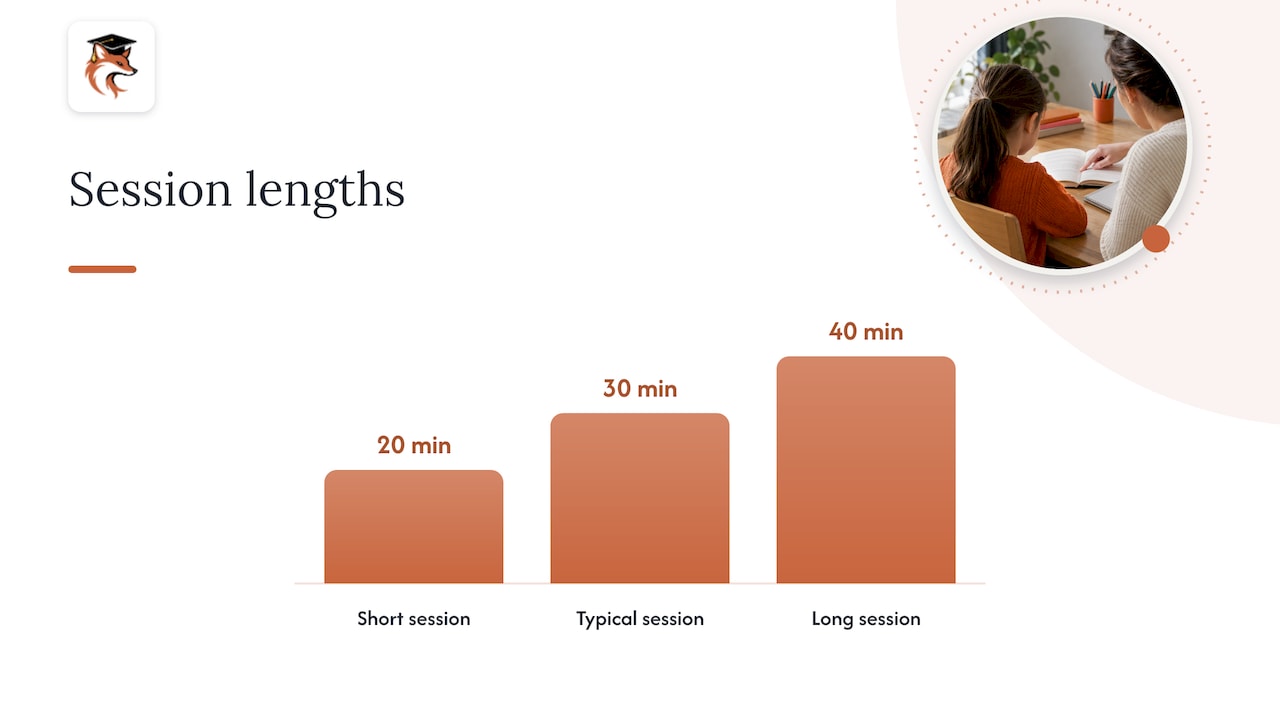
Dosing from the research ranges from about 20 to 40 minutes per session, with frequency from twice-weekly to daily for students aiming at faster catch-up. When sessions move online, look for digital progress tracking, shared text access, and tutors trained specifically for virtual delivery, since virtual tutoring programs with these features can produce gains comparable to in-person options.
5. Who tends to benefit most from reading comprehension tutoring
Tutoring tends to produce the clearest gains for students reading below grade level, those who have the vocabulary but have not yet learned to use comprehension strategies deliberately, multilingual learners building academic reading skills in a second language, and students with persistent fluency gaps that have not responded to classroom instruction alone.
A short checklist helps decide whether tutoring is the right next step:
- Recent benchmark or classroom assessment results show a gap versus grade expectations.
- The student is not responding fully to classroom-level interventions already in place.
- The student shows willingness to engage, even if frustrated with current reading tasks.
When gaps are severe or tied to a suspected learning difference, a specialist assessment alongside tutoring, rather than tutoring alone, is usually the better starting point.
6. Réussite A+ perspective: aligning our programmes with the evidence
With many years in education, we build each programme around a diagnostic baseline, explicit strategy instruction, and measurable benchmarks, the same components that show up across the strongest tutoring research. Parents can choose different types of sessions depending on the goal.
What we think matters most in this conversation
The evidence on reading tutoring is more convincing than most parents realize, but a lot of advice on the topic treats “more tutoring” as automatically better. It is not. Frequency and dose matter, but the real driver in the strongest trials was always the quality of instruction inside each session: explicit strategy teaching, guided practice, and tight feedback loops.
Conventional advice tends to focus heavily on finding a tutor who is “a good fit personality-wise,” which matters less than whether that tutor can explain and model a comprehension strategy, then check whether it transferred. We would rather see parents ask a prospective tutor how they measure progress than ask how many years they have been tutoring.
If there is one thing to prioritize first, it is this: ask for a baseline assessment before the first paid session and a short, repeatable way to check progress every few weeks. Without that, you are guessing whether sessions are working, no matter how good they feel.
— Réussite A+
Ready to start? Here is what to expect from us
If you are weighing whether to book a session, start with a conversation about where your child currently stands and what a realistic timeline for progress looks like. We build every plan around a diagnostic baseline, then track progress against benchmarks so you can see concrete movement, not just a sense that things feel better.
A few practical next steps:
- Book a session régulière for ongoing weekly support, or explore exam preparation if a secondary entrance exam is coming up.
- Ask about our homework help and tutoring options if your child needs flexible, lighter-touch support.
- Confirm tutor training, how progress will be measured, and what happens if the first session is not a good fit before committing.
Whatever provider you choose, confirm those three things. They are the difference between tutoring that produces real gains and tutoring that simply feels productive.
FAQ
Can a tutor help with reading comprehension?
Yes, a tutor can meaningfully improve reading comprehension, particularly when sessions include explicit strategy instruction rather than general reading practice alone. Randomized trials on structured tutoring programs have shown statistically significant gains in comprehension outcomes for elementary students.
What is Vygotsky’s theory of reading comprehension?
Vygotsky’s broader learning theory centres on the idea that students learn best with guided support just above their current ability level, often called the zone of proximal development. In reading tutoring, this looks like a tutor modelling a strategy, then gradually handing responsibility to the student as skill develops.
Is reading comprehension a skill or talent?
Reading comprehension is best understood as a learnable skill built from specific strategies, such as summarizing, questioning, and monitoring one’s own understanding. University-based guidance on teaching active reading strategies emphasizes that explicit instruction develops these skills rather than relying on innate ability.
What are the benefits of tutoring?
The main benefits are measurable academic gains, such as improved reading scores and comprehension accuracy, alongside confidence and motivation improvements that come from scaffolded, low-risk practice. We design our programmes, including session régulière and exam preparation options, around both of these outcomes with ongoing progress monitoring.
Sources
- Study: Air Reading (WWC/IES)
- Study on daily one-on-one volunteer tutoring (WWC/IES)
- Large-scale RCT on structured tutoring for nonfiction comprehension (WWC/IES)