




Writing tutoring delivers reliable academic and personal gains: better-organized writing, higher assignment marks and greater confidence in students who once dreaded a blank page. These outcomes are not guesswork. University research on strategy-based instruction backs them up, and we apply these research-informed methods every day with students across grade levels. Below, we unpack the evidence and show you exactly what to look for.
TL;DR:
- Significant improvements in writing quality, organization, and grades are most evident after weeks of consistent, personalized strategy-based tutoring.
- One-on-one instruction is particularly effective for struggling students, as it allows real-time correction and tailored support for individual gaps.
- Building confidence and reducing anxiety develop gradually through small successes in goal setting, self-monitoring, and achieving mastery.
- Strategies like SRSD teach repeatable processes that transfer across subjects and long-term writing tasks, enhancing overall academic and professional skills.
- Sustained tutoring sessions, often around 36 hours, are necessary to produce meaningful, observable improvements in student writing.
Table of Contents
- Academic benefits: measurable gains in writing quality, productivity and grades
- Cognitive and personal benefits: confidence, reduced anxiety and stronger motivation
- What effective writing tutoring actually teaches: SRSD and practical processes
- Who benefits most and which formats work best
- Key studies and what they mean for parents and teachers
- Impact of writing tutoring on standardized testing performance
- Long-term benefits and transferability of skills
- Role of personalized feedback and goal setting
- How writing tutoring supports college and career readiness
- Réussite A+ perspective: applying research in practice
- If you want help today: Réussite A+ services and next steps
- FAQ
- Sources
Academic benefits: measurable gains in writing quality, productivity and grades
When a student receives one-on-one, strategy-based writing instruction, the gains show up where it counts: in the writing itself. Research on self-regulated strategy development shows that Grade 1 students who received this kind of targeted instruction produced large gains in text quality, word count and story features compared with peers in regular classroom instruction alone. That is not a minor bump. It reflects a different way of learning to write: one built around explicit steps rather than general encouragement to “write more” or “try harder.”
One-on-one instruction tends to outperform classroom-only teaching for struggling writers because a tutor can watch exactly where a student gets stuck, whether that is organizing ideas, choosing precise words or sustaining an argument, and adjust the lesson in real time. A classroom teacher managing 25 students simply cannot offer that kind of moment-to-moment correction.
Parents and teachers usually notice the shift before a report card confirms it:
- A clearer thesis or main idea stated in the opening lines rather than buried in the middle.
- Paragraphs that stay on one idea instead of drifting into three.
- Richer supporting detail instead of repeated, vague statements.
- Fewer abandoned drafts and more finished assignments handed in on time.
For a deeper look at how individualized tutoring moves the needle on text quality and organization for students in Grades 1 through 8, our Evidence First for Parents page walks through the mechanics in plain language.
Cognitive and personal benefits: confidence, reduced anxiety and stronger motivation
Grades matter, but the quieter shift, the one that often matters more long-term, is how a student feels about writing. Research on remedial literacy programs found that when feedback supports a student’s sense of control rather than imposing it, intrinsic motivation and literacy engagement improve, particularly for children who had been struggling. The mechanism is straightforward: a tutor who offers choices, sets small achievable goals and gives feedback that explains rather than judges helps a student build mastery experiences one assignment at a time.
That steady accumulation of small wins is what eventually erodes writing anxiety. A student who has revised three paragraphs successfully with guidance starts to believe the fourth one is possible too.
Watch for these practical signs that confidence is building:
- Less procrastination before starting an assignment.
- Faster, calmer revisions instead of refusing to touch a finished draft.
- A willingness to attempt a first draft without demanding perfection immediately.
Pro Tip: Ask your child to read one paragraph out loud before submitting. If they can explain why they wrote it that way, the strategy has taken hold, not just the content.
Our page on how tutoring raises grades and confidence together explores this link in more detail.
What effective writing tutoring actually teaches: SRSD and practical processes
The strongest results in writing instruction come from a specific approach called self-regulated strategy development, or SRSD. It is not a single trick. It is a sequence of teachable habits that a tutor builds over several sessions:
- Goal-setting: the student and tutor agree on a specific, visible target for the piece of writing, such as including three pieces of evidence in a paragraph.
- Strategy steps: the tutor teaches a memorable sequence (often a mnemonic) for planning, drafting and checking work, broken into manageable stages.
- Modelling through think-aloud: the tutor demonstrates the thinking process out loud, showing how a skilled writer makes decisions, not just what the finished sentence looks like.
- Scaffolded practice: the student tries the strategy with support, which fades gradually as independence grows.
- Self-monitoring: the student learns to check their own work against the strategy steps rather than waiting for someone else to catch errors.
- Self-reinforcement: the student recognizes their own progress, which is what makes the skill stick after the tutoring session ends.
This is a fundamentally different process from one-off editing or proofreading, where someone else simply fixes mistakes. Strategy instruction teaches the student to catch and correct their own mistakes next time, which is why the gains tend to transfer across different writing genres and assignments.
Who benefits most and which formats work best
The research points to a few groups who see the largest gains: early-grade students building foundational skills, English-language learners developing academic vocabulary, students with learning exceptionalities who need explicit structure, and busy students juggling school with other responsibilities.
- One-on-one tutoring suits students who need the lesson paced entirely around their own gaps, especially younger learners or those with exceptionalities.
- Group tutorials work well for students who benefit from hearing peers’ questions and seeing multiple examples of the same strategy applied differently.
- Students balancing work, extracurriculars or family responsibilities see a particular benefit from scheduled group tutorials, since the structure itself helps them stay on track.
- For most families, the deciding factor is less about age and more about how much individual correction the student currently needs.
Key studies and what they mean for parents and teachers
The evidence behind these benefits comes from several Canadian university studies, each looking at a different population and format.
The SRSD research out of Western Ontario focused on Grade 1 students and found that individualized strategy instruction produced large gains in text quality and self-regulation knowledge compared to standard classroom teaching. The practical implication: younger students can build strong writing habits early, before poor habits set in.
Students who attended group writing tutorials had fewer low grades on assignments, and students juggling work or family responsibilities who skipped tutorials had double the odds of poor performance compared to those who attended.
University of Alberta, group writing tutorials study
One study found that postsecondary English-language learners gained a notable improvement in writing performance after sustained targeted strategy instruction over several weeks, alongside reduced writing anxiety. That timeline matters: meaningful change took sustained instruction, not a single session.
These are strong findings, but they come from specific populations and timeframes. Expecting dramatic change after one or two sessions sets families up for disappointment; the research points to weeks of consistent, structured practice.
Impact of writing tutoring on standardized testing performance
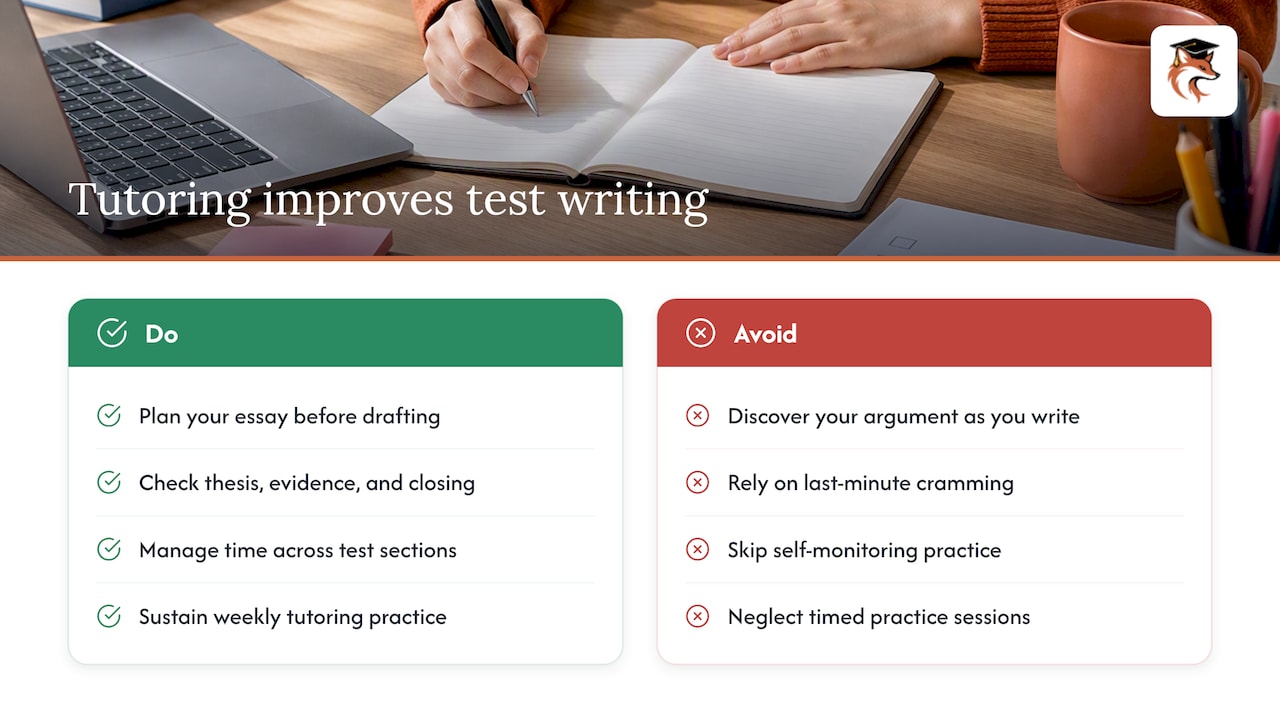
Standardized tests, including provincial exams and secondary school entrance examinations, often weigh heavily on a student’s ability to organize an argument quickly and support it with clear evidence under time pressure. These are exactly the skills that strategy-based writing instruction targets directly: planning before drafting, checking work against a clear structure and managing time across sections of a response.
Students who have internalized a strategy for planning an essay before writing it tend to produce more coherent, complete responses within a fixed time limit, since they are not discovering their argument as they write. This matters most on timed writing portions of standardized assessments, where disorganized first attempts rarely get revised properly before time runs out.
The same self-monitoring habits taught through SRSD, checking for a clear thesis, sufficient evidence and a logical closing, translate directly into exam strategy. A student who has practised catching these gaps in regular tutoring sessions is more likely to catch them again under test conditions, even without a tutor present.
For families preparing for secondary school entrance exams specifically, this transfer of skill from weekly tutoring into test-day performance is one of the clearest practical payoffs of sustained writing instruction, rather than last-minute cramming the week before an exam.
Long-term benefits and transferability of skills
The real test of writing tutoring is not next week’s assignment. It is whether a student can apply the same planning and revision habits to a lab report in Grade 9, a history essay in Grade 11 and a cover letter years later without a tutor standing by.
Strategy instruction is designed for exactly this kind of transfer. Because SRSD teaches a repeatable process rather than fixing errors in a single piece of writing, students carry the steps, goal-setting, planning, drafting, checking, into new subjects and formats. A student who learns to organize a persuasive paragraph in English class can usually apply the same structure to a science argument or a social studies response, since the underlying skill is reasoning and sequencing, not subject content.

This is also why strategy-focused instruction tends to outperform simple proofreading services over time: proofreading fixes today’s draft, while strategy instruction changes how a student approaches every future draft. The research on postsecondary English-language learners reinforces this, since gains in performance accompanied a genuine shift in how students approached writing tasks, not just a one-time score improvement on a single assignment.
Role of personalized feedback and goal setting
Generic feedback like “add more detail” rarely changes behaviour because it does not tell a student what to do differently next time. Effective tutoring replaces vague comments with specific, actionable goals tied to the student’s actual draft: write a topic sentence that names the argument, add one piece of evidence per paragraph, or cut a repeated phrase.
Goal setting works because it gives students something concrete to check their own work against, rather than waiting for someone else’s judgment. Research into remedial literacy support found that feedback framed around choice and attainable goals, rather than control, improved both motivation and engagement for students who had previously struggled.
Personalized feedback also respects that no two students make the same mistakes. A tutor working one-on-one can target the exact gap, whether that is weak transitions, thin evidence or unclear topic sentences, instead of delivering a one-size-fits-all comment sheet. Over several sessions, the goals shift as the student masters each skill, which keeps the instruction matched to where the student actually is rather than where a generic curriculum assumes they should be.
How writing tutoring supports college and career readiness
Writing well under deadline pressure, organizing complex information and revising based on feedback are not skills unique to school assignments. They carry directly into postsecondary applications, coursework and eventually the workplace, where clear written communication remains a baseline expectation in nearly every field.
Students who develop strong self-regulation habits through tutoring, planning before writing, checking their own work, revising based on specific goals, arrive at college or university already equipped for the heavier writing load that postsecondary programs demand. The same habits support application essays, scholarship submissions and the sustained research papers that first-year courses often require with little hand-holding.
Beyond school, these habits apply to reports, proposals and professional correspondence. An employee who can organize an argument clearly, support it with evidence and revise based on feedback has an advantage regardless of field, since that process rarely stops being relevant once formal schooling ends.
Réussite A+ perspective: applying research in practice
We build our tutoring sessions around the same strategy-based framework the research supports: clear goals, explicit modelling and ongoing progress monitoring rather than one-off corrections. In the first few sessions, families can expect clearer goal-setting and a visible starting point for measuring progress, not instant mastery.
— Réussite A+
If you want help today: Réussite A+ services and next steps

If your child needs ongoing writing support, our session régulière offers weekly, personalized sessions built around your child’s specific gaps. Families preparing for secondary school entrance exams or other high-stakes tests can book exam-prep sessions through our preparation aux examens scolaires page, and students who need a flexible summer refresher can start with our session d’été. To get started, have a recent writing sample ready so we can build a learning plan around your child’s actual needs from the first session.
FAQ
What is the 2/3-1 rule in writing?
Definitions of this rule vary across teaching contexts, and it is not a standardized or universally recognized framework in the research we reference here. Rather than guess at a specific version, we recommend asking your child’s teacher or tutor which structure they use, since terminology differs between schools and programs.
What are the 5 benefits of writing instruction?
Strategy-based writing instruction tends to improve text quality and organization, build self-regulation skills, raise assignment grades, reduce writing-related anxiety and strengthen a student’s confidence in starting and finishing drafts independently. These gains are documented across early-grade SRSD research and postsecondary strategy-instruction studies alike.
What are the benefits of using tutoring for writing specifically?
Writing tutoring gives students individualized correction they cannot get in a full classroom, targeting their exact gaps in organization, evidence or self-monitoring. Group tutorial attendance has also been linked to fewer low grades on assignments, especially for students balancing outside responsibilities.
What are the general benefits of tutoring beyond writing?
Tutoring in any subject typically improves grades, builds study habits and reduces the anxiety that comes from falling behind in class. For writing specifically, the added benefit is a repeatable strategy students carry into every future assignment, not just the one they are working on with a tutor.
How long does it take to see results from writing tutoring?
Meaningful gains generally require sustained instruction rather than a single session. One study found measurable improvement in postsecondary learners after roughly 36 hours of targeted instruction, so families should expect weeks of consistent sessions before significant change appears.
Sources
- Self-regulation in early writing strategy instruction (SRSD study) — University of Western Ontario
- Group writing tutorials: Do they improve student writing? — University of Alberta
- Strategy-focused writing interventions for EAL students — University of Toronto