



The most effective immediate step is booking a diagnostic tutoring session that follows your child’s exact Quebec grade, cycle and immersion framework, not a generic French review. A good diagnostic session reveals whether the gap is comprehension, vocabulary or writing structure before anyone touches a worksheet. We recommend starting there, and before you call a tutor, ask your child to explain the assignment in their own words first.
TL;DR:
- A diagnostic session should confirm whether your child’s main issues lie in comprehension, vocabulary, or writing structure before any worksheet work begins.
- Tutors must understand Quebec’s specific curriculum frameworks, especially the difference between French as instruction and immersion evaluation criteria, to provide relevant support.
- Active at-home strategies like summarizing, explaining reasoning aloud, and verifying understanding greatly enhance the effectiveness of paid tutoring sessions.
- Asking for a session plan, explaining progress reporting methods, and confirming curriculum alignment are critical steps before hiring a tutor or service.
- Focus on diagnosing specific gaps first, as early assessment ensures targeted support and avoids wasting time on ineffective generic lessons.
Table of Contents
- 1. What quality French-immersion homework support looks like in Quebec
- 2. How to choose a tutor or paid homework service that fits your immersion student
- 3. At-home strategies and study methods that make paid sessions more effective
- 4. Quick hiring checklist and exact questions to ask a prospective tutor
- 5. Réussite A+ perspective: why diagnosis-first, curriculum-aligned tutoring works
- 6. How Réussite A+ can help: services and how to get started
- FAQ
- Sources
1. What quality French-immersion homework support looks like in Quebec
Quebec’s curriculum builds French ability around three competencies: oral communication, reading varied texts, and writing varied texts, with real emphasis on making meaning rather than memorizing rules. The ministerial evaluation frameworks treat French as a language of instruction differently from French as a second language or immersion track, so a tutor needs to know which framework applies to your child, not just that French is the subject.
A well-structured session follows a clear sequence:
- A short diagnostic to find out exactly where understanding breaks down
- Modelling, where the tutor shows how to approach the task
- Guided practice, where your child tries it with support nearby
- A comprehension check to confirm the concept stuck
- A brief progress note you can read afterward
Primary and secondary students need different things from this structure. A grade 3 student usually needs discussion-based reading support: talking about characters, predicting what happens next, retelling a story in their own words. A secondary student juggling five subjects needs planning help as much as subject help: breaking a project into steps, tracking deadlines, prioritizing what’s due first.
Pro Tip: Before your first session, ask the tutor to request a sample of your child’s recent schoolwork so the plan matches what the teacher is actually assigning.
When you’re vetting anyone, paid tutor or homework service, ask directly whether they’ll align with your school’s materials and evaluation approach. A tutor who sticks to a generic French curriculum instead of your child’s actual cycle wastes time on the wrong material.

2. How to choose a tutor or paid homework service that fits your immersion student
Not every French tutor is the right fit for an immersion student, and the selection process matters more than most parents expect.
- Confirm the grade and cycle match. Ask whether the tutor regularly works with your child’s specific cycle, since primary cycle 1 needs differ enormously from secondary cycle 2.
- Check familiarity with Quebec frameworks. A tutor should know the difference between French as language of instruction and French immersion evaluation criteria, as described in the provincial evaluation frameworks.
- Ask for a sample session plan. A tutor who can’t describe how a first session would run probably doesn’t have a structured approach.
- Ask how they diagnose needs. Quebec’s own intervention referentials describe diagnosing before intervening, a sequence worth asking about directly.
- Request progress-monitoring details. Will you get written notes, a periodic summary, or nothing beyond “it went well”?
Pro Tip: Treat the first session as a trial. A tutor confident in their methods will welcome a single diagnostic session before you commit to a package.
Watch for red flags: vague answers about curriculum alignment, no mention of your child’s grade or cycle, or a plan that sounds identical regardless of the student. On budget and scheduling, Quebec families often benefit from flexible online sessions that fit around extracurriculars, since French immersion homework tends to arrive in uneven bursts rather than a steady trickle.
3. At-home strategies and study methods that make paid sessions more effective
Paid sessions work better when the time between them isn’t wasted. Statistics Canada’s analysis of PISA results identifies three control strategies linked to meaningfully better outcomes: checking whether the main points were retained, identifying which concepts remain unclear, and actively verifying comprehension rather than assuming it.
Using at least two of these three strategies together was associated with score increases of a substantial amount on the PISA scale, according to Statistics Canada’s PISA analysis, a gap far larger than simply adding more study hours without a strategy behind them.
For reading, this looks like asking your child to summarize a chapter aloud, predict what happens next, or explain why a character made a choice, across the varied text types Quebec’s program expects students to handle. For math, it means asking your child to explain their reasoning out loud rather than checking only the final answer, since reasoning gaps are usually where the real problem hides.
A few home routines support this without turning into another homework battle:
- A quiet, consistent workspace free of phone notifications
- Short, focused blocks of 20 to 30 minutes rather than one long session
- A visible agenda or planner for secondary students juggling multiple subjects
- A standing rule that the tutor diagnoses the gap before assigning more practice
The goal between paid sessions isn’t more homework. It’s using the same comprehension-checking habits a good tutor models.
4. Quick hiring checklist and exact questions to ask a prospective tutor
Use this before your first call or message with a prospective tutor:
- Confirm the grade and cycle match your child’s current year.
- Confirm curriculum alignment with your child’s school materials.
- Request a sample session plan in writing.
- Ask how progress will be reported and how often.
- Clarify cancellation terms and hourly fees upfront.
- Ask for a single trial diagnostic session before committing to a package.
Four questions worth asking directly: “How will you diagnose my child’s needs?” “Which Quebec curriculum documents or school materials will you use?” “How do you measure and report progress?” “Will you keep my child doing the work, or will you solve it for them?” That last question matters most: Alloprof’s guidance on homework autonomy warns that the most common failure in paid homework help is an adult quietly doing the task instead of guiding the student through it.
Our recommendation: book one diagnostic session, get a written plan out of it, then decide on a package.
5. Réussite A+ perspective: why diagnosis-first, curriculum-aligned tutoring works
We built our approach around a simple observation: a tutoring hour spent on the wrong gap is wasted, no matter how skilled the tutor is. We start every student with a diagnostic rather than a generic lesson plan, because immersion students rarely struggle with “French” as a whole. They struggle with one specific competency, oral communication, reading comprehension or written structure, and the fix only works once that gap is named correctly.
We track progress session by session rather than leaving families to guess, which helps support strong outcomes for students preparing for Quebec secondary entrance exams.
— Réussite A+
6. How Réussite A+ can help: services and how to get started
If your child needs regular support that actually follows Quebec’s curriculum rather than a generic French program, our Tutorat et aide aux devoirs sessions are built around that diagnostic-first approach, with a tutor matched to your child’s grade, cycle and immersion stream.
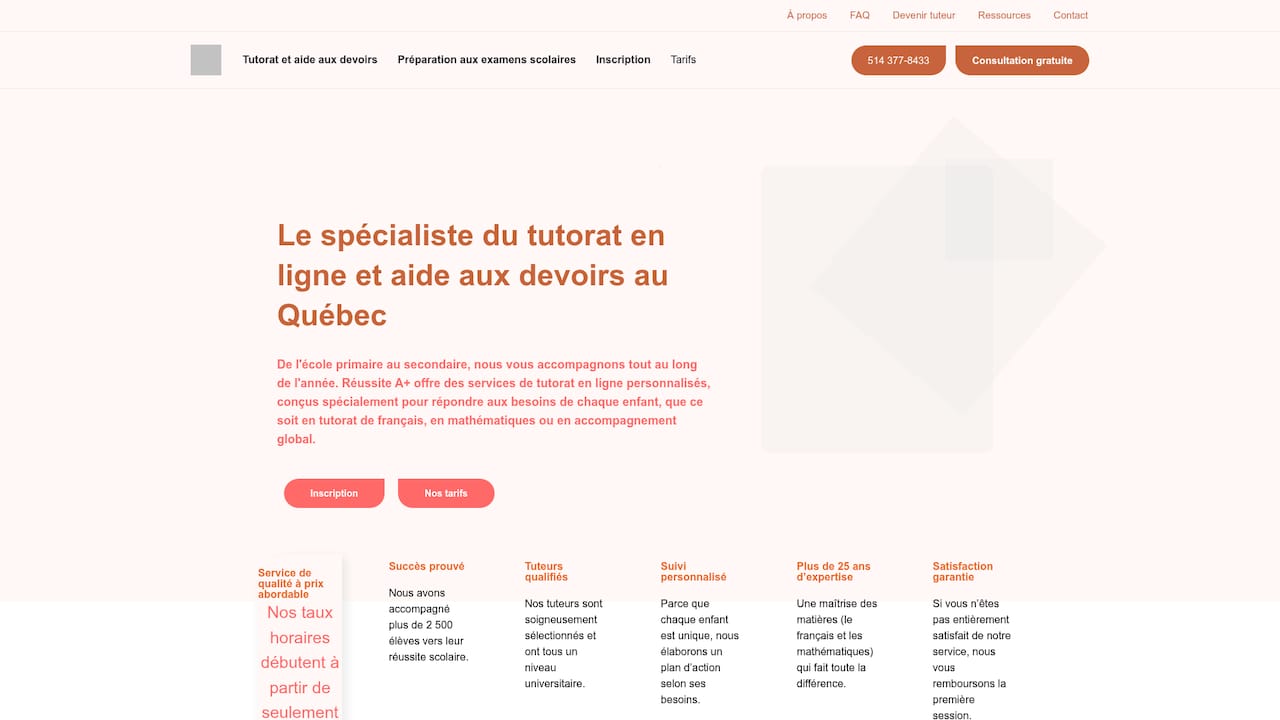
Depending on what your family needs right now, a few paths fit:
- Session régulière for ongoing weekly support throughout the school year
- Programmes de tutorat en français for immersion students who need dedicated French-specific coaching
- Session de préparation aux examens d’entrée au secondaire for families preparing for secondary entrance exams
- Session d’été for catching up or staying sharp over the summer
Sessions come with progress reports so you can see what’s improving, and scheduling stays flexible around your family’s week. If a first session isn’t the right fit, we offer a refund, which makes the trial diagnostic a low-risk way to start. Visit our aide aux devoirs page to book a diagnostic session and get a written plan before committing to anything further.
FAQ
How much does French immersion tutoring cost in Quebec?
Paid tutoring sessions in Quebec, including homework help and French-specific tutoring, commonly run $30 to $35 per hour, with a one-time registration fee of $65 for regular and exam-prep programs. Exact pricing varies by provider and package, so confirm the rate before booking.
Should I help my child with their French immersion homework myself?
A limited, guiding role works best: ask your child to explain the task first, confirm they understand what’s being asked, then step back rather than completing it for them. Alloprof’s parent guidance recommends this approach specifically to preserve student autonomy, especially as secondary students take on more planning responsibility.
What should a first tutoring session include?
A strong first session is diagnostic, identifying exactly where comprehension breaks down, before any new material gets introduced. Ask the tutor what their diagnostic process looks like and request a written plan afterward so you can see what they found and how they intend to address it.
Which study strategies actually help with French immersion schoolwork?
Checking retention of main points, identifying unclear concepts, and verifying comprehension are the three strategies Statistics Canada’s PISA analysis links to meaningfully better outcomes, more so than simply increasing study hours. Using at least two of these together produced the strongest results in that analysis.
How do I know if a tutor understands Quebec’s curriculum?
Ask directly which evaluation framework they use and whether they distinguish French as language of instruction from French immersion criteria, since Quebec’s ministerial frameworks treat these differently. A tutor who can’t answer specifically, or gives a generic answer about “teaching French,” likely isn’t working from your child’s actual program.
Sources
- Ministerial evaluation frameworks — Government of Québec
- Homework: encouraging your child to become autonomous — Alloprof
- Study methods and time: PISA analysis — Statistics Canada