



Quebec uses competency based grading: each subject is broken into discrete competencies, and three report card stages, usually weighted 20%, 20% and 60%, combine to form your child’s final mark. Focus first on the competency scores and the teacher’s written comments, not just the overall percentage. Those two pieces tell you where your child stands right now and where the term is heading.
TL;DR:
- Competency-based grading breaks down subjects into specific skills, with each competency assessed separately rather than averaging a single overall percentage.
- The final subject mark is a weighted combination of disciplinary competencies, typically with the most weight on the last report card stage, often 60%.
- Ministerial exams in Secondary 4 and 5 can replace a weaker school mark if the exam score is higher, and both are weighted equally at 50%.
- Inconsistent application of weightings and evaluation standards across schools can make comparisons and interpretations of report cards challenging.
- To improve a child’s competencies, targeted tutoring focusing on specific skills, with measurable goals, is recommended over general review.
Table of Contents
- What competency based grading means in Quebec
- What’s on a Quebec report card
- How ministerial exams and moderation change final results
- How to read the report card and act on it
- How targeted tutoring maps to report card competencies
- Why Quebec moved to competency based grading
- Competency grading versus traditional grading
- How competency grading affects motivation and learning
- Common criticisms of competency based grading in Quebec
- The teacher’s role in competency based assessment
- How competency based grades are read for post-secondary admissions
- A tutor’s perspective on reading the report card
- How Réussite A+ supports competency-focused progress
- Where to check the official rules yourself
- Sources
- FAQ
What competency based grading means in Quebec
In the Québec Education Program, a competency is a specific, observable skill: your child’s ability to read and interpret a text, solve a mathematical problem, or communicate an idea clearly in writing. Rather than a single number for “French” or “math,” the report card breaks each subject into two or three competencies, each assessed on its own.
This is different from a subject percentage in a traditional system, where one grade sums up everything. A competency result tells you specifically which skill needs attention. Your child might be strong in reading comprehension, but weaker in written production, and a single French mark would hide that difference. Competency lines do not.
Quebec’s curriculum separates two kinds of competencies:
- Disciplinary competencies, tied to a specific subject, such as “to read and listen to literary and non-literary texts” or “to solve a situational problem” in math.
- Transversal competencies, broader skills like critical judgment, cooperation or the use of information, which cut across all subjects.
Alloprof’s guidance for parents notes that transversal competencies are evaluated differently from school to school and generally do not affect diploma credits. They matter for your child’s overall development, but a soft mark there is rarely the thing to worry about before an exam period. Save your attention for the disciplinary competencies tied to the subjects your child is being marked and, eventually, tested on.
What’s on a Quebec report card
A typical secondary report card lists several distinct pieces of information, and knowing what each one means saves you from misreading the page. You will usually see:
- Competency lines, one per disciplinary competency, each with its own result.
- An overall subject mark, a weighted combination of the competencies for that subject.
- The group average, showing how the class performed on the same evaluations.
- Teacher comments, which explain effort, behaviour or specific gaps that numbers alone will not show.
- Credits, at the secondary level, tracking progress toward the required total for graduation.
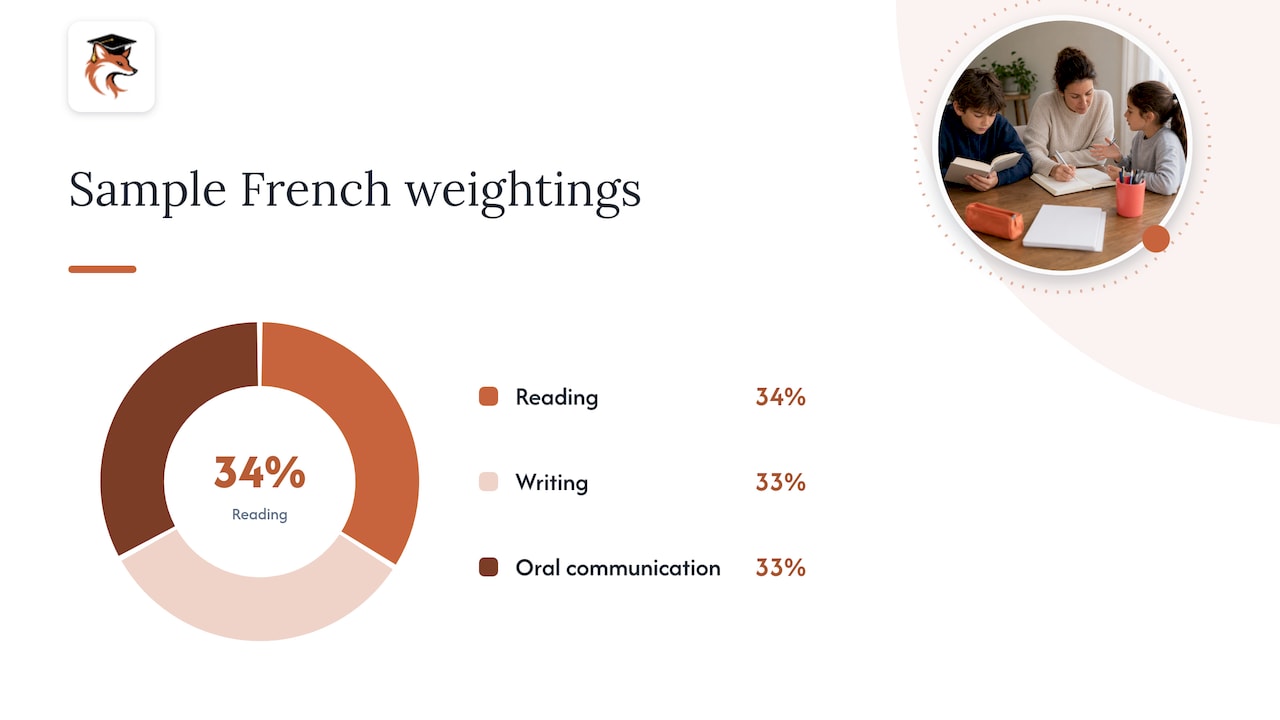
Weightings vary by school board and subject, but the ministry publishes sample breakdowns. In some secondary French examples, reading counts for 34%, writing for 33% and oral communication for 33% of the final subject mark. Math, science and English typically follow a similar logic, with two or three competencies each carrying a defined share.
The ministry’s own weighting tables are the definitive reference for how a subject mark is built. Quebec’s sample libellés and pondérations show exactly how much weight each competency carries, which lets you calculate how a soft result in one area will pull down the whole subject.
Younger grades sometimes use a 1 to 4 scale instead of a percentage, where each number corresponds to a level of competency achievement rather than a raw score. A 3 generally means the student meets grade-level expectations, while a 4 signals work beyond that standard. As children move into secondary school, these scales are converted into percentages, but the underlying logic, measuring a defined skill rather than a vague overall impression, stays the same.
How ministerial exams and moderation change final results
For students in Secondary 4 and 5, some subjects end the year with a ministerial exam, and the process for combining that mark with the school year’s work is worth understanding before results arrive. These exams generally run in May and June, with additional sessions in January and August for some subjects, most often to accommodate students who need to retake a course.
For subjects with a ministerial exam, the final result is calculated by combining the moderated school mark and the exam mark, each worth 50%. If the ministerial exam mark is higher than the moderated school mark, the exam mark becomes the final result instead. This means a strong exam performance can lift a shakier term average, which is worth knowing if your child had a rough patch mid-year.
A few practical points follow from this:
- The passing threshold across Quebec is 60%.
- Moderation adjusts school marks statistically so that results are comparable across different schools and teachers.
- Parents should expect some movement in the school mark once moderation is applied, even if the classroom grade seemed final.
Our study guide to ministerial exams breaks down how to plan study time around these dates.
How to read the report card and act on it
Reading a Quebec report card well means resisting the urge to jump straight to the bottom-line percentage. Alloprof’s advice to parents is to treat the report card as a snapshot, a signal for where to focus, not a verdict on your child’s ability.
- Scan the competency lines first. Look for a competency that dropped from the previous stage, or one sitting well below the others in the same subject.
- Read the teacher’s comments next. They often explain a dip in terms a number cannot, such as missed homework, difficulty with a specific type of question, or inconsistent participation.
- Compare against the group average. A mark below your child’s usual level but close to the class average suggests the material itself was hard for most students, not just your child.
- Set two or three specific goals, tied to the weakest competencies, rather than a vague resolution to “do better in math.”
When you meet with a teacher, ask direct questions: which evaluation criteria applied to this competency, whether a re-evaluation opportunity exists, and what a realistic intervention plan looks like over the next few weeks.
Pro Tip: Bring the report card and a highlighter to the meeting: mark the two lowest competency results before you sit down, so the conversation stays focused rather than general.
If the same competency shows up weak across two consecutive stages, that is usually the point to arrange targeted tutoring or a diagnostic assessment rather than waiting for the final report.

How targeted tutoring maps to report card competencies
A diagnostic session identifies the exact competency behind a weak report card line, whether that is “producing a written text” or “interpreting a situational problem” in math, so the plan that follows is not a generic review but work aimed at one skill. A focused plan over six to eight weeks, paired with the classroom’s own evaluation criteria, tends to produce a visible shift by the next reporting stage.
The tutoring provider described has experience working with many students across Quebec, drawing on extensive experience and tutors selected at the university level.
- Sessions begin with a short diagnostic tied to the child’s actual report card competencies.
- Tutors report progress at a cadence parents can follow, alongside the school’s own three-stage schedule.
- Goals are measurable: a specific competency, not a general subject.
Pro Tip: Ask any tutoring provider which competency the plan targets and how they will measure movement by the next report card stage, not just whether grades “improve.”
Why Quebec moved to competency based grading
Quebec’s shift toward competency based grading traces back to the Québec Education Program reforms of the early 2000s, when the ministry moved away from a model built mainly around memorization and toward one built around demonstrated skills. The reasoning was straightforward: a percentage on a single test says little about whether a student can actually read critically, write clearly or reason through a problem they have not seen before.
Breaking subjects into competencies was meant to give teachers, parents and students a clearer picture of strengths and gaps, rather than one blended number that could hide either. It also aligned Quebec with a broader movement in education systems internationally toward outcomes-based assessment, where the goal is to confirm mastery of specific skills before a student moves forward.
The transversal competencies were added to reflect skills, like cooperation, critical judgment and the use of information, that matter well beyond any single subject and that employers and post-secondary programs increasingly value. Two decades later, the system remains a mix of the old and new: subject marks still exist, ministerial exams still anchor Secondary 4 and 5 results, but the underlying architecture is built on competencies rather than raw test scores.
Competency grading versus traditional grading
The clearest difference between competency based grading and a traditional percentage system is what the number is meant to represent. A traditional grade often blends a test score, homework completion and participation into one figure, which can obscure whether a student actually understands the material. A competency result isolates one skill, so a low mark points to something specific: weak written production, not “bad at French” in general.
Traditional grading tends to reward consistency and effort across many small assignments. Competency based grading, by weighting evaluations more heavily toward major tasks and tests, rewards demonstrated mastery, even if it arrives later in the term. This can help students who take time to develop a skill but sometimes frustrates families used to seeing steady, cumulative marks build up over the year.
Neither model is inherently more forgiving. A student can pass a competency based course by mastering the required skills on the major evaluations that count most, even with an uneven start, while the same student in a pure cumulative system might struggle to recover from early low marks regardless of later improvement.
How competency grading affects motivation and learning
Breaking a subject into named competencies can make progress feel more concrete for students who previously experienced “my grade” as one opaque number. Seeing “written production” improve from one stage to the next, even while “reading comprehension” stays flat, gives a student something specific to work toward rather than a vague sense of doing better or worse overall.
That specificity cuts both ways. A student who sees the same competency underperform across two stages in a row can become discouraged if the feedback stops at the number and does not include a path forward, which is why teacher comments and a clear intervention plan matter as much as the score itself. Alloprof’s guidance to parents stresses that encouragement and a focus on progression tend to support a child’s confidence better than a reaction to the raw number alone.
For students preparing for ministerial exams, the competency structure also clarifies exactly what the exam will test, since the same competencies that appear on the report card reappear, in a more formal form, on the exam itself. Knowing precisely which skill needs work, rather than facing an undefined “get better at math,” tends to make study time more productive and less stressful.
Common criticisms of competency based grading in Quebec
Competency based grading is not without its critics, and parents raise a few recurring concerns. The most common is that libellés and weightings are not applied identically across every school board, which can make it hard to compare a child’s report card against a sibling’s from a different school, or against results discussed by other parents.
Transversal competencies draw particular criticism because they are evaluated inconsistently and, as Alloprof notes, generally do not affect diploma outcomes, which leaves some parents unsure how much weight to give a weak transversal result. Others point out that breaking a subject into multiple competency lines can make the report card harder to read at a glance, especially for parents encountering the system for the first time with an older child transferring in from elsewhere.
External school performance analyses, such as those published periodically by the Fraser Institute, offer comparative data on Quebec secondary schools using different methodologies from the ministry’s own reporting, and are worth reading as outside context rather than official policy.
The teacher’s role in competency based assessment
Teachers carry significant responsibility for translating ministry frameworks into fair, consistent evaluations, since the competencies themselves are defined broadly and it falls to each teacher to design tasks and rubrics that measure them accurately. The ministry’s own policy documents on evaluation of learning set out guiding principles, including equity, transparency and a student’s right to re-evaluation, that teachers are expected to apply when building and grading their evaluations.
This puts real weight on professional judgment. Two teachers assessing the same competency, “to write a coherent text,” for instance, may weigh grammar, structure and originality somewhat differently within the ministry’s general guidelines, which is part of why comparing raw numbers across classrooms or schools can be misleading.
School boards typically provide ongoing training and shared evaluation tools to help teachers apply competency frameworks consistently, and moderation of ministerial exam results in Secondary 4 and 5 exists partly to correct for exactly this kind of variation between schools. When you ask a teacher how a competency was evaluated, you are asking a fair and useful question, not challenging their judgment. Most teachers welcome the conversation, since it usually surfaces something concrete you can work on with your child at home.
How competency based grades are read for post-secondary admissions
Cégeps and universities in Quebec generally admit students based on the overall percentage and the cote de rendement au collégial or secondary averages rather than individual competency lines, so the underlying competency breakdown mostly stays behind the scenes for admissions purposes. What matters most for a college or university application is the final subject grade, which already reflects the weighted combination of a student’s competencies across the year.
That said, the skills behind those competencies still matter well beyond the transcript. A student who genuinely mastered written production and reading comprehension, rather than one who scraped by on test-taking strategy alone, tends to be better prepared for the writing-heavy demands of Cégep and university coursework. Admissions committees are not evaluating competency lines directly, but the skills those lines were designed to measure are exactly what determines whether a first-year student thrives or struggles once coursework picks up.
For families weighing tutoring or additional support in the final years of secondary school, this is a useful reminder: closing a competency gap now is not just about the report card in front of you, it is preparation for the work that follows once your child moves on.
A tutor’s perspective on reading the report card
The families who navigate report cards most calmly are the ones who treat a weak competency as information, not a crisis. A student who struggled with written production one term and worked on it for eight focused weeks often shows a real shift by the next stage, not because the material got easier, but because the effort finally had a target. Talk to the teacher, watch the trend, and adjust early.
— Réussite A+
How Réussite A+ supports competency-focused progress
Once you know which competency needs work, the next step is finding support that targets it directly instead of reviewing an entire subject from scratch. That is the gap This service aims to close that gap: personalized plans, built around a child’s actual report card, delivered by university-level tutors who track progress against the same competencies the school is measuring.

A few ways our sessions map to what you see on the report card:
- Session régulière for ongoing, weekly support on a specific competency that keeps slipping across report card stages.
- Exam preparation sessions timed around ministerial exam dates, for Secondary 4 and 5 students whose final mark depends on the moderation process.
- Programmes de tutorat en français and math support, both priced within a typical range per hour, focused on the exact disciplinary competency flagged by a teacher.
- Tutorat et aide aux devoirs for lighter, ongoing help between report card stages.
Every plan starts with a short diagnostic and a one-time registration fee, then moves into sessions targeted at the skill that needs the most attention, with progress reported back before the next stage.
Where to check the official rules yourself
For the exact weightings, timelines and moderation rules that apply to your child’s school, the ministry’s own pages are the most reliable reference. Quebec publishes final results calculations for Secondary 4 and 5 and sample report card weightings and libellés for every level.
Alloprof offers plain-language guidance for parents on reacting well to a report card and on the difference between disciplinary and transversal competencies. For concrete descriptors of what a competency looks like at a given grade, MediaSmarts publishes competency charts aligned to Quebec’s curriculum.
Sources
- Pondérations et libellés du bulletin — secondaire | Gouvernement du Québec
- Démystifier le bulletin scolaire | Alloprof
- Quebec competencies chart — MediaSmarts
FAQ
What is the grading system used in Quebec schools?
Quebec uses competency based grading, where each subject is broken into specific competencies assessed separately, then combined across three report card stages typically weighted 20%, 20% and 60%. The final stage carries the most weight, and for some Secondary 4 and 5 subjects, a ministerial exam is factored in as well.
What does competency based grading actually mean?
Competency based grading measures a student’s demonstrated skill in a specific area, like reading comprehension or problem solving, rather than blending everything into one subject percentage. Quebec separates disciplinary competencies, tied to a single subject, from transversal competencies, which apply across subjects and generally do not affect diploma outcomes.
What does a 1 to 4 competency scale mean?
A 1 to 4 scale, used mostly in younger grades, describes how well a student meets grade-level expectations for a given competency rather than assigning a raw percentage. A 3 generally indicates the student meets expectations, while a 4 shows performance beyond the expected standard, and these levels are later converted into percentages as students move into secondary school.
What are the main criticisms of competency based grading?
Critics point to inconsistent application of weightings and libellés across school boards, which makes comparing report cards between schools difficult. Transversal competencies also draw criticism for being evaluated unevenly and rarely affecting diplomas, leaving some parents unsure how seriously to treat a weak result there.
How do ministerial exams affect a student’s final mark?
For Secondary 4 and 5 subjects with a ministerial exam, the final result combines the moderated school mark and the exam mark, each worth 50%.