


Start tonight: pick one prompt from the bank below, set a timer for 30 minutes, and have your child write using the five-part narrative structure or four-part persuasive structure outlined further down. This article gives you a ready-to-use bank of entrance exam writing prompts across grades and genres, a minute-by-minute timed-practice routine, and simple scoring checklists. This plan reflects what actually moves a mark-up in preparing for Quebec secondary entrance exams.
TL;DR:
- Regular practice should focus on one high-quality timed essay per week, with detailed review and specific improvement targets.
- Using a structured, memorized response template for each genre helps reduce anxiety and increases scoring consistency under exam pressure.
- Incorporating stimulus images and timed starter lines can better mirror actual test conditions and improve spontaneous response skills.
- Short, focused drills to correct common errors, such as off-topic drifting and mechanical mistakes, accelerate skill development more than volume alone.
- A 30-minute practice cycle, including planning, drafting, upgrading, and proofreading, closely aligns with actual exam timing and helps build test familiarity.
Table of Contents
- Building your entrance exam writing prompts bank
- How to run a realistic 30-minute timed practice session
- Pressure-safe templates your child can use on exam day
- Common mistakes and the 2-minute drills that fix them
- What separates an average response from a high-band one
- A 12-week plan built on the Réussite A+ approach
- Managing test anxiety and staying focused on exam day
- Language, vocabulary, and grammar accuracy that examiners notice
- Revising and proofreading when the clock is almost out
- Why practice quality matters more than practice quantity
- Ready to build a real practice routine with expert guidance
- Sources
- FAQ
Building your entrance exam writing prompts bank
Selective and scholarship exams tend to draw from three or four recurring categories: narrative, persuasive, and informative or discursive writing. Some exams also fold in a descriptive or reflective variant, but the underlying skills overlap enough that practising the three core types covers almost everything a student will face. What follows is a working bank organized by genre and age band, built so a parent or tutor can open this page five minutes before a practice session and have something usable immediately.
Narrative prompts, elementary (grades 3 to 5)
- Write about a day when something small went wrong and turned into something good.
- A mysterious box arrives at your door. Tell the story of what happens next.
- Describe a moment when you had to be brave, even though you were scared.
- Write a story that begins with the line: “I never expected to find a key in my lunch bag.”
- Tell about a time you helped an animal or it helped you.
Narrative prompts, middle school (grades 6 to 8)
- Write about a decision you made that you later saw differently.
- A character discovers a note meant for someone else. What happens?
- Describe the last five minutes before something important happened to you.
- Write a story where the weather changes everything about the day.
- Tell about a moment when you understood an adult in your life a little better.
Narrative prompts, high school (grades 9 and up)
- Write about a moment when silence said more than words could.
- Describe an ordinary object that carries an extraordinary memory.
- Tell the story of the first time you realized you had changed.
Persuasive prompts, elementary
- Should students be allowed to choose their own homework?
- Convince your principal that recess should be longer.
- Persuade your family to adopt a pet.
Persuasive prompts, middle school
- Should cellphones be allowed in classrooms?
- Argue for or against year-round schooling.
- Convince a skeptical friend that reading fiction is worth their time.
- Should students get a say in how school hallways are decorated?
Persuasive prompts, high school
- Should artificial intelligence tools be permitted for homework?
- Argue whether social media has made friendship stronger or weaker.
- Persuade your school board to change one specific rule.
Informative or discursive prompts, all ages
- Explain how a skill you have learned changed how you think.
- Discuss both sides of whether competition helps or hurts young learners.
- Describe a place that matters to your community and why.
- Explain what makes a good leader, using a specific example.
- Discuss the advantages and disadvantages of learning a second language early.
Stimulus and image starters work especially well for narrative practice because they mimic what many entrance exams actually hand students on test day.
- A photograph of an empty chair at a dinner table.
- An image of a door left slightly open in an unfamiliar hallway.
- A drawing of a boat on still water at dawn.
- A picture of a clock with no hands.
- A photo of footprints in fresh snow leading nowhere visible.
Timed-starter lines work well for older students who need to jump straight into drafting without a lengthy setup.
- “By the time anyone noticed, it was already too late to stop it.”
- “There is a version of that day I never told anyone about.”
- “The letter had been sitting there for three years.”
- “Everyone assumed she would say yes.”
- “The last thing he expected to hear was silence.”
To raise the difficulty once a prompt feels comfortable, add a constraint: cap the story at 150 words, require the narrator to be an object rather than a person, or force the persuasive piece to end with a concession to the opposing view. These small twists mirror how the official ACT sample prompts vary structure and framing across their scored examples, which is worth reviewing once your child has a baseline structure down.
How to run a realistic 30-minute timed practice session
Most students underperform on exam day not because they lack ideas but because they never practise under an actual clock. A 30-minute session, run the same way every time, builds the muscle memory that makes test day feel familiar rather than foreign.
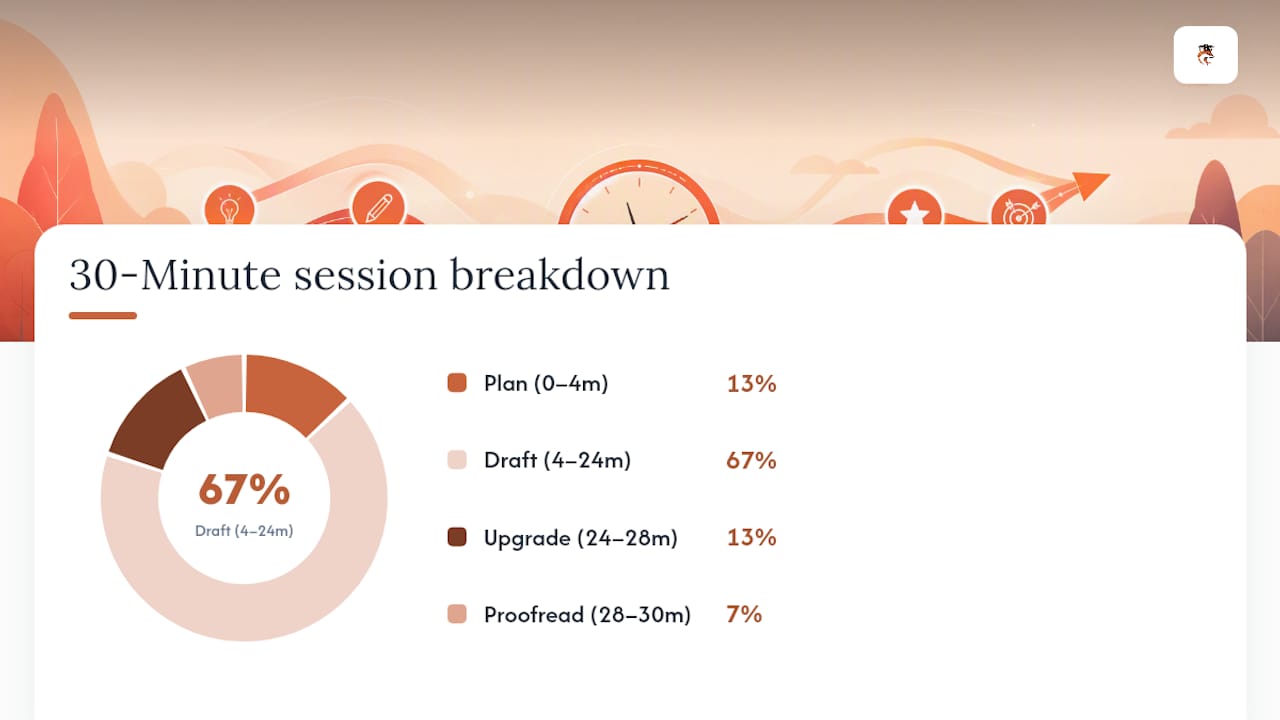
- 0 to 4 minutes: read and plan. Read the prompt twice. Decide the response type (narrative, persuasive, informative). Jot 3 to 4 bullet points outlining the shape of the response before writing a single full sentence.
- 4 to 24 minutes: write the draft. Focus entirely on following the chosen structure. Do not stop to fix spelling or reread from the top. Momentum matters more than polish at this stage.
- 24 to 28 minutes: upgrade and add detail. Swap at least three generic words for stronger ones, and insert one vivid sensory detail somewhere in the piece.
- 28 to 30 minutes: proofread. Run through a short checklist: capital letters, end punctuation, subject-verb agreement, and one read for sense.
This breakdown lines up closely with the timed structure recommended for NSW selective writing tests, and it works just as well for scholarship and private-school entrance exams outside that system because the underlying skill (planning before drafting) transfers everywhere.
After each session, log two things in a notebook or shared document: what went well, and one specific focus for next time. “Add more sensory detail” is a better target than “write better.” Choose only one focus per attempt. Trying to fix five problems at once usually fixes none of them.
Pro Tip: Time the planning phase separately with a visible countdown. Students who skip planning under pressure almost always produce flatter, less organized responses, even when they write more words overall.
Selective-ready guidance recommends practising one timed response per week rather than cramming several sessions into one weekend. Consistency beats volume, and reviewing time-management techniques between sessions helps students internalize pacing rather than just repeating it by accident.
Pressure-safe templates your child can use on exam day
A memorized structure is the single fastest way to raise a nervous writer’s score, because it removes the “what do I even write” panic that eats up planning time.
Narrative: the 5-part model
- Hook: One line that drops the reader into a moment. Example: “The porch light flickered twice before it died completely.”
- Setup: Who, where, and what is at stake, in two or three sentences.
- Turn: The moment something shifts or goes wrong.
- Climax: The peak of tension or decision, shown through action and dialogue rather than explained.
- Resolution: A short, specific ending that reflects on what changed, without a moral lecture.
Markers consistently reward narrative pieces that “show, don’t tell,” lean on precise verbs, and stay narrow in scope rather than sprawling across an entire life story, according to guidance on decoding the selective writing stimulus. A tightly told five minutes beats a rushed retelling of an entire weekend.
Persuasive: the 4-part model
- Claim: State the position in one clear sentence.
- Reason one with evidence: A specific example or logical point.
- Reason two with evidence: A second, different angle.
- Counter and close: Acknowledge one opposing point in a single sentence, then explain why the original claim still holds, ending on a firm final line.
Informative or discursive: open with a clear statement of what the piece will explore, present balanced points in short paragraphs, and close by weighing them rather than picking an artificial winner. Keep tone even and avoid slang.
Practice frequency matters: guidance from selective test preparation resources points to one timed piece per week, building toward two once a student is comfortable, as the pace that produces measurable gains without burning students out.
A short list of Tier 2 vocabulary swaps helps students lift plain writing quickly: “said” becomes murmured, insisted, or admitted; “good” becomes remarkable, reassuring, or commendable; “walked” becomes wandered, strode, or crept. Useful sentence openers include “Without warning,” “For the first time,” and “It wasn’t until later that.” Reading classic public-domain texts through Project Gutenberg is a free way to expose students to this kind of varied phrasing in context, since the sentence rhythm in a novel like Frankenstein or The Adventures of Tom Sawyer shows vocabulary working inside real sentences rather than a flashcard list.
Common mistakes and the 2-minute drills that fix them
Most students repeat the same handful of errors across every practice attempt, which means a handful of short drills can fix most of the damage.
- Drifting off-topic: Drill: circle the exact keywords in the prompt before writing, and check the response against them after drafting.
- Skipping the plan: Drill: force a 60-second bullet-point plan before allowing any full sentences.
- Flat openings: Drill: rewrite the first line three different ways and pick the strongest.
- Weak development in the middle: Drill: add one specific sensory detail (sound, smell, or texture) to the middle paragraph.
- Generic vocabulary: Drill: highlight five overused words and replace each with a stronger synonym.
- Mechanical errors: Drill: read the piece aloud once, slowly, listening for anything that sounds wrong.
- Poor pacing: Drill: mark where the 4-minute and 24-minute points landed and adjust next time.
- No reflection or conclusion: Drill: write one sentence that answers “so what changed?”
Pro Tip: Run one drill per session rather than trying to correct everything at once. A student who fixes flat openings this week and generic vocabulary next week improves faster than one asked to fix eight things simultaneously.
For the final three minutes of any timed piece, a quick checklist works as a home marking rubric: capital letters and end punctuation present, no repeated words in back-to-back sentences, and at least one strong verb swapped in.
What separates an average response from a high-band one
Markers generally score entrance exam writing on two broad dimensions: content and organization (ideas, structure, voice) and technical accuracy (grammar, spelling, punctuation). A response can be technically clean and still score low if the ideas are generic or the structure collapses halfway through, and the reverse is also true.
Compare two openings to the same prompt, “Write about a decision you made that you later saw differently”:
- Average: “One day I had to make a decision. It was hard but I did it and I learned a lesson.”
- Higher-band: “The coach’s whistle cut through the noise, and I realized I had exactly three seconds to decide whether to pass the ball or take the shot myself.”
The second version drops the reader directly into the moment, uses concrete sensory detail, and avoids announcing the lesson before it has even happened.
A small story told well, with narrow scope and sensory precision, consistently outperforms a sprawling plot rushed through in the same word count.
A simple home checklist: does the opening hook attention in the first sentence? Does the middle develop one clear idea rather than several thin ones? Does the ending reflect rather than just stop? Is the response free of repeated basic errors on a second read?
A 12-week plan built on the Réussite A+ approach
Consistency over twelve weeks beats a frantic week of cramming. A realistic weekly rhythm: one timed 30-minute writing session, one 15-minute feedback review of the previous attempt, and two shorter sessions built around vocabulary building or reading from varied sources.
- Week structure: one timed essay, one feedback session, two vocabulary or reading tasks.
- What to measure: structure clarity (does the response follow its template?) and one mechanical accuracy score (errors per hundred words).
- Realistic progress: small, specific gains most weeks rather than dramatic jumps.
Each student’s plan is built individually, with pacing and focus areas based on the child’s struggles, using university-level tutors. Plans include ongoing progress monitoring to stay adjusted to the student’s needs, not a fixed script.
Managing test anxiety and staying focused on exam day
Nerves show up as either a blank page or a rushed, unplanned scramble, and both are fixable with the same underlying fix: familiarity. A student who has run ten timed practices feels the exam clock as normal rather than threatening, because the format is no longer new.
Breathing matters more than most students realize. A slow four-count inhale and six-count exhale before the timer starts lowers the physical panic response enough to think clearly for the first crucial planning minutes. Encourage your child to do this at home during every practice session so it becomes automatic, not something they try for the first time under real pressure.
Remind students that skipping ahead is allowed if a prompt genuinely stalls them. Most entrance exams offer a choice of prompts or sections; a quick 20-second gut check on which one feels more workable beats staring at a blank page out of stubbornness.
Physical comfort plays a bigger role than most families expect: a full water bottle, a comfortable pencil grip, and a full night’s sleep the night before all affect focus more than any last-minute review session. Avoid introducing new material the night before an exam. Reviewing a familiar checklist or rereading one strong past response builds confidence without adding new pressure.
Language, vocabulary, and grammar accuracy that examiners notice
Grammar mistakes cost more when they cluster, so accuracy matters most in the areas graders check first: the opening line, dialogue punctuation, and subject-verb agreement across longer sentences. A single small error rarely sinks a score, but repeated basic errors signal rushed proofreading.
Sentence variety matters as much as vocabulary. A response built entirely from short, simple sentences reads as flatter than one that mixes a short punchy line with a longer, more complex one. Encourage students to read their draft aloud during practice; awkward rhythm is far easier to hear than to spot silently on the page.
Vocabulary should sound natural, not forced. A thesaurus swap that produces an odd or overly formal word (“the boy perambulated to school”) reads worse than a plain, well-chosen one (“the boy trudged to school”). Precision beats novelty every time. Building a working bank of ten to fifteen strong verbs and transition phrases, practised until they feel natural, does more for a score than memorizing fifty rarely used words. Reading widely from varied sources, including older texts through Project Gutenberg, exposes students to sentence patterns and word choices they would not encounter in typical school readers.
Revising and proofreading when the clock is almost out
The last two minutes of any timed response should follow the same fixed routine every single time, so it becomes automatic rather than another decision under pressure.
Start with the ending, not the beginning. Students who reread from the top often run out of time before reaching their own conclusion, which is usually where the weakest writing happens under fatigue. Check that the final line actually resolves something rather than trailing off.
Scan specifically for the three most common mechanical slips: missing end punctuation, inconsistent verb tense (switching from past to present mid-story), and repeated words in adjacent sentences. Looking for one error type at a time is faster and more accurate than trying to catch everything in a single unfocused read.
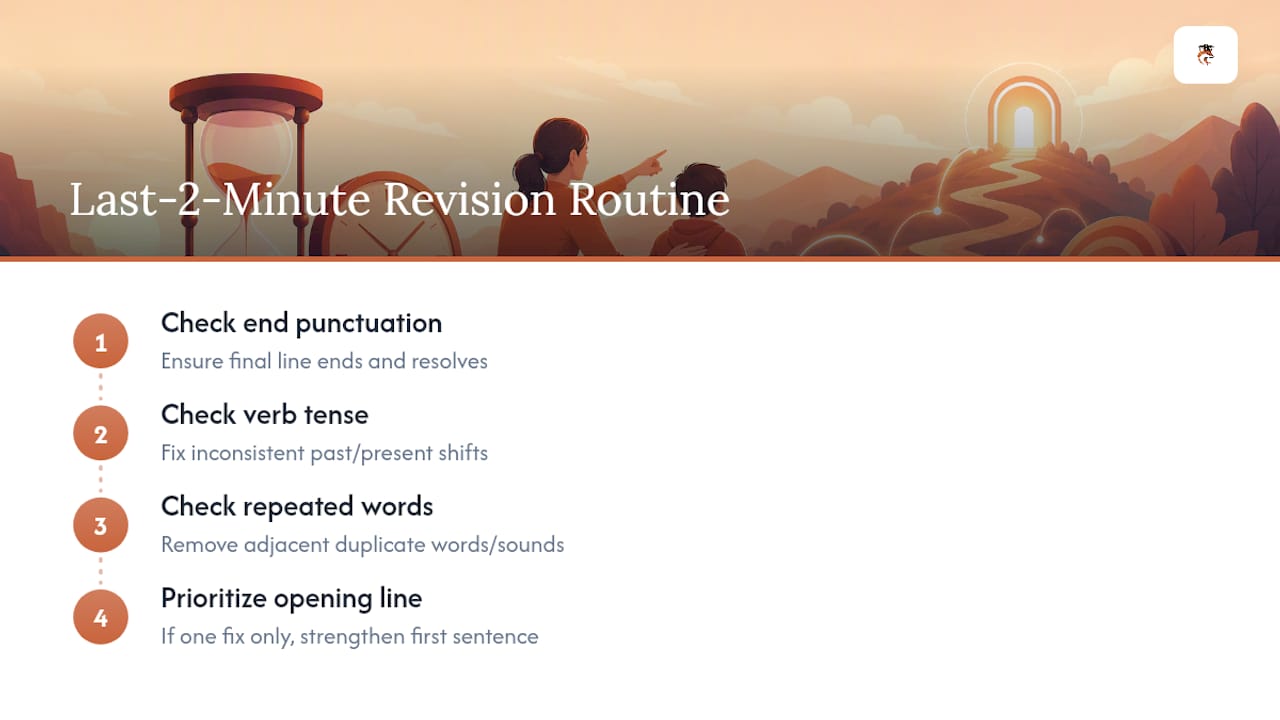
If time allows for only one fix, prioritize the opening line. A strong, hooky first sentence colours how a marker reads everything that follows, even if the rest of the piece has rough patches.
Why practice quality matters more than practice quantity
Parents often assume more timed essays automatically produce a better score. In practice, a student who writes eight essays with no feedback in between usually improves less than one who writes four essays and reviews each one carefully against a checklist. The review is where the actual learning happens. Writing under time pressure only exposes the gaps; it does not close them on its own.
The other misconception worth challenging: that a student needs to master every prompt type equally well before test day. Most entrance exams lean noticeably toward one or two genres. Spending disproportionate energy on the genre that shows up most often, usually narrative or persuasive, produces better returns than spreading practice thin across four genres a student will rarely be asked to use.
Keep sessions short and specific. A tired, resentful ten-year-old grinding through a fourth timed essay in one week is not building skill; that student is building dread. One focused session, reviewed properly, most weeks is enough to see real movement by week eight or nine.
— Réussite A+
Ready to build a real practice routine with expert guidance
Réussite A+’s exam preparation sessions are built specifically around what secondary entrance exams actually test, using university-level tutors who adjust pacing to your child’s specific weak spots rather than running a generic worksheet program.
Every exam preparation and regular tutoring session runs between $30 and $35 per hour, with a one-time $65 registration fee, and scheduling stays flexible around school and family commitments. If your child freezes under a timer or struggles to organize ideas quickly, a tutor can run exactly the kind of structured, reviewed practice this article describes, week after week, with real feedback instead of guesswork. Book an initial session through the exam preparation page and bring one recent timed writing sample so your tutor can build the first plan around where your child actually stands.
Sources
- ACT Writing Sample Essays: Official Prompts and Scored Examples
- Selective Ready — Selective Test Writing Guide
- NSW Selective Writing Test: Scoring, Genres & 12-Week Prep — EurekaWrite
- Selective entry writing practice guide — SK Edge Prep
- Decoding the selective writing stimulus — GoTestPrep
FAQ
What are common entrance exam essay topics?
Most entrance exams draw from narrative, persuasive, and informative or discursive prompts, often built around a personal experience, an opinion question, or a short stimulus image. Some exams also include a descriptive or reflective variant, but practising the three core types covers nearly every format a student will encounter.
What are good writing prompt ideas for practice?
Strong practice prompts ask for a specific moment rather than a broad topic, such as “write about a decision you later saw differently” instead of “write about your life.” Stimulus images (a closed door, an empty chair) and timed-starter lines also work well because they mirror how many selective and scholarship exams present material on test day.
How many practice essays should a student write before the exam?
Selective-ready guidance recommends one timed response per week, increasing to two closer to the exam date, with a feedback review after each one. Quality of review matters more than raw volume of essays written.
Does Réussite A+ offer entrance exam writing preparation?
Yes. Réussite A+’s entrance exam preparation sessions run $30 to $35 per hour with a one-time $65 registration fee, delivered by university-level tutors who build an individualized plan around each student’s writing gaps.
How long should a timed practice writing session be?
A realistic session runs 30 minutes, broken into four minutes of planning, roughly twenty minutes of drafting, four minutes of upgrading vocabulary and detail, and two minutes of proofreading. This structure mirrors the timing many selective writing tests actually use.