


Personalized tutoring reliably improves learning outcomes and student confidence by targeting skill gaps, pacing, and feedback to each learner. The strongest evidence comes from randomized controlled trials and meta-analyses showing measurable gains in reading and math, alongside real improvements in motivation. Providers like Réussite A+ build on this evidence with structured, one-to-one programs designed around each student’s actual starting point.
TL;DR:
- Personalized tutoring provides the strongest benefits when it begins with a thorough diagnostic assessment tailored to the student’s specific skill gaps.
- Consistent, scheduled sessions outperform sporadic or one-off tutoring, especially for long-term progress in subjects like math and reading.
- One-to-one online tutoring generally yields larger learning gains and higher engagement compared to group formats, with results improving through frequent and focused sessions.
- Early grade interventions see faster improvements, with confidence boosts within weeks and measurable academic gains often appearing after several months.
- Choosing a tutor or program requires verifying qualifications, diagnostic procedures, curriculum alignment, progress reporting, and clear, upfront terms to ensure effective and lasting results.
Table of Contents
- What are the main benefits of personalized tutoring?
- What does the research say about tutoring outcomes?
- How does personalization actually work?
- One-to-one, small group, online, or in-person: what actually fits?
- How do you choose the right tutor or program?
- What does personalized tutoring look like at Réussite A+?
- When does tutoring investment pay off fastest?
- Ready to start? Here’s how Réussite A+ fits
- Sources
- FAQ
What are the main benefits of personalized tutoring?
Parents usually ask about grades first, but the benefits split into four connected categories, and they don’t all show up on the same timeline.
Short-term wins come fast: better homework completion, fewer careless errors, higher test scores within weeks. Long-term gains take longer to surface but matter more. These include actual conceptual mastery, the kind that lets a student solve a new problem type they’ve never seen before, not just repeat a memorized method.
The academic side is only half the story. Tutored students consistently report lower anxiety and more willingness to raise their hand in class. That shift happens because a tutor who already knows a student’s weak points creates a lower-stakes space to be wrong.
- Academic gains: stronger test scores, better grades, fewer knowledge gaps carried forward.
- Confidence and motivation: reduced school anxiety, more classroom participation.
- Study skills: organization, self-checking, and time management that transfer to other subjects.
- Age and subject variation: younger children often show faster reading gains, while math benefits tend to compound over a longer stretch.
A seven-year-old struggling to decode words responds differently than a fifteen-year-old preparing for a secondary exam, and the benefit mix shifts accordingly.
What does the research say about tutoring outcomes?
The clearest large-scale evidence comes from a randomized controlled trial of an early reading program, which found tutored kindergarten students were more than twice as likely to hit their target reading level by year’s end. More tutored students reached the benchmark compared to the comparison group, with tutored students achieving the target reading level by year’s end at more than double the rate of those without tutoring.
By the numbers: A systematic review and meta-analysis pooling results across preK to grade 12 studies found an overall effect size of roughly 0.37 standard deviations. In practical terms, that translates to several extra months of learning progress compared to students who don’t receive tutoring.
That average hides real variation. Effects run stronger when a teacher or trained paraprofessional leads the sessions, and they tend to be larger in earlier grades than in high school. The same review notes that impact depends heavily on how closely tutoring aligns with what a student is already studying in class.
- Reading programs in early grades show some of the largest, most consistent effects.
- Math gains often build more gradually and depend on session frequency.
- Sporadic, one-off sessions underperform scheduled, sustained tutoring programs.
Consistency, not intensity on a single day, is what drives the numbers that matter.
How does personalization actually work?
Personalization isn’t a marketing word. It’s a sequence of specific steps a good tutor follows every time.
- Diagnose first. A proper program starts with an assessment that maps exactly where a student’s understanding breaks down, not a generic placement quiz.
- Pace to mastery. Instead of moving at a fixed classroom speed, the tutor adjusts based on when a concept is actually solid.
- Give immediate feedback. Errors get corrected in the moment, before a wrong method turns into a habit.
- Build rapport deliberately. Stanford’s tutoring research points to the tutor-student relationship as a real driver of whether a student takes intellectual risks instead of just guessing to avoid embarrassment.
- Hunt for invisible gaps. A student stuck on algebra might actually be struggling with fractions from two grades earlier, and a personalized approach traces the problem to its root.
Pro Tip: Ask a prospective tutor how they’d explain a wrong answer differently to two students who made the exact same mistake for different reasons. A vague answer usually means the “personalization” is really just a fixed script.
One-to-one, small group, online, or in-person: what actually fits?
There’s no single right format, but the trade-offs are well documented and worth knowing before you commit.
A pilot study comparing 1:1 and 3:1 online math tutoring found one-to-one sessions produced larger learning gains and higher tutor-reported engagement. Tutors in that same trial rated one-to-one sessions as more effective across nearly every measure they tracked. Small groups still have a place, mainly for peer discussion and cost, but they trade some personalization for that social dynamic.
Online versus in-person is a separate question entirely, and it hinges more on the child than the format:
- Online tutoring offers flexible scheduling, access to specialized tutors regardless of location, and consistent digital materials session to session.
- In-person tutoring can help students who get distracted easily by screens or notifications.
- Session frequency matters more than the delivery method. A single weekly hour rarely rivals two or three shorter, consistent sessions.
- Hybrid setups work well when a student needs intensive support short-term (exam prep) layered onto a lighter ongoing schedule.
The format is a preference. The consistency behind it is the variable that actually moves outcomes.
How do you choose the right tutor or program?
A rushed decision here usually costs more in wasted sessions than a careful one costs in time. Run through this before signing up:
- Confirm the tutor’s qualifications and subject background, not just general teaching experience.
- Ask whether the program starts with a structured diagnostic, not a casual chat.
- Check that lessons align with the student’s actual school curriculum.
- Request a clear progress-reporting rhythm (weekly notes, monthly reviews, whatever is offered).
- Clarify pricing and cancellation terms upfront, in writing.
Ask directly in your first call: How do you decide what to work on each session? How will I know it’s working after six weeks? What happens if my child hits a plateau?
Watch for these red flags:
- No diagnostic assessment before sessions begin.
- Vague, unmeasurable progress claims (“she’s doing great!”) with no specifics.
- One-off “cram” sessions marketed as a fix for a long-standing gap.
Give any legitimate program six to twelve weeks before judging results. A systematic review of tutoring interventions notes that outcomes vary widely depending on tutor quality and consistent scheduling, so a slow first month with a well-structured plan is not a warning sign on its own.
What does personalized tutoring look like at Réussite A+?
Réussite A+ builds every program around a customized learning plan shaped by a student’s strengths, pace, and specific gaps in French or math, rather than a fixed curriculum applied to everyone the same way.
The track record backs the approach up:
- Helped thousands of students with personalized tutoring.
- Maintains a high client satisfaction rate.
- Consistently strong results for students preparing for secondary school entrance examinations.
A typical family starts with a diagnostic session, receives a tailored plan built around that assessment, and gets regular progress updates as the tutor adjusts pacing. Tutors have post-secondary education, and scheduling is flexible enough to fit around a family’s week rather than forcing families to fit around the tutor.
When does tutoring investment pay off fastest?
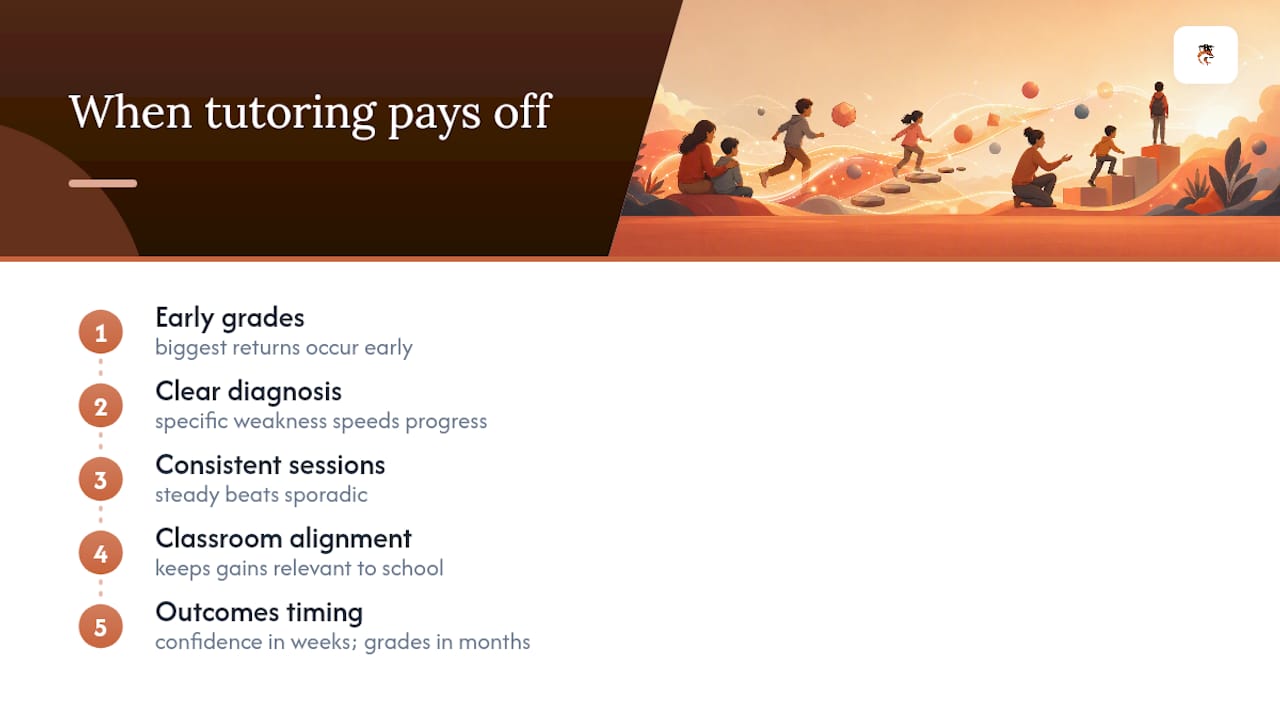
The best return usually shows up in early grades, when a gap is clearly diagnosed, and when sessions run consistently rather than sporadically. A student with a specific, identified weakness in reading or fractions tends to progress faster than one with a vague “needs to do better” label.
Expect visible confidence shifts within a few weeks. Expect the deeper academic gains, the ones that show up on report cards and standardized measures, to take a few months of steady work. Quality and consistency matter more than any single teaching method, and alignment with what’s happening in the classroom keeps the gains from feeling disconnected from school.
— Réussite A+
Ready to start? Here’s how Réussite A+ fits
If you’ve been weighing one-to-one against small groups, or online against in-person, Réussite A+ builds its programs around exactly the trade-offs covered above: one-to-one sessions in French and math, delivered online with flexible scheduling, and shaped from day one by a tailored learning plan rather than a fixed lesson bank.
Every program starts with a diagnostic to pinpoint the real gap, not a guess, then builds a plan around it with regular progress check-ins so you’re never wondering whether it’s working. Pricing stays straightforward, with scheduling flexible enough to fit around homework loads and after-school activities rather than the other way around.
Curious what 7 advantages of online tutoring actually look like in practice? Or ready to move forward? You can register for tutoring and homework support directly, or start with online homework help to see how a tailored session runs before committing to a full plan.
Sources
- A scalable approach to high-impact tutoring for young readers: results of a randomized controlled trial (NBER w32039)
- The impressive effects of tutoring on preK–12 learning: a systematic review and meta-analysis (ERIC ED671405)
FAQ
What are some real examples of personalized learning?
Examples include a tutor slowing down on fractions before moving to algebra because a diagnostic revealed a gap, or a reading program that adjusts book difficulty week to week based on a child’s actual decoding speed rather than a fixed grade-level list.
What are the main benefits of tutoring for students?
Students typically see stronger test scores, better homework habits, reduced school anxiety, and improved study skills that carry over into other subjects, with the strongest evidence coming from randomized trials showing measurable reading and math gains.
Do tutors benefit from tutoring too?
Tutors often report improved communication and instructional skills from adapting explanations to different learners, and many use the experience to strengthen their own subject mastery before teaching careers or graduate study.
What strategies make personalized learning effective?
The most consistent strategies are an upfront diagnostic assessment, mastery-based pacing instead of fixed timelines, immediate feedback on errors, and a session schedule frequent enough to build genuine rapport, all of which shape how Réussite A+ structures its tutoring plans.
How quickly should parents expect to see results?
Confidence and homework habits often shift within a few weeks, while deeper academic gains on tests and report cards typically take a few months of consistent, weekly sessions to show clearly.