




The fastest way to conjugate French verbs is to master three things first: the present tense of regular -er verbs, the near future (aller + infinitive), and the passé composé with its two auxiliaries, avoir and être. Add être, avoir, aller, and faire in all their irregular glory, and you can already say most of what you need in everyday French.
Here’s your next 30 minutes, mapped out:
- Write out the six present-tense endings for -er verbs (parler): parle, parles, parle, parlons, parlez, parlent.
- Memorize the present tense of être and avoir. Every compound tense in French leans on these two.
- Practice one near-future sentence for each day of your week using je vais + infinitive.
Your study priorities, in order:
- Present tense of -er verbs, plus être, avoir, aller, faire
- The auxiliary system (avoir vs. être) for compound tenses
- The top 30 highest-frequency verbs
- A searchable conjugator for daily reverse lookup and drills
Key Takeaways
Mastering French verb conjugation requires prioritizing present tense, near future, and passé composé with the top 15 irregular verbs before expanding to less frequent forms and tenses.
| Point | Details |
|---|---|
| Start with high-frequency verbs | Master être, avoir, aller, faire, and the rest of the top 15 before branching out. |
| Learn tenses in order | Present, near future, passé composé, imparfait, then conditional and subjunctive last. |
| Choose auxiliaries correctly | Most verbs take avoir; movement, state-change, and reflexive verbs take être with agreement. |
| Use conjugators actively | Reverse-lookup drills on tools like Bescherelle or Reverso build recall, not just recognition. |
| Get targeted help when stuck | Réussite A+ offers personalized tutoring that diagnoses recurring conjugation errors and builds custom drills around them. |
Table of Contents
- French verb conjugation tables you can copy today
- How are French verbs grouped, and why does it matter?
- Which French tenses should you learn first?
- Which French verbs should you memorize first?
- What are the best online French conjugation tools?
- How do you build a 4-week French conjugation study plan?
- What are the most common French conjugation mistakes?
- When should you consider tutoring for French verb conjugation?
- Get personalized help mastering French verb conjugation
- Where to check French verb conjugation online
- Sources
- FAQ
French verb conjugation tables you can copy today
Every reliable approach to conjugating French verbs starts with pattern recognition, not memorization of isolated forms. Here’s the reference set to bookmark.
Present tense across the three groups
| Pronoun | Parler (-er) | Finir (-ir) | Vendre (-re) |
|---|---|---|---|
| je | parle | finis | vends |
| tu | parles | finis | vends |
| il/elle | parle | finit | vend |
| nous | parlons | finissons | vendons |
| vous | parlez | finissez | vendez |
| ils/elles | parlent | finissent | vendent |
Notice the -issons/-issez/-issent pattern that shows up only in group 2 verbs like finir. That extra “iss” syllable is the single clearest signal you’re dealing with a group 2 verb rather than a group 3 irregular that happens to end in -ir (like partir or dormir).
Passé composé: the compound past
The formula never changes: auxiliary (avoir or être) conjugated in the present, plus the past participle. Most verbs take avoir.
- J’ai parlé (I spoke / I have spoken)
- Tu as fini (You finished)
- Il a vendu (He sold)
A shortlist of verbs takes être instead, mostly movement and state-change verbs like aller, venir, arriver, partir, entrer, sortir, monter, descendre, naître, mourir, retourner, rester, tomber. With être, the past participle agrees in gender and number with the subject.
- Elle est allée au marché (She went to the market. Note the extra “e” because “elle” is feminine.)
- Ils sont partis tôt (They left early.)
Reflexive verbs also take être in compound tenses. Elle s’est levée à sept heures shows the same agreement pattern.
Imparfait, futur simple, and conditional
The imparfait stem comes from the nous form of the present tense (nous parlons → parl + ais/ais/ait…), which holds true even for most irregular verbs. The futur simple and conditional both build on the infinitive (or a modified stem for irregulars), which is why their endings look so similar. Futur simple uses the present tense of avoir as its ending pattern; conditional uses the imparfait endings on that same future stem.
Present subjunctive
| Pronoun | Parler | Finir |
|---|---|---|
| que je | parle | finisse |
| que tu | parles | finisses |
| qu’il/elle | parle | finisse |
| que nous | parlions | finissions |
| que vous | parliez | finissiez |
| qu’ils/elles | parlent | finissent |
The subjunctive stem for most verbs comes from the ils/elles form of the present indicative, then swaps in these endings. It shows up after expressions like il faut que, je veux que, and bien que.
Pro Tip: When you check a form on a searchable conjugator, always look at the participle agreement columns too. Sites like Le Robert’s free conjugator show masculine and feminine participle variants side by side, which catches agreement mistakes before they become habits.
How are French verbs grouped, and why does it matter?
French verbs sort into three groups, and knowing which group a verb belongs to tells you almost everything about how to conjugate it. This single classification step saves more study time than any other grammar concept in the language.
Group 1 covers regular -er verbs: parler, manger, aimer, travailler, chercher. These make up the overwhelming majority of French verbs and follow one predictable pattern, with minor spelling tweaks for verbs like manger and commencer (more on that later).
Group 2 covers regular -ir verbs that insert -iss- in the plural forms: finir, choisir, réussir, grandir. If you can conjugate finir, you can conjugate hundreds of others in this group with zero surprises.
Group 3 is everything else, and it’s the group that trips learners up: irregular -ir verbs (partir, venir, dormir), all -re verbs (vendre, prendre, dire), and the handful of essential irregulars that don’t fit anywhere else (être, avoir, aller, faire, pouvoir, vouloir, devoir). Group 3 verbs need to be memorized individually, but the payoff is huge because these are also the most frequently used verbs in the language.
Choosing the right auxiliary for compound tenses is its own skill. Here’s a compact way to think about it:
- Avoir is the default auxiliary. When in doubt, use avoir.
- Être applies to a specific list of movement and state-change verbs (aller, venir, naître, mourir, monter, descendre, and their compounds).
- Être also applies to every reflexive verb, regardless of meaning: se laver, se souvenir, s’endormir.
- A useful mnemonic some instructors teach is “Dr. and Mrs. Vandertramp,” an acronym built from the first letters of the common être verbs.
For study order, tackle group 1 first because it builds your ear for regular patterns fast, then layer in the top group 3 irregulars (être, avoir, aller, faire) since you’ll need them in nearly every sentence anyway. Group 2 can wait a little longer. It’s smaller and less urgent than the irregulars you’ll hit constantly in real conversation.
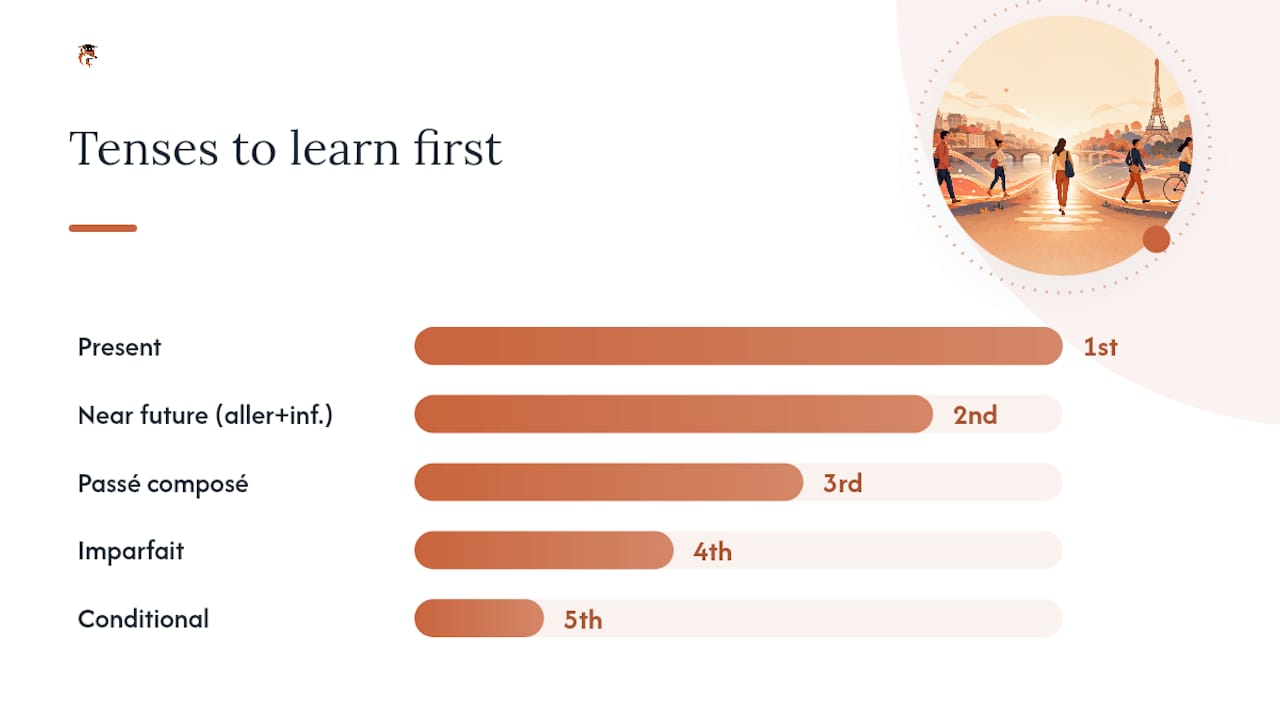
Which French tenses should you learn first?
Not every tense deserves equal study time. A practical French verb conjugation guide built around real usage recommends this order, and it lines up with how native speakers actually talk.
- Present tense. It covers current actions, general truths, and often stands in for the near future in casual speech. Je mange can mean “I eat” or “I’m eating.”
- Near future (aller + infinitive). This is the easiest future construction in French and the one people actually use in conversation. Je vais manger (I’m going to eat) shows up far more often than the futur simple in spoken French.
- Passé composé. This is your default past tense for anything that happened and is finished. J’ai mangé (I ate) or Je suis allé (I went).
- Imparfait. This handles background description, ongoing states, and habitual past actions. Je mangeais tous les jours à midi (I used to eat every day at noon).
- Conditional. Useful for polite requests and hypothetical situations. Je voudrais (I would like) is one of the most common conditional forms you’ll ever use.
- Subjunctive. Reserve this for later since it depends on recognizing trigger phrases first, not just conjugating correctly.
The trickiest distinction for most learners is choosing between passé composé and imparfait, and it’s a narrative choice more than a grammatical one. Passé composé marks a completed, bounded event. Imparfait paints the scene around it. A University of Texas grammar resource frames it clearly: passé composé answers “what happened,” while imparfait answers “what was going on.”
Compare: Il pleuvait quand je suis sorti (It was raining when I went out). The rain is background, described with imparfait. Going out is the completed event, marked with passé composé. Once you start labelling past sentences as either “the ongoing scene” or “the thing that happened,” the tense choice becomes far more intuitive than memorizing another rule.
Which French verbs should you memorize first?
Not all 12,000-plus French verbs deserve your attention equally. French verb frequency follows a Zipf-style distribution, meaning a small cluster of verbs accounts for a disproportionate share of everything you’ll hear and read. The top 100 most common French verbs cover the vast majority of everyday spoken and written French, and the top 10 alone (être, avoir, aller, faire, dire, pouvoir, vouloir, savoir, voir, devoir) do an enormous share of that work.
This isn’t a rough estimate. Frequency lists built from corpus analysis, drawing on data like the Lonsdale and Le Bras Frequency Dictionary of French, confirm that a small number of high-frequency verbs account for a large share of the verb forms that appear in real French text and speech. That’s the practical case for drilling frequency lists before wandering into obscure irregulars you might use twice a year.
Here’s a compact starting list, roughly ordered by usefulness:
Once those first 15 feel automatic, expand toward the top 30, then the top 100, using the same drilling sequence for each new verb: present tense first, then passé composé, then the near future. Don’t try to learn all six tenses for a new verb at once. Three forms done well beat six forms done shakily.

A reasonable pace is two to three new verbs a week once you’re past the top 10, spending roughly 15 minutes per verb across present, passé composé, and near future forms before moving on.
What are the best online French conjugation tools?
A good conjugator turns passive lookup into active practice, but only if you use it that way. Several tools dominate this space, and each has a distinct strength worth knowing.
- Reverso Conjugator excels at showing a verb in context, pairing conjugated forms with real bilingual example sentences pulled from translated text, which helps you see usage, not just endings.
- Lawless French offers structured grammar lessons alongside conjugation reference, making it useful when you need the “why” behind a rule, not just the table.
- Conjuguemos is built for drilling. It generates timed quizzes and fill-in-the-blank exercises, which makes it one of the better free options for active recall rather than passive reading.
- Bescherelle, through Le Conjugueur Bescherelle, is the reference standard in French grammar education, with a searchable database covering more than 9,500 verbs and a search engine tolerant of typos and already-conjugated forms.
- Le Robert offers thousands of verb conjugations and explicitly displays masculine and feminine participle agreement side by side, which makes it especially useful for double-checking agreement rules.
- Larousse Conjugation documents irregular patterns and orthographic quirks in detail, including spelling shifts like y-to-i changes that trip up even intermediate learners.
To turn any of these into an active study tool rather than a reference you glance at once, try reverse lookup: type in a conjugated form you don’t recognize and work backward to the infinitive and tense. This builds the recognition skill you actually need when reading or listening, which is different from the recall skill you need to produce a form yourself.
Automated conjugators are reliable for regular verbs but can stumble on rare compound or archaic forms, so cross-check anything unusual against Bescherelle or Larousse before you commit it to memory. When two tools disagree, the more established grammar reference wins.
How do you build a 4-week French conjugation study plan?
Consistency beats intensity here. A steady 20 to 40 minutes a day produces better retention than one long cram session on a Sunday.
- Week 1: Foundations. Drill present tense for -er verbs plus être, avoir, aller, and faire. Spend 20 minutes daily on flashcards (physical or spaced-repetition apps) covering just these forms.
- Week 2: Compound past. Add passé composé, focusing on the avoir/être split. Practice writing five sentences a day about what you did yesterday, alternating avoir and être verbs deliberately.
- Week 3: Imparfait and contrast drills. Learn imparfait formation, then write short paragraphs mixing both past tenses, describing a scene (imparfait) that leads to an event (passé composé).
- Week 4: Expansion and speed. Add the near future and conditional, then run timed oral drills: conjugate a verb aloud in five tenses within 30 seconds, using a random verb generator or a stack of index cards.
Layer in these activities throughout the four weeks:
- Spaced-repetition flashcards for verb forms, reviewed daily rather than in long weekly batches.
- Fill-in-the-blank conjugation exercises from a tool like Conjuguemos.
- Timed oral drills, saying forms out loud rather than only writing them.
- Dictation practice, which forces you to hear and correctly spell conjugated endings you’d otherwise skim past.
- A running error log where you write down every mistake you catch and review it weekly.
Dictation pairs particularly well with conjugation practice because a structured three-step dictation method forces you to actually hear the difference between silent verb endings that look nearly identical on paper.
Pro Tip: Increase difficulty only after you can produce a form correctly three times in a row without pausing to think. If you’re still hesitating, you need more repetition at the current level, not a harder verb.
What are the most common French conjugation mistakes?
Certain errors show up so predictably across learners that they’re worth memorizing as a group, not just correcting one at a time.
- Wrong auxiliary choice. Writing j’ai allé instead of je suis allé. Fix: memorize the être verb list as a block, not case by case.
- Missing past participle agreement. Writing elle est allé instead of elle est allée. Fix: whenever the subject is feminine or plural and the auxiliary is être, add the agreement ending before you move on.
- Overregularizing irregular verbs. Producing forms like je prendre instead of je prends, treating an irregular like it follows the -re pattern. This is one of the most frequent traps learners fall into, and it responds well to contrast drills that pair the irregular stem directly against the regular pattern it resembles.
- -ger/-cer spelling shifts in the nous form. Writing nous mangons instead of nous mangeons, or nous commencons instead of nous commençons. Fix: say the rule aloud, “manger keeps its soft g, commencer keeps its soft c,” every time you drill these verbs.
- Confusing imparfait and passé composé. Fix: before writing a past-tense sentence, ask whether you’re describing the scene or the event, then pick the tense that matches.
When should you consider tutoring for French verb conjugation?
Self-study takes most learners a long way, but certain signals suggest it’s time for outside help. Recognizing these patterns early saves months of frustration.
- You’ve plateaued. If your conjugation accuracy hasn’t improved in several weeks of consistent practice, you’re likely reinforcing the same errors instead of correcting them.
- The same mistake keeps returning. Auxiliary confusion or agreement errors that survive multiple rounds of self-correction usually need a second set of eyes to diagnose the root cause.
- You’re preparing for an exam. Secondary school entrance exams and formal assessments reward precision under time pressure, which is difficult to simulate alone.
- Speaking confidence lags behind written accuracy. Some learners can conjugate perfectly on paper but freeze mid-sentence when speaking. That gap needs live conversation practice, not more worksheets.
Personalized tutoring closes these gaps by diagnosing exactly which patterns are breaking down, then building targeted drills around them instead of re-teaching material you’ve already mastered. A focused block of four to eight sessions is often enough to correct a specific recurring error and rebuild speaking confidence, with a tutor tracking progress against clear benchmarks along the way.
Pro Tip: When choosing what to focus a tutoring session on, pick one weak pattern (say, être versus avoir) rather than “all of conjugation.” Narrow sessions produce faster, more measurable gains than broad review.
Author’s practical priorities for faster progress
Réussite A+ has watched enough students work through this material to notice a pattern: the ones who progress fastest stop chasing complete verb tables and start chasing usage. They ask “when do I use this?” before “how do I conjugate this?” Frequency-based study, paired with short daily micro-practice rather than long occasional sessions, consistently outperforms exhaustive memorization. If you take one thing from this guide, try a 10-minute daily drill on the top 15 verbs before you attempt anything more ambitious.
Get personalized help mastering French verb conjugation
Self-guided tables and drills solve most of the problem, but not all of it. When a specific error keeps resurfacing no matter how many flashcards you make, a tutor who can actually hear your speech patterns and see your written mistakes in real time closes that gap faster than another round of solo drilling. Réussite A+ builds custom learning plans around exactly the verb patterns a student is struggling with, delivered by university-level tutors who track progress session over session rather than guessing at what needs work.
What that looks like in practice: a diagnostic session that pinpoints whether the issue is auxiliary choice, agreement, or tense selection, a lesson plan built around that specific gap, and ongoing tracking so both the student and the parent can see accuracy improve week to week. This is one of the seven advantages of online tutoring worth knowing if you’re weighing whether personalized help is worth it over continued self-study. Every plan runs on a flexible online schedule, which matters when a school week is already full.
If a plateau in verb conjugation has been slowing your child’s progress, book a session through Réussite A+’s online tutoring and homework help and get a clear read on exactly which patterns need targeted work.
Where to check French verb conjugation online
- Bescherelle’s Le Conjugueur: the authoritative searchable database for verifying full conjugation tables across more than 9,500 verbs.
- Le Robert’s free conjugator: shows masculine and feminine participle agreement clearly, useful for double-checking compound tenses.
- Larousse Conjugation: strong for spotting irregular spelling patterns and orthographic exceptions.
- Bonjour Verbs: a ranked frequency list with full tables for the top 100 verbs, ideal for structuring your study order.
- Le Conjugueur’s frequency list: a corpus-based ranking useful for confirming which verbs deserve priority.
Sources
- 100 Most Common French Verbs (List) + Full Conjugation Tables | Bonjour Verbs
- Liste des Verbes Français les plus Fréquents
- Passé composé vs imparfait explanation (University of Texas LATIS resource)
- Le conjugueur Bescherelle, la référence en conjugaison !
FAQ
What are the 20 most important French verbs to learn?
There’s no single official list of “20 verbs,” but a solid starting set draws from the top-ranked frequency list: être, avoir, aller, faire, dire, pouvoir, vouloir, savoir, voir, devoir, prendre, venir, falloir, mettre, croire, trouver, donner, parler, aimer, and passer.
What are the 21 verb forms in French?
This figure varies by how forms are counted, since French has roughly 15 to 20 verb tenses and moods across indicative, subjunctive, conditional, and imperative, plus non-finite forms like the infinitive and participles. Rather than memorizing an exact count, focus on the six or seven tenses covered in this guide, since they handle the vast majority of real communication.
What are the 100 most common French verbs?
The top 100 most common French verbs include everyday essentials like être, avoir, aller, faire, dire, and pouvoir, and they cover the large majority of everyday spoken and written French. Learning them in frequency order, starting with the top 10 to 15, gives you the fastest return on study time.
What are the most common mistakes in French conjugation?
The most frequent errors include choosing the wrong auxiliary (avoir instead of être), forgetting past participle agreement with être and reflexive verbs, overregularizing irregular verbs, and misspelling -ger/-cer verbs in the nous form. Targeted drills addressing each specific pattern correct these faster than general review.
How can tutoring help with French verb conjugation specifically?
A tutor can diagnose which specific error pattern is causing repeated mistakes, something that’s hard to spot alone, and build focused drills around it. Réussite A+ structures sessions around exactly this kind of targeted diagnosis rather than generic grammar review.