


Specialised French tutoring can absolutely help a child with dyslexia, provided it uses Structured Literacy methods adapted to French, paired with proper assessment and school supports. The key word is specialised: a general French tutor who relies on memorisation and guessing strategies will not move the needle. A tutor trained in explicit phonics, phonological awareness, and French orthography will. Here are three steps you can take right now:
- Request a screening. Ask your child’s school team for a phonological awareness screener in French. If your child is in French immersion, ask specifically about tools designed for that context.
- Require evidence-based methods. When speaking with any tutor or specialist, ask directly whether they use Structured Literacy principles adapted to French. If they cannot explain what that means, keep looking.
- Start targeted tutoring. Once you have screening results, begin one-on-one sessions with a tutor who has explicit training in French literacy intervention. Dyslexia Canada recommends early, evidence-based reading instruction in both languages as the most reliable path to success in French immersion.
Key takeaways
Specialised French tutoring works for children with dyslexia when it uses Structured Literacy methods adapted to French, begins with proper screening, and coordinates consistently with the school team.
| Point | Details |
|---|---|
| Screen early, act early | Request a French phonological awareness screener at the first sign of reading difficulty; do not wait for the problem to resolve on its own. |
| Require Structured Literacy | Any tutor or specialist must use explicit phonics, decodable French texts, and systematic phonological awareness instruction. |
| Coordinate tutor and school | Share monthly progress summaries between tutor and teacher so both use consistent language and goals. |
| Use named Canadian tools | Ask about Acadience Reading Français for screening and ÉCLAIR for a full diagnostic profile in French. |
| Réussite A+ as a next step | Réussite A+ provides personalised online French tutoring with Structured Literacy principles, progress tracking, and school coordination across Quebec. |
Table of Contents
- Why dyslexia in French is different from dyslexia in English
- How do you know your child needs specialised French tutoring?
- What actually works: Structured Literacy for French reading
- What French tutoring for dyslexia typically looks like
- How do you choose a French tutor for a child with dyslexia?
- Working with the school: IEPs, accommodations and collaborative plans
- Canadian resources, screeners and diagnostic tools to ask about
- What the research says and what it means for your child
- What we see in practice: a note from Réussite A+
- Réussite A+ supports children with dyslexia in French
- Sources
- FAQ
Why dyslexia in French is different from dyslexia in English
Dyslexia is a phonological processing difficulty. That core deficit does not change depending on which language a child is learning. A child who struggles to hear and manipulate individual sounds in words will face that same challenge in French as in English. What does change is the shape of the problem and, in some ways, the opportunity.
French orthography is more transparent than English in one specific direction: once a child learns a spelling pattern, it tends to be pronounced consistently. The letter combination ou, for example, almost always makes the same sound. That regularity can make decoding slightly more predictable for some learners once the patterns are taught explicitly. The flip side is that French has a rich morphological system, with gendered nouns, verb conjugations, and silent letters that carry grammatical meaning, all of which add complexity for a child who is already working hard to decode.
Two myths come up constantly in Canadian school conversations, and both are worth addressing directly. The first is that French immersion causes reading difficulties. It does not. What immersion does is expose a phonological weakness that was already there, often earlier than it would appear in an English-only programme. The second myth is that pulling a child out of immersion is the obvious solution. Research from McGill shows that students with reading disabilities who receive proper supports in French immersion can perform comparably to peers in English programmes. The decision to stay or transfer should be made individually, with monitoring, not as a blanket policy.
How do you know your child needs specialised French tutoring?
When to request screening versus a full assessment
Screening is the right first step when you notice early warning signs: difficulty rhyming, slow letter-sound learning, trouble blending syllables in French words, or persistent reading errors that do not resolve with classroom instruction. A screener takes 10–20 minutes and flags whether a child is at risk. A full psychoeducational assessment goes much deeper and is needed when a screener raises concerns, when a child is not responding to classroom intervention, or when you need formal documentation for school accommodations.
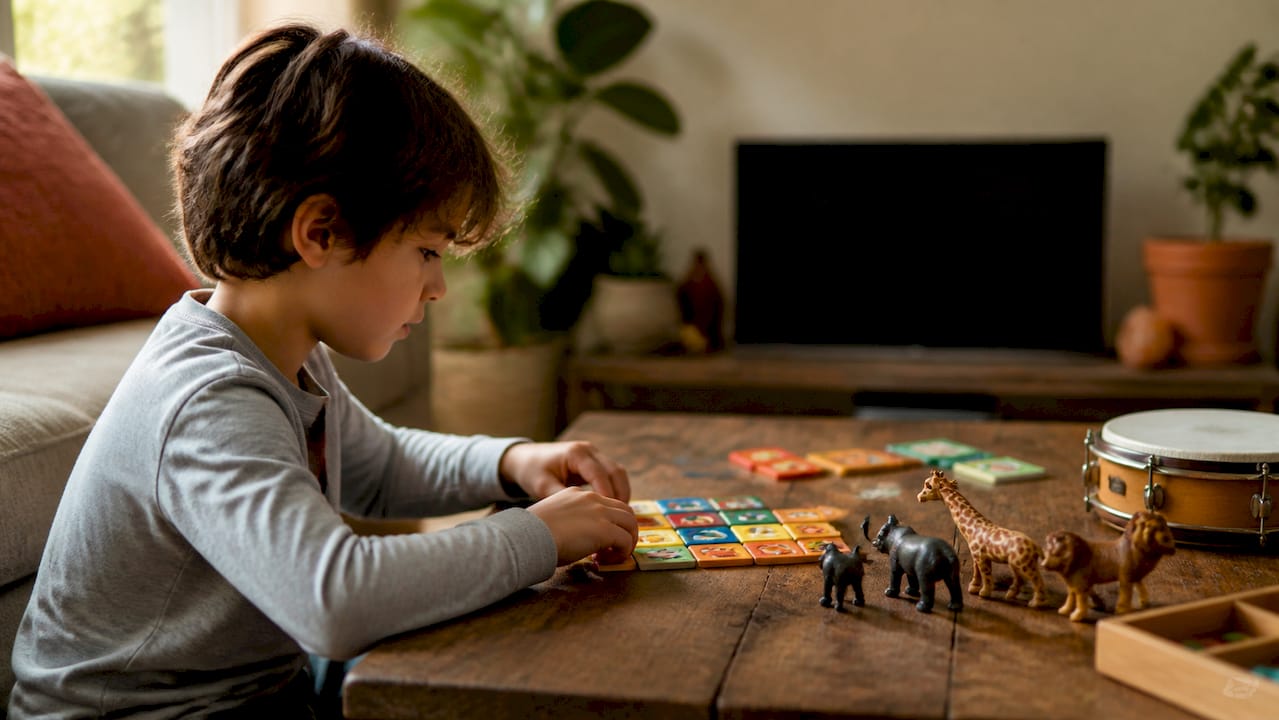
Clinical experts advise against waiting to see whether difficulties resolve on their own in immersion. Phonological awareness weaknesses should prompt assessment early, because the early grades are the most responsive window for literacy intervention.
Named tools used in Canada
| Tool | What it assesses | Who uses it |
|---|---|---|
| Acadience Reading Français | Phoneme segmentation, nonsense word fluency, oral reading fluency in French | School-based screening teams, orthopédagogues |
| ÉCLAIR | Comprehensive diagnostic reading profile in French, including phonological awareness, decoding, and comprehension | Orthopédagogues, clinical psychologists |
Both tools are named by Dyslexia Canada as appropriate for French immersion contexts. Ask your school team by name whether either has been administered.
Your checklist before a school meeting
- Bring a written list of specific reading behaviours you have observed at home (e.g., “skips small words,” “reads the same line twice,” “avoids reading aloud”).
- Ask whether a phonological awareness screener has been completed in French and request a copy of the results.
- Ask what the school’s next step is if the screener shows risk, and who on the team is trained in French literacy intervention.
- If your child has already been screened, ask whether a referral to an orthopédagogue or speech-language pathologist (S-LP) is appropriate.
- Request a follow-up meeting date before you leave.
What actually works: Structured Literacy for French reading
Structured Literacy, as defined by the International Dyslexia Association, is explicit, systematic, and cumulative instruction across phonology, sound-symbol mapping, morphology, and syntax. The same principles that drive reading gains in English apply directly to French, with adaptations for French orthography and morphology. LD@School confirms that Structured Literacy is equally applicable to French and that instruction must be explicit, systematic, and built around decodable texts tailored to French.
The core components a French tutor must address are:
- Phonological awareness: oral work with French phonemes, syllables, and rhyme before any print is introduced.
- Explicit phonics: teaching sound-spelling correspondences in French in a deliberate sequence, not incidentally.
- Morphology: French prefixes, suffixes, and verb endings taught as meaning-bearing units, not memorised as exceptions.
- Orthographic mapping: building the mental connections between spoken sounds and their written forms so words become automatic.
- Fluency: timed oral reading with decodable French texts, not levelled readers that encourage guessing.
- Vocabulary and comprehension: taught explicitly alongside decoding, not assumed to develop on their own.
In practice, a tutor using these methods might spend the first ten minutes of a session on oral phoneme work in French, move to a short explicit phonics lesson on a new sound-spelling pattern, then have the child read a decodable French passage that only uses patterns already taught. Multisensory spelling routines, such as Simultaneous Oral Spelling adapted for French, are also frequently cited by orthopédagogues as high-impact activities.
Pro Tip: Ask any prospective tutor to show you a sample decodable French reader they use. If they cannot name one, or if they rely on levelled readers where the child is expected to guess from pictures, that is a clear signal the approach is not Structured Literacy.
What French tutoring for dyslexia typically looks like
A well-structured session for a child with dyslexia is not a homework help session. It follows a deliberate sequence, and every component has a purpose. Here is what a typical session looks like:
- Warm-up review (5 minutes). The tutor revisits sounds, patterns, or words from the previous session. This retrieval practice strengthens long-term retention.
- Targeted skill instruction (15–20 minutes). One new phonics pattern or morphological concept is introduced explicitly, with examples, guided practice, and immediate corrective feedback.
- Decodable reading (10–15 minutes). The child reads a short French text composed only of patterns already taught. The tutor tracks errors and provides immediate, specific feedback.
- Spelling and writing (5–10 minutes). The child practises writing words and sentences using the new pattern, often using a multisensory routine.
- Home practice assignment (2 minutes). The tutor assigns a short, specific task the child can complete independently before the next session.
Frequency and intensity
For a child with moderate-to-severe dyslexia, multiple sessions per week improve the chance for meaningful progress. One session per week can maintain skills but rarely accelerates them. Intensive summer programmes with frequent sessions can produce significant gains within weeks.
Online versus in-person
Online tutoring is a practical and effective option for most families, particularly in Quebec where geography can limit access to specialists. A skilled tutor can deliver all Structured Literacy components through a shared screen, digital manipulatives, and video. The main advantage of in-person sessions is the ease of using physical letter tiles and hands-on materials, though many tutors have adapted these for online delivery. For children who are anxious or easily distracted, online sessions can actually reduce pressure by removing the social dynamics of a face-to-face setting.
Progress monitoring
A tutor should track fluency rates, accuracy percentages, and specific error patterns at every session, not just at the end of a term. Curriculum-based measures, such as one-minute oral reading fluency probes in French, give a quick, objective snapshot of growth. Ask your tutor to share a simple progress graph with you monthly. If a child is not showing measurable gains after six to eight weeks of consistent sessions, the approach needs to change.
How do you choose a French tutor for a child with dyslexia?
Credentials to look for
Not every French tutor is equipped to work with dyslexia. The credentials that matter most are:
- Structured Literacy training: look for Orton-Gillingham certification, a certificate in Structured Literacy from a recognised provider, or equivalent training documented in French literacy intervention.
- Orthopédagogue: a Quebec-trained specialist in learning disabilities and literacy; the most directly relevant credential for French literacy intervention.
- Speech-language pathologist (S-LP): particularly relevant when phonological processing deficits are severe or when oral language is also affected.
- Experience in French: training in Structured Literacy is not enough if the tutor has only applied it in English. Ask specifically about French materials and French phonics sequences.
Questions to ask in an interview
- “What phonics scope and sequence do you use for French?”
- “Can you show me an example of a decodable French text you use with students?”
- “How do you track progress between sessions, and how often will you share that data with me?”
- “How do you communicate with my child’s classroom teacher or school team?”
Red flags
A tutor who relies primarily on rote memorisation of word lists, encourages guessing from context or pictures, cannot name a specific French phonics sequence, or is unwilling to set measurable goals is not using evidence-based methods. Walk away.
Comparing tutor types
| Tutor type | Best for | Method | Coordination with school |
|---|---|---|---|
| Structured Literacy practitioner (French-trained) | Moderate to severe dyslexia; French immersion students | Explicit phonics, decodable texts, multisensory spelling | High; shares progress data and aligns with IEP goals |
| Orthopédagogue | Diagnostic clarity plus intervention; Quebec school system | Assessment-informed, Structured Literacy principles | High; often works directly with school teams |
| General French tutor | Mild difficulties; grade-level support | Varies; may not use Structured Literacy | Low to moderate |
| Bilingual classroom tutor | Bridging English and French phonics; transitional support | Varies; depends on training | Moderate |
Working with the school: IEPs, accommodations and collaborative plans
An Ontario study found that French immersion teachers generally support including students with reading disabilities but often lack the confidence and French-language resources to do so effectively. That gap is real, and it means parents often need to advocate clearly and specifically.
Common accommodations that help children with dyslexia in French class include:
- Extra time on reading and writing tasks (typically some additional time).
- Access to audiobooks or text-to-speech tools in French (apps such as Balabolka or built-in screen readers on school devices).
- Alternate response formats, such as oral answers instead of written ones.
- Reduced copying from the board, with printed notes provided instead.
- Seating near the teacher to allow for quiet verbal prompts.
To request an Individual Education Plan (IEP) or a school team meeting, put your request in writing and address it to the principal and classroom teacher together. Bring your child’s screening results, a sample of recent written work, and a short written list of specific accommodations you are requesting. The more concrete your request, the faster the school can act.
Consistency between tutor and teacher is the piece most families overlook. Ask your tutor to write a brief monthly summary of the skills being taught and share it with the classroom teacher. When the teacher uses the same terminology for a phonics pattern that the tutor introduced, the child’s brain consolidates the learning twice as fast. A simple shared vocabulary list, even one page, makes a meaningful difference.
For parents who are not fluent in French themselves, this guide for non-French parents offers practical strategies for supporting your child at home without needing to be a French speaker.
Canadian resources, screeners and diagnostic tools to ask about
| Resource | Type | What it provides |
|---|---|---|
| Dyslexia Canada | National organisation | Guidance on French immersion, tool recommendations, parent resources |
| Acadience Reading Français | Screener | Quick phonological and fluency checks in French for school-based use |
| ÉCLAIR | Diagnostic tool | Comprehensive French reading profile for orthopédagogues and psychologists |
| LD@School | Ontario-based resource hub | Evidence-based teaching strategies and French literacy resources for educators |
| International Dyslexia Association (IDA) Canada chapters | Professional network | Referrals to Structured Literacy practitioners; training information |
Provincial notes: In Quebec, orthopédagogues are the primary specialists for French literacy assessment and intervention; most school boards have at least one on staff. In Ontario, French immersion schools vary widely in their access to French-language specialists, and private assessment through a registered psychologist or S-LP is often faster than waiting for a school referral. In Alberta, French immersion programmes are growing, and the Alberta Regional Professional Development Consortia have begun offering Structured Literacy training in French, though access remains uneven.
For a broader look at improving French reading skills, Réussite A+ has published practical exercises and case studies relevant to Quebec students.
What the research says and what it means for your child
The evidence on dyslexia and French immersion points in a consistent direction, even when individual study results vary.
- Students with reading disabilities who receive proper, evidence-based supports in French immersion can perform comparably to peers in English programmes, though individual monitoring remains essential because results across studies are mixed.
- Dyslexia Canada emphasises that coordinated supports in both English and French produce the best long-term outcomes, since phonological deficits affect both languages simultaneously.
- Early identification consistently improves outcomes. The early grades are the most brain-responsive window for literacy intervention, and waiting to see whether difficulties resolve on their own costs intervention time that cannot be recovered.
- LD@School confirms that Structured Literacy principles transfer directly to French instruction, with adaptations for French orthography and morphology.
- French immersion can reveal dyslexia earlier than an English-only programme would, and that earlier visibility is an opportunity, not a reason to withdraw.
The practical implications are straightforward: screen early, require Structured Literacy from any tutor or specialist, monitor progress with objective measures, and coordinate between home, tutor, and school.
Research snapshot: Students with dyslexia who receive early, evidence-based Structured Literacy instruction in French show measurable reading gains and, with appropriate supports, can remain successfully in French immersion programmes.
What we see in practice: a note from Réussite A+
Working with children who have dyslexia in French has taught us one thing above all else: the moment a child realises that reading is learnable, not a fixed talent they either have or do not, something shifts. We see it regularly. A child who has been avoiding reading aloud for two years starts volunteering to read after six weeks of consistent, structured sessions. That change is not magic. It is the result of teaching phonics explicitly, in sequence, with decodable texts the child can actually decode.
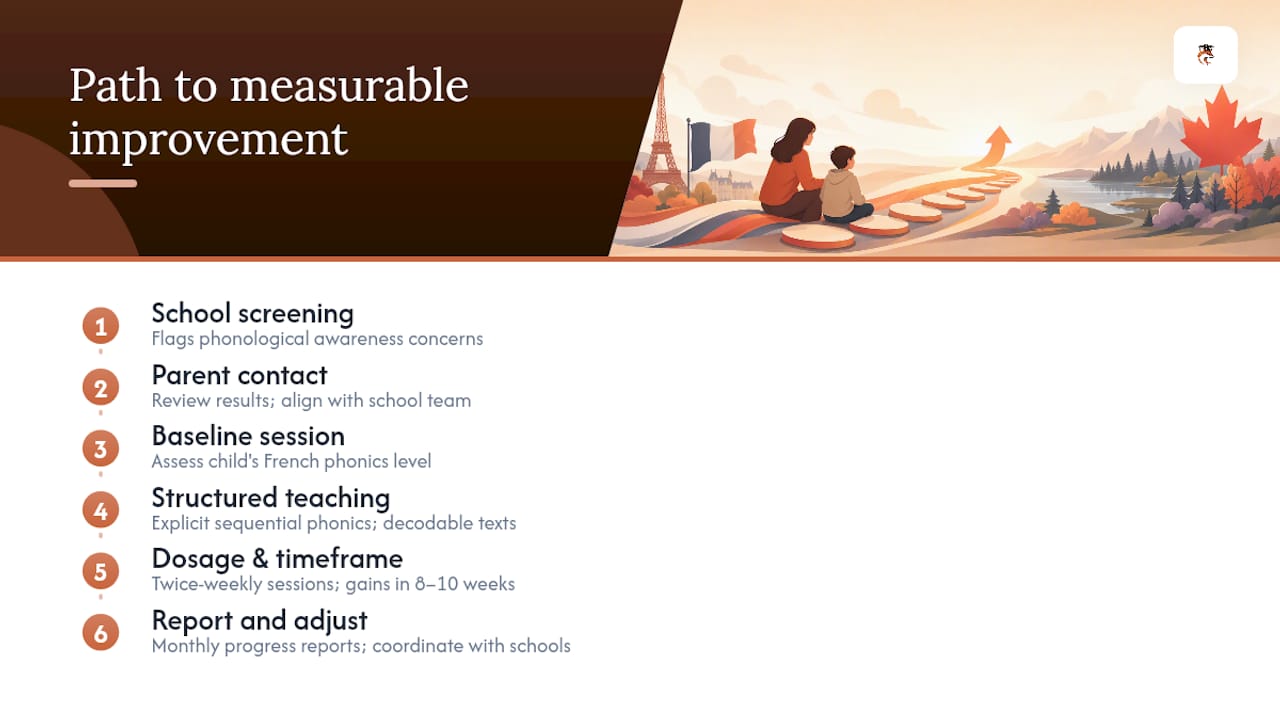
The path from screening to measurable improvement typically looks like this: a parent contacts us after a school screening flags phonological awareness concerns. We review the results, align our approach with the school team’s goals, and begin with a baseline session to understand exactly where the child’s French phonics knowledge starts. Within eight to ten weeks of twice-weekly sessions, most children show measurable gains in oral reading fluency. We share those numbers with parents and teachers every month, in plain language, so everyone is working from the same picture.
Our commitment is simple: we coordinate with schools, we report progress clearly, and we adjust when something is not working. A child’s reading trajectory is not fixed at age seven. With the right support, it changes.
Réussite A+ supports children with dyslexia in French
Réussite A+ offers personalised online French tutoring built around each child’s specific profile, including students with dyslexia or reading difficulties in French. Every tutoring plan starts with a baseline session to identify exactly where gaps exist, then builds a structured sequence of explicit phonics, phonological awareness work, and decodable French reading practice tailored to that child’s pace.
Sessions are delivered online with flexible scheduling across Quebec, and tutors maintain regular communication with school teams so that classroom instruction and tutoring stay aligned.
The first step is simple: register for a tutoring session and tell us about your child’s current French reading level and any assessments already completed. From there, we build a plan together.
Sources
- French immersion – Dyslexia Canada
- The suitability of French immersion education for students with reading disabilities
- Is my child struggling because of French immersion or something more? — Chickadee Psychology
- Reading and learning disabilities in French as a second language — LD@School
- Ontario French immersion teachers’ perceptions of including students with reading disabilities
- What is structured literacy? — International Dyslexia Association
FAQ
Can a child with dyslexia learn French successfully?
Yes. Research shows that students with reading disabilities who receive proper, evidence-based supports in French immersion can perform comparably to peers in English programmes. Success depends on early identification and Structured Literacy instruction adapted to French.
Should I get a tutor for my child with dyslexia in French?
A specialised tutor is worth pursuing when classroom instruction alone is not closing the gap. Look for someone with explicit Structured Literacy training in French, not a general French tutor, since the methods required for dyslexia are specific and evidence-based.
What is the best tutoring approach for dyslexia in French?
Structured Literacy is the evidence-based standard: explicit, systematic instruction in phonological awareness, phonics, morphology, and fluency using decodable French texts. Réussite A+ builds its French tutoring programmes around these principles, adapted to each child’s current level.
Does French immersion make dyslexia worse?
No. French immersion does not cause or worsen dyslexia. It can make an existing phonological weakness visible earlier, which is actually an advantage if it prompts faster assessment and intervention. Dyslexia Canada recommends keeping children in immersion with appropriate supports rather than transferring them out without first trying evidence-based intervention.
What language is easiest for a child with dyslexia to learn?
Languages with more transparent orthographies, where spelling patterns map consistently to sounds, tend to be somewhat easier to decode. French is more transparent than English in several respects, though its morphological complexity adds its own challenges. The most important factor is not the language itself but whether instruction is explicit, systematic, and phonics-based.