



Dyscalculia is a neurodevelopmental difficulty with number sense — not a sign of low intelligence or a lack of effort. Children and adults with dyscalculia process numerical information differently at the brain level, and the signs show up in predictable ways across every age group. If you are wondering whether what you are seeing is more than ordinary math struggles, these are the red flags to watch for right now:
- Persistent trouble connecting numerals to quantities (e.g., knowing “5” but not grasping what five objects looks like)
- Continued reliance on finger counting well past the age when peers have moved on
- Slow, inconsistent recall of basic math facts despite repeated practice
- Difficulty managing money, making change, or estimating costs
- Confusion with time — reading clocks, estimating how long tasks take, or planning a schedule
- Persistent errors on multi-step problems even when the individual steps are explained clearly
If three or more of these patterns persist despite good instruction, the most useful thing you can do right now is log three specific classroom or home examples with dates and share them with your child’s teacher or school psychologist. That documentation is what moves a concern into a formal screening request.
Key takeaways
Dyscalculia is a neurodevelopmental condition affecting number sense that requires targeted, personalised intervention — not more practice of the same approach that has not worked.
| Point | Details |
|---|---|
| Recognise the signs early | Persistent finger counting, place-value errors, and fact-recall gaps that don’t close with instruction are the clearest early indicators. |
| Signs shift with age | Number-sequence problems in preschool become fact-recall gaps in elementary school and money/time difficulties in adults. |
| Up to 60% have comorbidities | Working memory issues, ADHD, and visuospatial deficits often co-occur, making comprehensive assessment more effective than math testing alone. |
| Canada-specific pathway | Start with the classroom teacher and SERT for free school-based screening; private psychoeducational assessment typically costs $2,000–$4,000 and produces a diagnostic report with recommendations. |
| Réussite A+ personalised tutoring | Réussite A+ builds math tutoring plans around each student’s specific profile, with progress tracking and alignment to assessment recommendations. |
Table of Contents
- What are the dyscalculia signs that point to a real learning difference?
- How do dyscalculia signs change from preschool through adulthood?
- How does dyscalculia affect emotions and daily life?
- What causes dyscalculia and which conditions often appear alongside it?
- How is dyscalculia assessed in Canada?
- What supports and interventions actually help?
- What does effective personalised tutoring look like?
- What should you do right now if you suspect dyscalculia?
- What Réussite A+ has seen working with students who struggle with numbers
- Réussite A+ offers personalised math tutoring built around your child’s needs
- Sources
- FAQ
What are the dyscalculia signs that point to a real learning difference?
Dyscalculia is a specific learning disability in mathematics rooted in atypical brain processing of number sense. The Cleveland Clinic describes it as a condition that affects a person’s ability to understand numbers and learn math facts, and it is distinct from the ordinary variation in math ability that teachers see every day.

Three things commonly get confused with dyscalculia, and telling them apart matters for getting the right help.
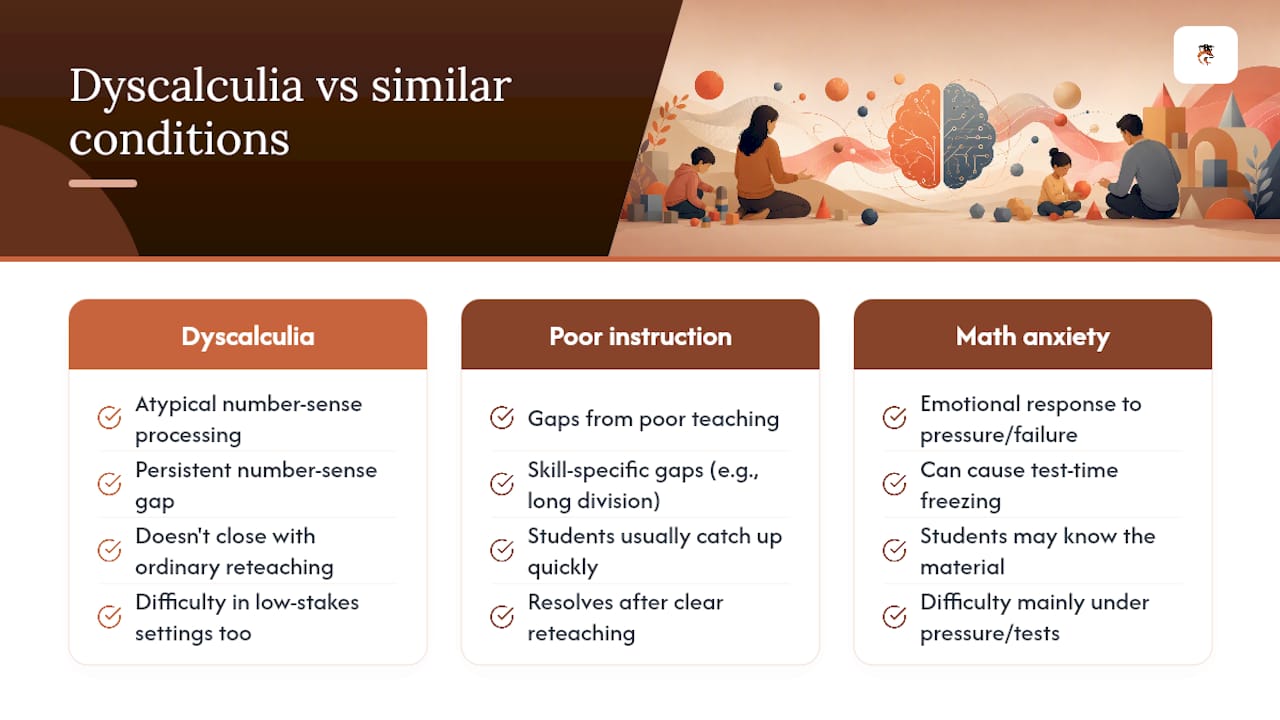
Poor instruction leaves gaps in specific skills — long division, for example — but students can usually catch up quickly once the concept is re-taught clearly. Dyscalculia creates a persistent number-sense gap that does not close with ordinary re-teaching.
Math anxiety is an emotional response, often triggered by past failure or pressure. It can make a student freeze during tests even when they know the material. Dyscalculia, by contrast, affects number processing itself — the difficulty is present even in low-stakes, one-on-one settings.
General learning difficulties affect many academic areas broadly. Dyscalculia is specific: a student may read fluently, write well, and struggle almost exclusively with numerical tasks.
Dyscalculia affects a small but significant portion of the population. Up to 60% of students with dyscalculia also have comorbid difficulties such as impaired working memory, visuospatial deficits, or ADHD — which is why a thorough assessment looks at more than just math scores.
How do dyscalculia signs change from preschool through adulthood?
Signs shift as the curriculum grows more demanding. Early number-sense problems progress to fact-recall and multi-step problem difficulties in older students, so the checklist below is organised by developmental stage.
Preschool and kindergarten (ages 3–6)
- Difficulty learning to count in sequence or skipping numbers consistently
- Trouble matching a numeral to a group of objects (pointing to “3” but not understanding three apples)
- Struggles recognising simple patterns or sorting objects by size
- Avoidance of number games that peers enjoy
What to document: Note specific counting errors during play or snack time — “counted to 7 but skipped 4 and 5 three times this week.”
Elementary school (Grades 1–5)
This is where dyscalculia indicators become most visible. Students who have not mastered basic number sense by Grade 2 or 3 will show it clearly as the curriculum accelerates.
- Slow or inconsistent recall of addition and subtraction facts, even after extensive drill
- Persistent finger counting when peers have moved to mental strategies
- Place-value errors — writing 51 instead of 15, or confusing tens and ones
- Misreading operation signs (adding when the question says subtract)
- Difficulty telling time on an analogue clock
When to be concerned: If targeted small-group instruction over six to eight weeks produces little change, that persistence is a meaningful signal. AboutKidsHealth notes that students with math disabilities often struggle specifically with one-to-one correspondence and the rules of operations even after repeated exposure.
Middle school (Grades 6–8)
- Difficulty with fractions, ratios, and percentages
- Trouble estimating — answers that are wildly off without the student noticing
- Multi-step word problems feel impossible even when reading comprehension is strong
- Confusion handling money in real-life situations like a school canteen
- Inconsistent test performance that does not reflect effort
What to document: Save marked tests showing the same type of error recurring across different units.
High school and adults
Abstract mathematics amplifies every foundational gap. Algebra, rates, and data interpretation all require the number sense that was shaky from the start. Understood highlights that teens often develop avoidance strategies — choosing courses that minimise math, or relying heavily on calculators without understanding whether the answer is reasonable.
Adults with unidentified dyscalculia commonly report:
- Difficulty budgeting or tracking expenses, often avoiding financial tasks entirely
- Trouble calculating tips, splitting bills, or comparing prices
- Chronic lateness linked to poor time estimation
- Getting lost easily due to spatial orientation difficulties
- Workplace struggles with data, scheduling, or any role requiring numerical reasoning
Many adults were never assessed as children. Recognising these patterns in yourself is the first step toward getting support that actually fits the problem.
How does dyscalculia affect emotions and daily life?
Dyscalculia commonly triggers math anxiety, avoidance behaviour, and a lasting dent in academic confidence — and those effects extend well beyond the classroom.
- Math anxiety: Repeated failure in a subject that peers seem to find manageable creates genuine fear around number tasks. The anxiety then compounds the difficulty, making it harder to access even the skills a student does have.
- Avoidance: Students may choose electives, hobbies, and eventually careers based on what does not involve numbers, narrowing their options without realising why.
- Self-esteem: Because dyscalculia is invisible and often misread as laziness, many students internalise the message that they are “just bad at math.” That belief can persist into adulthood.
- Daily tasks: Telling time, following a recipe, managing a transit schedule, estimating travel time, and handling cash all require the number sense that dyscalculia disrupts. The daily-life impact is real and cumulative.
One distinction worth making clearly: math anxiety and dyscalculia are not the same thing, though they often travel together. Anxiety is an emotional state that can result from dyscalculia; dyscalculia is a neurological processing difference. Treating only the anxiety without addressing the underlying number-sense difficulty rarely produces lasting improvement.
What causes dyscalculia and which conditions often appear alongside it?
Dyscalculia is neurodevelopmental. It stems from differences in how the brain processes numerical information, particularly in regions associated with number sense and quantity representation. It runs in families, suggesting a genetic component, and it is present from birth — not caused by poor teaching or lack of motivation.
Up to 60% of students with dyscalculia have at least one co-occurring difficulty, which shapes both assessment and intervention:
- Working memory impairments: Holding numbers in mind while calculating is harder, making multi-step problems especially taxing.
- ADHD: Both conditions can look like disorganisation and time-management problems. Careful task analysis focused on number-sense performance helps tell them apart. Psychology Today Canada notes that dyscalculia is frequently mistaken for attention issues.
- Visuospatial processing differences: Difficulty mentally rotating shapes or tracking position in space affects column alignment in arithmetic and spatial reasoning in geometry.
- Language processing difficulties: Word problems require both reading comprehension and numerical reasoning; a language difficulty can mask or amplify dyscalculia.
Before any diagnosis is made, assessment must rule out poor instruction or language barriers as the primary cause of the difficulty. A student who has had inconsistent schooling or is learning in a second language needs a different kind of support than one with a genuine processing difference.
If your child also shows signs of ADHD, reading these strategies for students with ADHD alongside dyscalculia guidance can help you build a more complete picture.
How is dyscalculia assessed in Canada?
The pathway from concern to confirmed diagnosis follows a clear sequence, though timelines and costs vary by province.
Step-by-step assessment pathway
- Talk to the classroom teacher. Share your documented examples and ask whether the teacher has observed similar patterns. Request a meeting with the special education resource teacher (SERT) or equivalent.
- School-based screening. The SERT or school psychologist administers brief screening tools to identify whether a full assessment is warranted. This is typically free through the public school system.
- Referral for full assessment. If screening flags concerns, the school may refer internally to a school psychologist, or the family may choose a private educational psychologist or neuropsychologist.
- Full psychoeducational or neuropsychological assessment. This includes standardised tests of academic achievement, cognitive processing, working memory, and visuospatial skills. The assessor rules out other explanations and documents the specific profile.
- Written report and recommendations. The report outlines the diagnosis (if applicable), the student’s specific strengths and difficulties, and recommended accommodations and interventions for school and home.
Screening vs. full assessment
School-based screening is brief (30–60 minutes), conducted by a SERT or school psychologist, and identifies students who need further evaluation. It does not produce a diagnosis. Cost: typically covered by the school board.
Full psychoeducational assessment takes 6–10 hours across multiple sessions, is conducted by a registered psychologist or neuropsychologist, and produces a detailed diagnostic report with recommendations. Private assessment in Canada typically ranges from approximately $2,000 to $4,000, though some provincial health plans, employee benefit plans, or insurance policies cover part of the cost. School board assessments are free but wait times can extend to one to two years in many provinces.
Questions to ask an assessor:
- Which standardised tools will you use to assess number sense specifically?
- Will the assessment include working memory and visuospatial processing?
- How will the report translate into school accommodations or an IEP?
- What is the typical turnaround time for the written report?
For Canadian families, the Learning Disabilities Association of Canada (LDAC) maintains a directory of provincial member associations that can help locate registered assessors and navigate school board processes.
What supports and interventions actually help?
Targeted, individualised instruction and accommodations significantly reduce the functional impact of dyscalculia. The goal is not to “fix” the brain but to build genuine number-sense skills while removing unnecessary barriers to demonstrating knowledge.
Classroom accommodations to request:
- Extended time on tests and assignments involving calculation
- Use of manipulatives (counters, base-ten blocks, number lines) during instruction and assessment
- Access to a calculator for computation when the learning goal is reasoning, not arithmetic
- Graph paper or lined paper turned sideways to support column alignment
- Alternative assessment formats (oral responses, untimed tasks)
- Visual supports: anchor charts, multiplication grids, formula sheets
Targeted interventions go beyond accommodations. Effective intervention combines explicit number-sense instruction, manipulatives and visual supports, working-memory scaffolds, and distributed practice tied to mastery criteria rather than time-on-task. Apps like Prodigy Math and Number Pieces (by the Math Learning Centre) offer structured, visual practice. Visual timers such as Time Timer help students with time perception difficulties manage transitions and task pacing.
Progress monitoring matters as much as the intervention itself. Teachers and tutors should track specific skills weekly — not just overall grades — and update IEPs or referral documentation when measurable gains appear. For more structured approaches, math intervention programme options can give you a clearer sense of what different levels of support look like.
What does effective personalised tutoring look like?
Effective tutoring for a student with dyscalculia is personalised, diagnostic, progress-monitored, and aligned with the recommendations in the assessment report. A tutor who simply re-teaches the same curriculum faster is not the right fit.
What to look for in a tutor or programme
A strong tutor begins with a diagnostic session to identify exactly which number-sense skills are solid and which are shaky — not just “Grade 4 math” but specifically whether the student understands quantity, can decompose numbers flexibly, and has reliable strategies for basic facts. From there, the plan targets those specific gaps in a deliberate sequence, because math skills build cumulatively. Missing place value makes fractions impossible; shaky fractions make algebra painful.
Progress data should be visible and shared with parents regularly. Ask to see session notes or a simple tracking chart showing which skills have been introduced, practised to fluency, and maintained over time. A tutor who cannot show you this data is working without a map.
Curriculum alignment is the third piece. The tutor’s plan should connect directly to what the student’s school expects, so gains transfer to the classroom. If your child has an IEP or assessment report, share it with the tutor before the first session.
A concrete example of a personalised plan
A Grade 5 student struggling with multiplication and place value might begin with three weeks of structured work on grouping and quantity (using base-ten blocks and visual arrays), then move to skip-counting strategies tied to multiplication facts, then to two-digit by one-digit multiplication using a partial-products method before the standard algorithm. Each skill is practised until the student reaches a fluency target, not just until the session ends.

Pro Tip: When interviewing a tutor, ask: “How will you know when my child has truly mastered a skill, not just completed it?” A tutor who answers with a specific fluency criterion or mastery check is thinking diagnostically. A tutor who says “when they seem comfortable” is not.
What should you do right now if you suspect dyscalculia?
Act now if multiple dyscalculia warning signs persist despite good instruction. Here is a clear sequence to follow.
- Document three to five specific examples with dates, subject, and what the student did (e.g., “October 14 — reversed digits in every two-digit number on the place-value worksheet”).
- Request a meeting with the classroom teacher to share your observations and ask whether they have noticed the same patterns.
- Ask the teacher to involve the SERT (special education resource teacher) or equivalent, and request a school-based screening for math learning difficulties.
- Request interim accommodations while the screening proceeds — extended time, use of a number line, and access to manipulatives are reasonable starting points that most schools can provide immediately.
- Consider a private assessment if the school wait time is long and the difficulties are significantly affecting your child’s confidence or grade-level progress.
Template phrases for parent-teacher meetings:
- “I’ve noticed [specific pattern] at home consistently over the past [timeframe]. Has this come up in class?”
- “I’d like to formally request a screening for a possible math learning disability. Who do I speak with to start that process?”
- “While we wait for screening, what accommodations can we put in place this week?”
If your child is struggling with math more broadly, these steps apply whether or not dyscalculia turns out to be the cause.
What Réussite A+ has seen working with students who struggle with numbers
Working with students who have number-sense difficulties over more than 25 years, one thing stands out clearly: the earlier the support is personalised, the faster confidence returns. Many of the students who arrive at Réussite A+ have already spent years believing they are simply “not math people.” What they actually needed was instruction that started where their understanding genuinely was, not where the curriculum assumed it should be.
Assessment and targeted instruction can improve both skills and daily functioning. The goal is not perfection — it is giving a student enough number sense to navigate school, and eventually life, without the constant friction that unaddressed dyscalculia creates. That is achievable. It takes the right plan, consistent practice, and a tutor who tracks progress rather than just covering content.
Réussite A+ offers personalised math tutoring built around your child’s needs
Families in Quebec dealing with dyscalculia or persistent math difficulties have a concrete next step available. Réussite A+ provides personalised online math tutoring for elementary and secondary students, with every plan built around the student’s specific profile — not a generic curriculum sequence.
Each Réussite A+ tutor is selected from the university level for both academic excellence and teaching ability. Sessions are flexible, online, and structured around measurable goals, with progress tracked and shared with parents throughout. If your child has an assessment report, that report informs the tutoring plan directly. If assessment is still pending, the intake process identifies the specific gaps to target in the meantime.
School supports, private psychologists, and provincial programmes are all valid parts of the picture, and Réussite A+ works alongside them rather than replacing them. To learn more about how sessions are structured or to register, visit the tutoring and homework help page or explore the learning techniques for math Réussite A+ uses with students.
Sources
The sources below were selected for their Canadian relevance, clinical authority, or age-based sign guidance.
- Ate mathematics diagnosed
- Learning-Disabilities-in-Mathematics-Handout.pdf
- Dyscalculia: What It Is, Causes, Symptoms & Treatment
- Signs of dyscalculia at different ages
- Math disabilities: Overview
This article is general information, not a substitute for advice from a qualified doctor. Consult a qualified healthcare professional about your own circumstances before acting on anything here.
FAQ
How do I tell if my child has dyscalculia rather than just weak math skills?
Look for a persistent gap in number sense that does not close after targeted re-teaching — specifically, trouble connecting numerals to quantities, consistent place-value errors, and slow fact recall even after extensive practice. If these patterns appear across multiple settings and persist despite good instruction, a formal screening is the right next step.
What does dyscalculia look like in adults?
Adults with dyscalculia often avoid financial tasks, struggle to calculate tips or compare prices, are chronically late due to poor time estimation, and find data-heavy work stressful. Many were never assessed as children and have developed workarounds that mask the difficulty until demands increase.
Can you have mild dyscalculia?
Yes. Dyscalculia exists on a spectrum. A person with a milder profile may manage adequately in early grades but hit a wall when the curriculum becomes more abstract, typically around Grade 5 or when fractions and algebra are introduced. Mild presentations are often identified later precisely because compensatory strategies delay the visible impact.
What aspects of daily life do people with dyscalculia struggle with most?
Beyond school math, the most commonly reported difficulties include managing money and budgeting, reading clocks and estimating time, following recipes with measurements, navigating spatial directions, and any workplace task involving numerical data or scheduling.