


The single most reliable way to build foundational math skills at home or school is a short, grade-by-grade shortlist of curriculum-aware workbooks paired with consistent daily practice. Here are the top picks for Canadian parents and educators, from Pre-K through Grade 9.
Quick shortlist:
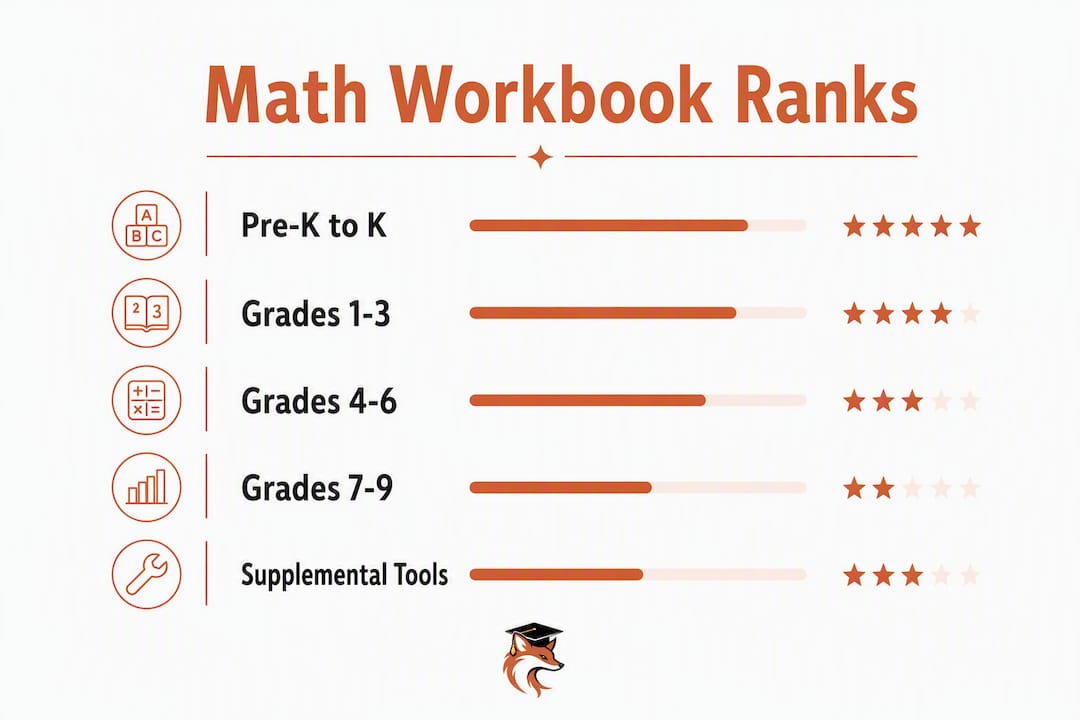
- Pre-K / Kindergarten: Scholastic Early Learners workbooks — gentle number sense, colourful, low-pressure
- Grades 1–3: Math Mammoth Light Blue series — thorough, affordable, strong on place value and operations
- Grades 4–6: Singapore Math Primary Mathematics — rigorous problem solving, excellent progression
- Grades 7–9: Kumon workbooks (pre-algebra and algebra) — structured drill with clear answer keys
- Curriculum-aligned (all grades): Pearson Mathology practice workbooks — designed specifically for Canadian provincial curricula
Canadian curriculum alignment is the deciding factor when choosing between otherwise similar titles. A workbook that uses different terminology or skips strands your child’s teacher is covering creates confusion rather than confidence. Aim for daily practice sessions that are short and consistent, with durations increasing as children grow older and their skills develop. Short and regular beats long and occasional, every time.
Table of Contents
- The best math workbooks at a glance: quick comparison
- What works best for pre-K and kindergarten
- Best workbooks for Grades 1–3: building foundations and fluency
- Best workbooks for Grades 4–6: fractions, multi-digit arithmetic, and problem solving
- Best workbooks for Grades 7–9 and enrichment
- Specialised and supplemental workbooks for targeted practice
- How to choose the right math workbook for your child
- How to use a workbook effectively: routines, tracking, and parent scripts
- Why curriculum alignment matters for Canadian families
- Key takeaways
- A Réussite A+ educator’s perspective on workbooks
- When tutoring complements workbooks: how Réussite A+ can help
- Useful sources and further reading
- FAQ
The best math workbooks at a glance: quick comparison
Each of the picks below fills a distinct role. The goal is not to buy them all — it is to match one or two to your child’s current needs.
| Title / Series | Best for | Grade range | Canadian curriculum alignment | Format and extras | Price range (CAD) |
|---|---|---|---|---|---|
| Scholastic Early Learners | Number sense, pre-reading skills | Pre-K – K | Low (general North American) | Sticker rewards, colour pages, no answer key needed | $8–$14 |
| Math Mammoth Light Blue | Conceptual foundations, operations | Grades 1–7 | Medium (adaptable) | Worked examples, answer key, reproducible PDFs | $30 (download) |
| Singapore Math Primary Mathematics | Problem solving, multi-step reasoning | Grades 1–6 | Medium | Textbook + workbook pairs, answer key | $20 per level |
| Kumon workbooks | Fluency and drill, self-paced practice | Pre-K – Grade 9+ | Low (skill-based, universal) | Timed pages, answer key, incremental steps | $10–$16 per book |
| Pearson Mathology | Curriculum-aligned independent practice | Grades K–6 | High (provincial strands) | Mixed question types, teacher notes, unit-based practice | School/district pricing |
| Perceptions Math (Canadian edition) | Intensive intervention, gap-filling | Grades 3–8 | High (Canadian edition) | 16-week programme, instruction manual, video option | Bundle pricing |
Easiest to source in Canada: Scholastic, Kumon, and Singapore Math titles are widely stocked at Indigo, Costco, and Amazon.ca. Pearson Mathology is ordered through Pearson Canada’s school channel. Perceptions Math ships directly from mathcanada.ca.

What works best for pre-K and kindergarten
At this stage, the goal is number sense — counting with meaning, recognising quantities, and connecting numerals to real objects. A workbook that feels like a game wins every time.
- Scholastic Early Learners (Numbers 1–20, Shapes, Patterns): — Bright pages, sticker rewards, and activities that take 5–10 minutes. The main strength is accessibility; no reading required. The one limitation is that it does not follow a specific provincial curriculum, so treat it as a warm-up rather than a curriculum substitute.
Pro Tip: Match the workbook to your child’s functional skill level, not their age. A four-year-old who already counts to 30 confidently will disengage from a book that spends ten pages on counting to 5. Start one level below where you think they are — early success builds momentum.
Sessions at this age should stay at 10–15 minutes maximum. Stopping while the child still wants to continue is far more productive than pushing through to the end of a page.
Best workbooks for Grades 1–3: building foundations and fluency
Grades 1–3 are where number sense becomes arithmetic fluency. The workbooks that work best here combine clear explanations with enough varied practice to move skills from “understood” to “automatic.”
- Math Mammoth Light Blue series (Grades 1–3): Conceptual explanations appear right on the student page, so children do not need a separate textbook. Strong on place value, addition and subtraction with regrouping, and early multiplication. Reproducible PDFs make it cost-effective for home use. The spiral-within-mastery structure means a topic is taught thoroughly before moving on, which suits children who need to consolidate before progressing. One caution: the visual design is functional rather than engaging, which can feel dry for younger students.
- Singapore Math Primary Mathematics (Standards Edition, Grades 1–3): The bar-model method it introduces in Grade 2 is one of the most transferable problem-solving tools a child can learn. Pairs a textbook with a separate workbook, so the upfront cost is higher, but the conceptual depth is excellent. Alignment to Ontario and BC curricula is medium — the core strands match, but terminology occasionally differs.
- Kumon Grade 1–3 workbooks (Addition, Subtraction, Multiplication): Pure fluency practice. No explanations, just incremental drill. Best used alongside a conceptual resource rather than alone. Answer keys are clear and complete.
- Scholastic Grade-Level Practice workbooks (Grades 1–3): Affordable, widely available, and loosely aligned to North American grade expectations. A reliable choice for general review or summer practice. Teacher notes are minimal, but the question variety is good.
- Pearson Mathology practice workbooks: The strongest curriculum alignment of any option on this list for Canadian classrooms. Mathology practice workbooks cover multiple strands, include unit-based practice, and come with teacher-facing notes that help parents understand what the classroom is targeting. Ordering through the school channel is the norm, but individual copies can sometimes be sourced through school supply retailers.
Statistic to know: Canadian education research consistently supports short, regular practice over long infrequent sessions. Even 10 minutes of focused daily work maintains skill retention and reduces learning loss over school breaks.
Best workbooks for Grades 4–6: fractions, multi-digit arithmetic, and problem solving
Upper elementary is where many children hit their first real wall in math. Fractions, long division, and multi-step word problems all arrive at once. The workbooks that help most at this stage are the ones that show the thinking, not just the answer.
- Singapore Math Primary Mathematics (Grades 4–6): The bar-model method scales beautifully into fractions and ratio problems. Worked examples are embedded in the textbook component, and the workbook provides graded practice. Best for children who are ready to be challenged. Moving a child back to Grade 3 Singapore Math if they are struggling with Grade 4 material is a legitimate and effective strategy.
- Math Mammoth Light Blue (Grades 4–6): Worked examples appear on the student page, which means a child can self-correct and self-teach to a degree. The fractions chapters are particularly thorough. Answer keys are complete with solutions, not just final answers — a genuine advantage for parents who want to understand where a child went wrong.
- Kumon Fractions and Decimals workbooks: Targeted drill for the specific skills that trip up most Grade 4–6 students. No worked examples, but the incremental structure means errors are caught early. Use these alongside a conceptual resource for best results.
- Scholastic Grade 4–6 Practice workbooks: Good for mixed review and consolidation. Word problems are present but not the focus. Useful as a low-pressure supplement during the school year.
- DK Workbooks: Math (Grades 4–6): Clear visual layout with step-by-step worked examples for each topic. One of the more parent-friendly options because the explanations are written for the child to read independently. The progression within each topic is logical, though the overall scope is slightly narrower than Math Mammoth.
When to move a child up or back: If a child completes a page with fewer than two errors consistently for a full week, move up. If errors cluster around the same concept across multiple pages, drop back one level and work that strand until it is solid before advancing.
Best workbooks for Grades 7–9 and enrichment
Middle school math in Canada covers proportional reasoning, introductory algebra, and geometry. The right workbook depends on whether the goal is remediation, grade-level consolidation, or enrichment for a student who is ready to go further.
- Kumon Algebra workbooks (Pre-Algebra, Algebra 1): Structured, self-paced, and clear. Excellent for students who need to build algebraic fluency through repetition. The incremental steps make abstract concepts feel manageable. Best for remediation and consolidation rather than enrichment. For Grade 7–9 support, pairing Kumon with a tutor or teacher check-in is more effective than using it alone.
- Math Mammoth (Grades 7–8 pre-algebra): Conceptual explanations remain strong at this level. The pre-algebra content covers integers, ratios, percentages, and introductory equations with worked examples throughout. A solid choice for a student who needs to fill gaps before a secondary school entrance exam.
- Perceptions Math (Canadian edition): Designed as an intensive intervention programme over a 16-week sequence. Includes student workbooks, an instruction manual, and optional video support. Best suited to students with significant gaps who need structured remediation rather than light review. Canadian pricing is available directly through mathcanada.ca.
- Art of Problem Solving (AoPS) Introduction to Algebra: For mathematically curious students who are ready to be stretched, AoPS is in a different category from drill workbooks. Problems require genuine reasoning rather than procedure application. Not a curriculum supplement — a challenge programme for students who find grade-level work easy.
- Beast Academy (Grades 3–5, with bridge to middle school): Combines comic-book style guides with rigorous practice books. Excellent for enrichment at the upper-elementary to middle-school transition. The problems are genuinely hard, and the format keeps engagement high.
For students preparing for secondary school entrance exams, exam preparation resources that mirror the format of the specific exam are more useful than general workbooks alone.
Specialised and supplemental workbooks for targeted practice
Sometimes the goal is narrow: faster recall, stronger logic, or a specific test format. These workbook types fill those gaps without replacing a core programme.
- Mental math workbooks (e.g., Kumon Mental Math, Canadian Curriculum Press Mental Math): Best for daily 5-minute warm-ups. Builds number fluency and reduces cognitive load for multi-step problems. Pair with mental math strategies for maximum effect.
- Times tables workbooks (e.g., Scholastic Times Tables Practice, Kumon Multiplication): Timed pages with answer keys. Use for a focused 4–6 week sprint rather than indefinitely. Once tables are solid, move on.
- Logic and puzzle workbooks (e.g., Mindware Math Perplexors, Scholastic Brain Quest): Excellent enrichment for students who find standard drill disengaging. Develops reasoning skills that transfer to multi-step word problems. Not a replacement for procedural practice.
- Test-prep workbooks (e.g., Canadian Curriculum Press provincial test prep, Scholastic Test Prep): Most useful in the 4–6 weeks before a standardised assessment. Format familiarity reduces test anxiety as much as content review does.
Multi-modal approaches — combining workbook pages with manipulatives, video explanations, or digital practice — tend to produce stronger retention than single-format drill, particularly for students who struggle with abstract notation.
How to choose the right math workbook for your child
The right workbook is the one your child will actually use, at a skill level appropriate to them. Grade labels should be considered as starting points rather than strict rules. Canadian school boards recommend matching materials to provincial curriculum outcomes so that terminology and conceptual approaches align with classroom instruction.
5. Ask: does it match what the teacher is doing? — If your child’s class is using Ontario’s 2020 math curriculum strands, a workbook that uses different vocabulary for the same concept creates unnecessary confusion.

Red flags to avoid: no answer key, no progression logic (random topic order), adult-level language with no scaffolding, and workbooks that are entirely multiple-choice with no space for written work.
How to use a workbook effectively: routines, tracking, and parent scripts
A workbook sitting on a shelf does nothing. The difference between a workbook that builds skills and one that collects dust is almost always the routine around it.
- Set a consistent time. Same time, same place, every day. After school snack, before dinner, or first thing in the morning — the specific time matters less than the consistency. For Kindergarten to Grade 2, aim for 10 minutes. Grades 3–6, 15 minutes. Grades 7–9, 20 minutes.
- Do not sit beside them the whole time. Set the task, walk away, and come back to review. Independence during practice is part of the skill.
- Review errors together, not during. After the session, look at mistakes together. Ask “What were you thinking here?” before correcting. Understanding the error matters more than fixing it quickly.
- Track mastery by strand, not by pages completed. Mark each topic (e.g., “adding fractions with unlike denominators”) as “practising,” “getting it,” or “solid.” Move on when a strand is solid; return to it if errors reappear.
- Use a simple weekly log. A sticky note on the fridge with five boxes — one per day — is enough. Checking a box is a small reward that keeps momentum going.
Pro Tip: When a child is stuck, try the parent script: “Tell me what you do know about this problem.” It shifts the focus from the answer to the process, which is where the learning actually happens. Avoid saying “That’s wrong” — say “Walk me through your thinking” instead.
To prevent summer learning loss, keep a light workbook routine through July and August — even three days a week at 10 minutes maintains far more than starting from scratch in September.
Why curriculum alignment matters for Canadian families
Choosing a workbook that aligns with your province’s curriculum is not just a nice-to-have. It is the factor that determines whether workbook practice reinforces or confuses what a child is learning in class.
“Workbooks are most effective when used as a supplement to classroom instruction rather than a replacement; choose books that match a child’s functional skill level, which may differ from their grade.” — About Kids Health, Hospital for Sick Children
Ontario’s 2020 mathematics curriculum reorganised content around five strands: Number, Algebra, Data Literacy, Spatial Sense, and Financial Literacy. A workbook built around older Ontario expectations or a US Common Core framework will miss Financial Literacy entirely and may use different strand names that confuse a child who hears different vocabulary at school. BC’s curriculum is similarly organised around Big Ideas and Curricular Competencies rather than discrete skill lists, which means the best BC-aligned workbooks emphasise reasoning and communication alongside computation.
Key alignment checks before you buy:
- Does the workbook reference provincial curriculum outcomes or strands by name?
- Does it use the same vocabulary your child’s teacher uses (e.g., “decomposing numbers” rather than “breaking apart”)?
- Does it include problem-solving and reasoning tasks, or only computation?
Canadian schools are also moving toward Flex and self-paced models, particularly at the Grade 7–9 level. Manitoba’s education framework, for example, supports self-paced and mastery-based progression with formative checks built in. Workbooks that allow a student to work a strand until mastery — rather than moving page by page — fit this model well. Math Mammoth and Perceptions Math both support this approach.
Key takeaways
The most effective approach to math workbook practice is matching a curriculum-aligned title to your child’s functional skill level and using it for short, daily sessions rather than long, infrequent ones.
| Point | Details |
|---|---|
| Match level, not grade | Choose a workbook at your child’s current functional skill level, which may be one grade above or below their classroom grade. |
| Prioritise curriculum alignment | Canadian provincial curricula (Ontario 2020, BC Big Ideas) use specific strands and vocabulary — workbooks that match reduce confusion. |
| Short daily practice works | Ten to twenty minutes of daily practice maintains skills and reduces learning loss far more effectively than occasional long sessions. |
| Target weak strands directly | Work specific gaps (fractions, place value) to mastery rather than completing a whole book front to back. |
| Réussite A+ for persistent gaps | When workbook practice is not closing a gap, personalised tutoring from Réussite A+ provides targeted instruction and progress tracking. |
A Réussite A+ educator’s perspective on workbooks
Workbooks are genuinely useful tools — but they work best when they are one part of a larger plan, not the whole plan. The families who see the strongest results are those who use a workbook to practise what a child already partially understands, not to introduce something new. A child who has never seen long division will not learn it from a workbook page. They need someone to show them the thinking first.
The other pattern worth naming is the “front-to-back trap.” Many parents feel a workbook is only useful if the child completes every page in order. In practice, targeted strand-based use is far more efficient: identify the specific gap (say, multiplying fractions), go directly to that chapter, and work it until the skill is solid. That approach produces faster, more visible progress than grinding through pages on topics the child already knows.
Workbooks also cannot respond to a child. They cannot notice that a student is using the wrong strategy consistently, or that they understand the concept but make the same careless error every time. That responsiveness is what a good tutor provides — and it is why workbook practice and personalised instruction work so well together.
When tutoring complements workbooks: how Réussite A+ can help
Workbooks are a strong foundation. But when gaps persist after weeks of consistent practice, or when a child is preparing for a secondary school entrance exam, a workbook alone is rarely enough.
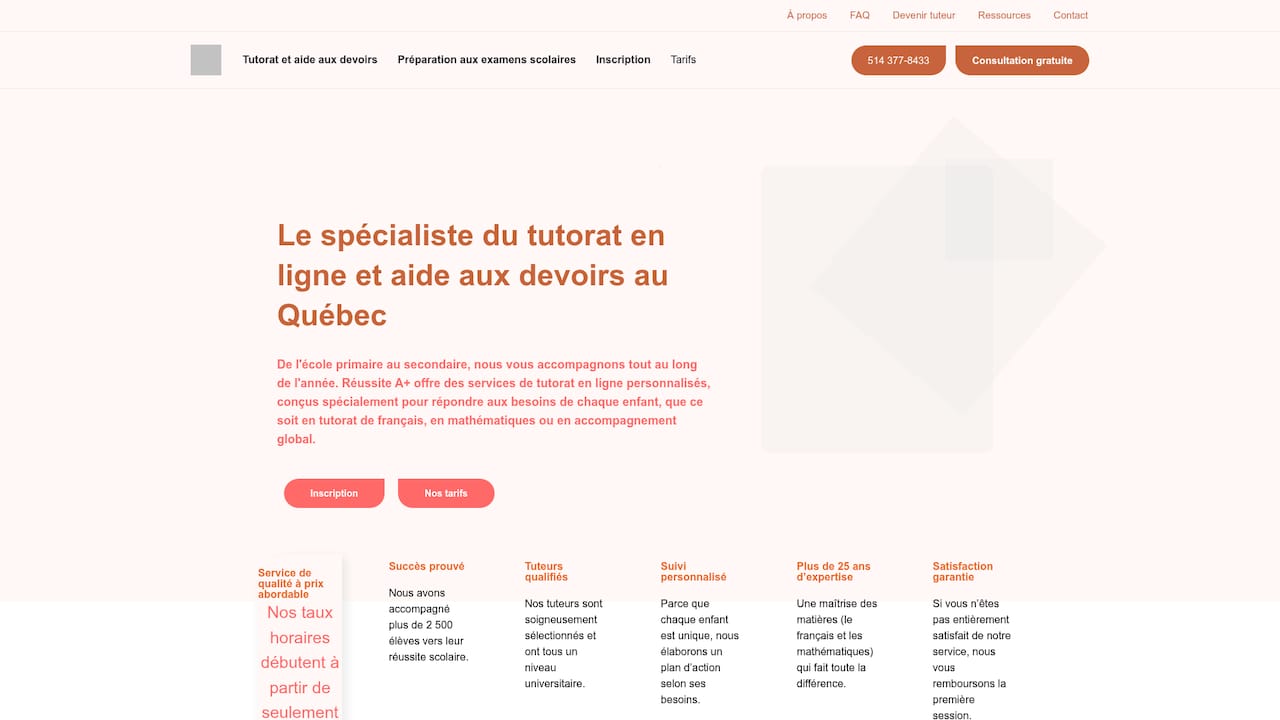
Réussite A+ offers personalised online tutoring and homework support for elementary and secondary students across Quebec. Every student receives a customised learning plan built around their specific gaps, learning pace, and goals — not a generic programme. Tutors are selected at the university level for academic excellence and teaching ability, and progress is tracked continuously so families always know where their child stands.
The difference between a workbook and a Réussite A+ session is responsiveness. A tutor notices the moment a child’s strategy breaks down and adjusts in real time. For students preparing for entrance exams, that targeted instruction is what moves the needle. With more than 3,500 students helped and a 99% client satisfaction rate, Réussite A+ has the track record to back that claim.
If your child is working hard with a good workbook and still not making progress, that is a clear signal that personalised support is the right next step. Register for tutoring with Réussite A+ and get a learning plan built around your child’s exact needs.
Useful sources and further reading
These Canadian curriculum pages and publisher resources are worth bookmarking before you make a purchase. Checking your province’s curriculum strands against a workbook’s table of contents takes five minutes and saves a lot of frustration.
- Mathematics curriculum — BC Ministry of Education — Official BC curriculum pages with Big Ideas and Curricular Competencies by grade; use to check strand alignment for BC families.
- Encouraging Math Learning at Home (OECTA) — Teacher-produced parent guide with book recommendations and home activity ideas.
- Self-Paced and Mastery in Grade 9 Mathematics — Manitoba Education — Provincial guidance on Flex and mastery models; useful context for choosing workbooks that support self-paced progression.
FAQ
What is the highest-rated homeschool math curriculum in Canada?
Math Mammoth Light Blue and Singapore Math Primary Mathematics are the most consistently recommended options for Canadian homeschoolers, valued for their conceptual depth and complete answer keys. Pearson Mathology is the strongest choice for families who want direct alignment to provincial curriculum strands.
What are some good math workbooks similar to Kumon?
Math Mammoth offers a similar incremental structure with the added benefit of worked explanations on the student page. For enrichment-focused alternatives at the upper-elementary level, Beast Academy provides rigorous problem-solving practice in a more engaging format.
What is the best math workbook for Grade 5?
Singapore Math Primary Mathematics Grade 5 is a strong pick for problem solving and fractions. Math Mammoth Grade 5 is the better choice if a child needs worked examples and self-teaching support alongside the practice pages.
How long does it take to complete a math workbook?
At 10–15 minutes of daily practice, most single-grade workbooks take 8–16 weeks to complete. Targeted strand-based use — working only the chapters covering a child’s weak areas — can produce measurable improvement in 4–6 weeks.
When should a parent consider tutoring instead of a workbook?
When the same errors persist across multiple weeks of consistent workbook practice, or when a child is preparing for a secondary school entrance exam, personalised tutoring is the more effective next step. Réussite A+ builds individual learning plans for exactly these situations.