




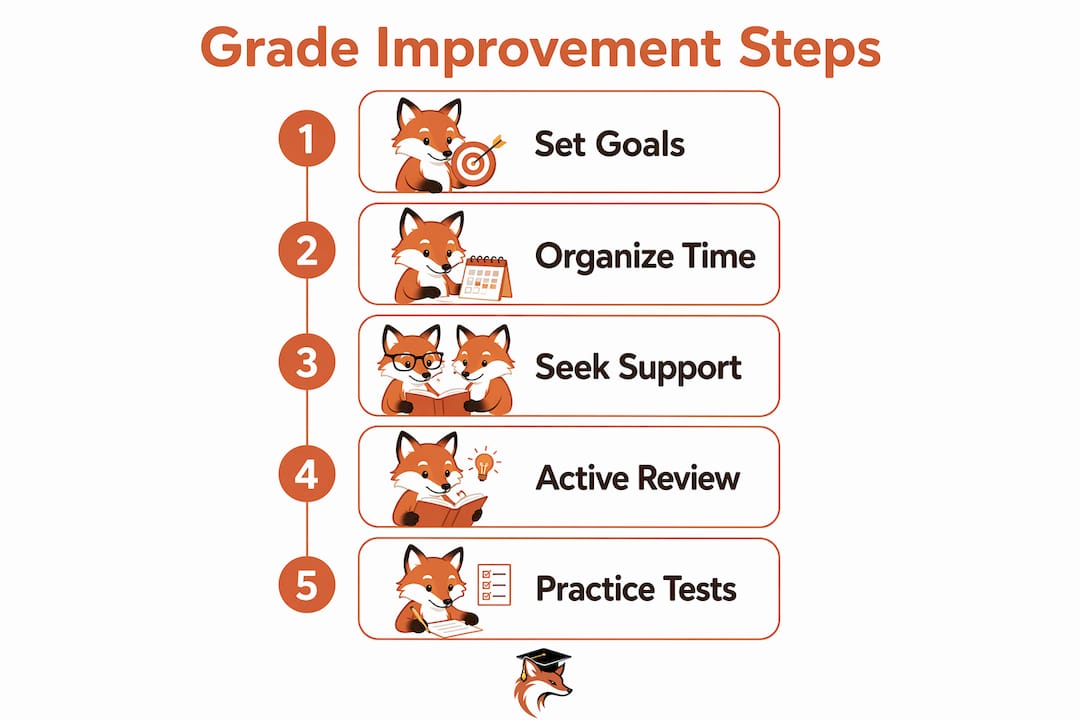
Raising your grades doesn’t require a personality overhaul or a sudden burst of genius. The most effective ways to improve grades are practical, repeatable habits that any student can start this week. Here’s what actually works:
- Complete homework consistently and participate actively in every class
- Build structured study habits with organized notes and active learning techniques
- Create a realistic study schedule and stick to it
- Ask for help early, whether from a teacher, tutor, or classmate
- Set clear goals, protect your sleep, and manage stress before it manages you
Each of these strategies is expandable into a daily routine. The sections below show you exactly how.
Table of Contents
- 1. How to develop effective study and organizational habits for better grades
- 2. Maintaining motivation and seeking academic support to boost performance
- 3. Canadian academic insights and tutoring benefits for grade improvement
- Réussite A+ gives your child a real academic advantage
- FAQ
- Key Takeaways
1. How to develop effective study and organizational habits for better grades
Good grades rarely come from studying harder. They come from studying smarter, with a system that removes guesswork and keeps you moving forward even on low-energy days.
- Use time blocking. Assign specific subjects to specific time slots rather than studying “whatever feels right.” This prevents the common trap of spending three hours on your strongest subject while ignoring the one that’s dragging your GPA down.
- Apply spaced repetition and active recall. These are the two most evidence-based study methods available, consistently outperforming passive re-reading and highlighting. Instead of reviewing your notes, close them and write down everything you remember, then check.
- Take structured notes. The Cornell note-taking method, which divides your page into a cue column, a notes section, and a summary, forces you to process information rather than transcribe it.
- Eliminate distractions deliberately. Put your phone in another room, use a browser blocker like Freedom or Cold Turkey, and tell people around you when you’re in a focus block. Partial attention produces partial results.
- Prioritize by GPA impact and deadline. Students balancing multiple courses should rank assignments by their weight in the final grade, not by how easy or enjoyable they are. A 30% midterm deserves more prep time than a 5% quiz.
Pro Tip: Break every assignment into specific, timed sub-tasks and schedule them as fixed appointments in your calendar. A vague to-do item like “study for bio” stays undone; “review Chapter 4 cell diagrams, 4:00–4:45 PM Tuesday” gets done.
2. Maintaining motivation and seeking academic support to boost performance
Motivation isn’t a personality trait. It’s a skill you build through structure, small wins, and the right support system around you.
- Set SMART goals. Goals that are Specific, Measurable, Achievable, Realistic, and Timely increase focus and confidence far more reliably than vague intentions like “do better in math.” Try: “Raise my math quiz average from 62% to 75% by the end of this unit.”
- Approach challenges with curiosity. Students who treat a confusing concept as a puzzle to solve, rather than proof they’re not smart enough, recover faster from setbacks. Academic struggles often reflect organizational and emotional challenges, not a lack of ability.
- Ask teachers early and specifically. Visiting a teacher during office hours and asking “Which topics carry the most weight on the final?” is one of the highest-return activities a student can do. Most students never ask.
- Join a study group. Collaborative study groups help struggling students by sharing resources, filling knowledge gaps, and keeping motivation alive through accountability. One session per week with two or three focused classmates can replace hours of solo confusion.
- Protect your sleep, nutrition, and stress levels. A student running on five hours of sleep retains significantly less from a study session than a rested one. Managing exam stress is not optional; it’s part of the academic strategy.
Setting small, achievable goals is especially powerful when a student has fallen behind. Each small win rebuilds confidence and breaks the cycle of avoidance that makes grades spiral further down.
3. Canadian academic insights and tutoring benefits for grade improvement

Canadian students, particularly those in Ontario and Quebec, face specific academic pressures worth understanding clearly.

The University of Toronto Scarborough’s Academic Advising & Career Centre recommends that students dedicate two to three hours of independent study for every hour spent in class. For a student carrying five courses, that translates to a substantial amount of focused study per week outside the classroom. Most students significantly underestimate this number.
Ontario final exams often carry substantial weight in a course’s final grade. That means early exam preparation focused on weak areas, combined with active problem solving rather than passive review, is the single highest-leverage activity a student can do in the weeks before finals. Waiting until the last week is not a strategy; it’s a gamble.
Tutoring works best when it targets conceptual gaps, the specific points where a student’s understanding breaks down, rather than simply providing more practice on material already understood. A tutor who identifies why a student keeps making the same algebra error delivers more value than one who assigns 50 more practice problems.
Réussite A+ has helped many students with a very high client satisfaction rate, built on over 25 years of educational experience and a methodology that combines personalized instruction with continuous progress monitoring.
| Factor | Impact on Grade Improvement |
|---|---|
| Recommended independent study time | 2–3 hours per hour of class (University of Toronto) |
| Ontario final exam weight | Often significant; early prep on weak areas is key |
| Tutoring focus | Most effective when targeting conceptual gaps |
| Réussite A+ client satisfaction | 99% across thousands of students helped |
| Réussite A+ experience | extensive experience with university-level tutors |
For students preparing for Quebec secondary school entrance exams, personalized exam preparation that addresses specific subject weaknesses produces measurably better outcomes than generic review. The combination of a structured plan, a knowledgeable tutor, and consistent practice is what separates students who pass comfortably from those who scrape by.
Réussite A+ gives your child a real academic advantage

Falling behind in math or French doesn’t mean a student lacks ability. It usually means they need someone to explain the right concept, in the right way, at the right moment. That’s exactly what Réussite A+ delivers.
Réussite A+ offers personalized online tutoring for elementary and secondary students across Quebec, with sessions tailored to each student’s specific gaps, pace, and goals. Every tutor is selected from the university level for both academic excellence and teaching ability. There’s no generic curriculum handed to every student; each learning plan is built around what that student actually needs.
With more than 25 years of experience, a very high client satisfaction rate, and a track record of online tutoring benefits that include flexible scheduling and affordable pricing, Réussite A+ is a practical choice for families who want results, not just reassurance. If your child is struggling with math, French, or exam preparation, register for tutoring support and get a customized plan started today.
FAQ
How many hours should a student study each day?
The University of Toronto recommends two to three hours of independent study for every hour spent in class, which typically means 25–30 hours of study per week for a full course load.
How do I improve from a D to a C quickly?
Focus on the assignments and tests with the highest grade weight first, ask your teacher which topics to prioritize, and use active recall instead of re-reading notes. Addressing one specific conceptual gap at a time produces faster results than reviewing everything broadly.
When does tutoring actually help raise grades?
Tutoring is most effective when it targets the specific concepts a student doesn’t understand, rather than just adding more practice. A tutor who identifies the root of a student’s confusion, whether in algebra, reading comprehension, or essay structure, can produce noticeable improvement within a few sessions.
What is the best study method for exam preparation?
Active recall and spaced repetition consistently outperform passive review. Test yourself on material without looking at your notes, then review only what you got wrong, spacing those reviews over several days before the exam.
How can Réussite A+ help a student improve their grades?
Réussite A+ builds a personalized learning plan for each student based on their specific strengths, gaps, and academic goals, with university-level tutors in French and math. With a very high client satisfaction rate and thousands of students helped, it’s a proven option for families in Quebec.
Key Takeaways
Consistent study habits, targeted support, and clear goals are the most reliable ways to raise academic grades at any level.
| Point | Details |
|---|---|
| Study time commitment | Aim for 2–3 hours of independent study per hour of class, per University of Toronto guidance. |
| Active recall over passive review | Self-testing and spaced repetition outperform re-reading for long-term retention. |
| Prioritize by grade weight | Rank assignments and exam topics by their impact on your final grade, not by ease. |
| Seek help at the concept level | Tutoring works best when it targets specific gaps in understanding, not just more practice. |
| Réussite A+ tutoring | Personalized plans, 25+ years of experience, and a very high client satisfaction rate |