




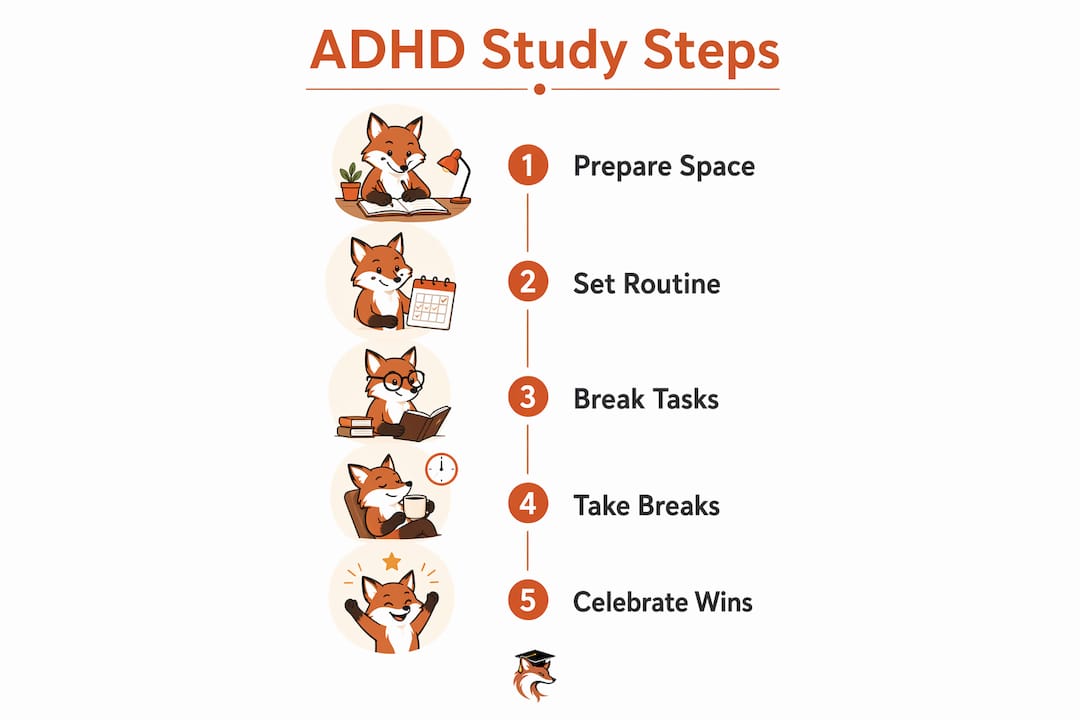
The most effective way to motivate a child with ADHD to study is not to push harder. It’s to work differently. Children with ADHD respond to structure, choice, novelty, and immediate rewards, not to long lectures about future consequences. Here are the strategies that actually work:
- Give your child choices. Let them pick which subject to start with or where to sit. Small decisions build ownership.
- Break every task into tiny steps. “Do your homework” is overwhelming. “Write one sentence” is doable.
- Use positive reinforcement immediately. Praise the effort right after it happens, not at the end of the week.
- Create a dedicated, quiet study space away from screens and household noise.
- Set a timer for short work blocks, like 10 or 15 minutes, followed by a movement break.
- Tap into interest and novelty. Let your child study a topic they love first, or turn a drill into a game.
- Stay nearby without hovering. Your calm presence helps them stay on task without feeling monitored.
These aren’t workarounds. They are evidence-based accommodations that match how the ADHD brain actually works.
Table of Contents
- Why studying is harder for children with ADHD
- How to create an effective study environment for children with ADHD
- Establishing structured routines and schedules that support ADHD study
- Effective task management: breaking down and organizing homework for ADHD learners
- How movement and breaks help your child stay focused
- Support and technology tools available in Canada for ADHD study motivation
- The 5 C’s approach to motivating a child with ADHD: a holistic framework
- Réussite A+ supports children with ADHD where it counts most
- FAQ
- Key Takeaways
Why studying is harder for children with ADHD
ADHD is not a motivation problem in the traditional sense. It’s a neurological difference that affects how the brain regulates attention, impulse control, and executive function. When your child resists sitting down to study, they are not being lazy or defiant. Their brain genuinely struggles with the demands that homework places on it.
The core challenges include:
- Attention regulation. Children with ADHD have difficulty sustaining focus on tasks that feel repetitive or low-interest, even when they understand the material.
- Executive functioning impairments. Planning, organizing, starting tasks, and shifting between activities all require executive functions that ADHD directly disrupts.
- Working memory challenges. A child may forget the instructions before they finish reading them, or lose their train of thought mid-sentence.
- Impulsivity. Distractions feel irresistible. A notification, a sound, or a passing thought can derail a study session in seconds.
- Time blindness. ADHD brains struggle to feel the passage of time, making it hard to pace work or recognize when a deadline is approaching.
- Motivation wiring. The ADHD brain responds poorly to importance-based motivation. Interest, novelty, challenge, and urgency drive engagement far more than long-term consequences do.
Understanding that these symptoms are involuntary changes everything. Criticism and pressure don’t fix a neurological difference. The right accommodations do.
How to create an effective study environment for children with ADHD
The physical space where your child studies shapes their ability to focus more than most parents realize. A cluttered, noisy, or distraction-filled room works against the ADHD brain before a single page is opened.
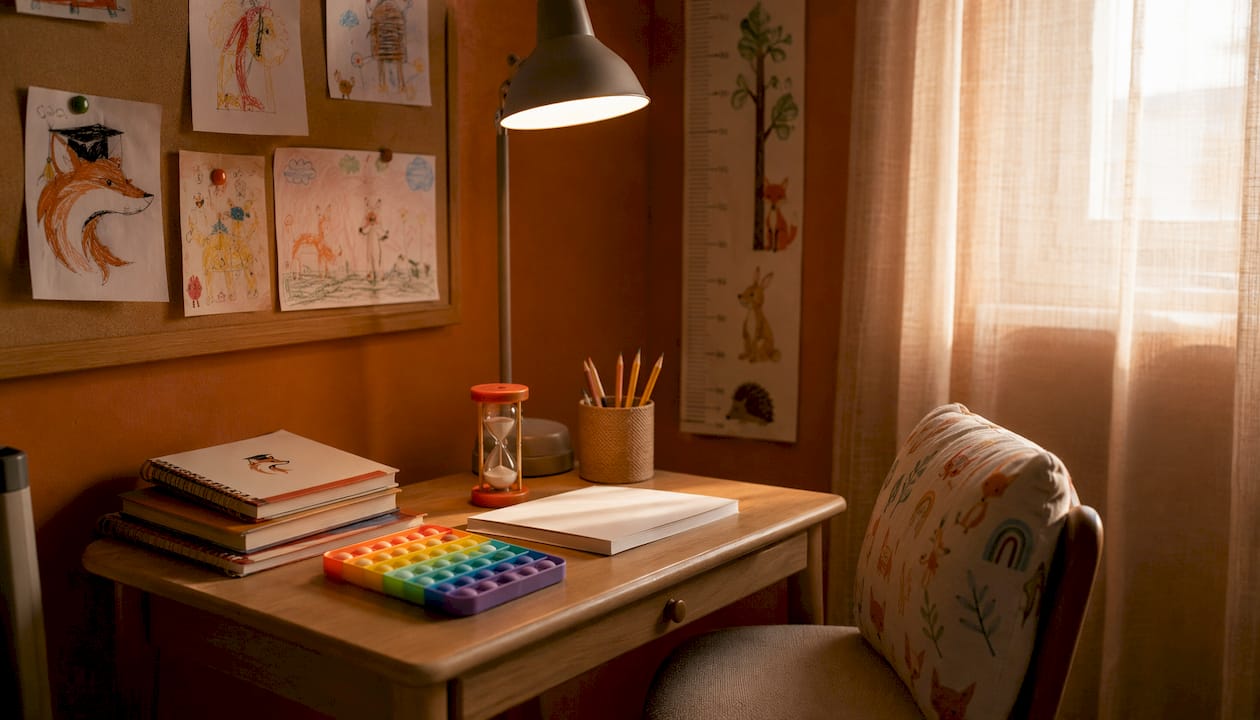
Set up a study space with these features:
- Quiet and clutter-free. Remove toys, devices, and anything visually busy from the study area. A clean surface reduces cognitive load.
- Away from screens. TV in the background is not white noise for an ADHD child. It’s competition. Keep devices out of sight during study time.
- Sensory support tools. Fidget toys, visual timers, and background white noise give the brain just enough stimulation to stay regulated without tipping into overload.
- Standing desk or flexible seating. Some children focus better when they can move slightly. A wobble cushion or standing surface can help.
- Visual cues and organizers. Label supply bins, post a daily checklist on the wall, and keep materials in the same spot every day. Predictability reduces the friction of getting started.
- Body doubling. Working with someone present, whether a parent reading nearby or a sibling doing their own work, provides social accountability that improves task initiation far better than reminders from another room.
The goal is a space that says “this is where we focus” without saying “this is a punishment.” Warm lighting, a comfortable chair, and a small personal touch like a favorite pencil cup go a long way.
Establishing structured routines and schedules that support ADHD study
Predictability is calming for the ADHD brain. When your child knows exactly when study time happens and what comes next, the mental energy spent resisting transitions drops significantly.
Build a routine that works with your child, not just for them:
- Set a consistent daily study time. Right after school with a snack break, or after dinner, whichever fits your family. Consistency matters more than timing.
- Involve your child in building the schedule. When children help create the plan, they feel ownership over it. Ask: “Do you want to do math or reading first today?”
- Use a visual schedule. A simple whiteboard or printed chart showing the sequence of tasks and breaks makes expectations concrete and reduces arguments.
- Set micro-goals for each session. Instead of “finish your homework,” the goal is “complete three math problems, then take a break.”
- Use a timer your child can see. A visual countdown timer, like the Time Timer brand, lets children watch time passing rather than guessing, which reduces anxiety and impulsivity.
- Plan for transitions. Give a two-minute warning before study time starts. Abrupt shifts are hard for ADHD brains.
Pro Tip: Let your child decorate their visual schedule or choose the timer sound. These tiny acts of personalization increase buy-in and make the routine feel like theirs.
Effective task management: breaking down and organizing homework for ADHD learners
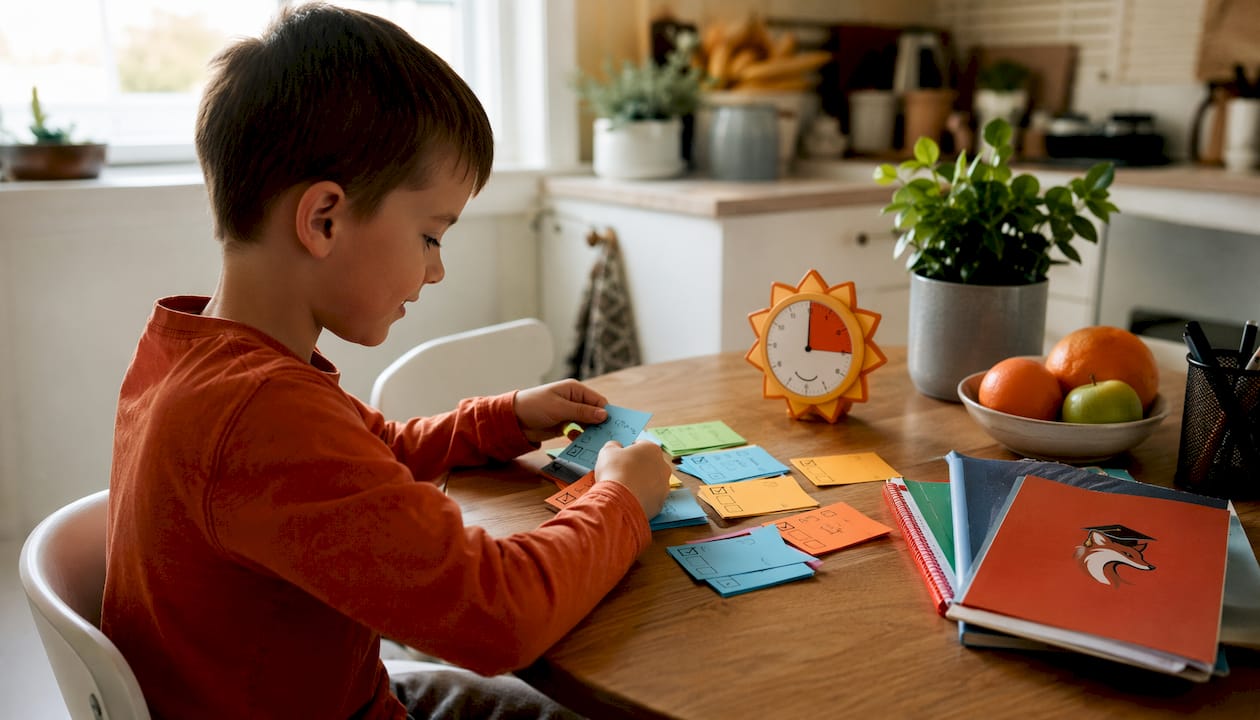
Long assignments feel like walls to a child with ADHD. The trick is turning the wall into a staircase, one small, achievable step at a time.
Micro-tasking creates quick wins that release dopamine and sustain momentum. Here’s how to apply it practically:
- Break every assignment into named steps. For an essay: “choose a topic,” “write one sentence,” “add two details,” “read it out loud.” Each step is its own task.
- Write the steps down together. A short checklist your child can cross off gives them visible proof of progress, which is motivating on its own.
- Start with the easiest step. Getting started is often the hardest part. A quick win at the beginning builds momentum for harder steps.
- Check in at each step, not at the end. Brief, encouraging check-ins (“Great, you finished the first part!”) keep the energy up without hovering.
- Separate drafting from editing. Tell your child their first draft doesn’t have to be perfect. Getting words on the page comes first. Fixing them comes later. This removes a major source of paralysis.
- Use a task-tracking tool. A simple notebook, a sticky note system, or a free app like Microsoft To Do lets children see what’s done and what’s next.
The goal is to make progress feel real and frequent. Each checkmark is a small signal to the brain that says “you can do this.”
How movement and breaks help your child stay focused
Sitting still for 45 minutes is genuinely difficult for most children with ADHD. Trying to push through without breaks usually produces frustration, not focus. Scheduled movement is not a reward for finishing. It’s part of the study plan.
- Use short, frequent work blocks. A 10-to-15-minute work period followed by a 5-minute break fits the ADHD attention window better than a long uninterrupted session.
- Make breaks active. A quick walk, jumping jacks, or tossing a ball channels excess energy and resets the brain for the next work block.
- Allow sensory tools during study. Chewing gum, a fidget spinner, or a stress ball can provide enough sensory input to keep the brain regulated without becoming a distraction.
- Alternate quiet and movement phases. A pattern like “read for 10 minutes, stretch for 5, answer questions for 10” gives the session a rhythm the child can anticipate.
- Avoid screens during breaks. Video games and social media are hard to disengage from and often extend breaks far beyond the plan. Physical movement or a snack works better.
The research is clear that movement and sensory regulation prevent burnout and improve attention over the course of a study session. Building these breaks in from the start is not giving up on focus. It’s protecting it.
Support and technology tools available in Canada for ADHD study motivation
Canadian families have access to a meaningful set of supports through schools, provincial systems, and community resources. Knowing what exists, and how to ask for it, can change your child’s academic experience.
- Individual Education Plans (IEPs) and Individualized Program Plans (IPPs). Parents can work with school staff to create formal plans that document accommodations like extended time, preferential seating, reduced workload, and frequent breaks. These plans go beyond avoiding failure. They actively improve performance.
- Prepare documentation before IEP meetings. Bring written notes about your child’s specific challenges, including executive functioning, working memory, and attention regulation. Well-prepared evidence strengthens the case for tailored accommodations.
- CADDAC (Centre for ADHD Awareness, Canada). This national organization provides advocacy resources, guides for parents, and information on educational rights for children with ADHD across Canadian provinces.
- Assistive technology tools. Visual timers like the Time Timer, text-to-speech apps, and organizational tools such as Google Calendar or Microsoft OneNote help children manage time and materials independently.
- Study apps designed for focus. Apps that use the Pomodoro technique, like Forest or Focus@Will, structure work and break intervals in a way that suits the ADHD attention pattern.
- Online tutoring with ADHD-aware educators. A tutor who understands how ADHD affects learning can adapt pacing, use micro-tasks, and provide the consistent encouragement children need. For Quebec families, online tutoring options tailored to ADHD learners are worth exploring.
Pro Tip: When requesting an IEP meeting, send a written request by email so there is a paper trail. Schools in most Canadian provinces are required to respond within a set timeframe once a formal request is made.
The 5 C’s approach to motivating a child with ADHD: a holistic framework
Tactics help in the moment. But sustaining motivation over months and years requires a mindset shift for the whole family. The 5 C’s of ADHD parenting offer a neurodiversity-affirming framework that reduces stress for both parents and children.
- Self-Control. Managing your own frustration before responding to your child’s behavior is the foundation. When you stay calm, your child’s nervous system has a better chance of regulating too.
- Compassion. Approach your child’s struggles with genuine curiosity rather than judgment. Ask “what’s making this hard right now?” instead of “why haven’t you started yet?”
- Collaboration. Treat homework as a team effort, not a battle. Sit together, problem-solve together, and let your child lead where they can.
- Consistency. Steady routines and predictable responses from you build the safety net that allows children with ADHD to take academic risks and try again after setbacks.
- Celebration. Recognize effort, not just results. A child who sat down and tried for 15 minutes deserves acknowledgment, even if the assignment isn’t finished. Prioritizing progress over perfection protects self-esteem and keeps motivation alive.
Pro Tip: Model self-regulation out loud. When you feel frustrated, say: “I’m going to take a breath before I respond.” Children with ADHD learn emotional regulation by watching the adults around them practice it.
The 5 C’s don’t replace structure or task management. They create the emotional climate in which those strategies can actually work. For more on building lasting study motivation in children, a consistent, compassionate approach at home makes all the difference.
Réussite A+ supports children with ADHD where it counts most

Children with ADHD don’t need more pressure. They need a tutor who already knows how to work with their brain. Réussite A+ offers personalized online tutoring for elementary and secondary students across Quebec, with every session built around the individual child’s pace, strengths, and challenges.
Réussite A+ has extensive experience and a high client satisfaction rate, having helped many students build confidence and achieve real academic progress. Tutors are selected from the university level for their teaching ability and their commitment to student success, not just subject knowledge. For a child with ADHD, that distinction matters: a patient, adaptive tutor who breaks tasks down, celebrates small wins, and adjusts the session in real time is a very different experience from a standard classroom.
Sessions are flexible, scheduled around your family’s routine, and focused on the subjects where your child needs the most support, including French and Mathematics. Whether your child is catching up, preparing for secondary school entrance exams, or simply needs a consistent, encouraging presence to get through homework, Réussite A+ is built for exactly that. Visit the online tutoring page to learn more and get started.
FAQ
What is the holistic approach to ADHD in children?
A holistic approach addresses the child’s neurological, emotional, and environmental needs together. The 5 C’s framework, which covers Self-Control, Compassion, Collaboration, Consistency, and Celebration, is one well-established model for supporting children with ADHD across home and school settings.
What are the 5 C’s of ADHD motivation?
The 5 C’s of ADHD parenting are Self-Control, Compassion, Collaboration, Consistency, and Celebration. Together they create the emotional and structural conditions that allow children with ADHD to stay motivated and engaged over time.
What is the 10-3 rule for ADHD kids?
The 10-3 rule refers to working for 10 minutes followed by a short movement or sensory break. It fits the shorter attention window common in children with ADHD and prevents the frustration that builds during long, unbroken study sessions.
How do you discipline a teenager with ADHD?
Effective discipline for teenagers with ADHD focuses on structure and natural consequences rather than punishment. Clear expectations, consistent routines, and calm, collaborative problem-solving work better than criticism, which research shows damages future engagement and motivation.
Key Takeaways
Children with ADHD need ADHD-specific strategies, not more effort, to study successfully. Structure, choice, movement, and immediate positive reinforcement are the tools that work.
| Point | Details |
|---|---|
| Match motivation to the ADHD brain | Interest, novelty, challenge, and urgency drive engagement far more than long-term consequences. |
| Micro-task every assignment | Breaking work into steps like “write one sentence” creates dopamine wins that sustain focus. |
| Build movement into the plan | Short active breaks during study prevent burnout and improve attention regulation. |
| Use Canadian school supports | IEPs and IPPs formalize accommodations; prepare written documentation before requesting a meeting. |
| Réussite A+ for ADHD learners | Personalized online tutoring in Quebec, adapted to each child’s pace and challenges. |