


What are children’s learning styles in early years?
Children’s learning styles in early years describe the different ways young children prefer to access and engage with information. Most frameworks group these preferences into five main categories: visual, auditory, kinesthetic, tactile, and reading/writing. Think of them less as permanent labels and more as tendencies that shift from day to day. A child who reaches for a picture book on Monday may spend Tuesday stacking blocks for an hour without looking up.
These categories remain widely used in early childhood education because they give parents and educators a practical starting point for observation. Canadian pedagogical frameworks, including Ontario’s How Does Learning Happen?, emphasize watching how each child engages rather than assigning a fixed type. The goal is responsiveness, not categorization.
Key points to keep in mind from the start:
Learning preferences are fluid, not fixed traits present at birth.
Children routinely shift between preferences depending on the activity, the day, and their mood.
No single style predicts how well a child will learn overall.
The most effective early years programs engage multiple senses at once rather than targeting one style.
Observing your child’s current interests is more useful than labeling their “type.”
How each learning style shows up in preschool settings
Understanding what each preference looks like in practice helps you notice patterns without over-interpreting them.
Visual learners
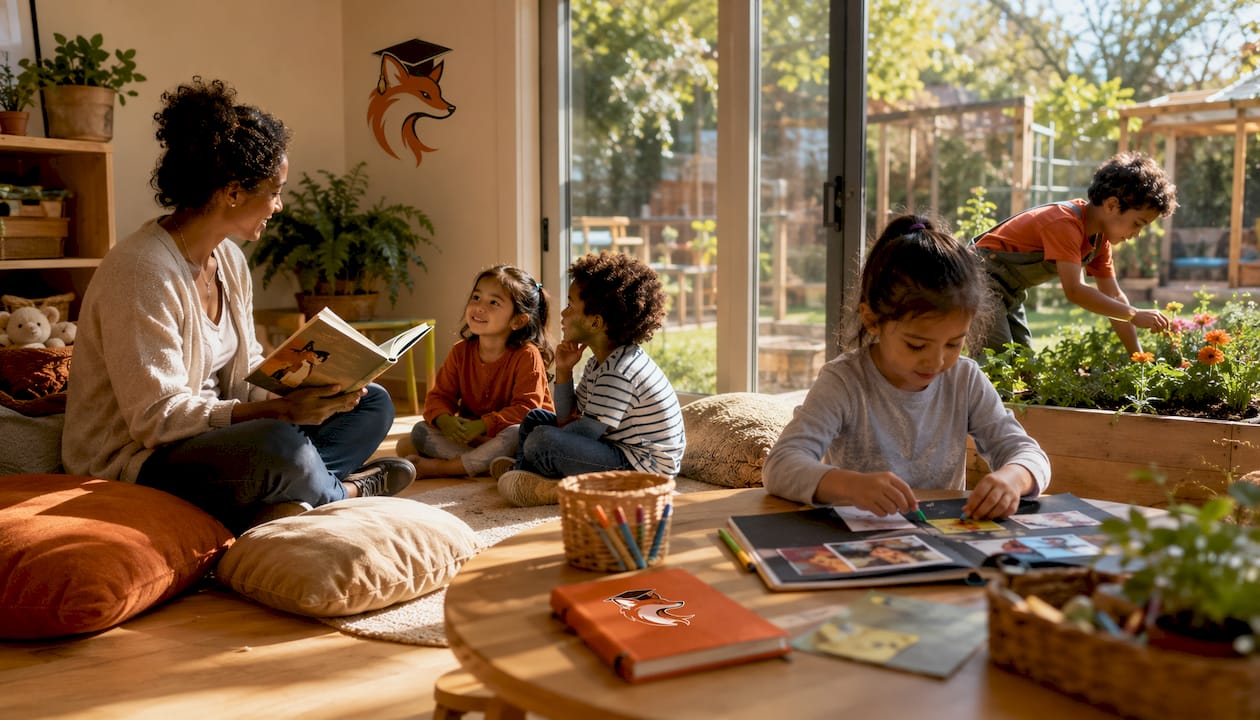
Visual learners gravitate toward pictures, colors, diagrams, and spatial arrangements. In a preschool room, they are often the children who pause longest at the illustrated wall display or who reach for crayons before any other material.
Common behaviors:
Drawn to books with detailed illustrations
Organize play materials by color or shape
Remember faces and places more easily than spoken instructions
Enjoy puzzles, maps, and visual sorting games
Auditory learners
Auditory learners process information most comfortably through listening and speaking. They tend to talk through problems aloud and often hum or sing while they work.
Common behaviors:
Repeat instructions back to themselves
Love songs, rhymes, and read-alouds
Pick up new vocabulary quickly from conversation
Easily distracted by background noise
Kinesthetic learners
Kinesthetic learners need to move their whole bodies to stay engaged. Sitting still for extended periods is genuinely harder for them, not a behavior problem.
Common behaviors:
Learn counting by jumping or clapping
Act out stories rather than just listening
Prefer outdoor exploration to table activities
Use gesture and movement when explaining ideas
Tactile learners
Tactile learners are closely related to kinesthetic learners but focus specifically on touch and hands-on manipulation of objects. They want to feel textures, squeeze clay, and handle materials directly.
Common behaviors:
Gravitate toward sand tables, water play, and sensory bins
Learn letter shapes by tracing them in sand or on textured cards
Prefer building with real blocks over digital equivalents
Become frustrated when asked to observe without touching
Reading and writing learners
Reading and writing learners prefer text-based engagement. Even in preschool, these children often show early interest in letters, labeling their drawings, or “reading” familiar books from memory.
Common behaviors:
Ask adults to write words for them to copy
Enjoy making lists or simple journals
Prefer instructions given in written or printed form
Spend longer periods with books than with construction materials
Children often move fluidly across all five styles. A single morning of play might involve a child watching a demonstration (visual), singing a cleanup song (auditory), and then kneading playdough (tactile). That overlap is healthy and normal.
How to apply learning styles knowledge in early childhood settings
The most useful thing you can do with learning styles knowledge is observe, not label. Pedagogical documentation gives Canadian educators a structured way to do exactly that. By recording photos, notes, and children’s own words during play, educators build a living picture of how each child currently engages with the world. This approach treats documentation as a “pedagogy of listening” rather than a checklist.
Ontario’s How Does Learning Happen? framework describes play and inquiry as the primary vehicles through which children develop problem-solving, creativity, and communication skills. Play naturally activates multiple senses at once, which means a well-designed play environment supports every preference simultaneously without requiring you to sort children into groups.
Practical strategies for parents and educators:
Rotate activity types across a week: art projects, movement games, storytelling, building challenges, and simple journaling each activate different preferences.
Follow the child’s lead. If a child keeps returning to the water table, offer counting, sorting, and language activities there rather than pulling them away.
Avoid rigid labeling. Telling a child “you’re a visual learner” can discourage them from trying auditory or kinesthetic tasks, narrowing their experience.
Involve families. Share observations with parents so they can extend similar experiences at home. When educators and families align, children benefit from consistent, responsive support.
Document and revisit. Keep brief notes or photos of how a child engages over several weeks. Patterns that emerge across time are more meaningful than a single observation.
Pro Tip: When a child seems disengaged, try changing the sensory channel before changing the content. Offer the same concept through movement, then sound, then touch. You will often find the child reconnects quickly, which tells you more about their current preference than any assessment tool.
Why the science asks us to look beyond fixed learning styles
Here is something worth knowing before you invest too much in any single learning style framework: no empirical evidence supports the idea that matching instruction to a child’s dominant style improves learning outcomes. The scientific community has recognized this as a myth since the mid-2000s, yet the belief persists widely in classrooms and at kitchen tables.
Only 7% of educators correctly identified “teaching to different learning styles will improve learning” as false in a recent survey.
Part of the reason the myth is so sticky is a psychological pattern called essentialism. Research published in Educational Psychology found that early years educators are more likely than educators of older students to hold essentialist beliefs about learning styles, treating them as innate, brain-based, and unchanging. The practical risk is real: when a child is told they are “a kinesthetic learner,” they may avoid reading-based tasks entirely, creating a self-fulfilling gap. Educators who work with younger children are significantly more likely to hold this fixed view than those who teach older students.
The better frame is multimodal learning. Active learning that combines visual, auditory, tactile, and kinesthetic elements benefits all children, regardless of any stated preference. This is not just a theoretical position; it aligns directly with what Canadian provincial frameworks already recommend.
Pro Tip: Replace “What is this child’s learning style?” with “What is this child curious about right now?” That single shift moves you from a fixed label to a responsive teaching stance, which is where the real learning happens.
Major learning style models you should know about
Several frameworks have shaped how educators think about learning differences in early childhood. Understanding them helps you read the research critically.
VARK (Visual, Aural, Read/Write, Kinesthetic), developed by Neil Fleming in 1987, is the most widely cited model in teacher training programs. It offers a useful vocabulary but was never validated as a basis for differentiating instruction.
Howard Gardner’s Multiple Intelligences theory, introduced in Frames of Mind (1983), proposed eight distinct intelligences including linguistic, logical-mathematical, musical, spatial, bodily-kinesthetic, interpersonal, intrapersonal, and naturalist. Gardner himself has clarified that intelligences are not the same as learning styles, though the two are frequently conflated in early childhood settings.
Kolb’s Experiential Learning Cycle describes learning as a four-stage loop: concrete experience, reflective observation, abstract conceptualization, and active experimentation. This model maps well onto play-based early childhood education because it centers experience and reflection rather than fixed types.
Dunn and Dunn’s Learning Styles Model expanded the concept to include environmental, emotional, sociological, physiological, and psychological elements. It remains influential in some Canadian school boards, though its empirical base has been questioned by researchers who note that scientific support for these theories is lacking.
What these models share is a recognition that children are not blank slates who absorb information identically. Where they differ is in how fixed or flexible they treat those differences. Current evidence favors the flexible end of that spectrum.
Cultural considerations in Canadian early years settings
Canada’s early years population is one of the most linguistically and culturally diverse in the world, and that diversity shapes how children express learning preferences. A child from an Indigenous community may engage most naturally through storytelling, land-based exploration, and oral tradition. A child from a recent immigrant family may be navigating two or more languages simultaneously, which affects how they process both auditory and reading-based tasks.
Nova Scotia’s Capable, Confident, and Curious framework explicitly names linguistic and cultural responsiveness as a core practice, describing it as the ability to understand, communicate with, and effectively interact with people across cultures. This goes well beyond awareness. It means intentionally planning learning environments that reflect children’s home languages, cultural identities, and community knowledge.
For educators, this has a direct implication: a child who appears disengaged from a text-based activity may simply be more accustomed to learning through oral storytelling or collaborative group work. Interpreting that as a fixed “non-reading learner” misses the cultural context entirely. The Ontario College of Early Childhood Educators’ pedagogical practice guidelines describe families as key contributors to the learning environment, not just observers of it.
Practical steps for culturally responsive practice:
Invite families to share songs, stories, and games from their home culture.
Offer materials that reflect the visual languages and symbols children encounter at home.
Avoid assuming that quietness or physical restraint signals a preference for auditory or reading-based learning; it may reflect cultural norms around deference to adults.
Build in outdoor and nature-based learning, which resonates across many Indigenous and non-Indigenous cultural traditions in Canada.
How educators can assess individual learning preferences
Formal learning styles assessments designed for young children have limited reliability. A four-year-old’s self-report is not a stable data point. The most effective assessment in early childhood is sustained, structured observation over time.
The Ontario College of Early Childhood Educators describes observation as a vital component of pedagogical practice, one that involves much more than watching. It means observing with intent, guided by questions like: What does this child return to repeatedly? How do they communicate when they are most engaged? What materials do they reach for first?
Practical assessment strategies:
Anecdotal records: Brief written notes taken during free play, noting what the child chose, how long they stayed, and what they said or did.
Learning stories: Narrative documentation that captures a meaningful moment of learning and connects it to developmental goals. This format, widely used in New Zealand’s Te Whāriki framework and increasingly adopted in Canadian programs, gives families a window into their child’s learning process.
Portfolio documentation: A collected record of photos, drawings, and work samples that shows change over time. Patterns across a portfolio reveal preferences more reliably than a single observation.
Child-led conferences: Even with preschoolers, inviting children to show a parent or educator what they made and why builds metacognitive awareness and gives educators direct insight into how the child thinks about their own learning.
The goal of any assessment approach is not to produce a label. It is to inform your next responsive move as an educator or parent. Knowing that a child spent 20 minutes at the sensory table three days in a row tells you where to introduce new concepts this week.
How to build a lesson plan that reaches every learner
A well-designed early years lesson does not need to be complicated to engage multiple preferences at once. The key is intentional variety within a single activity rather than separate activities for separate “types.”
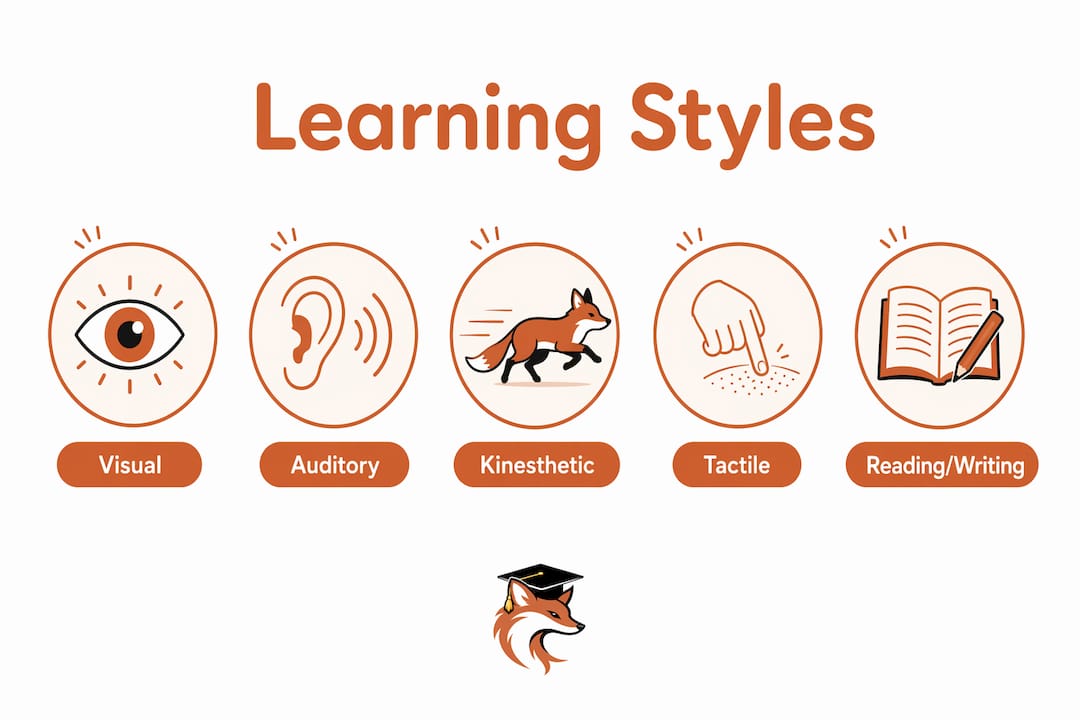
Take a simple concept like learning the number five. A multimodal approach might look like this:
| Modality | Activity example |
|---|---|
| Visual | Display a large illustrated card showing five objects in different arrangements |
| Auditory | Sing a counting song or chant “five, five, five” with rhythm and clapping |
| Kinesthetic | Jump five times, take five steps, or pass five beanbags around a circle |
| Tactile | Count five stones, buttons, or pieces of playdough by touching each one |
| Reading/Writing | Trace a numeral on a textured card or stamp it with a sponge |
Running through all five modalities takes roughly ten minutes and reaches children wherever their current preference sits. The child who needed to jump to connect with the concept gets that, and the child who needed to trace the numeral gets that too.
Ontario’s How Does Learning Happen? describes this kind of engagement as children exploring the world “with body, mind, and senses.” That phrase is not poetic filler. It is a description of how the brain actually consolidates learning in early childhood, through varied, repeated, embodied experience.
Pro Tip: Design your environment before your lesson. A room with a sensory bin, a movement space, a reading corner, and a drawing table already offers multimodal access. The lesson plan becomes the invitation, not the constraint.
How parents can support learning at home
Parents are not outside observers of their child’s early learning. Ontario’s How Does Learning Happen? framework describes families as active participants and contributors whose involvement directly strengthens children’s sense of belonging and motivation to learn. That is a meaningful role, and it does not require a teaching degree to fill it.
The most useful thing parents can do is pay attention to what their child gravitates toward during unstructured time. Does your child narrate everything they do? They may be processing auditorily. Do they immediately disassemble a new toy to see how it works? That is tactile and kinesthetic curiosity in action. These observations are worth sharing with your child’s educator, because they add context that a classroom setting cannot always reveal.
Ways to stay connected with your child’s learning:
Ask open questions after school: “What did you make today?” rather than “Did you have fun?”
Share observations with the educator at pickup or through a communication app. A note saying “she spent an hour sorting her rocks by color this weekend” is genuinely useful data.
Extend classroom themes at home using whatever materials you have. If the class is exploring patterns, look for patterns on your walk to the park.
Read together daily, regardless of your child’s apparent preference. Reading aloud builds vocabulary, listening skills, and imagination across every learning tendency.
If you notice your child struggling consistently in one area, that is worth a conversation with their educator. For children who need more targeted support, personalized tutoring can help bridge gaps while honoring the way your child currently learns best. Understanding your child’s learning challenges early makes a real difference in how confidently they approach school.
When your child reaches elementary school, those early preferences evolve into more defined academic strengths. Réussite A+ works with students across Quebec to build on those strengths through personalized online tutoring tailored to each child’s pace and goals. With more than 25 years of experience and a 99% client satisfaction rate, Réussite A+ has helped more than 3,500 students find their footing in French, mathematics, and beyond.
Ready to support your child’s learning with a plan built around them? Explore tutoring options at Réussite A+ and see how a personalized approach makes school feel possible again.
Key Takeaways
Children’s learning styles in early years are best understood as flexible, shifting preferences rather than fixed traits, and multimodal teaching reaches every child more effectively than targeting a single style.
| Point | Details |
|---|---|
| Preferences are fluid, not fixed | A child’s preferred way of learning can shift day to day and should never be treated as permanent. |
| Multimodal learning works best | Combining visual, auditory, tactile, and kinesthetic activities benefits all children simultaneously. |
| Only a small minority of educators recognized the myth | Only 7% of educators correctly identified learning style matching as ineffective in a recent survey. |
| Pedagogical documentation guides responsive teaching | Recording children’s play and interests over time reveals real patterns more reliably than any single assessment. |
| Cultural context shapes learning expression | In Canadian early years settings, cultural and linguistic background significantly influences how children engage with learning. |
FAQ
What are the main types of learning styles in early childhood?
The five most commonly referenced types are visual, auditory, kinesthetic, tactile, and reading/writing. These describe preferences for how children access information, not fixed categories that determine their learning ability.
What learning style works best for preschoolers?
No single style works best. Research supports multimodal approaches that combine movement, sound, touch, and visual elements, since young children’s brains consolidate learning most effectively through varied, embodied experience.
What are the 7 learning areas in early childhood programs?
Canadian early years frameworks typically organize development across areas including language and literacy, mathematics, science and technology, social-emotional development, physical development, the arts, and social studies or the world around us. These areas overlap and are not tied to specific learning styles.
Do learning styles actually improve outcomes when matched to instruction?
No. Scientific consensus since the mid-2000s shows no evidence that matching instruction to a child’s stated learning style improves outcomes. Responsive, play-based, multimodal teaching is consistently more effective.
How can parents identify their child’s learning preferences?
Watch what your child returns to during free play, note how they communicate when most engaged, and share those observations with their educator. Sustained observation over several weeks reveals preferences far more reliably than any questionnaire designed for young children.