



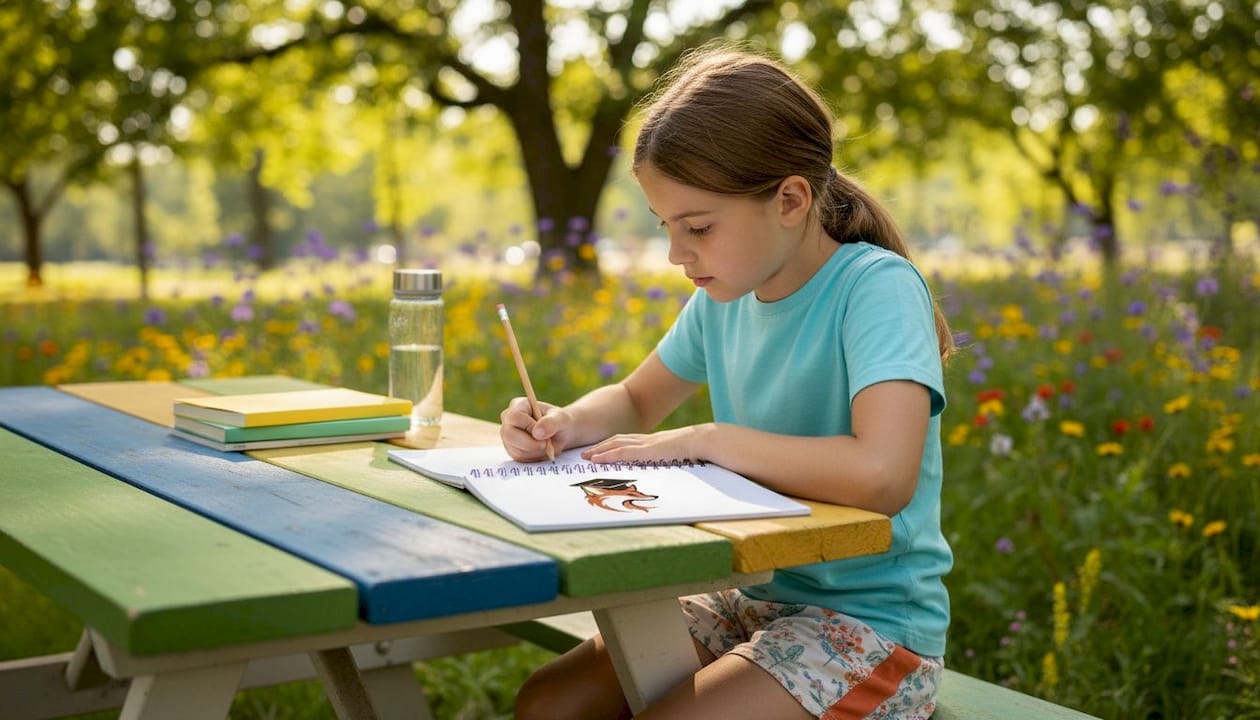
Motivating your child to study independently is defined by educational researchers as building autonomous motivation and self-regulated learning (SRL) skills. These two concepts are the foundation of lasting academic independence. Children who study because they find meaning in learning outperform those who study only to avoid punishment or earn rewards. Your role as a parent is not to manufacture motivation from scratch. It is to create the right conditions for motivation to grow naturally, with patience and the right structure.
How to motivate your child to study independently: the psychology behind it
Autonomous motivation and controlled motivation are not the same thing. Autonomous motivation is driven by genuine interest, curiosity, and a sense of personal meaning. Controlled motivation is driven by external pressure, fear of failure, or reward dependency. The difference matters enormously for long-term outcomes.
Children who operate from autonomous motivation show stronger perseverance, deeper engagement, and a healthier relationship with school overall. Those driven by controlled motivation tend to disengage the moment the external pressure disappears. That is why a sticker chart works for a week and then stops working entirely.
Autonomous motivation fosters more sustained engagement, perseverance, and a positive relationship with school. Controlled motivation weakens long-term engagement the moment external pressure is removed.
Motivation does not switch on overnight. It develops gradually through small, meaningful interactions between you and your child. A parent’s most powerful role is creating the right environment rather than pushing harder when a child resists.
Here is what autonomous motivation looks like in practice:
- Your child chooses which subject to tackle first without being told.
- Your child asks questions about a topic because they are genuinely curious.
- Your child returns to a difficult problem without being reminded.
- Your child feels proud of progress, not just of grades.
These behaviors do not appear by accident. They appear when children feel safe, capable, and connected to what they are learning.
How to create a home environment that encourages independent study
The physical and emotional setup of your home shapes your child’s ability to study alone more than most parents realize. A well-organized, distraction-free space signals to the brain that it is time to focus. A chaotic or noisy environment does the opposite.
Follow these steps to build a study-ready home:
- Designate a fixed study spot. Use the same desk or table every day. Consistency trains the brain to shift into focus mode faster.
- Remove digital distractions. Phones and tablets should be out of sight during study time, not just silenced. Out of sight genuinely means out of mind for most children.
- Set goals together. Sit with your child at the start of the week and agree on what needs to get done. Children who help set their own goals feel more ownership over completing them.
- Offer meaningful choices. Let your child decide whether to start with math or reading, or whether to study before or after a snack. Providing small choices helps children internalize a sense of ownership. Too much control from parents does the opposite.
- Use structured breaks. Study sessions of 20 minutes of uninterrupted work followed by a short break maintain motivation and reduce procrastination. This is the recommended starting point for building independent study habits.
- Stay in contact with teachers. Ask teachers what skills your child is working on and align your home support with those goals. Consistency between school and home reduces confusion and builds confidence.
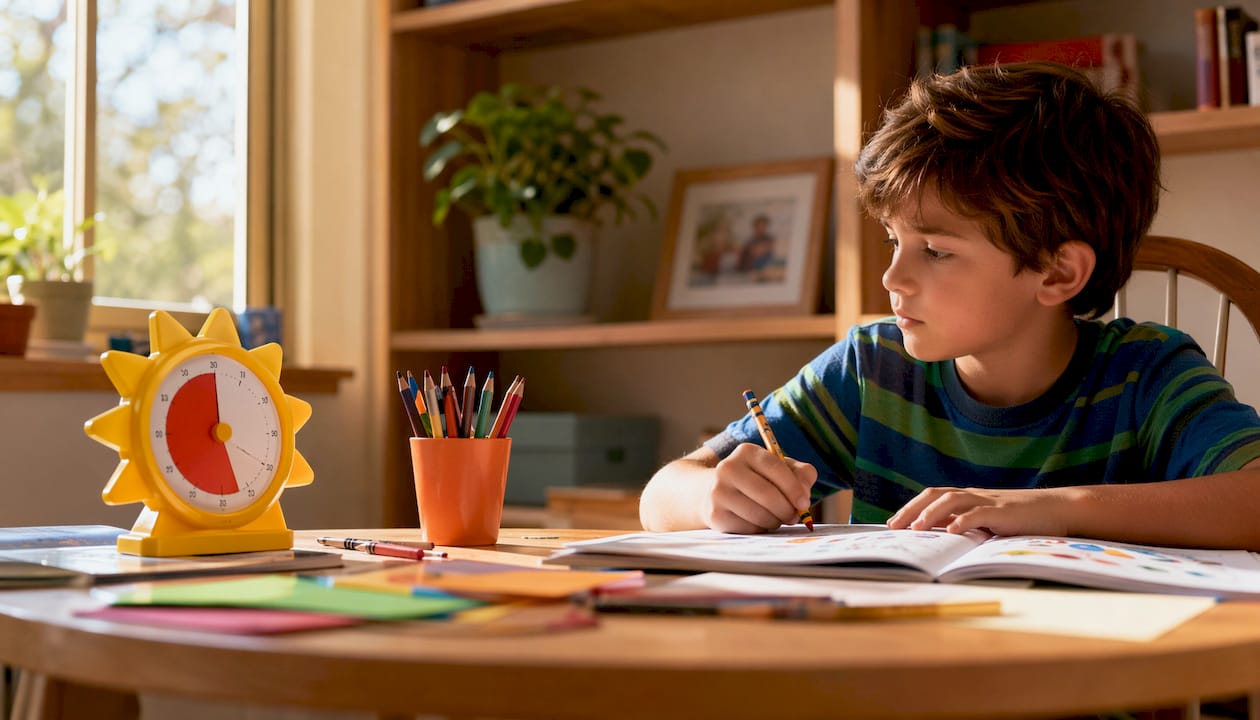
Pro Tip: Set a visual timer on the desk during study sessions. Children respond well to seeing time pass. It makes the 20-minute block feel concrete and achievable rather than open-ended.
Teaching your child self-regulated learning skills
Self-regulated learning, or SRL, is the most research-backed framework for building genuine academic independence. The three-stage SRL process consists of Forethought, Performance, and Self-reflection. Each stage requires explicit teaching. Children do not develop these skills automatically.
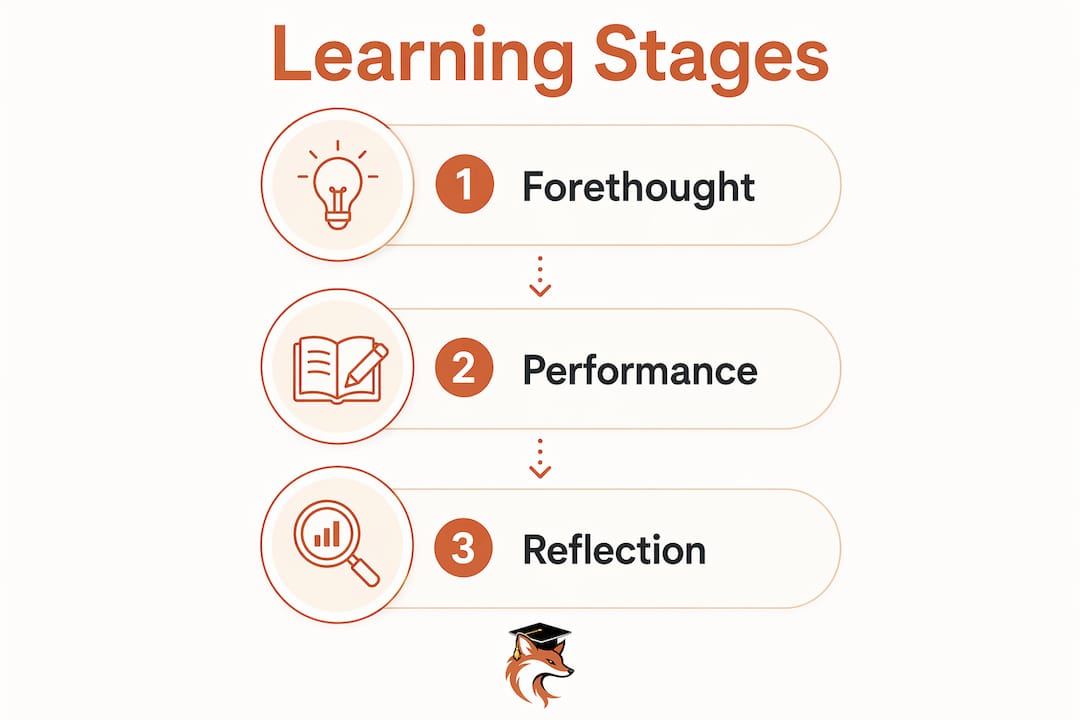
| SRL Stage | What it means | How you can help |
|---|---|---|
| Forethought | Planning and setting goals before studying | Ask: “What do you want to finish today?” |
| Performance | Monitoring focus and effort during study | Teach your child to notice when they drift and refocus |
| Self-reflection | Evaluating what worked after studying | Ask: “What was hard? What would you do differently?” |
The Forethought stage is where most parents skip ahead. They tell the child what to study instead of asking the child to plan it. That one shift, from telling to asking, builds the planning muscle that independent learners need.
During the Performance stage, teach your child to recognize distraction as a normal part of studying, not a failure. A simple rule works well: when you notice your mind wandering, write down the distraction on a notepad and return to work. This technique, sometimes called a “distraction dump,” keeps the brain from chasing every stray thought.
The Self-reflection stage is the most overlooked. After a study session, spend two minutes asking your child what felt hard and what felt easy. This builds metacognition, which is the ability to think about one’s own thinking. Children who practice self-reflection regularly adjust their study habits faster and plateau less often.
- Ask “What strategy did you use?” rather than “Did you finish?”
- Celebrate effort and process, not just correct answers.
- Help your child identify one thing to try differently next time.
Pro Tip: Keep a simple weekly study journal with your child. One page per week: what they planned, what they did, and what they noticed. After a month, patterns become visible and children start self-correcting without being asked.
How to keep your child motivated when challenges arise
Every child hits a wall. Boredom, frustration, and the feeling that school has nothing to do with real life are normal. The way you respond in those moments determines whether motivation recovers or collapses.
The most effective strategy is to break overwhelming tasks into smaller, manageable steps. A child who says “I can’t do this” is usually looking at the whole mountain. Show them the next single step instead.
Shifting the conversation from “Did you get it right?” to “What did you try?” changes how a child relates to difficulty. Effort becomes the measure of success, not the outcome.
Practical ways to rebuild motivation when your child is stuck:
- Connect the material to their interests. A child who loves video games can learn fractions through game mechanics. A child who loves animals can practice reading comprehension with wildlife articles.
- Acknowledge the frustration first. Before offering a solution, say “That sounds really hard.” Children who feel heard are more willing to try again.
- Focus feedback on strategy and progress. Constructive feedback that highlights effort and approach builds lasting motivation. Feedback focused only on results does not.
- Resist the urge to rescue. Letting your child sit with a problem for a few minutes before stepping in builds tolerance for difficulty. That tolerance is what independent learners need most.
- Trust the timing. Executive function development varies by child. Emotional safety and patience matter more than pushing a child to meet an artificial timeline.
Common mistakes parents make when encouraging independent study
Good intentions can backfire. These are the most common errors parents make, along with what to do instead.
- Withdrawing support too fast. Independence is built gradually. Effective scaffolding moves from guided practice to monitored work to full self-regulation. Pulling back too quickly leaves children disoriented, not empowered.
- Using rewards as the main motivator. Sticker charts and prizes work short-term. They create dependency on external validation and weaken the internal drive you are trying to build. Use rewards sparingly and pair them with conversations about effort.
- Ignoring emotional safety. A child who fears being judged for wrong answers will not take the risks that learning requires. Psychological safety at home is a prerequisite for academic risk-taking.
- Skipping the school connection. Parents who stay in touch with teachers catch learning gaps early. Those who operate in isolation often discover problems too late to address them before exams.
- Over-relying on technology. Apps and AI tools can support homework organization and practice. They work best as supplements to human guidance, not replacements for it. A child who outsources thinking to a tool does not build the independent skills you are aiming for.
Key Takeaways
Building independent study habits requires autonomous motivation, structured self-regulated learning skills, and a home environment that balances support with meaningful freedom.
| Point | Details |
|---|---|
| Autonomous motivation is the goal | Children driven by curiosity and meaning outperform those driven by pressure or rewards. |
| Environment shapes behavior | A fixed study space, clear goals, and small choices build ownership and focus. |
| Teach the SRL three-stage process | Forethought, Performance, and Self-reflection must be explicitly practiced, not assumed. |
| Feedback drives long-term motivation | Focus on effort and strategy, not results, to keep children engaged after setbacks. |
| Scaffold independence gradually | Withdraw support in stages. Pulling back too fast causes disorientation, not growth. |
What 25 years of working with students has taught us about motivation
The parents who see the biggest breakthroughs are rarely the ones who push hardest. They are the ones who get curious about their child’s experience instead of anxious about their child’s grades. That shift in focus changes everything.
At Réussite A+, we have worked with more than 3,500 students across Quebec. The pattern we see repeatedly is this: children who feel trusted take more academic risks. Children who feel watched and evaluated shut down. The difference between those two experiences often comes down to one or two small daily habits at home.
Structure and freedom are not opposites. The most independent learners we work with have parents who set clear expectations and then step back. They celebrate small wins out loud. They ask “What did you figure out today?” instead of “Did you finish your homework?” Those questions sound minor. Over months, they build a completely different relationship with learning.
The goal is not a child who studies because you are watching. The goal is a child who studies because they have learned to trust themselves. That takes time, and it is absolutely worth it.
— Réussite A+
How Réussite A+ supports your child’s path to independent learning
Building independent study habits at home is powerful. Pairing that effort with expert guidance makes the results last longer.

Réussite A+ offers personalized online tutoring for elementary and secondary school students across Quebec, with programs built around each child’s individual strengths, pace, and goals. Every tutor is selected for academic excellence and teaching ability, not just subject knowledge. The approach focuses on building confidence and self-directed skills alongside core content in French and Mathematics. You can learn more about the benefits of online tutoring or explore the full range of homework help and tutoring services available to Quebec families.
FAQ
What is autonomous motivation in children?
Autonomous motivation is the drive to learn because of genuine interest, curiosity, or personal meaning. It produces stronger academic outcomes than motivation based on external pressure or rewards.
How long should a child study independently at one time?
Starting with 20-minute blocks of uninterrupted work is the recommended approach. Short, focused sessions build the habit of concentration without causing burnout.
What is self-regulated learning and why does it matter?
Self-regulated learning is a three-stage process covering planning, monitoring, and reflection. Children who practice these stages develop stronger study habits and adapt faster when they encounter difficulty.
How do I help my child when they say they hate studying?
Acknowledge the frustration first, then connect the material to something they already care about. Breaking the task into one small step reduces the feeling of being overwhelmed and makes starting easier.
At what age can children start studying independently?
Most children can begin practicing basic independent study habits in elementary school, starting with short, structured sessions. The level of parental scaffolding should decrease gradually as the child demonstrates readiness, not on a fixed schedule.