




If you live in the West Island and are looking for tutoring, you will find five broad kinds of help: learning centres, in-home private tutors, the tutoring program run through Quebec schools, online tutoring, and group or enrichment classes. Each suits a different child and a different budget. This guide explains how they differ, what to ask before you commit, and where our own online tutoring fits, so you can choose calmly and without guessing.
Most parents start this search after a report card, a note from a teacher, or a child who suddenly says “I hate math” or “I’m bad at French”. Take a breath. In most cases, the gap is small and fixable with a clear plan and regular practice. The real task is to find the format that your child will actually stick with.
TL;DR
- West Island families can choose between learning centres, in-home tutors, school-based tutoring, online tutoring and group classes. The best choice depends on your child’s needs, schedule and learning style, not on the name on the door.
- Quebec’s own tutoring program is built around individualized support that adjusts to the student’s changing needs. Use that as your yardstick for any private provider too.
- Ask every provider the same questions: who teaches, how the plan is built, how progress is shown to you, and what happens if it is not a good fit.
- Online tutoring removes travel across the island and makes evening and weekend slots easier. Réussite A+ offers it for elementary and secondary students in math and French at $30–$35 per hour, plus a one-off $65 registration fee.
Table of Contents
- The main types of tutoring available in the West Island
- Which subjects and grades to expect
- Which West Island communities are covered?
- How much does tutoring cost, and what changes the price?
- A practical checklist for choosing
- How to tell whether a program is truly personalised
- Our perspective: what we see after 25 years
- Where Réussite A+ fits among the options
- Matching the option to your child
- Mistakes to avoid
- FAQ
- Sources
The main types of tutoring available in the West Island
The West Island covers a wide area, from Dorval and Pointe-Claire to Kirkland, Beaconsfield, Dollard-des-Ormeaux and beyond. Families here are often bilingual or trilingual, and school paths vary: English sector, French sector, French immersion. That variety explains why so many kinds of tutoring exist. Here is how they compare.
| Type of service | Typical format | Strengths | Watch out for |
|---|---|---|---|
| Learning centre | In person, at a fixed location, set weekly time | Structured space, set curriculum, children work alongside others | Travel time, fixed schedule, plans that follow the centre’s system more than your child’s needs |
| In-home private tutor | One-to-one in your home or a public place | Full attention, flexible choice of tutor | Quality varies widely, you do the vetting, little formal progress tracking |
| School-based tutoring (Quebec program) | Offered through the school system | Linked to what happens in class | Availability depends on your school and its resources |
| Online tutoring | One-to-one or small group by video | No travel, easy to reschedule, wide choice of tutors | Needs a quiet spot and a decent connection, younger children need a parent nearby at first |
| Group or enrichment classes | Small groups, often by subject or test | Lower hourly cost, peer motivation | Less individual attention, pace is set for the group |
No type is automatically better. A child who needs to get out of the house and work in a calm room may thrive at a centre. A child with a packed after-school schedule may do better online. A child who needs one patient adult for 45 minutes a week may do best one-to-one, wherever it takes place.
Learning centres
Centres offer a structured program, often with an assessment at the start and a set weekly slot. They suit families who like routine and want a place to send their child. The trade-off is that you adapt to the centre’s calendar and location, which in a spread-out area like the West Island can mean a weekly drive in traffic. Ask whether the plan is built from your child’s own report card and work, or whether it comes from a standard level system.
In-home private tutors
A private tutor who comes to your home gives your child undivided attention in a familiar setting. Some are certified teachers, others are university students. Tutors can be found through word of mouth, school contacts or matching platforms. Because quality depends so much on the individual, you will need to check experience, ask for a trial session and agree on how the tutor will report back to you. Our own comparison of home tutoring and online tutoring goes through this trade-off in more detail.
School-based tutoring
Quebec’s government describes its tutoring program as something distinct from homework help: individualized support based on students’ evolving pedagogical and psychosocial needs, with the aim that it adjusts flexibly to keep students moving forward. If your child’s school offers it, ask the teacher or administration how students are chosen and how often sessions run. It can be a good first step, and it can sit alongside private help.
Online tutoring
Online tutoring takes place by video call, usually one-to-one, with shared screens and digital materials. It has become a mainstream option for families who want strong tutors without the commute. For West Island parents, the practical benefit is simple: a Tuesday evening session happens at the kitchen table, not after a 25-minute drive. Our page on online tutoring and homework help explains how sessions run.
Group and enrichment classes
Small groups lower the hourly cost and can motivate children who like working with peers. They work best when the group is matched by level. They are less suited to a child with a specific gap, for example in fractions or in French verb agreement, because the pace is set for the group, not for one child.
Which subjects and grades to expect
Most providers cover math, French and English at the elementary and secondary levels. Some add science, test preparation for private-school admission, or study skills. When you call, do not stop at “do you teach math?” Ask for the specific grade and the program: Quebec’s elementary and secondary curriculum differs from other provinces in how topics are sequenced, and a tutor who knows it will not waste sessions on the wrong material.
French deserves its own question for West Island families. A child in the English sector learning French as a second language needs a different approach from a child in French immersion or the French sector who struggles with grammar, dictation or writing. Ask the provider which of these profiles their tutors usually work with. We have a specific page for families in French immersion homework support and a French tutoring program built around this.
Which West Island communities are covered?
In-person providers usually serve a few neighbouring areas around their location: Pointe-Claire, Dorval and Kirkland are commonly named, along with Dollard-des-Ormeaux, Beaconsfield and Pierrefonds. Home tutors will often travel, but the farther they come, the more likely a travel surcharge or a limited choice of time slots. Always ask where the tutor works and whether the quoted rate includes travel.
Online tutoring removes the question. The tutor’s location does not matter, so your options are not limited to your own neighbourhood. We work with families across Quebec, including Montreal, Laval, Longueuil, Brossard and Gatineau, and we have a dedicated page for tutoring in Pointe-Claire.
How much does tutoring cost, and what changes the price?
Prices in the West Island vary a lot, and a direct comparison only works if you compare the same thing. Here are the main factors that move an hourly rate:
- Who teaches. A certified teacher usually charges more than a university student.
- One-to-one or group. Groups cost less per child, but each child gets less attention.
- Location. In-home sessions can include travel time. Centres include their overhead. Online sessions have neither.
- What is included. Some providers include lesson planning, materials and progress reports. Others charge for these or do not offer them.
- Fees around the hourly rate. Registration fees, minimum packages, cancellation rules and annual commitments change the real cost.
So when you compare quotes, write down the total for one month of weekly sessions, including every fee, rather than only the hourly figure.
For our part, sessions with Réussite A+ are $30–$35 per hour for regular sessions, exam preparation, summer sessions, tutoring with homework help and French programs, with a one-off registration fee of $65. You can see the details on our rates page. Math courses are available too, and we will confirm the rate when you contact us. If the first session does not suit your child, we refund it.
A practical checklist for choosing
Use this list with any provider, including us. It takes about 15 minutes on the phone or by email.
- Define the goal. Catch up, keep pace, prepare for a specific exam, or go beyond grade level? Each calls for a different plan.
- Ask who the tutors are. Education, subject knowledge, experience with your child’s grade and school sector.
- Ask how the plan is built. The right answer starts with your child’s own work, report card and goals, not a generic package.
- Ask how progress is measured. Look for something concrete: short assessments, notes after sessions, a regular summary for parents.
- Check the schedule. Can it adjust around hockey, music, or a busy week? What is the cancellation rule?
- Ask about a trial or guarantee. A provider confident in its work will explain what happens if the match is wrong.
- Add up the real cost. One month, all fees included.
- Ask your child. A child who feels comfortable with the tutor will learn more. Pay attention to how they talk about the first session.
How to tell whether a program is truly personalised
“Personalised” appears on nearly every tutoring website. A few simple signs show whether it is real:
- The provider asks for your child’s recent tests, report card or homework before the first session.
- The first session is diagnostic: the tutor observes how your child works, where mistakes appear, and how quickly they pick things up.
- You receive a written or spoken plan with two or three clear targets, not a vague “we will work on math”.
- The tutor adapts week to week. If your child masters fractions in two sessions, the plan moves on.
- You see progress in your child’s schoolwork, not just in the tutor’s comments.
This matches the idea behind Quebec’s tutoring program, which stresses support that adjusts to a student’s evolving needs. If a provider cannot explain how it adjusts, it probably does not. Our guide to the first tutoring session shows what a good start looks like.
Our perspective: what we see after 25 years
We have supported more than 3,500 students, and the same pattern comes back. Families rarely need more hours. They need the right hours: a tutor who knows the child’s gaps, a plan that stays small enough to finish, and a parent who sees progress.
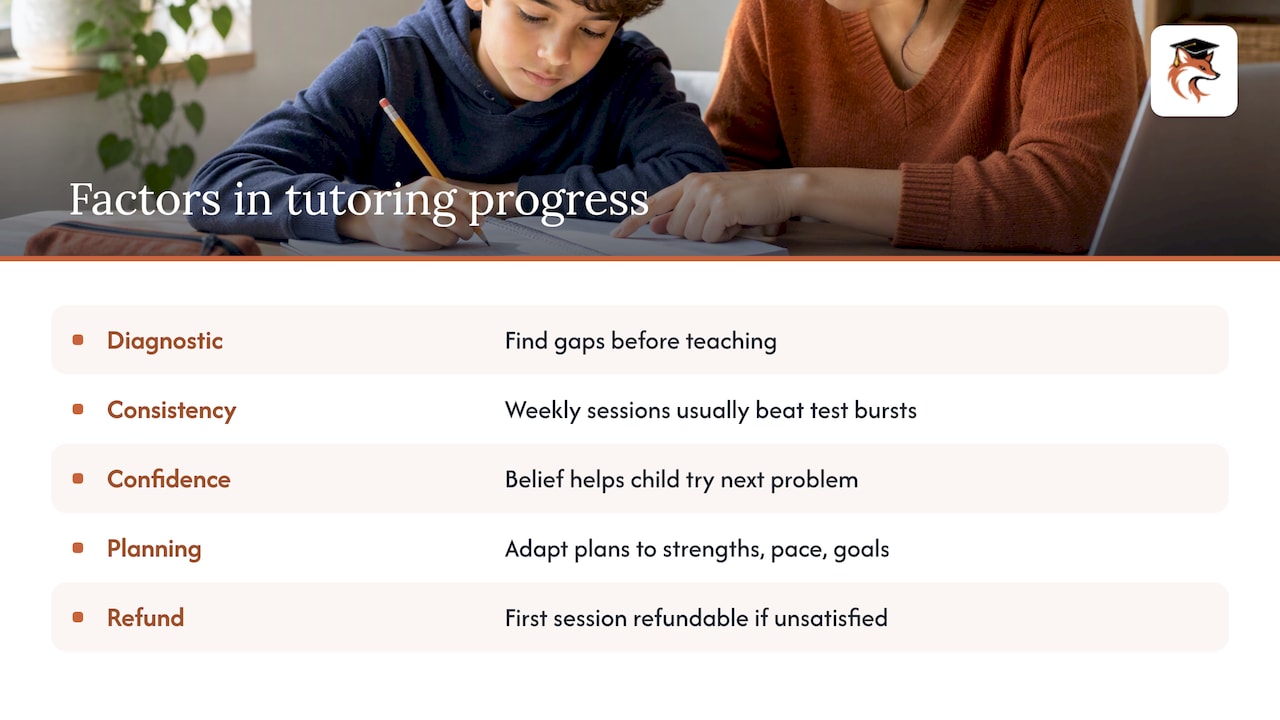
Three things matter most in our experience. First, a diagnostic start. Before teaching anything, we look at where your child actually stands, because two children with the same grade in math can have very different gaps. Second, consistency. One session a week, every week, usually does more than a burst of four sessions before a test. Third, confidence. A child who believes they can do it will try the next problem. Many of the “trap words” in French or multi-step problems in math feel less scary once there is a method, and we sometimes turn that method into a game so that stress does not get in the way.
We choose our tutors from university level for academic excellence, teaching ability and commitment. We monitor progress throughout, and we adapt each plan to the student’s strengths, pace and goals. That is why we can offer a refund of the first session if you are not satisfied.
— Réussite A+
Where Réussite A+ fits among the options
We are an online tutoring service for elementary and secondary students across Quebec, focused on math and French. Here is what that means for a West Island family:
- No commute. Sessions happen at home, which suits busy weeknights and weekends.
- One-to-one and group sessions, with hourly rates published openly.
- Custom learning plans and materials built around your child’s strengths, challenges and pace.
- Continuous progress tracking, so you know what is improving.
- Programs across the school year: a regular session during the year, a summer session for catch-up, and school exam preparation, including entrance exams for secondary school.
We are not the right match for every child. A student who needs to leave the house to focus, or who cannot sit at a screen for 45 minutes, may do better in person. If that is your child, we would rather you know before you register.
Ready to start? You can register for tutoring and academic support or look at our Montreal tutoring page first.
Matching the option to your child
Here are some common situations and the option that tends to fit.
Your child is falling behind in one subject. Start with one-to-one tutoring in that subject, either online or at home. A diagnostic session will show whether the gap is a single concept or a weak foundation.
Your child has entrance exams for secondary school coming up. Look for exam preparation with practice papers and timed simulations. Practising under exam conditions builds familiarity and calms nerves. Read our piece on exam simulations and our high school entrance exam plan for parents and students.
Your child is doing fine but loses ground over the summer. A light summer program of a session or two a week keeps skills warm. Our summer learning loss guide explains how.
Your child needs daily homework support. A tutor who combines homework help with skill-building is more useful than one who only checks answers. Ask whether the tutor teaches the method or simply gives the solution.
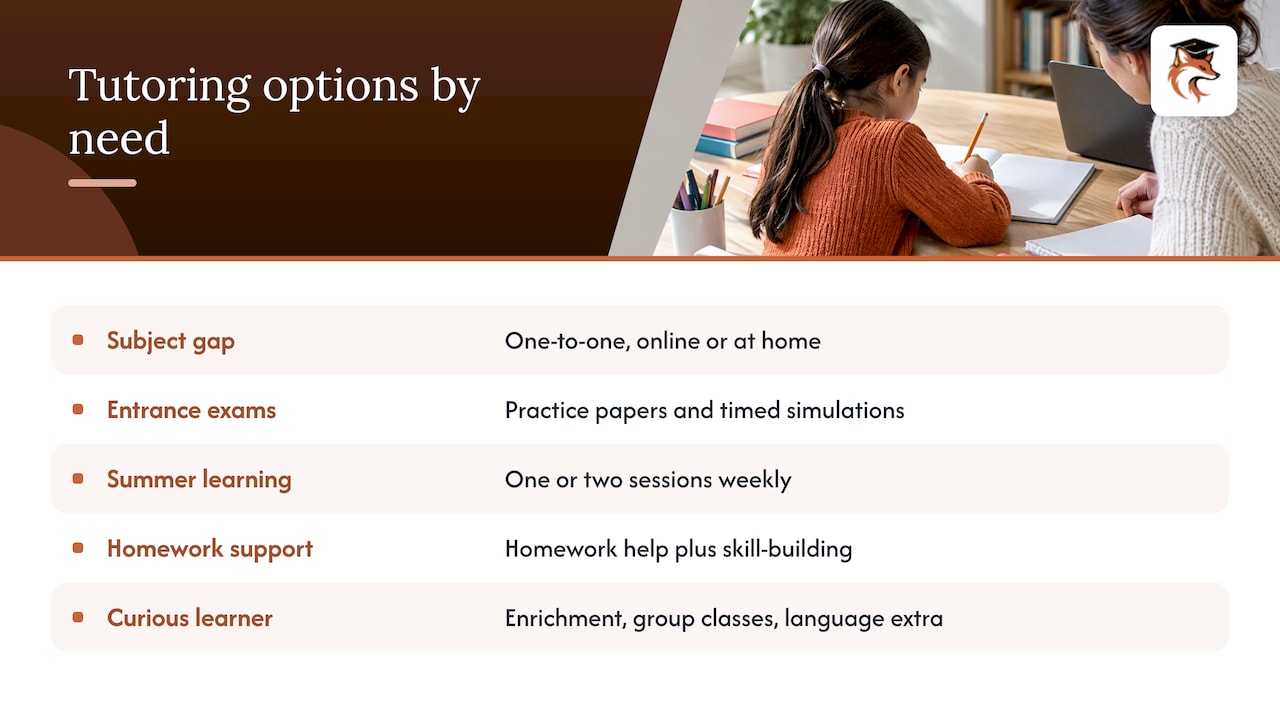
Your child is curious and wants more. Enrichment or group classes may keep them engaged. Some families also add a language extra, such as kids’ Mandarin courses, once core subjects are steady.
Mistakes to avoid
- Choosing by price alone. A low hourly rate that does not produce progress costs more in the end.
- Waiting for a crisis. Starting early, when the gap is small, takes fewer sessions.
- Skipping the trial. A tutor looks good on paper. Only a real session shows whether your child connects with them.
- Asking for too much at once. Pick one or two goals per term.
- Staying out of the loop. Ask for a short update every few weeks and compare it with your child’s school results.
FAQ
Is tutoring the same as homework help?
Not quite. Homework help gets tonight’s assignment done. Tutoring, as Quebec’s own program describes it, is individualized support based on the student’s evolving needs, so it targets the skills behind the homework. Good providers combine both, but the plan should aim at skills, not only at finishing tasks.
Should I choose in-person or online tutoring in the West Island?
Choose the format your child will actually attend and focus in. In-person suits children who need a change of setting. Online suits busy schedules, avoids travel across the island and gives you a wider choice of tutors. A trial session in each format, when possible, settles the question quickly.
How many sessions per week does my child need?
For most elementary and secondary students, one session a week is a good start, with a second added before exams or for a large gap. A diagnostic session will give a clearer answer. Consistency matters more than volume.
How do I know if the tutoring is working?
Look for three signs within a few weeks: your child talks about the subject with less dread, homework takes less time, and test results begin to move. A good provider shares progress notes without being asked.
Does Réussite A+ serve the West Island?
Yes. Because our tutoring is online, we serve families anywhere in Quebec, including the West Island, Montreal, Laval, Longueuil and Brossard. Sessions are $30–$35 per hour, with a one-off $65 registration fee.