




Timed practice tutoring combines personalised instruction with exercises completed under real exam time limits, so students learn to pace themselves instead of racing the clock. The main benefit is calmer, steadier performance on test day: students know how long a question should take and what to do when it doesn’t. At Réussite A+, we build this timing work into each student’s individual learning plan rather than treating it as a stand-alone drill.
TL;DR:
- Begin by measuring accurate response speed, then use 10 to 15 minute drills two or three times weekly; lengthen sessions only when accuracy holds.
- Students should set a per question time budget, skip and flag stalled questions, check pacing midway, and reserve the final minutes for review.
- Use short drills for fluency, section practice for pacing, and full exams for stamina; computerized tests require practice with review screens and on screen timers.
- Students with attention differences often do better with short bursts and active breaks, while anxiety calls for low stakes exercises that gradually approach exam conditions.
- Track speed and accuracy together, compare timed with untimed results, and review recurring errors; if scores fall as frustration rises, return briefly to untimed work.
Table of Contents
- 1. How personalised learning plans use timed practice
- 2. Test-taking strategies that help with time management
- 3. Which timed practice format fits which stage of prep
- 4. Adapting timed practice for different learning needs
- 5. Measuring progress: feedback, rubrics and what to track
- 6. How to choose a tutor who runs effective timed practice
- 7. Réussite A+ evidence: how our timed-practice approach works
- 8. Why timed practice belongs inside personalised tutoring
- How Réussite A+ builds timed practice into tutoring
- FAQ
- Sources
1. How personalised learning plans use timed practice
Before any clock starts, we need a baseline. A first session typically measures how fast a student answers accurately, not just how fast they answer. That gap between speed and accuracy tells us where to start.
From there, goals and session frequency follow a simple progression: short, low-pressure drills first, then longer timed sections, then full practice exams closer to the real date. A plan might include:
- Short 10 to 15 minute bursts on a single skill, repeated two or three times a week
- Progressive lengthening of timed sections as accuracy holds steady.
- Full timed mock exams scheduled in the final weeks before the test
- Review sessions built in after every timed block, not just at the end
This structure is the backbone of our 12-week entrance exam plan, which lays out, week by week, how writing prompts and timing expectations grow alongside the student’s confidence. A first-session plan sets the starting point, and a six-week essay plan applies the same logic to longer written responses.
2. Test-taking strategies that help with time management
Most students lose time not because they’re slow, but because they don’t have a plan for when a question stalls them. We teach a short set of habits that fix this quickly.
- Set a time budget per question before starting, based on total time divided by number of questions, with a small buffer left over.
- Use checkpoints, pausing briefly at the halfway and three-quarter marks to confirm pacing is on track.
- Apply a decision rule for multiple choice: eliminate clearly wrong answers first, guess and flag if stuck past the time budget, move on.
- Chunk the exam into sections and tackle the strongest section first to build momentum.
- Reserve the last few minutes as a dedicated review window rather than leaving it to chance.
Simulation matters as much as strategy. Practising in a quiet space, with a real timer and the same rules as the actual exam, makes these habits automatic instead of theoretical. Our guide on managing time during exams walks through these tactics in more detail.
Pro Tip: Practise the skip-and-flag habit even on easy drills, so it feels natural rather than panicked when a hard question shows up on test day.
3. Which timed practice format fits which stage of prep
Not every timed exercise serves the same purpose, and using the wrong one at the wrong stage wastes effort.
- Micro-drills (10 to 15 minutes) build raw fluency on a narrow skill, like solving ten algebra problems or answering a block of grammar questions.
- Section-timed practice trains pacing across a multi-part exam, so a student learns how much time a reading section should actually take.
- Full timed exams rehearse stamina, the exam-day routine, and the mental fatigue that shows up near the end of a long test.
- Computerized timed practice adds another layer: navigation, review screens, and on-screen timers that behave differently from paper. Canada’s public service situational judgement test guidance notes that these computerized formats are strictly timed and include review screens, which means practising on a similar interface matters as much as practising the content.
Sequencing these formats in order, rather than jumping straight to full exams, keeps students from associating timed practice with failure. Our notes on last-minute revision techniques cover how to use these formats efficiently when time before the exam is short.
4. Adapting timed practice for different learning needs
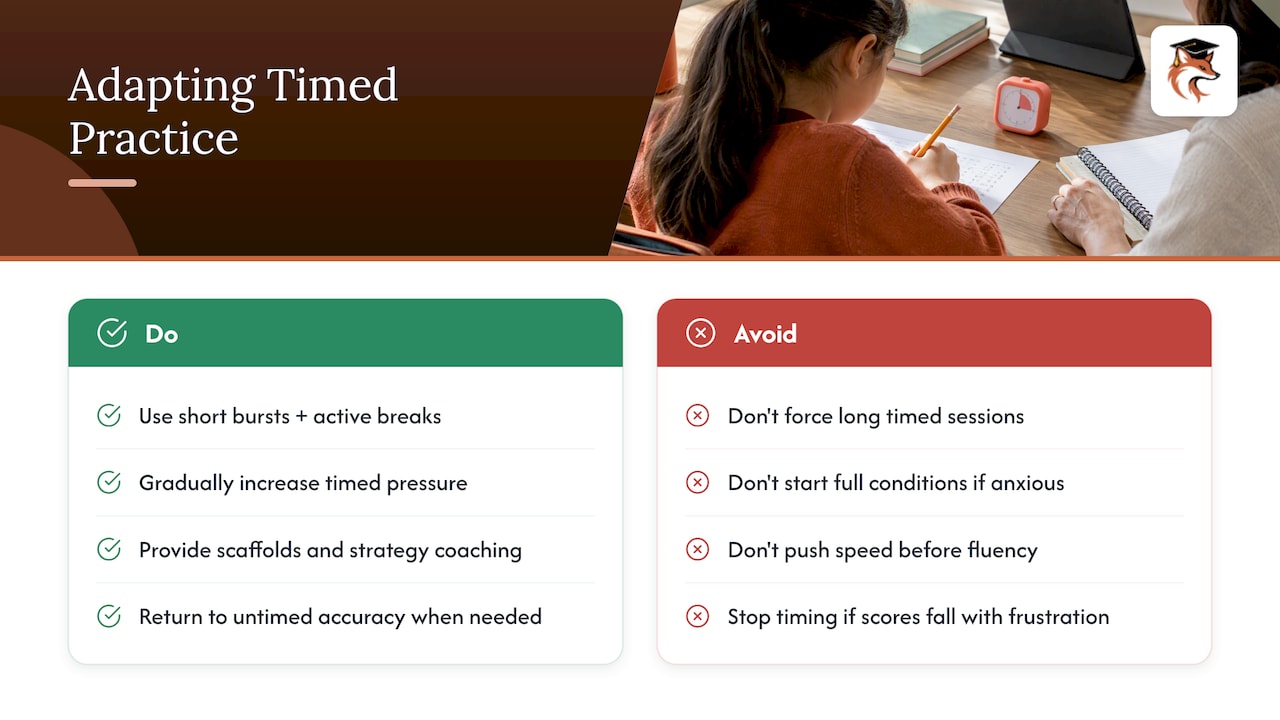
Timed practice only works when it’s adjusted to the student in front of us. For a child with executive-function differences, including many students with ADHD, shorter bursts with active breaks between them tend to hold focus better than one long session. For a student who gets anxious under the clock, we lean on graded exposure: short, low-stakes timed exercises first, building gradually toward full conditions, alongside the stress-management techniques covered in our exam anxiety resources.
For a student still building fluency in the language of the test, scaffolding prompts and strategy coaching matter more than raw speed at first. A clear sign that timed practice has become counterproductive is when scores drop and frustration rises together. When that happens, pulling back to untimed accuracy work for a session or two usually resets things before returning to the clock.
5. Measuring progress: feedback, rubrics and what to track
Timing alone tells us very little without context. CMEC’s assessment research notes that simply giving students more time does not reliably raise achievement on its own, while formative tools like rubrics and targeted feedback correlate more strongly with improvement. That’s why we track both accuracy and speed side by side, watching how each one moves as practice continues.
Concrete indicators we review with parents include:
- Time spent per question compared to the budget set at the start
- Percentage correct on timed versus untimed versions of the same material
- Patterns in an error log, showing which mistakes repeat under pressure
- Notes from the review screen at the end of each timed block
The PCAP2019 contextual report similarly links instructional time management and rubric use with stronger achievement, which supports folding timed drills into a broader, feedback-driven plan rather than running them in isolation.
6. How to choose a tutor who runs effective timed practice
A good first consultation answers a few direct questions before a parent commits to anything.
- Ask how the tutor assesses baseline speed and accuracy before setting goals.
- Ask to see a sample timed drill and a sample progress report.
- Ask what structured plan they follow, such as a 12-week schedule or a documented first-session plan.
- Ask how pricing works: hourly rate, package pricing, and whether a trial session is available.
- Watch for red flags: a speed-only focus with no accuracy tracking, no written progress reports, or no adjustment for a student’s specific needs.
Pricing varies by provider and by province, so comparing packages on reported progress and feedback quality tends to matter more than comparing raw hourly rates alone.
7. Réussite A+ evidence: how our timed-practice approach works
Our methodology comes from extensive tutoring experience applied with a high focus on client satisfaction. Timed practice sits inside that same personalised structure, never as a separate add-on.
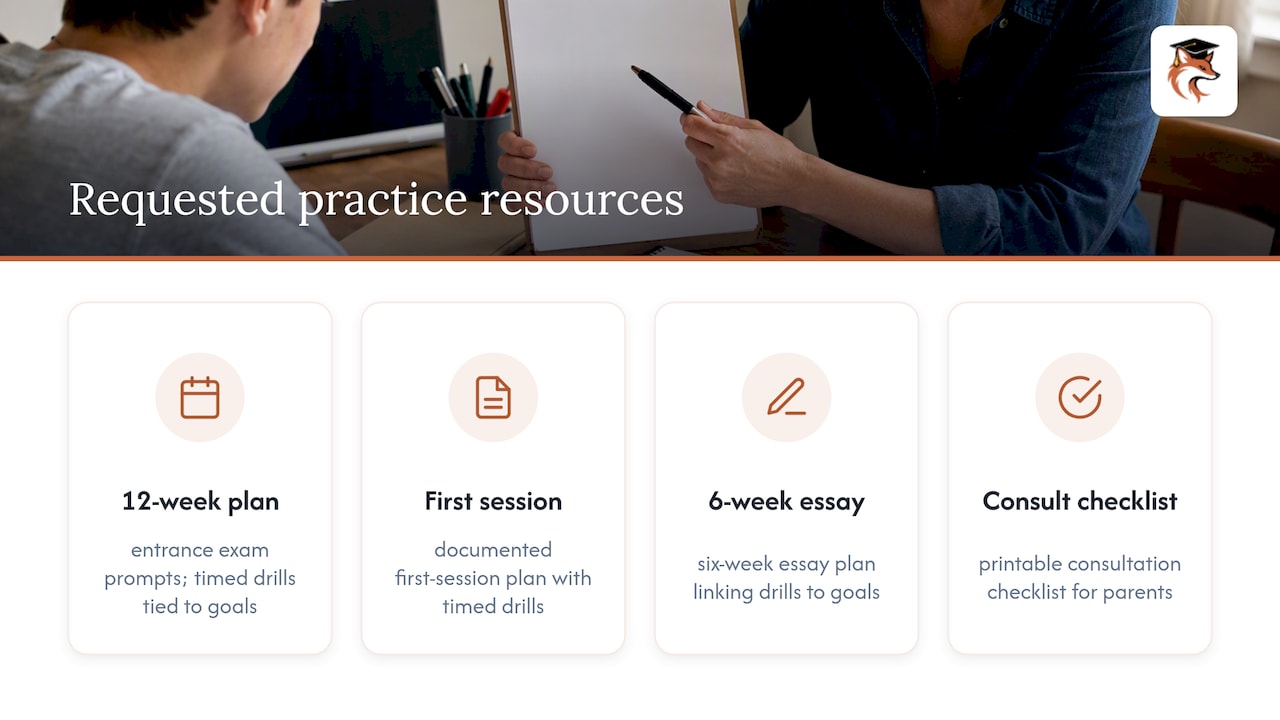
Parents can request concrete resources to see how this works in practice: the 12-week plan for entrance exam prompts, a documented first-session plan, a six-week essay plan, and a printable consultation checklist. Each one ties timed drills to a specific, measurable goal rather than leaving practice open-ended.
8. Why timed practice belongs inside personalised tutoring
Timed drills repeated without feedback just teach a student to be fast at making the same mistakes. The real value shows up when timing is paired with coaching: watching where a student stalls, adjusting the next drill, and easing pressure when anxiety starts working against accuracy. Parents worried about over-drilling should ask for a progress review, not a faster stopwatch. We’re glad to walk through our consultation checklist with any family who wants to see how that balance works in practice.
— Réussite A+
How Réussite A+ builds timed practice into tutoring
We fold timed practice directly into our session régulière and our dedicated exam preparation sessions, both built from an individual plan rather than a generic drill package.
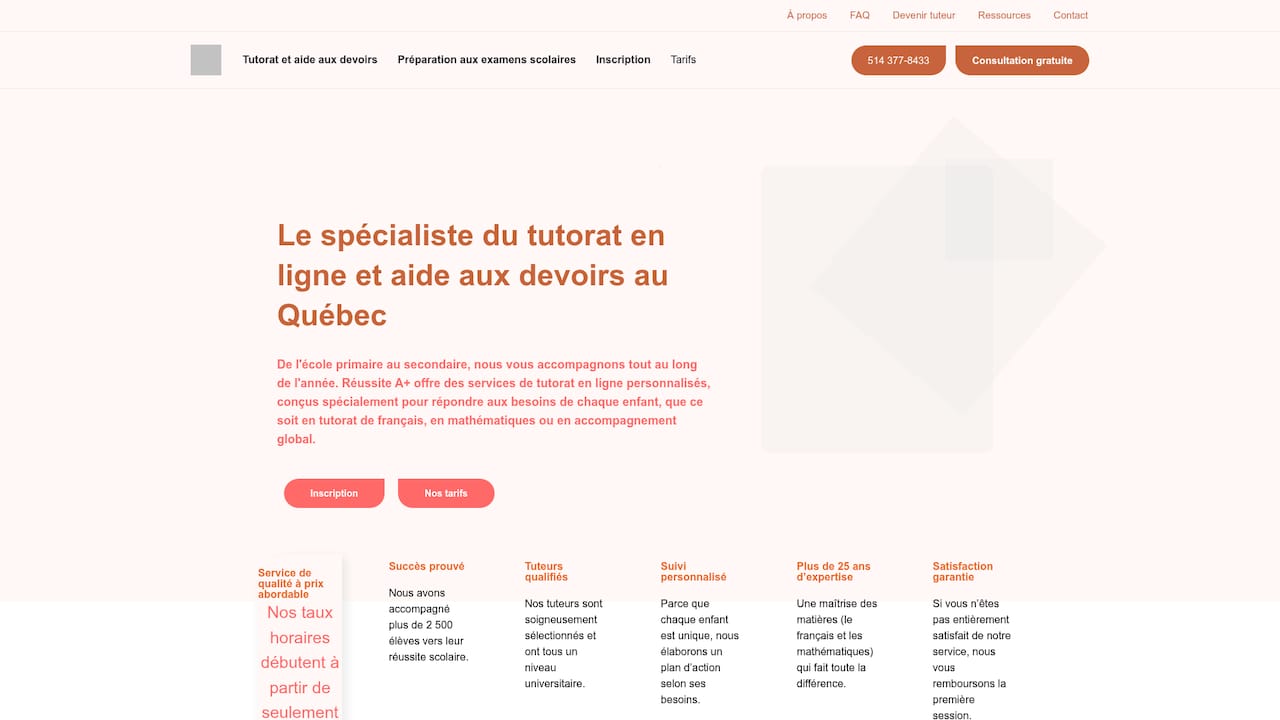
At booking, ask for a trial session, a sample timed drill, and a written progress report so you can see the approach before committing to a full package. Session régulière and exam preparation sessions run 30 $ to 35 $ per hour, with a 65 $ one-time registration fee. Start with a registration and consultation to find the right pace for your child.
FAQ
How much does a private tutor cost per hour?
Private tutoring rates vary widely by subject, region, and provider, so it’s worth comparing package value and progress reporting alongside the hourly figure. Our own session régulière and exam preparation sessions run 30 $ to 35 $ per hour, plus a one-time registration fee.
What is ADHD tutoring?
ADHD tutoring adapts teaching methods for students with attention and executive-function differences, often using shorter focused bursts with active breaks instead of long, continuous sessions. Within timed practice specifically, this means scaling drill length to the student’s attention span rather than applying a standard exam-length timer from the start.
How much does a tutor cost per hour?
Hourly tutoring rates depend on the subject, the tutor’s experience, and whether sessions are one-on-one or group-based. Our session régulière and exam preparation programs are priced at 30 $ to 35 $ per hour, with a separate one-time registration fee.
What is a practice tutor?
A practice tutor guides a student through timed and untimed exercises that mirror real test conditions, then reviews the results to adjust the next session. The goal is steady improvement in both speed and accuracy, tracked through concrete benchmarks rather than timing alone.
How does timed practice fit into overall exam preparation?
Timed practice works best as one part of a broader plan that includes untimed skill-building, feedback review, and stress-management techniques. Pairing timing with formative feedback, such as rubrics and error logs, tends to support progress more reliably than timed repetition on its own.