



Study skills tutoring teaches a child how to learn, not just what is in this week’s lesson. A tutor works one-on-one with your child on the habits behind good grades: taking useful notes, planning homework, revising in short and effective blocks, and approaching a test calmly. If your child works hard but the results do not follow, this is often where the gap is, and it can be closed with simple, structured methods.
Below, you will find what these skills are, the signs that your child needs them, a step-by-step routine to try at home this week, and how online tutoring in Quebec can reinforce all of it.
TL;DR
- Study skills are teachable. Many students struggle because nobody has ever shown them explicit strategies, not because they lack ability.
- The core skills are note-taking, organization, time management, active revision and test-taking habits.
- Middle school and the start of secondary school are the best moments to build them, before the workload peaks.
- The best support blends skills coaching with a real subject, such as French or math, so strategies are practised on actual homework.
- Our tutors at Réussite A+ build a personalized plan and track progress, with sessions at $30-35 per hour and a one-time $65 registration fee.
Table of Contents
- What study skills really are
- Why these skills are rarely taught
- Signs your child could use study skills support
- Study strategies for middle schoolers
- Time management: the skill behind homework help
- What the research says
- How study skills tutoring works with us
- Our perspective: skills first, then confidence
- Getting started with Réussite A+
- Frequently asked questions
- Sources
What study skills really are
Study skills are the methods a student uses to take in, organize and remember information, and then show what they know. Think of them as the tools in a toolbox. Knowing fractions or the agreement of past participles is the content. Knowing how to review them over a week, check your own understanding and avoid trap words in a question is the skill.
The five skills we work on most often are:
- Note-taking and organizing materials. Keeping a binder, agenda and digital files in order so nothing is lost.
- Time management. Breaking a project into steps and assigning each a day.
- Active revision. Quizzing yourself, explaining a concept aloud, redoing exercises without looking at the answer.
- Reading and understanding instructions. Spotting the action verb (compare, justify, calculate) and the trap words in a question.
- Test-taking habits. Managing time, starting with what you know, and checking your work.
A sixth skill sits underneath all of them: metacognition, the ability to step back and ask “Do I really understand this, or does it only look familiar?” Ontario’s curriculum resources describe metacognition as a core element of critical thinking, and it is what lets a student monitor their own progress and ask for help at the right moment.
Why these skills are rarely taught
Most children are expected to pick up study habits on their own. Teachers cover the curriculum, and there is little class time left to show every student how to review. Ontario’s own guidance on teaching strategies makes the same point: useful learning strategies work best when they are taught directly instead of being assumed.
The result is a familiar pattern. A student breezes through elementary school on good memory and effort, then reaches secondary school, where the volume, the pace and the independence expected all jump at once. Researchers who support struggling engineering undergraduates describe the same thing at a higher level: students often reach demanding programs without the specific learning strategies those programs require, such as note-taking, organizing materials and self-advocacy.
That is reassuring news for parents. A weak result is not a verdict on your child’s ability. It is usually a skills gap, and skills can be learned.
Signs your child could use study skills support
You do not need a failing grade to benefit. Look for these patterns:
- Homework takes much longer than it should, or is regularly left until the last minute.
- Your child says “I studied for hours” but the test result is lower than expected.
- Rereading is the only revision method.
- Backpacks, binders and agendas are chaotic, and handouts go missing.
- Your child freezes on tests, even on material they knew the night before. Our guide to pre-exam anxiety and ten ways to calm it can help here.
- The move to secondary school, or a first ministerial exam, is approaching.
If two or three of these sound familiar, a short block of skills-focused tutoring is likely to pay off.
Study strategies for middle schoolers
The years around the end of elementary school and the start of secondary school are a turning point. Children get more teachers, more deadlines and less hand-holding. This is the ideal window to install habits that will carry them through to Secondary 5.
Here is a simple weekly structure we recommend to parents.
A 5-step homework routine
- Write it down. Your child lists every task and due date in one place, such as an agenda or a whiteboard.
- Order the tasks. Start with the hardest or the most urgent, while energy is high.
- Set a block. Work for 20 to 25 minutes, then take a five-minute break. Short blocks make a long evening feel manageable, a bit like a game.
- Check, don’t just finish. Before closing the book, your child explains one thing they learned aloud, as if teaching you.
- Pack tomorrow’s bag. Two minutes tonight saves a stressful morning.
A simple revision method for tests
Start a week ahead rather than the night before. Spread the review over several short sessions, and in each one use self-testing: cover the notes and try to recall, make flashcards, redo a problem from scratch. Mistakes are useful information here, so keep a short “error list” and revisit it before the test. For more ideas, see our revision strategies for secondary school exams, and our piece on microlearning and knowledge retention shows why short, repeated sessions work.
Mini-checklist before any test
- Did I read each question twice and underline the action verb?
- Did I spot the trap words (“not”, “except”, “at least”)?
- Did I show my steps in math?
- Did I keep five minutes at the end to reread?
Time management: the skill behind homework help
Parents often ask for homework help when the real problem is time. A child who understands the material but starts at 8:30 p.m. will struggle regardless of how good the explanation is.
Try these three adjustments:
- Work backwards from the deadline. For a project due Friday, decide what must be finished on Monday, Tuesday and Wednesday.
- Keep a realistic daily window. Homework that regularly spills far beyond the usual time for your child’s grade often signals a method or comprehension problem rather than laziness. Raise it with the teacher.
- Protect a fixed time. The same hour each day, in the same place, with the phone out of the room, builds the habit faster than any app.
When the schedule is the obstacle, our article on managing time during exams carries the same ideas into the exam room.
What the research says
We like to be clear about what is known and what is not. Most of the published Canadian work on explicit study skills training involves university students, so the results are an encouraging signal for younger children, not a direct proof.
- A “learning how to learn” course at Mount Saint Vincent University for at-risk students was associated with significant gains in GPA, and with better use of learning strategies.
- A more recent metacognitive guide for effective studying explains that learners who judge their own progress accurately make better choices about what to study next.
- For younger students, a randomized controlled trial of a tutoring program in Ontario with children in foster care found gains in reading fluency and math calculation compared with a control group. The sample was small (70 children) and not every sub-skill improved, so we read it as support for structured, individual tutoring rather than as a guarantee.
The common thread: explicit, structured, individual support works better than hoping a child will work it out alone.
How study skills tutoring works with us
A good skills tutor does not teach study tips in the abstract. The strategies are practised on your child’s real French and math homework, so they stick. Here is how it unfolds at Réussite A+:
- Registration and a first look. We learn about your child’s strengths, challenges, pace and goals.
- A personalized learning plan. It sets the skills to build first, for example organization and note-taking for one child, active revision for another.
- Weekly online sessions. One-on-one with a university-level tutor, with custom educational material.
- Continuous progress monitoring. We track what is improving so you are never guessing.
- Adjustment. As habits become automatic, sessions shift toward the subject or exam that matters most.
Because sessions are online, there is no travel and scheduling is flexible, which matters on busy weeknights. Our article on how online tutoring helps parents follow their child’s progress explains how you can stay informed without hovering.
Choosing the right type of support
| Type of support | Best for | Limits |
|---|---|---|
| Free school or community homework help | Quick questions on a specific exercise | Rarely builds a personal method or follows progress over time |
| Group classes or workshops | Introducing general techniques | Less adapted to your child’s pace and gaps |
| Large learning-center programs | Structured programs with fixed schedules | Often tied to a location and a set format |
| One-on-one online tutoring | Building habits on real homework, with a plan | Needs a regular weekly commitment from your child |
We believe the last option gives most families the best balance of personalization, convenience and cost, because the plan follows your child, not a template.
Our perspective: skills first, then confidence
After more than 25 years in education and over 3,500 students helped, we have noticed that grades rarely rise in a straight line. They rise after a child discovers they can handle the work. That moment almost always follows a small, concrete win: a clean agenda, a first test where the revision plan worked, a math problem solved because the child finally reread the question properly.
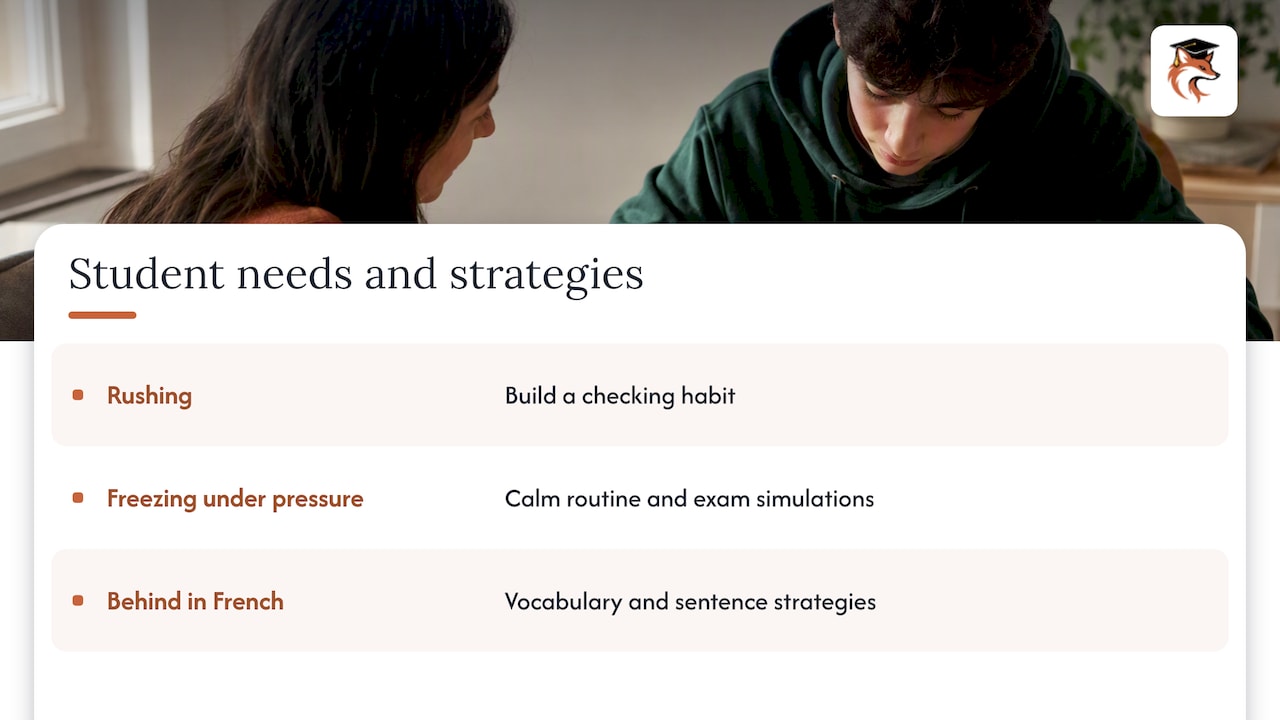
That is why we resist the one-size-fits-all approach. A child who rushes needs a checking habit. A child who freezes needs a calm routine and practice under test conditions, which is why we use exam simulations. A child who is behind in French needs vocabulary and sentence strategies, not only more exercises.
Our advice to parents is simple. Pick one skill, practise it for two weeks, and celebrate effort rather than the mark. Keep the tone light. When learning feels like a game with clear rules, stress drops and the habits last.
Talk to the school as well. Alloprof’s guidance for parents stresses that regular, open communication with teachers is essential for a child’s success at school. A teacher can tell you which skill to prioritize.
— Réussite A+
Getting started with Réussite A+
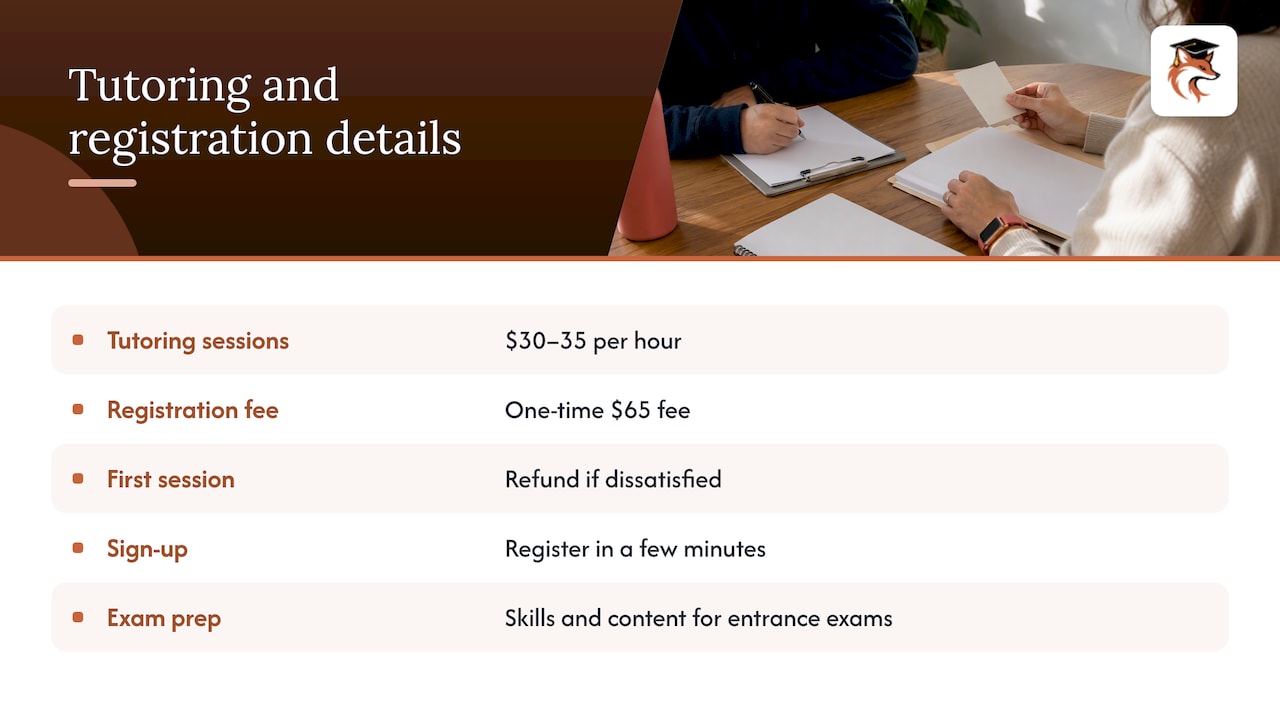
We offer online tutoring for elementary and secondary students across Quebec, including Montreal, Laval, Longueuil, Brossard and Gatineau. Our regular session is where most skills work begins, and it is paired with tutoring and homework help in French and math. Sessions are $30-35 per hour, with a one-time $65 registration fee (see our rates page). If you are not satisfied with the first session, we refund it.
Ready to begin? You can register for tutoring and academic support in a few minutes. If a specific deadline is coming up, our exam preparation sessions combine skills and content for the secondary school entrance exams.
Frequently asked questions
How long does it take to see results from study skills tutoring?
Most families notice calmer homework evenings and better organization within a few weeks. Grades usually take longer, because a new habit has to be repeated before it becomes automatic. We track progress session by session, so you can see what is changing in the meantime.
At what age should my child start?
The end of elementary school and the first years of secondary school are ideal, because the workload and independence expected increase sharply. That said, younger children benefit from simple routines such as a homework spot and an agenda, and older students can still improve before important exams.
Is study skills tutoring different from homework help?
Yes. Homework help gets tonight’s assignment done. Study skills tutoring teaches your child the method behind it, so they need less help over time. In practice we combine both: the homework becomes the material for practising the skill.
Will my child need to study more hours?
Usually not. The goal is to make the time your child already spends more effective: shorter blocks, active recall and a clear plan. If homework regularly takes far longer than expected, it is worth discussing with the teacher and your tutor.
Sources
- Learning How to Learn: A Student Success Course for At Risk Students, Canadian Journal for the Scholarship of Teaching and Learning
- A Metacognitive Instructional Guide to Support Effective Studying Strategies, Canadian Journal for the Scholarship of Teaching and Learning
- Effects of the TutorBright tutoring programme on the reading and mathematics skills of children in foster care, Oxford Review of Education
- Supporting engineering students on academic probation by improving their learning skills
- Pensée critique et littératie critique, Ontario curriculum
- Stratégies d’enseignement et d’apprentissage, Ontario curriculum
- Helping your child adapt to the Quebec school system, Alloprof