



For most struggling students, targeted, regular tutoring is the first thing to try, and in Quebec it is also what the school must show has been tried before anyone talks about repeating a year. Research on grade retention shows no average gain and more risk of absences and dropping out, while high-dose tutoring has a consistent, substantial, positive effect for students in serious difficulty. At Réussite A+, our online tutors build a personalized plan around your child’s gaps, so the year ahead can be a step forward and not a repeat.
TL;DR
- Repeating a grade means doing the same year again. Tutoring adds targeted teaching on top of the normal school year. They are not the same kind of help.
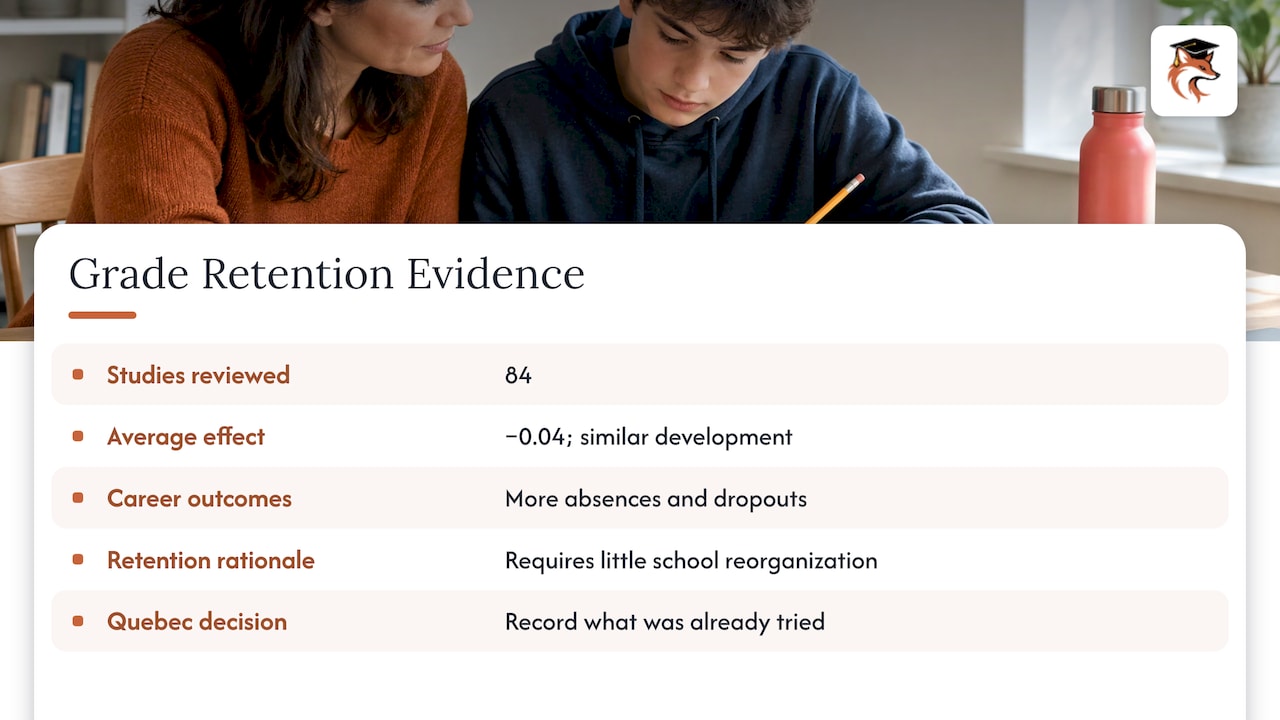
- A large review of 84 studies found retention had an average effect of −0.04, and repeaters had a higher chance of absences and dropping out.
- In Quebec, the school director decides on retention after consulting the teacher, with parental consent. Ask to see the intervention plan first.
- Tutoring works best when it is personalized, regular and in contact with the classroom. Sessions during the school year and in the summer each have a role.
- Our sessions cost $30–$35 per hour, plus a one-off $65 registration fee.
Table of Contents
- What is the difference between repeating a grade and tutoring?
- What the research says about repeating a grade
- What the research says about tutoring
- How the decision works in Quebec
- When does each option make sense?
- Summer or school-year tutoring?
- What to look for in a tutoring plan
- Our experience: why we favour support that moves your child forward
- Getting started with Réussite A+
- FAQ
- Sources
What is the difference between repeating a grade and tutoring?
Repeating a grade (redoublement) is a school decision. Your child stays in the same level for another year and goes through the same curriculum, usually with the same type of teaching that did not work the first time.
Tutoring is a support. Your child moves forward with their class and gets extra, focused teaching on the exact skills that are missing: a fraction concept, verb agreement, reading comprehension. It changes how your child learns, not just how long.
That difference matters because most struggles come from specific gaps, not from “a year’s worth” of missing learning. A child who has not mastered multiplication tables does not need to relive science, social studies and art. They need multiplication tables, practised in a way that sticks.
| Repeating a grade | Tutoring | |
|---|---|---|
| Who decides | The school (director, with parental consent in Quebec) | The family |
| What changes | Time spent at the same level | The teaching, targeted to your child’s gaps |
| Social impact | Separation from classmates | Child stays with their class |
| Timing | Decided at the end of the year | Can start any week, including summer |
| Reversible | No, the year is done | Yes, adjusted as progress is tracked |
What the research says about repeating a grade
A systematic review of 84 studies found an average effect size of −0.04 for grade retention: on average, repeaters developed about the same as similar non-repeaters. The same review found that repeaters had more negative school and job career outcomes, including a higher chance of school absences and dropping out.
In plain words, the extra year does not reliably give the child an advantage, and it can bring real costs: a child who sees friends move on, who may feel labelled, and who may lose motivation.
The Australian and New Zealand Evidence for Learning toolkit makes a similar point: retention keeps being used largely because it requires little change to how a school is organized, not because of strong evidence that it works.
This does not mean every case is the same. Some children are much younger than their classmates and have struggled, and a school may see a reason to hold them back. That is why the decision should be built on a record of what was already tried, which is exactly how the Quebec process is framed.
What the research says about tutoring
A Canadian review, The Evidence for Tutoring to Accelerate Learning, reports that experimental studies find a substantial, positive impact on achievement. That includes students with greater academic difficulties, such as those who have been held back.
Two more findings are useful for parents:
- A 2023 study found that tutoring programs in secondary schools significantly increased student grades compared with homework support or general study-skill programs. Targeted teaching on the real gap beats general help.
- Quebec’s tutoring research centre, CTREQ, notes that tutoring is the support measure with the best results for students with difficulties in reading or mathematics, and that intensive tutoring gives the best results.
What “effective” looks like
The Quebec education ministry’s report on tutoring initiatives describes effective tutoring as at least three sessions per week, lasting 20 to 90 minutes depending on age, often in groups of four or fewer. CTREQ adds that tutoring should be personalized and regular, one-on-one or in a small group.
That is the model we follow: a plan built for one child, regular sessions and progress tracking. If your child struggles in French or math, a weekly session is a start, and an intensive schedule for a few weeks can speed things up. Our regular session can be run weekly or at a higher intensity.
How the decision works in Quebec
Families often feel that a retention recommendation arrives suddenly. In Quebec, it should not.
According to the Montreal school service centre’s decision tool for teachers:
- For primary and first-cycle secondary, the school director decides on retention, with the parents’ consent, after consulting the teacher.
- Teachers must inform parents at least once a month when there is concern that a student will not reach the success threshold for the grade.
- Retention should never rest on a fear of future failure. It should be grounded in solid evidence that earlier, intensive interventions were not effective.
This tells you what to ask for. If someone raises repeating a year, you can reasonably request:
- The student’s intervention plan and its dates.
- The record of additional and intensive interventions already tried, and the results.
- The monthly notices you should have received about the risk of not reaching the threshold.
- Which competencies are below the threshold, as shown on the report card.
Our guides on the school intervention plan and on reading a competency-based report card walk through these documents so you can ask precise questions at the meeting. Your school’s director and your child’s teacher remain the people who make the final school decision, so keep them in the conversation.
When does each option make sense?
This is not a diagnosis, and every child is different. Use these situations as a starting point for the conversation with your school.
Tutoring first: the most common case
- Your child is behind in one or two subjects, usually French or math.
- The gaps are specific: reading comprehension, fractions, written production, problem solving.
- Your child is motivated, or was motivated before falling behind.
- The report card shows some competencies close to the threshold.
Here, extra teaching aimed at the gaps is the logical step. It is also what the Quebec guidance expects to see documented before retention is considered.
Tutoring and the school together: the harder case
- Your child is far below the threshold in several subjects.
- Early support has not yet been consistent or intensive enough.
- Your child has a learning difficulty that has been identified or is being assessed.
Here, ask the school for an assessment and an intervention plan, and add regular tutoring that works on the same targets. CTREQ stresses that tutors should stay in contact with the family about classwork and learning needs, and that without coordination tutoring can slide into plain homework help. Share the report card and the plan with your tutor from day one.
Discussing a repeat year
If the school proposes it, treat it as a serious decision that needs the paper trail described above. Ask what would be different in the second year. If the answer is “the same program again”, you have the right to ask what additional support will come with it. In the meantime, a tutoring plan can start right away so your child’s skills are growing while the decision is made.
Summer or school-year tutoring?
Both have a role, and they do different jobs.
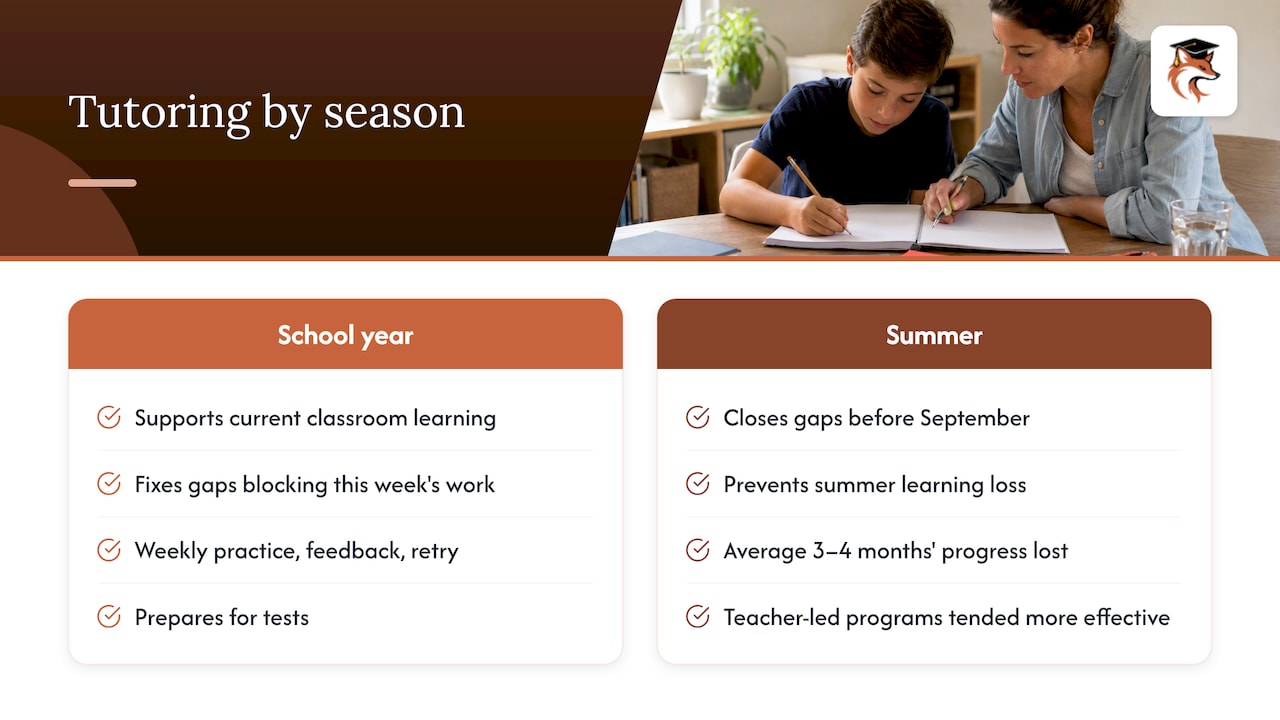
During the school year, tutoring works alongside the classroom. The tutor sees what your child is learning this week, fixes the gaps that block it, and prepares tests. This is where a weekly rhythm helps most: the child practises, gets feedback, and tries again within days. Our regular session and tutoring and homework help are built for this.
During the summer, the aim is to stop slipping and to close gaps before September. A 2025 review found that students at risk of underachievement lose an average of three to four months of academic progress over the summer, and that teacher-led programs tended to be more effective than home-based models without direct instruction. A live tutor who teaches, not just supervises, fits that finding. Our summer session is designed for exactly this, and our guide to preventing summer learning loss explains how to plan it.
For a child who is at risk of repeating, the strongest plan is continuous: regular sessions during the year, a summer session to consolidate, then a return to a regular schedule in the fall. Gaps are addressed before they pile up.
What to look for in a tutoring plan
Whether you choose us or compare options, the research points to the same features:
- Personalized: the plan starts from your child’s strengths and gaps, not a generic workbook.
- Regular: a steady rhythm beats occasional cramming.
- Small groups or one-on-one: attention is on your child.
- Connected to school: the tutor knows what the teacher is covering.
- Tracked: you can see progress, not just hours.
A good first month looks like this:
- Week 1: review of the report card and a short assessment to locate the exact gaps.
- Weeks 2 to 4: focused sessions on two or three priority skills, with short practice between sessions.
- End of month one: a progress check against the targets, then adjust the plan.
Our page on what happens in the first tutoring session shows how we begin, and the tutoring roadmap for Quebec families helps you decide where to start.
Helping at home between sessions
Parents do not need to teach. A few habits make tutoring work faster:
- Ten to fifteen minutes of reading aloud or independent reading each evening.
- A quick review of the last session’s key point before bed.
- Sending the tutor any test, correction or teacher comment.
- Praising effort and method (“you reread the question twice”) rather than only the grade.
These habits also protect your child’s confidence, which is often what suffers most when a child is told they might repeat.
Our experience: why we favour support that moves your child forward
We built Réussite A+ on more than 25 years of educational experience, and we have helped more than 3,500 students. The families who come to us are rarely asking for a miracle. They want to know what is going wrong and what to do about it this week.
Our answer is a personalized learning plan. We look at your child’s strengths, challenges, pace and goals, and we build the sessions around them, mostly in French and mathematics. Every tutor is selected from the university level for academic excellence and teaching ability, and we monitor progress continuously so you can see what is changing.
A child who is held back repeats a year. A child who is tutored learns the specific thing they were missing, in the company of their own classmates and with their confidence intact. That is why we put regular, targeted tutoring first, in the school year and in the summer.
Réussite A+
Getting started with Réussite A+
Our online tutoring covers elementary and secondary students across Quebec, including Montreal, Laval, Longueuil, Brossard and Gatineau. Sessions run on flexible schedules, with custom educational material and progress tracking. Hourly rates are $30–$35 for our regular, summer, exam-preparation and homework-help sessions, plus a one-off $65 registration fee. If you are not satisfied after the first session, we refund it.
You can choose a French tutoring program, a math course, or an exam-preparation session for secondary school entrance exams. To begin, go to our registration page.

FAQ
Does tutoring really help a child who is behind?
Yes. A Canadian review of the research finds that tutoring has a substantial, positive impact on achievement, including for students with greater academic difficulties. The best results come from regular, personalized sessions, one-on-one or in small groups. Bring your child’s report card so the plan targets the right skills.
Can my child be made to repeat a grade in Quebec without my consent?
For primary and first-cycle secondary, the school director decides after consulting the teacher, with the parents’ consent. You can ask for the intervention plan and the record of interventions already tried. Teachers must also tell you at least once a month if your child may not reach the success threshold.
Is summer tutoring enough to avoid repeating?
Summer tutoring helps a lot with consolidating skills, and research shows at-risk students can lose three to four months of progress over the break. For a child who is far behind, we suggest combining a summer session with regular sessions during the school year. Speak to your school about your child’s specific situation.
How many sessions per week does my child need?
Quebec’s education ministry describes effective tutoring as at least three sessions per week of 20 to 90 minutes, depending on age. Many families begin with a weekly session and increase the pace for exams or catch-up periods. We set the rhythm in the personalized plan.
Sources
- Effectiveness of grade retention: A systematic review
- Repeating a year, Evidence for Learning
- The Evidence for Tutoring to Accelerate Learning
- Catching up after COVID-19: do school programs help?
- Comment favoriser l’efficacité du tutorat? CTREQ
- Rapport portant sur les initiatives de tutorat, ministère de l’Éducation du Québec
- Outil d’aide à la décision: redoublement, CSSDM
- Summer learning loss and summer programs, Frontiers in Education, 2025