



The right French tutor for your child is someone who can show relevant training, explains how they will teach and measure progress, and fits your child’s level, personality and schedule. You can check all of that in one short conversation and one trial session. Below, we walk you through the steps, the questions to ask and the signs that a match is working, whether you live in Montreal, Laval, Longueuil or elsewhere in Quebec.
TL;DR
- Start with your child’s level and goal (catching up, keeping pace, exam preparation, or going beyond grade level), then look for a tutor who has worked with that exact situation.
- Ask about training, teaching experience, method, materials, progress reports, references and cancellation policy before you book.
- Choose online or in-person according to what your child will actually keep doing every week.
- Set two or three measurable goals, try one session, and review progress after a few weeks.
- Involve your child in the decision: comfort with the tutor matters as much as credentials.
Table of Contents
- Start with your child, not with the tutor
- What qualifications to check
- Questions to ask before you book
- How to judge a teaching approach
- Online or in person
- Choosing locally: Montreal, Laval, Longueuil and beyond
- What French tutoring costs and what affects the price
- Perspective: what we have learned from 3,500 students
- A simple five-step process
- Signs the match is working
- Match the service to the need
- Book a French tutor who builds a plan around your child
- FAQ
- Sources
Start with your child, not with the tutor
Before you read a single profile, write down three things: where your child is now, where they need to be, and by when. A tutor who is excellent for one situation can be a poor fit for another.
A simple way to organize it:
- Current level. Look at the last two report cards and any graded dictations or texts. Is the difficulty with reading, writing, grammar, oral expression, or all of them?
- Goal. Catch up after a difficult year, stay confident in French immersion, prepare for a secondary school entrance exam, or push beyond the grade-level expectations.
- Timeline. A summer catch-up, a six to eight week exam sprint and a year-long weekly routine call for different plans.
- How your child learns. Some children need patience and a lot of encouragement. Others want a clear challenge and quick feedback.
If your child is also coping with reading difficulties, say so from the first conversation. Our page on helping dyslexic children learn French in Canada explains why early screening matters and what to ask for.
If you do not speak French yourself, you are far from alone, and it should not stop you from choosing well. Our guide for non-French-speaking parents shows how to support homework without needing to correct it.
Let your child have a say
Children work harder for a tutor they like. Stanford’s tutoring programme advises involving the student in choosing and trying different matches early on to see what works. In practice, that means letting your child meet the tutor, even briefly, and asking afterwards how it felt. A child who says “she explains things without making me feel silly” has told you more than any résumé could.
What qualifications to check
There is no single licence that every private French tutor holds, so you are looking for a pattern of evidence rather than one document. Ask what the tutor studied, what they have taught and to which age group.
Training and subject knowledge
For reference, professional standards give a useful benchmark. The Languages Canada quality assurance standard (approved March 2, 2024) says academic staff teaching French at member schools should have a degree in Education, or a degree combined with experience teaching French as a second language. That standard governs language schools, not private tutoring for children, but it tells you what a sensible baseline looks like: subject knowledge plus real teaching experience.
School systems are stricter still. A Quebec school service centre’s teacher hiring page lists a legal teaching qualification, successful French-written certification testing and excellent mastery of French among its requirements. A tutor is not a classroom teacher, so you should not expect the same paperwork. You can, however, ask how the tutor demonstrates the same things: strong written French, knowledge of the Quebec program and an ability to explain.
Certified teachers and public registers
If your tutor is a certified teacher in another province, you can verify it. The Ontario College of Teachers’ public register shows certification dates, degrees, additional qualifications and any disciplinary notations. Ask whether the tutor has a register entry you can look up.
Experience with your child’s situation
A tutor who has helped ten Grade 5 students move from struggling dictations to confident ones is more useful than a brilliant speaker with no experience of children. Ask for concrete examples: “What did you do with a child who reads well but makes many agreement errors?”
At Réussite A+, every tutor is selected from the university level for academic excellence, teaching ability and commitment to student success, and our approach draws on more than 25 years of educational experience.
Questions to ask before you book
Memorial University’s Academic Success Centre recommends asking a prospective tutor about credentials, subject knowledge, experience with similar challenges, two or three recent references, methods, typical outcomes, how progress is measured, communication and cancellation policies. Adapted to French tutoring for a school-age child, here is a checklist you can use on the phone:
- What is your training, and have you taught French to students of this age?
- Have you worked with a child in a situation like ours (immersion, late start, dyslexia, entrance exam)?
- How do you find out where my child is starting from?
- Which materials will you use, and do they follow the Quebec school program?
- How will you measure progress, and how often will I hear about it?
- What happens if we do not see progress after a few weeks?
- Can I speak to one or two recent families?
- What is your cancellation and rescheduling policy?
- Is there a trial session, and what if my child and you are not a match?
For a printable version, see our tutoring consultation questions for parents.
Special learning needs
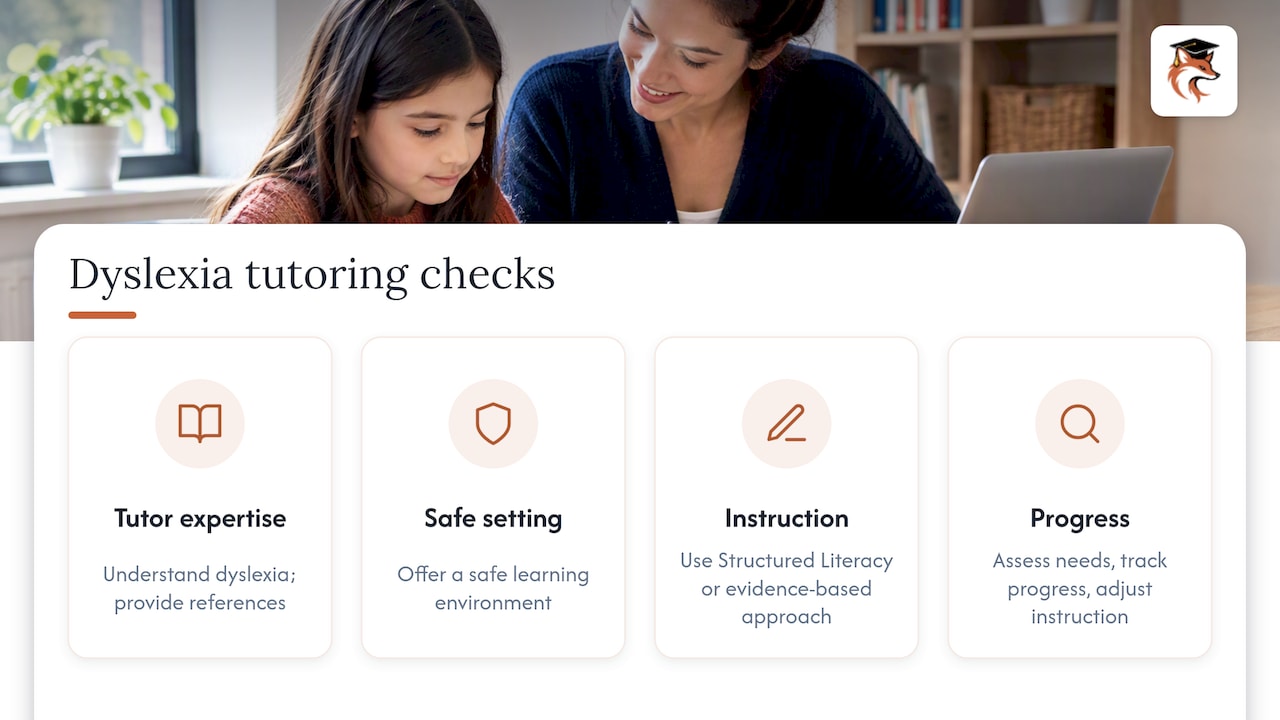
If your child has dyslexia, the bar is higher. IDA Ontario advises that the tutor should understand dyslexia, offer a safe environment, use Structured Literacy or another evidence-based approach, assess needs from school reports and informal assessments, track progress, adjust instruction and provide references. Bring the school report to your first call and ask the tutor to explain, in plain words, what they would do differently.
How to judge a teaching approach
A good tutor can describe a method in a few sentences. You are listening for three things: diagnosis, plan and feedback.
- Diagnosis. The tutor should assess before teaching: a short reading, a dictation, a few grammar questions, a conversation.
- Plan. The sessions should aim at specific skills, such as identifying the action verb in an instruction, spotting trap words, or applying agreement rules, not just “doing the homework”.
- Feedback. You should receive a summary after sessions or on a regular schedule, written so a parent can understand it.
The Conversation’s January 2026 guidance for parents (from Australia, but the logic travels well) suggests a preliminary meeting to assess communication style, how the tutor diagnoses needs, how they align with the school curriculum, how they give feedback and handle homework. It also recommends setting two or three measurable goals and reviewing progress after a few months.
Examples of measurable goals
| Situation | Possible goal | How to check |
|---|---|---|
| Weak dictation results | Reduce agreement errors in a weekly 10-line dictation | Compare scores every two weeks |
| Avoids reading aloud | Read a short page aloud without stopping at every word | Tutor reports fluency at each session |
| Entrance exam in the autumn | Complete a full practice exam within the time limit | Timed practice tests every week |
| French immersion homework stress | Finish homework in a set time without tears | Parent notes after each evening |
Goals like these turn “I think she is improving” into something you can see. If your child is in French immersion, our page on French immersion homework in Quebec describes how a first diagnostic session can pinpoint where homework breaks down.
Online or in person
Neither format is better in every case. The Government of Canada’s language learning portal notes that in-person classes offer live interaction, more speaking and listening, immediate feedback, structure and accountability, while online learning offers convenience and flexibility but typically requires more discipline. Its advice is to pick what the learner can do consistently.
For school-age children in the Montreal area, the practical differences look like this:
| Factor | Online | In person |
|---|---|---|
| Travel | None, which helps on school nights | Time in traffic or transit, every week |
| Choice of tutors | Any tutor in Quebec | Mostly those near you |
| Supervision | Parent can sit nearby, review recordings or notes | Parent is present or waits |
| Attention | Needs a quiet spot and a child who stays on task | Easier to hold attention for younger children |
| Scheduling | Flexible, easy to move a session | Fixed slots, harder to reschedule |
If you are still weighing it, our comparison of home tutoring and online tutoring goes through the differences. And if you want to follow your child’s progress closely, read how online tutoring can help parents monitor academic progress.
Tips for an online session that works:
- Choose a quiet table, not the sofa.
- Keep a notebook and pencil beside the screen so your child writes, not only listens.
- Keep sessions to the length your child can concentrate for, and ask the tutor to vary activities.
- Test the connection five minutes before starting.
Choosing locally: Montreal, Laval, Longueuil and beyond
Online tutoring removes geography as a limit, but local knowledge still matters. Entrance examinations, school calendars and programs vary by school and school service centre, so ask whether the tutor knows the exam your child will actually sit.
If you want a practical list for your area, we have written guides for Longueuil, Laval and Brossard. For Gatineau families preparing for entrance exams, see our plan to pass the Gatineau entrance exam in 6 to 8 weeks.
Before you commit to anyone in your area, ask:
- Which school levels and exams do you know best?
- Are the materials in line with the Quebec curriculum?
- Can you adjust sessions around my child’s school calendar, exams and holidays?
- Will the tutor communicate in the language you are comfortable with, English or French?
What French tutoring costs and what affects the price
Prices depend on the tutor’s experience, the format (individual or group), the length of the program and how much preparation material is included. Ask what is included, whether there is a registration fee, and whether you must buy a package or can pay per session.
At Réussite A+, regular sessions, summer sessions, exam preparation and homework help are $30 to $35 per hour, with a one-off registration fee of $65 (see our rates page). Whatever you pay, write down what the price covers.
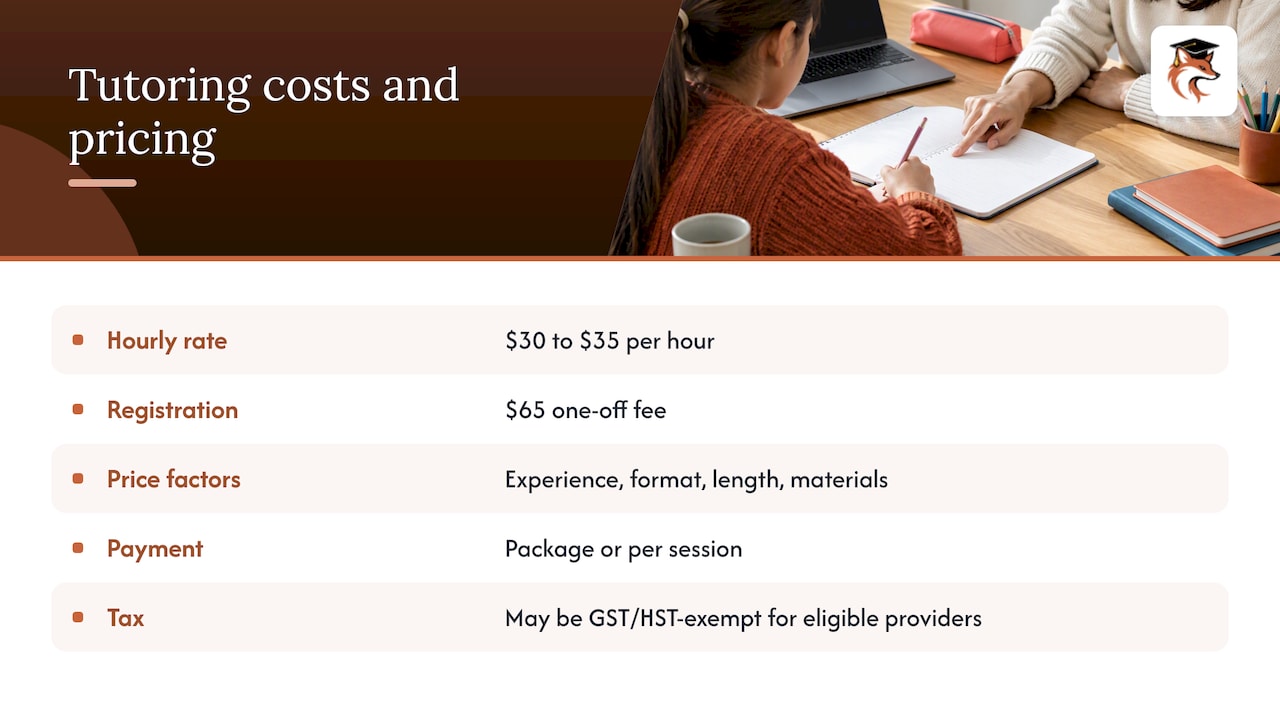
One technical point: the Canada Revenue Agency explains that second-language instruction can be GST/HST-exempt when supplied by a school authority, vocational school, university, public college or a business established and operated primarily to provide language instruction. If tax treatment matters to you, ask the provider how it applies to their service.
Perspective: what we have learned from 3,500 students
We have helped more than 3,500 students, and the families who are happiest at the end are almost always the ones who were clear at the beginning.
Our advice is simple. Ask the tutor to diagnose before teaching. Insist on a plan built around your child’s strengths, difficulties, pace and goals, not a generic program. And ask how you will see progress, because a tutor who cannot show it is guessing.
This is why every student at Réussite A+ receives an individualised learning plan, and why we monitor progress throughout. Our tutors come from university level and are chosen for their academic excellence and their ability to teach, since knowing French and teaching French are two different skills. We also offer a satisfaction guarantee: if you are not satisfied after the first session, you are refunded for it.
Most of all, we believe a child who feels understood learns faster. Confidence is not a bonus in tutoring. It is the method.
Réussite A+
A simple five-step process
- Define the goal. One sentence: “We want Emma to feel confident writing in French before secondary school.”
- Shortlist two or three tutors or services. Use the checklist above on a short call.
- Book a trial session. Sit in or review the notes. Ask your child how it felt.
- Agree on two or three measurable goals. Write them down with the tutor.
- Review after a few weeks. Keep going, adjust the plan, or change tutor if the match is not working.
Our first tutoring session plan shows what a well-organised first session looks like.
Signs the match is working
Watch for these in the first weeks:
- Your child is willing to log in or sit down for the session.
- They can tell you something they learned, in their own words.
- The tutor’s summaries mention specific skills and next steps.
- Homework stress goes down, or at least becomes more manageable.
- Quiz and dictation results begin to move, even slightly.
Signs to reconsider:
- Sessions are only homework completion, with no plan.
- You never receive feedback unless you ask.
- Your child dreads sessions or feels judged.
- The tutor cannot explain what they will change if there is no progress.
Match the service to the need
Once you know what your child needs, the program is easier to choose:
- Weekly support during the year: a regular session builds foundations steadily.
- Entrance exam in view: exam preparation focuses on format, timing and the trap words that cost marks. Our preparation plan for parents and students and our tips on managing exam stress help at home.
- Catching up over the holidays: the summer session offers intensive online courses.
- Daily homework struggles: tutoring and homework help gives your child a guide in the moment.
Book a French tutor who builds a plan around your child
Our French tutoring programs are delivered online by university-level tutors for elementary and secondary students across Quebec. Each child gets a customised learning plan, custom educational material and progress tracking, with flexible scheduling. Sessions are $30 to $35 per hour, plus a one-off $65 registration fee, and if you are not satisfied after the first session, you are refunded for it.
Ready to start? Register for tutoring and academic support and we will match your child with a tutor.
FAQ
How many sessions a week does my child need?
For most school-age children, one session a week gives time to practise between lessons. A child who is well behind, or who has an exam approaching, may benefit from two shorter sessions or an intensive program. Ask the tutor to recommend a rhythm after the first diagnostic, then review it with them after a few weeks.
Does a French tutor need to be a certified teacher?
Not necessarily. Certified teachers must meet formal requirements, and you can check them on public registers where they exist, such as Ontario’s. For private tutoring, look for a relevant degree, real experience with children and a clear method, and ask for references.
Should I stay in the room during online sessions?
For younger children, being nearby helps with focus and technical problems. For older students, a few minutes at the start and end is usually enough. Ask the tutor for notes or a summary so you stay informed without hovering.
What if my child does not click with the tutor?
Tell the tutor or provider quickly. Trying a different match early is normal, and a trial session or satisfaction guarantee is there for this reason. At Réussite A+, you are refunded for the first session if you are not satisfied.
Sources
- Matching Tutors with Students, Stanford National Student Support Accelerator
- Languages Canada Quality Assurance Standard, March 2, 2024
- Enseigner au CSSPI, Centre de services scolaire de la Pointe-de-l’Île
- Learn more about your child’s teacher, Ontario College of Teachers
- Tips for Working with a Private Tutor, Memorial University
- Finding the right tutor for a dyslexic student, IDA Ontario
- Thinking of a tutor for your child? 5 things to consider first, The Conversation
- Online vs. in-person language learning, Government of Canada
- Second-language Instruction, Canada Revenue Agency