


Entrance exam vocabulary is not one fixed list your child can memorize in a weekend. It is three layers of words: everyday words, academic words that appear in every subject, and the instruction and subject words (justifiez, périmètre, inférer) that decide whether a question is understood. Each school sets its own exam, so the best preparation is a method that works on any list. At Réussite A+, our tutors build that method into a personalized learning plan in French and mathematics, and this guide shows you the same routine you can start at home tonight.
TL;DR
- Vocabulary is the bridge between reading words and understanding a text, so a weak word bank hurts every subject, not only French.
- Study three layers: everyday words, cross-subject academic words, and exam instruction words such as comparez, justifiez and déduisez.
- Build the list from your child’s own practice exams and school texts, then review it in short, spaced sessions rather than one long cram.
- Teach look-alike words (aire and périmètre, for example) on different days to avoid mix-ups.
- A tutor who tracks which words your child misses saves weeks of guesswork.
Table of Contents
- What “entrance exam vocabulary” really means
- The three layers of words to study
- Build your list from real material
- A weekly routine that makes words stick
- Games that turn word study into play
- French and math: where vocabulary costs points
- How much time to give it
- Where a tutor changes the result
- Our perspective
- FAQ
- Sources
What “entrance exam vocabulary” really means
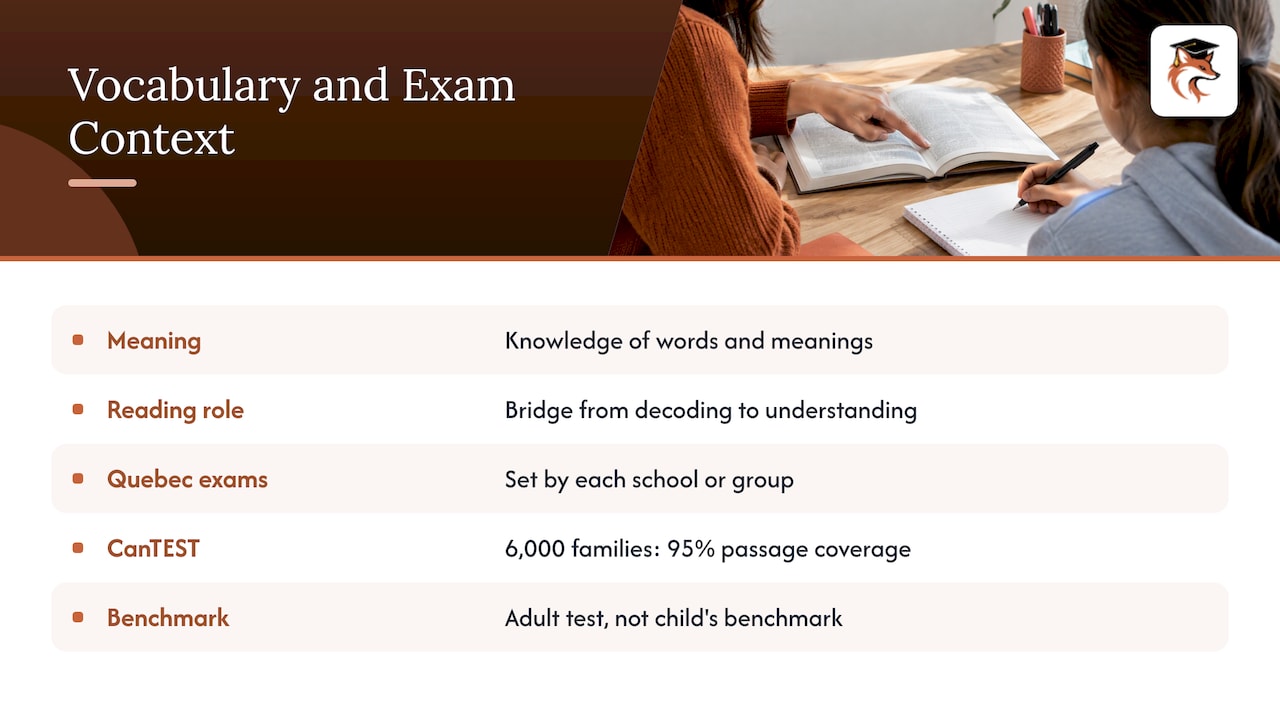
Ask ten parents and you will hear ten definitions. Some mean a list of “hard words”. Others mean the terms in the math section. In practice, vocabulary is the knowledge of words and their meanings, used to understand what we read and hear and to express ourselves. The Ontario school board that publishes this guidance calls it the bridge between decoding (reading the letters) and understanding the text.
That matters for an exam because a child can read every syllable of a question and still miss what is being asked. A single unfamiliar word in the instruction can turn a question your child could answer into a blank.
It is also worth knowing that entrance exams for private and specialized secondary schools in Quebec are set by each school or group of schools. Formats, subjects and difficulty differ. Our guides on entrance exams for private schools in Quebec and the Secondary 1 placement test explain what to look for. For the word work, the practical consequence is simple: start from the material your child will actually face, not from a generic list found online.
How big is the job? Research on a Canadian university-admission English test, the CanTEST, found that about 6,000 word families gave 95% coverage of its reading passages. That test is for adults, so it is not your child’s benchmark. It does show something useful: coverage of a text grows slowly with each new word, which is why steady daily exposure beats a last-minute list.
The three layers of words to study
Sorting words into layers keeps the work calm and manageable. It also tells you where to spend time.
Layer 1: everyday words
Researchers describe these as the 2,000 to 3,000 high-frequency word families needed for daily interaction. Most students at the end of elementary school know most of them. Gaps here are rare, but when they exist (a child who recently moved to Quebec, or who speaks another language at home), they come first.
Layer 2: academic words that travel across subjects
The same British Columbia study calls these Tier 2 words: general academic words with Greek or Latin roots that cross subjects, such as investigate, experiment, analyze and prepare. In French, think analyser, comparer, résumer, hypothèse, conséquence, cause, caractériser. The authors add that the demands of school language grow in quantity and complexity every year, so this layer is where a child at the end of elementary school most needs to grow.
Layer 3: instruction words and subject terms
This is the layer parents overlook. It includes:
- Instruction words (verbes d’action): justifiez, relevez, expliquez, déduisez, nommez, démontrez.
- Trap words (mots-pièges): words that look familiar but change the question, such as au moins versus au plus, tous versus certains, or sauf in a multiple-choice item.
- Subject terms: in math, quotient, facteur, périmètre, aire, médiane; in French, complément, groupe du nom, antécédent, homophone.
A child who knows the math perfectly but reads relevez as “write the answer” instead of “copy the evidence from the text” loses points for a reason that has nothing to do with ability. That is why we treat instruction words as a skill of their own.
Build your list from real material
The best list is your child’s own. Here is how to build it in about twenty minutes a week.
- Collect material. Use past exam samples from the target school, recent school tests and the reading texts your child brings home.
- Mark the stumbles. Ask your child to underline any word they hesitate on, or any word whose meaning they can only half guess.
- Copy the word with its sentence. The University of Saskatchewan’s student textbook advises writing down each new word with the sentence where it appeared, then inferring meaning from context and roots.
- Look it up the same day. The same chapter recommends checking a dictionary that day, writing a sentence of your own for each definition, and saying the word and its meaning aloud.
- Sort it. Tag each word as everyday, academic or instruction/subject. After two weeks you will see where the gaps cluster.
If your child’s weak spot looks like academic words, check an established list. The Academic Word List guidance from Victoria University of Wellington suggests starting with Sublist 1 and moving on only when those words are known. It was designed for English at university level, so use it as a model of how to progress, from the most frequent words to the rarer ones, and apply the same logic to French words from your child’s own texts.
A weekly routine that makes words stick
Memorizing is not the problem; keeping the words is. Two ideas from the research make the difference: retrieval and spacing. Wellington’s guidance explains that each time you retrieve a word, you strengthen the link between its form and its meaning, and that spaced repetition lasts longer. Their suggested spacing: a few minutes after first seeing the word, an hour later, the next day, a week later, then a couple of weeks after that.
Here is a version a family can follow.
- Monday, learn five to eight words. Not thirty. Write each word on one side of a card and the meaning on the other, plus your child’s own sentence.
- Monday, five minutes at the end of the evening. Quick recall: look at the word, say the meaning before flipping the card.
- Tuesday, use each word once. The Saskatchewan textbook suggests using a new word within two days. At supper, ask a question that needs the word in the answer.
- Thursday, quick mix. Shuffle this week’s cards with last week’s. Cards your child gets right move to the “weekly” pile; the others stay in daily rotation.
- Sunday, review. Ten minutes on the whole pile. The same source recommends reviewing new words weekly.
Short sessions suit children well. If you want to see why, our article on microlearning and knowledge retention explains how small, regular bursts outperform long sessions.
Retrieval beats rereading
Give the meaning first and ask your child to produce the word, not only the reverse. Wellington’s guidance recommends focusing on retrieving words rather than only recognizing them. A child who can pick déduire from four choices has not necessarily learned to produce it when writing a justification.
Keep look-alikes apart
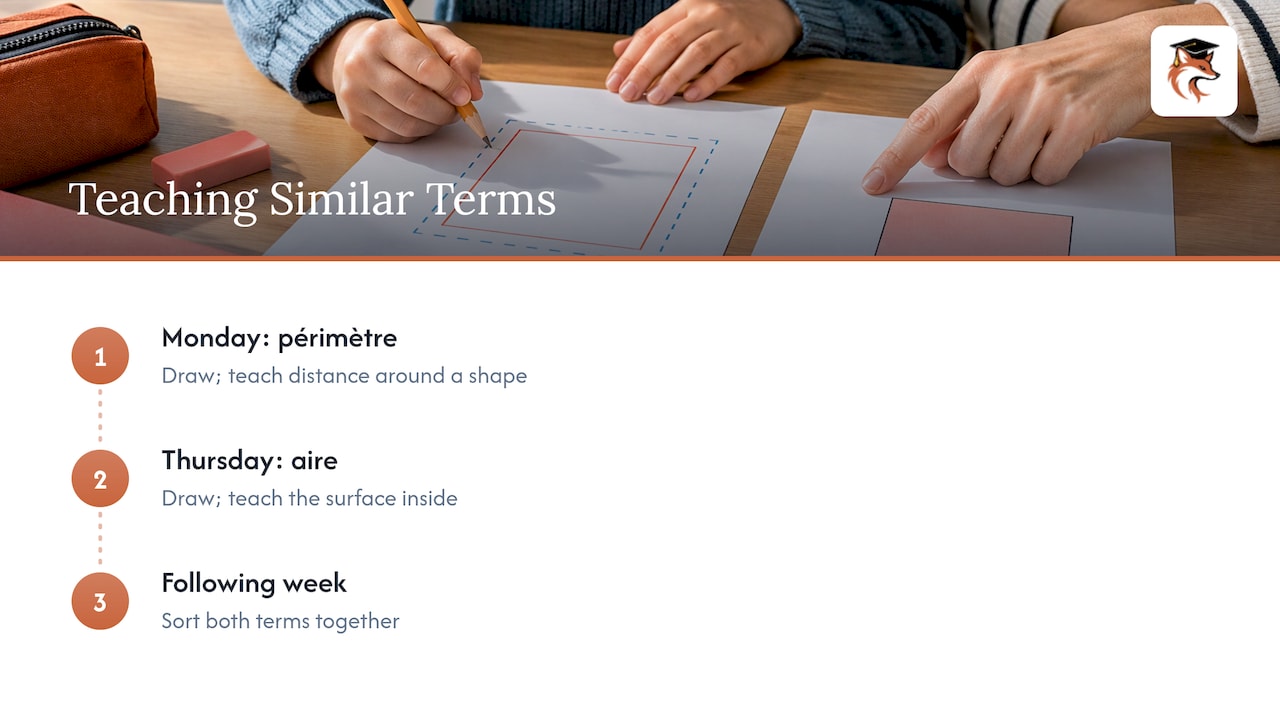
The same guidance warns that learning similar-looking or similar-meaning words at the same time creates interference and makes learning less effective. It is a very practical rule for entrance exam math. Aire and périmètre are the classic pair: teach périmètre (the distance around a shape) on Monday and aire (the surface inside it) on Thursday, each with a drawing, then mix them in a quick sorting game the following week. The same goes for quotient and produit, or numérateur and dénominateur.
Games that turn word study into play
Many children dread lists. Turning review into a game lowers stress and keeps them coming back. The Ontario Catholic school boards’ literacy page for parents suggests several simple options that need no equipment:
- Flashcards with the word on one side and the definition on the other.
- Tic-tac-toe, where a player must read a word and say its definition before placing a mark.
- Charades, acting out the word for the family to guess.
- Word chain, a game that tests previously learned words so that old vocabulary comes back around.
The same page encourages parents not to shy away from “big words” with children, and suggests audiobooks and podcasts so a child hears words above their independent reading level before meeting them in print. For a child preparing for a French exam, a French audiobook in the car is a gentle way to hear conséquence or hypothèse used naturally.
For adding variety, a few classroom techniques also work at the kitchen table. A professional development resource from TESL New Brunswick lists cloze activities (blanking target words in a passage for the learner to refill) and Frayer models, a four-part diagram with definition, characteristics, examples and non-examples. A cloze is easy to make: copy a paragraph from a reading text, hide five key words, and ask your child to fill them in from memory.
French and math: where vocabulary costs points
Because our tutoring covers French and math, here is where we see the vocabulary question matter most for secondary entrance exams in Montreal, Laval and Longueuil families.
In French
Reading comprehension questions depend on two vocabulary skills: understanding the passage and understanding the question. Build a short “verbes d’action” card set: relevez, justifiez, expliquez, reformulez, déduisez, comparez. For each, write what the answer should look like. For example:
- Relevez means: copy a word or phrase from the text, exactly.
- Justifiez means: give an answer and support it with evidence from the text.
- Reformulez means: say it in your own words, without copying.
Then practise a worked example. Take a short paragraph, ask “Justifiez votre réponse”, and have your child circle the verb before answering. That one habit, circling the action word first, is a démarche that removes many careless errors. For writing tasks, the same word bank feeds your child’s essay, which is why we pair this work with our six-week plan to improve entrance exam essays and the 12-week writing prompts plan.
In math
Word problems are vocabulary problems in disguise. Make a one-page glossary with a small picture or example next to each term: somme (result of an addition), différence, produit, quotient, multiple, diviseur, moyenne, médiane. Then add the trap words: au moins, au plus, de plus que, deux fois moins. Ask your child to rewrite each problem in plain words before computing. If the rewrite is wrong, the vocabulary is the issue, not the arithmetic.
Do not forget English
Some schools also test English. In that case, the same three layers apply, and the same routine works: a few new words at a time, in sentences, reviewed at spaced intervals. Context-based tasks, such as matching a word like independent or comprehension to its meaning using clues in a text, are exactly the type of exercise that Open Textbook BC’s literacy course pack uses.
How much time to give it
A realistic plan is ten to fifteen minutes a day, five days a week, starting at least a few months before the exam. Our entrance exam prep timeline shows how to place vocabulary work alongside practice exams and revision, and our high school entrance exam preparation plan gives the larger picture. If your child gets anxious, the stress management strategies for entrance exams pair well with the game-based review above: a child who feels the words are familiar walks into the exam room calmer.
Where a tutor changes the result
A list and a routine are the easy part. The hard part is knowing which words your child actually misses and why. A child may confuse aire with périmètre in math, skip over relevez in French, and be fine everywhere else. Finding those patterns needs someone to watch your child work, session after session.
That is what our personalized learning plans are built around: each student’s strengths, challenges, pace and goals. Our tutors are selected from university level for academic excellence and teaching ability, and we monitor progress continuously so the word list stays focused on what your child still needs.
We offer a preparation program for secondary school entrance exams as well as French tutoring and regular weekly sessions. Sessions are $30 to $35 per hour, and registration is a one-off $65 fee, listed on our rates page. If you are not satisfied with the first session, we refund it. Sessions are online with flexible scheduling, so a family in Montreal, Laval, Longueuil or elsewhere in Quebec can fit them around hockey practice and homework.
When you are ready, you can register for tutoring and academic support and we will start from your child’s real gaps.
Our perspective
After more than 25 years in education and more than 3,500 students, we have learned that exam vocabulary is rarely about “not knowing enough words”. It is about knowing the right words at the right moment: the verb that tells you what to do, the term that tells you which formula to pick.
That is why we do not hand every child the same list. We start from your child’s strengths, challenges, pace and goals, build a learning plan around them, and adjust it as we see progress. A child who is strong in reading but loses points on math word problems needs a different word bank from a child who is the reverse.
We also believe in keeping it light. Calling tricky words mots-pièges and treating review as a game helps children approach exams with confidence rather than dread. Our tutors bring that approach to every session, in French and in math, so that families across Quebec can feel reassured that the progress is structured and measurable.
Réussite A+
FAQ
How many words should my child learn each week?
Five to eight new words is a comfortable pace, with a weekly review of everything learned so far. A short list that is truly retrieved from memory is worth more than a long list that is only recognized. Increase the number only when last week’s cards come back easily.
Is there an official vocabulary list for Quebec entrance exams?
Not one universal list: each school sets its own exam. That is why we recommend building the list from the school’s sample exams, your child’s school texts and the instruction words that appear in questions. Our guide to Quebec private school entrance exams explains how to find what your target school expects.
Should my child use apps and online lists?
Any list can help as a source of ideas, as long as your child still writes each word in a sentence and reviews it at spaced intervals. The method matters more than the tool. Free general-purpose lists are not tailored to a given exam, so we pair them with words from your child’s own practice papers.
When should we start?
As early as possible, since vocabulary grows through steady exposure over months, not days. Ten to fifteen minutes a day starting several months before the exam is a realistic target. If the exam is closer, a tutor can focus the plan on the highest-impact words first.
Sources
- OCSB Literacy at Home (7-12): Vocabulary
- Academic Language in K-12: What Is It, How Is It Learned
- University Success: 5.4 Building Your Vocabulary
- Victoria University of Wellington: How to use the Academic Word List
- CanTEST lexical profile study, ScienceDirect
- TESL New Brunswick: Vocabulary Thresholds for Reading and Writing
- Open Textbook BC: Put to the Test