



French reading fluency is not about reading fast. It is reading accurately, at a comfortable pace and with natural expression, so your child’s attention goes to the meaning and not to decoding each word. Fluency grows from three things: regular short reading, a growing French vocabulary and calm, specific encouragement. You can start all three at home this week, and a tutor who builds a plan around your child’s level can speed up the process.
This guide is for Quebec parents, whether you speak French at home or not. It explains what fluency is, how vocabulary feeds it, which home activities have support behind them, and how to put it together in a routine of about 15 minutes a day.
TL;DR
- Fluency means accurate, comfortable, expressive reading that leaves room for understanding. Speed alone is not the goal.
- Vocabulary and fluency work together: a child who knows more French words reads more smoothly and understands more.
- Daily reading time, reading aloud together and talking about the story matter more than long, rare sessions.
- Do not correct every error. Praise something specific and keep the child willing to try.
- If progress stalls, a personalized plan with a French tutor can target the exact gap. We offer one online across Quebec.
Table of Contents
- What French reading fluency actually means
- How French vocabulary and fluency work together
- Home activities that build fluency and vocabulary
- Choosing French books at the right level
- When your child does not want to read in French
- A 15-minute daily routine you can start this week
- How to know your child is progressing
- Where a French tutor makes the difference
- Our French tutoring programs
- Our perspective
- FAQ
- Sources
What French reading fluency actually means
France’s Ministry of Education describes fluency as reading that is accurate, sufficiently quick and effortless, with adapted prosody (the rhythm and intonation of a spoken sentence), so that attention can go to comprehension. The same document makes an important distinction: fluency is a condition for comprehension, not a synonym for it.
In practice, a fluent young reader:
- recognizes most words on sight, without sounding out every syllable;
- reads in phrases, pausing at commas and full stops;
- changes the voice for a question or an exclamation;
- can tell you, afterwards, what happened.
A child who races through a page and cannot say what it was about is not fluent. A child who reads steadily, a little slowly, and can retell the story is on the right track.
Why speed is the wrong target
Pushing a child to read faster often backfires. Rushing leads to skipped small words, guessed endings and lost meaning. In French this matters even more, because small words such as le, la, les, un, une, des and verb endings carry gender, number and tense. If your child skips them, the sentence changes.
So instead of timing your child, listen for three things: smoothness, accuracy and expression. If all three are improving, speed will follow on its own.
How French vocabulary and fluency work together
A word your child has never heard is a word they must decode letter by letter. A word they know, they recognize in a glance. That is why vocabulary and fluency cannot be separated.
Research on French immersion students in Canada supports this. In a study of Grade 2 and Grade 3 pupils, fluency and vocabulary each contributed to reading comprehension in Grade 2, and by Grade 3 they interacted to predict comprehension in both English and French. In other words, the two skills reinforce each other as children grow.
Quebec’s own learning progression for French as a second language in immersion says that vocabulary is the entry point for understanding, reading and producing texts, and for communicating in French. Manitoba’s guide for immersion parents makes the same point from the classroom side: oral communication in French is the foundation of learning, and comprehension requires a solid language base of vocabulary and sentence structures.
What this means for a French-learning child
If your child comes from an English-speaking or multilingual home, they may arrive at school with strong spoken English and little French. Manitoba’s guide notes that Grade 1 teachers in this situation work first on oral vocabulary and language structures. So do not worry if reading feels slow in the early years. Words come first, then smooth reading.
The same guide notes that teachers may use songs, nursery rhymes and poems to build vocabulary and sound awareness before formal reading takes over. You can borrow those tools at home: a short French song in the car, a comptine at bedtime, a rhyming poem repeated until it feels easy.
Home activities that build fluency and vocabulary
Manitoba Education’s parent guide lists simple habits: a daily reading time, reading aloud to your child, discussing books and linking stories to the child’s own experiences, and keeping it fun. None of these requires you to be fluent in French yourself.
1. Read aloud together
Read a page, then let your child read the next. Hearing correct French pronunciation and phrasing gives them a model. If your own French is limited, take turns with a short book, listen to a story together and let your child lead.
2. Repeat the same short text
Rereading is one of the most useful fluency habits. The first read is for decoding. The second is smoother. By the third, your child begins to read with expression. Choose a short passage of 100 to 150 words and read it two or three times across a week. Notice the progress together, out loud: “Last time you stopped three times, today only once.”
3. Talk about the book
Ask one or two simple questions after each reading: Who is the main character? What happened first? What do you think happens next? Which new word did you find? This links fluency to comprehension, which is the whole point. Our guide to exercises to improve reading comprehension gives more question types by age.
4. Collect words, not lists
Instead of a long vocabulary list, keep three to five new words per week, taken from what your child actually read. Write each on a card with a short sentence and a quick drawing. Review the cards for two minutes at breakfast. Words met in a story and then reused stay far better than words memorized in isolation.

5. Let spelling support reading
Reading and spelling feed one another, since the patterns your child sees in print are the ones they must later write. Five minutes of sentence-level practice is enough; our article on French spelling rules in 5 to 10 minutes a day shows how.
Choosing French books at the right level
A book that is too hard produces stumbling and frustration. A book that is too easy gives no growth. The sweet spot is a text where your child reads most words correctly and meets only a few new ones per page.
A quick check: ask your child to read one page aloud. If they stumble on about one word in twenty or more, the book is probably too hard for independent reading, so use it as a read-aloud instead. If they read it with no effort and no new words, move up a level.
Manitoba’s guide says reading material can include books chosen by the child, books chosen by the teacher, illustrated texts, and parent read-alouds, in French or English. Mixing is fine. Let your child choose at least one book a week: choice builds motivation.
For younger children, picture books with repeated phrases and clear illustrations help them guess new words. For Grades 3 to 6, short chapter books and illustrated non-fiction on topics they already love, such as animals, hockey or space, give them a reason to push through. For help with beginner titles, see our list of best books to start learning French.
When your child does not want to read in French
Reluctance is common, especially when French is not spoken at home. The goal is to lower the pressure and raise the sense of success.
Manitoba’s parent guidance suggests to make reading fun, show interest in the books your child brings home, listen to them read, and give specific praise about what they do well. Specific praise sounds like: “I liked how you changed your voice for the dialogue.” It is more useful than “Good job.”
Do not correct every mistake
This is the hardest habit for caring parents. Manitoba’s handbook for French immersion school leaders advises parents not to correct every error, because the aim is to build fluency and encourage risk-taking rather than perfect decoding. If a mistake changes the meaning of a sentence, give the right word calmly and move on. If it does not, let it pass and keep the story going.
Use the language you speak at home
You do not have to read in French to help. Manitoba Education explains that reading skills transfer across languages, so reading with your child in the language spoken at home supports their French literacy too. Ask your child to tell you, in your language, what the French story was about. That is comprehension practice in itself. Our guide for non-French-speaking parents goes further.
Keep a physical book in the mix
Screens can be useful, but a shared paper book is hard to replace. A Canadian school library page puts it simply: reading a physical book together builds a love of reading. Reserve the bedtime slot for paper.
If effort does not bring progress
If your child works hard and still struggles to connect letters and sounds, talk to the school about an early assessment. Our article on dyslexia and learning French in Canada explains what to look for in the early grades.
A 15-minute daily routine you can start this week
Consistency beats intensity. Here is a simple weekly pattern for a child in elementary school.
| Day | Activity (about 15 minutes) |
|---|---|
| Monday | Choose a short text together. Read it aloud to your child while they follow with a finger. |
| Tuesday | Your child reads the same text aloud. Praise one specific thing. |
| Wednesday | Read it a third time, focusing on expression. Pick three new words for the cards. |
| Thursday | Read a new page from a book your child chose. Ask two questions about the story. |
| Friday | Play with the word cards, then read a favourite page just for fun. |
| Weekend | Listen to a French story or song together. No pressure, no corrections. |
A worked example
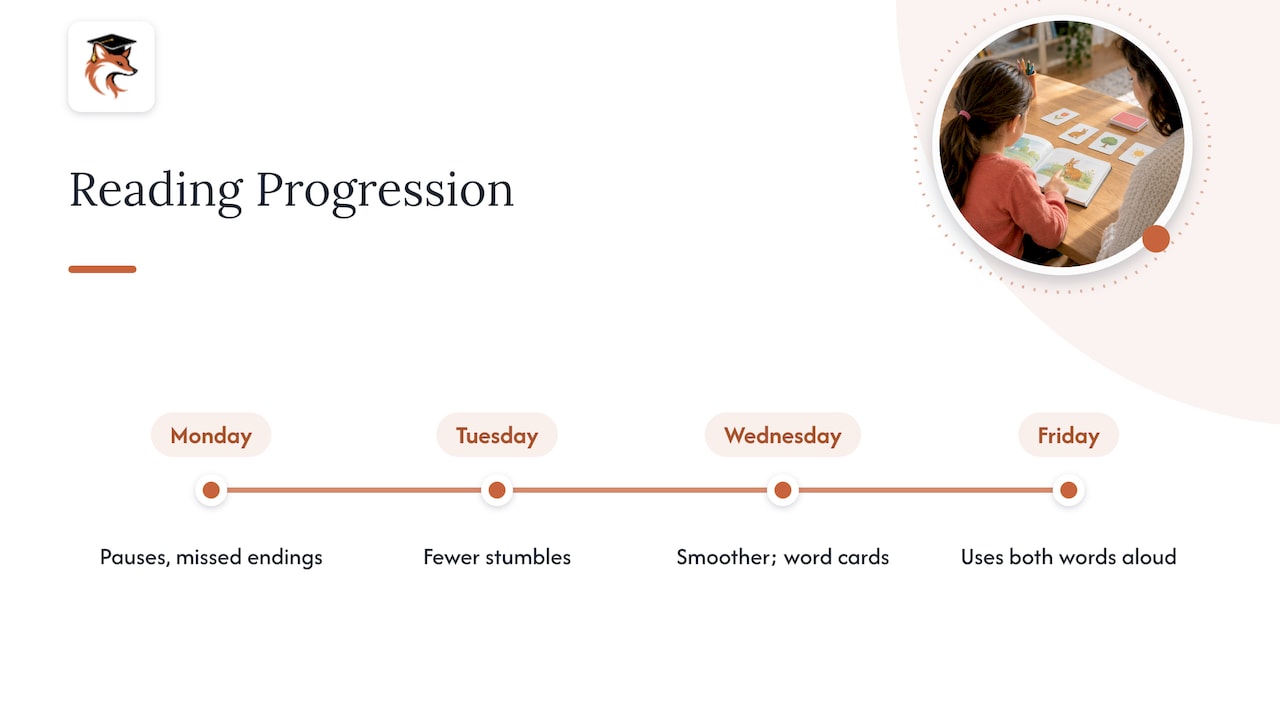
Imagine a Grade 3 student who reads a 120-word passage on Monday in about two minutes, pausing often and skipping the endings of verbs. On Tuesday, reading the same passage, they stumble less. By Wednesday, they read it in a smoother voice and notice the words traverser and soudain, which go on cards. By Friday they can use both words in a spoken sentence. Nothing here is fast or dramatic. But after a few weeks of repeating the pattern with new texts, reading becomes noticeably more comfortable, and the child starts to choose books on their own.
Make summer count
School-year routines often slip in July and August. A summer program can keep reading alive. A Canadian study of an eight-week summer intervention with 48 Grade 3 and 5 children found that those who read a book weekly while their parents were trained to support comprehension made significantly greater gains in comprehension, fluency and vocabulary than the control group. The lesson: a steady weekly book plus engaged parents works. Our summer learning ideas for French and maths can help you plan.
How to know your child is progressing
Parents often ask how to tell whether reading is really improving. Skip the stopwatch and watch for these signs over four to six weeks:
- fewer pauses and fewer restarts in the middle of a sentence;
- more expression, especially in dialogue;
- your child can retell the story in their own words;
- they recognize words from the word cards in new books;
- they choose to pick up a French book without being asked.
Write one line each week in a notebook: the book, the date and one thing that went better. After a month, you will have a clear picture of the progress, and something encouraging to show your child.
If, after six to eight weeks of steady routine, you see little change, that is useful information, not a failure. It usually means the starting point needs adjusting: easier texts, more oral vocabulary, or work on a specific skill such as sound-letter links. That is the moment a tutor who can look at your child’s work in detail becomes valuable. For more on how we approach it, read our guide to improving French reading skills for Quebec students.
Where a French tutor makes the difference
Home routines do a great deal. What they cannot always do is identify exactly where a child is stuck and adjust the plan week after week. That is where a tutor comes in.
At Réussite A+, every student receives a customized learning plan built around their strengths, challenges, learning pace and goals. Sessions are held online with university-level tutors, with progress monitoring throughout, and schedules are flexible so reading practice fits around school and activities. Our French programs cover reading, vocabulary, comprehension and writing for elementary and secondary students across Quebec, including Montreal, Laval and Longueuil. For parents who want to see results clearly, our article on trackable reading comprehension tutoring explains what progress tracking looks like.
Our French tutoring programs
Our French tutoring programs are delivered online, one-on-one or in a group, at $30 to $35 per hour. A one-time registration fee of $65 applies, as listed on our rates page. If you are not satisfied after the first session, we refund it. Over 3,500 students have worked with us, and our client satisfaction rate is 99%.

If your child needs a steady summer boost, our summer session is designed for that. For the full range of options, you can register for tutoring and academic support.
Our perspective
After more than 25 years in education, we keep seeing the same pattern: children rarely struggle with French reading because they lack ability. They struggle because a small gap, a handful of unfamiliar words, a few sound patterns not yet secure, was never named, and every new text builds on it.
That is why we do not use a one-size-fits-all program. We begin with the child: where reading is smooth, where it breaks down, and what the family wants to reach. Then we build a plan around that, with short, regular sessions, texts at the right level and clear progress monitoring, so parents can see the change and children can feel it.
We also believe in confidence. A child who feels successful reads more, and a child who reads more becomes fluent. Our university-level tutors are chosen for their academic strength and their ability to teach with patience and warmth. Together with the habits you build at home, that combination is what turns a hesitant reader into one who picks up a book on their own.
Réussite A+
FAQ
At what age should my child be a fluent French reader?
There is no single age, because it depends on when and how your child started learning French. In immersion, teachers may first focus on oral vocabulary and sound awareness before formal reading begins. If you are worried, talk to your child’s teacher about what to expect at your child’s grade, and compare progress over weeks, not days.
Does my child need to read faster to be fluent?
No. Fluency means accurate, comfortable reading with expression, which leaves attention free for meaning. A child who reads at a steady pace and can retell the story is more fluent than one who rushes and loses the sense. Speed tends to improve naturally once words are familiar.
How can I help if I do not speak French?
You can still do a lot. Set a daily reading time, ask your child to read aloud to you, and have them tell you about the story in the language you share. Reading skills transfer between languages, so your support counts. A tutor can add the French-language modelling you may not be able to provide.
How many new French words should my child learn each week?
Three to five words taken from books they have actually read is a good starting point. Use each in a short sentence and review the cards for a couple of minutes a day. If your child finds this easy, raise it gradually; if not, keep the number small and the practice steady.
When should I consider a tutor for French reading?
Consider one when a steady routine of six to eight weeks brings little change, when reading homework causes regular tears, or when your child’s teacher mentions reading as a concern. Starting early is easier than catching up later, and an online tutor can build a plan around your child’s current level.
Sources
- Fiche B : La fluidité de la lecture (Eduscol)
- An emergent interaction between reading fluency and vocabulary (Springer)
- Progression des apprentissages, Français langue seconde, immersion (Québec)
- Reading in French: parent guide (Manitoba Education)
- French Immersion in Manitoba: A Handbook for School Leaders
- Grade 2 French Immersion (Manitoba Education)
- Literacy (École Oceanside Elementary School)
- Involving Parents in a Summer Book Reading Program (Canadian Journal of Education)