



To find a good tutor in Montreal, start with one clear goal for your child (catching up, passing an exam, or building confidence). Then choose the format that fits your schedule, check the tutor’s qualifications, and book a first session to see how your child reacts. You can do all of it in about a week, and none of it needs to be stressful.
This guide walks you through each step, with Montreal prices, the questions to ask, the warning signs to watch for and a simple way to judge results.
TL;DR
- Define the goal first: a gap in French or math, an entrance exam, or simply more confidence. The goal decides the type of tutor you need.
- Expect to pay roughly $25 to $35 per hour for tutoring in Montreal, plus possible registration fees. Ask about every fee before you commit.
- Online tutoring widens your choice and removes travel. In-person suits younger children who struggle to focus on a screen.
- Book a trial session, set a four to eight week checkpoint, and ask for written progress updates.
- Tutoring is generally not tax-deductible in Canada, except in specific medical situations explained below.
Table of Contents
- Start with the goal, not the tutor
- Where to look for a tutor in Montreal
- What tutoring costs in Montreal
- Seven checks before you choose
- Online or in person: how to decide
- Our perspective: what makes tutoring work
- How to run the first session
- How to tell if tutoring is working
- Special situations in Montreal
- Is tutoring tax-deductible?
- Ready to try? Start with a session
- FAQ
- Sources
Start with the goal, not the tutor
Most parents begin by searching for names. It works better to begin with a sentence you can finish: “My child needs help with ___ so that ___.”
Here are examples we hear often:
- “Help with fractions so that math homework stops ending in tears.”
- “Help with verb agreement and reading comprehension so that French grades come up before the June exams.”
- “Preparation for the secondary school entrance exam so that my child feels ready, not anxious.”
- “A head start in summer so that September feels easier.”
Once you have your sentence, three things become clear: which subject, how often, and for how long. A child who needs to catch up on a few concepts may need six to eight weeks. A child preparing for an entrance exam needs a calendar working back from the exam date.
It also helps to talk to the teacher. Ask which skills are weak and which are strong. The Government of Québec stresses that academic support works best when schools, parents and tutors share the same goals and talk openly about methods. A tutor who knows what the teacher is working on can reinforce it rather than compete with it.
Where to look for a tutor in Montreal
There are five main routes. Each has real strengths.
School and community help
Your child’s school may offer tutoring or homework support. The Government of Québec describes a tutoring program for students who need extra support at specific moments. Ask the teacher or the school principal what is available in your school or school service centre. It costs nothing, so it is always worth asking first, even if you end up adding private help.
Independent tutors found by word of mouth
A university student recommended by a neighbour can be a good fit and is often the cheapest option. The trade-off is that you handle everything yourself: checking qualifications, planning lessons, and finding a replacement if the tutor cancels or leaves in April.
Online listing platforms
Directories let you browse profiles, rates and reviews. They give choice, but quality varies widely and the platform usually does not design a learning plan. You are responsible for judging each tutor.
In-person tutoring centres
Centres offer a fixed location and a routine, which some children like. Travel across Montreal, Laval or the South Shore at rush hour, though, can eat into an already busy week.
Online tutoring services
Online services combine a team of tutors with a structured method. Your child studies at home, you can sit nearby, and scheduling is easier across Montreal, Laval, Longueuil and Brossard. Our own page on online tutoring and progress monitoring for parents explains how that works in practice.
| Option | Typical strength | Typical limit |
|---|---|---|
| School support | Free, linked to the classroom | Limited hours and availability |
| Independent tutor | Flexible, often low-cost | You manage quality and continuity |
| Listing platform | Wide choice | Variable quality, no shared method |
| Tutoring centre | Fixed routine | Travel, fixed hours |
| Online service | Structured plan, flexible schedule | Needs a stable connection and a quiet space |
What tutoring costs in Montreal
Prices vary by level, subject and provider. A December 2025 rate overview puts general online tutoring in Montreal at roughly $24.50 to $29.00 per hour, with certified or specialized in-person tutors usually charging more. The same source cites Job Bank figures for tutors’ wages in Montreal, with a median of $21.98 per hour and a high end of $36.83. Keep in mind that a wage is not what a family pays, because a service also covers matching, planning and follow-up.
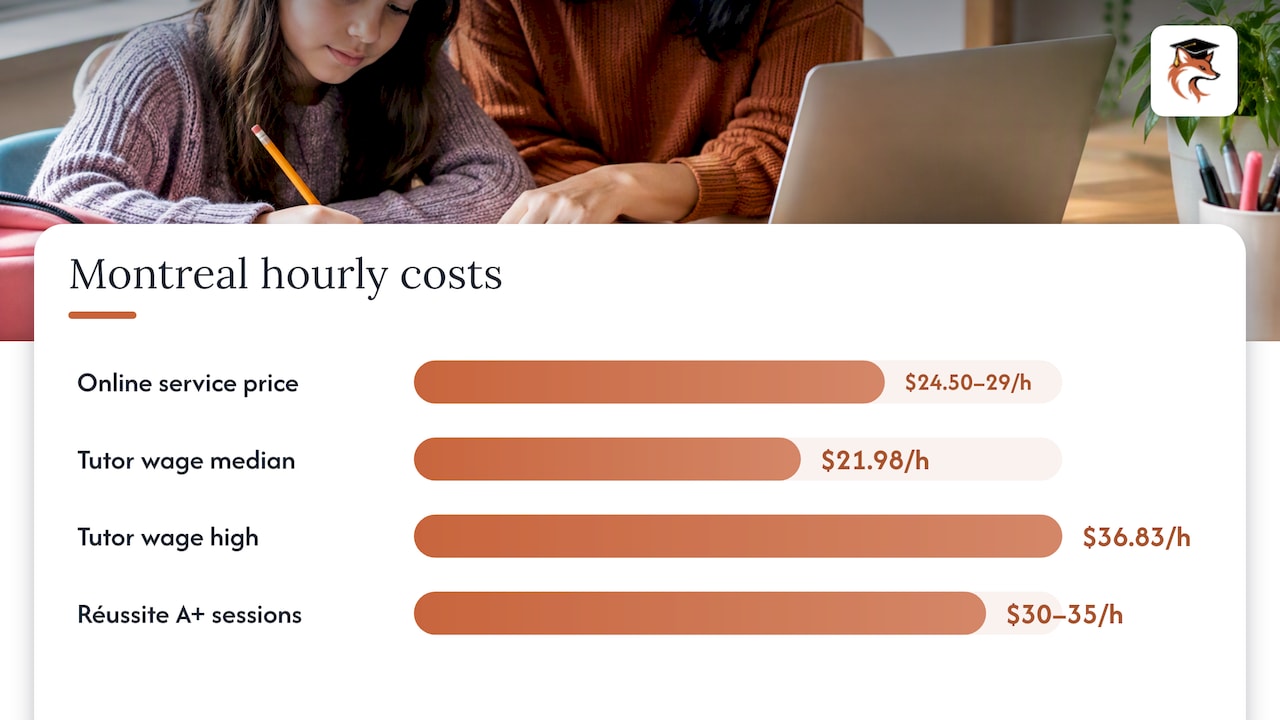
At Réussite A+, regular sessions, exam preparation sessions, summer sessions, homework help and French programs are all $30-35 per hour, and there is a one-time registration fee of $65. See our pricing page for the details.
Whatever provider you consider, ask these questions about money:
- Is there a registration or administration fee, and is it one-time or yearly?
- Is there a minimum number of hours or a package I must buy?
- What is the cancellation policy, and how much notice is needed?
- Is there a refund if my child and the tutor are not a good match?
- Are learning materials included?
A low hourly rate with several hidden fees can cost more than a slightly higher rate that is all-inclusive. Do the math for a full month, not for one hour.
Seven checks before you choose
Use this as a mini-checklist when you speak with a tutor or a service.
- Subject knowledge. Can the tutor explain a concept two different ways? Ask them to describe how they would teach your child’s current topic.
- Knowledge of the Québec curriculum. Methods in math and French follow the Québec Education Program. A tutor trained elsewhere may teach correct but unfamiliar techniques, which confuses a child in class.
- Teaching skill. Being good at a subject and being good at teaching it are different things. University-level tutors selected for both are a good sign.
- A written plan. Ask what the first month looks like. A good answer names skills, not just chapters.
- Progress tracking. You should receive regular, concrete feedback: what was covered, what improved, what remains.
- Fit with your child. A shy child may need patience. A restless one may need shorter, more varied activities.
- Reliability. Ask how replacements work if the tutor is ill or unavailable.
Warning signs
- A promise of a specific grade or guaranteed result.
- Pressure to sign a long contract before a trial.
- No clear answer on who the tutor is or how they were selected.
- Sessions that are only homework completion, with no work on the underlying gap.
- No communication with you for weeks.
Online or in person: how to decide
Neither format is better for every child. Think about your child’s age, attention and your household.
Online tends to work well when:
- Your child is in upper elementary or secondary school and is comfortable with a computer.
- You live in Laval, Longueuil, Brossard or the West Island and want to avoid travelling.
- You want to choose from a larger pool of tutors for a specific subject.
- Your schedule changes from week to week.
In person may be better when:
- Your child is very young and loses focus on a screen.
- Your home has no quiet space or reliable internet.
- Your child has a strong preference for face-to-face contact.
For online sessions, a few small habits make a big difference. Choose a quiet spot, close other tabs, keep paper and a pencil within reach, and have the current school material ready. The Québec government’s guidance also points to a home environment free of distractions as a support for what your child learns during tutoring.
Our perspective: what makes tutoring work
We have supported students across Quebec for more than 25 years, and more than 3,500 of them so far. Over that time, the same lessons keep coming back.
Personalization beats volume. Two children in the same grade can struggle for very different reasons. One may have missed a foundation skill in fractions. The other may understand the math but misread the question. Giving them the same worksheets wastes their time. This is why each of our students gets a learning plan built around strengths, challenges, pace and goals.
Progress must be visible. Parents should not have to guess whether tutoring is helping. We monitor progress continuously and share it, so you can see what has improved and what comes next.
Confidence comes first, and grades follow. A child who believes they can’t do math will avoid it. Small wins in the first sessions change that. We often turn practice into a game, and we teach “trap words” in exam questions so that children recognize them calmly rather than panic.
You should be able to leave. We offer a satisfaction guarantee: if you are not satisfied after the first session, you get a refund for that session. We think any tutoring provider should be comfortable with a trial that carries no risk for you.
— Réussite A+
How to run the first session
The first session tells you more than any website. Here is a simple way to use it.
- Before the session: send the tutor your goal sentence, a recent report card and two or three examples of homework your child found hard.
- During the session: stay nearby without taking over. Notice whether the tutor asks your child questions or just talks.
- After the session: ask your child three things. Did you understand? Did you feel comfortable? Would you like to continue?
- Within a day: ask the tutor for a short summary and a plan for the next sessions.
If your child says “it was okay” and the tutor shows a clear plan, that is a good start. If your child is uneasy, give it one more session before changing, as a first meeting can be awkward. If it still does not click, ask for another tutor. Good services expect this.
How to tell if tutoring is working
Give it four to eight weeks, and look at more than grades. Grades often lag behind understanding.
Signs of progress include:
- Your child starts homework with less resistance.
- They can explain a method in their own words.
- Fewer careless mistakes appear on tests.
- They ask questions in class.
- They talk about the subject with less dread.
At the four-week mark, compare notes: what the tutor sees, what the teacher reports, and what you observe at home. If the three views agree that things are moving, continue. If not, adjust the plan or the tutor. Our guide to academic success in Montreal over 4 to 8 weeks lays out what a realistic timeline looks like.
Special situations in Montreal
Secondary school entrance exams
Many families in Montreal, Laval and the South Shore prepare for private school entrance exams, usually in the autumn of the final year of elementary school. Start at least two to three months ahead, practise under timed conditions and keep the mood light. We have written a plan for parents and students and a guide on the Laval entrance exam. Our exam preparation sessions are built on that approach, including exam simulations.
French support
For children in English schools, French is often the subject where families look for help first. For children in French schools, grammar, agreement rules and reading comprehension are the usual sticking points. A tutor should work with texts and tasks similar to what your child sees in class. See our French tutoring programs.
Summer catch-up
Summer is a calm moment to fix gaps without homework pressure. A few sessions a week, combined with light daily activities, can make September easier. Our ideas for summer learning in French and math can be done at home.
Is tutoring tax-deductible?
In most cases, no. Tutoring is generally not a deductible expense in Canada. There is one narrow exception: if your child has a diagnosed learning disability or mental impairment and a medical practitioner certifies in writing that the tutoring is necessary because of it, the cost may qualify as a medical expense. According to the Canada Revenue Agency, the payment must go to a person ordinarily engaged in the business of providing tutoring services, who is not related to your child.
The CRA also has a tax tips page for parents on claiming tutoring for a child with a learning disability, though it dates from 2018. If your child has a diagnosis, speak with the practitioner who made it and with an accountant or the CRA before you claim.
Ready to try? Start with a session
If you would like a plan built around your child, our regular sessions are a good first step. Tutors are selected at the university level, sessions are online, and each student has a personalized plan. You can also read about our Montreal tutoring service, or go straight to registration. If you are not satisfied after the first session, we refund it.
FAQ
How much does a tutor cost per hour in Montreal?
Expect roughly $25 to $35 per hour for most tutoring, with specialized or certified in-person tutors often higher. Published rate data shows general online tutoring in Montreal around $24.50 to $29.00 per hour. Always ask about registration fees and package requirements.
How do I find a good private tutor?
Start with your child’s goal, then shortlist two or three options. Check subject knowledge, familiarity with the Québec curriculum and how progress is reported. Book a trial session and ask your child how it felt before you commit to more.
How long before I see results?
Most families can judge fit after one or two sessions and progress after four to eight weeks. Confidence and homework habits usually improve before grades do. If nothing has changed after two months, review the plan with the tutor.
Is tutoring a tax write-off in Canada?
Generally no. It can qualify as a medical expense only when a medical practitioner certifies in writing that your child needs it because of a diagnosed learning disability or mental impairment. Confirm your situation with the CRA or an accountant.
Sources
- Average Tutoring Rates in Canada: Hourly Costs Explained
- Income Tax Folio S1-F1-C1, Medical Expense Tax Credit, Canada.ca
- Back to school tax tips for parents, Canada.ca
- Supporting the involvement of families in young people’s learning, Gouvernement du Québec
- Programme de tutorat, Gouvernement du Québec