



The right tutor is the one who fits your child’s pace, goal and personality, and who can show you progress within a few weeks. Degrees and glossy profiles matter less than you might think. In this guide, we walk you through the steps we would follow as parents: define the need, try free help first, check the tutor’s profile, compare real costs, and judge the first sessions.
If you are feeling a little overwhelmed, that is normal. Most children who struggle in French or math can catch up with a simple, structured plan. You only need to know what to look for.
TL;DR
- Start with one precise goal (for example, “understand fractions” or “write a French text without agreement errors”), not a vague “better grades”.
- Try free help first. It can be enough for a one-off need, and a paid tutor is more useful once you know what is still missing.
- Look for compatibility, clear communication and a written plan, not just the most impressive academic record.
- In Quebec, rates typically run from $20 to $70 per hour depending on the tutor’s profile, so compare what is included.
- Judge the first two or three sessions: your child should be at ease, and you should receive feedback.
Table of Contents
- Start with the need, not the tutor
- Explore free help first
- What to look for in a tutor
- Types of tutoring: which format suits your child?
- Semi-private or one-on-one?
- What tutoring costs in Quebec
- Questions to ask before you commit
- Watch your calendar: the 3 p.m. to 6 p.m. rush
- How to judge the first sessions
- Our perspective: what we have learned in 25 years
- Our online tutoring, if you would like to see how it works
- Red flags to avoid
- Putting it together: a simple five-step method
- FAQ
- Sources
Start with the need, not the tutor
Before you contact anyone, take ten minutes to write down what is really happening. Tutors cannot help effectively with a fuzzy request, and you will not be able to tell whether the tutoring works.
Ask yourself these questions:
- What is the subject? French, math, or both? Is it one skill (long division, the passé composé, reading comprehension) or the whole subject?
- What is the goal? Catching up, keeping pace, preparing for an exam, or going beyond the grade level?
- What is the deadline? A secondary school entrance exam in a few months calls for a different plan from a gradual, year-long boost.
- How does your child react? Shy, anxious, easily distracted, or confident but unmotivated? This tells you what kind of personality will suit.
- What is your budget and weekly time? One hour a week is realistic for many families. Two is better for an exam sprint.
A useful trick: ask your child’s teacher for two or three specific weak points. Teachers see the work every day, and their answer usually beats any guess. Then turn it into a sentence such as “By the end of January, Léa will solve two-step word problems on her own.”
Explore free help first
Before paying, it is worth knowing what is available at no cost. Alloprof describes itself as the largest homework help organization in the province, with free services, including contact with teachers by text, chat or phone during set evening and Sunday hours. Many schools and community organizations also offer homework help, and the Learn Quebec parent resources gather tools for helping your child at home.
Free help works well when:
- your child has a precise question and is ready to ask it;
- the need is occasional (one tricky lesson, one test);
- your child is comfortable working fairly independently.
A paid tutor becomes worthwhile when the same gaps keep returning, when your child needs someone to build a plan and follow it, or when a real deadline is approaching. Our own roadmap, Quebec’s tutoring roadmap, is built on exactly that logic: free help first, paid tutoring when it is truly needed.
What to look for in a tutor
Subject mastery and teaching ability
A tutor must know the subject well, but knowing is not the same as explaining. A university student with excellent grades can be a superb tutor, as long as they can break an idea into small steps and rephrase it three different ways. Ask them to explain a concept from your child’s current unit, as if to your child. You will quickly hear the difference.
Do they need a teaching degree?
Not necessarily. According to this Quebec guide to finding a tutor, a formal teaching degree is not mandatory to become a private tutor in Canada, and parents mostly prioritize subject expertise, communication skills and proven teaching ability. Certified teachers do exist on the market, and they usually charge more. What you need is evidence: strong results in the relevant courses, experience with children of the same age, and a clear method.
Compatibility with your child
This is the criterion families underestimate most. The same guide notes that experts consider alignment with the child’s learning pace and teaching style to be often more important than the tutor’s own academic pedigree. A brilliant tutor who moves too fast can leave a child more discouraged than before. Look for someone patient, encouraging and attentive to your child’s reactions.
A plan, not just a session
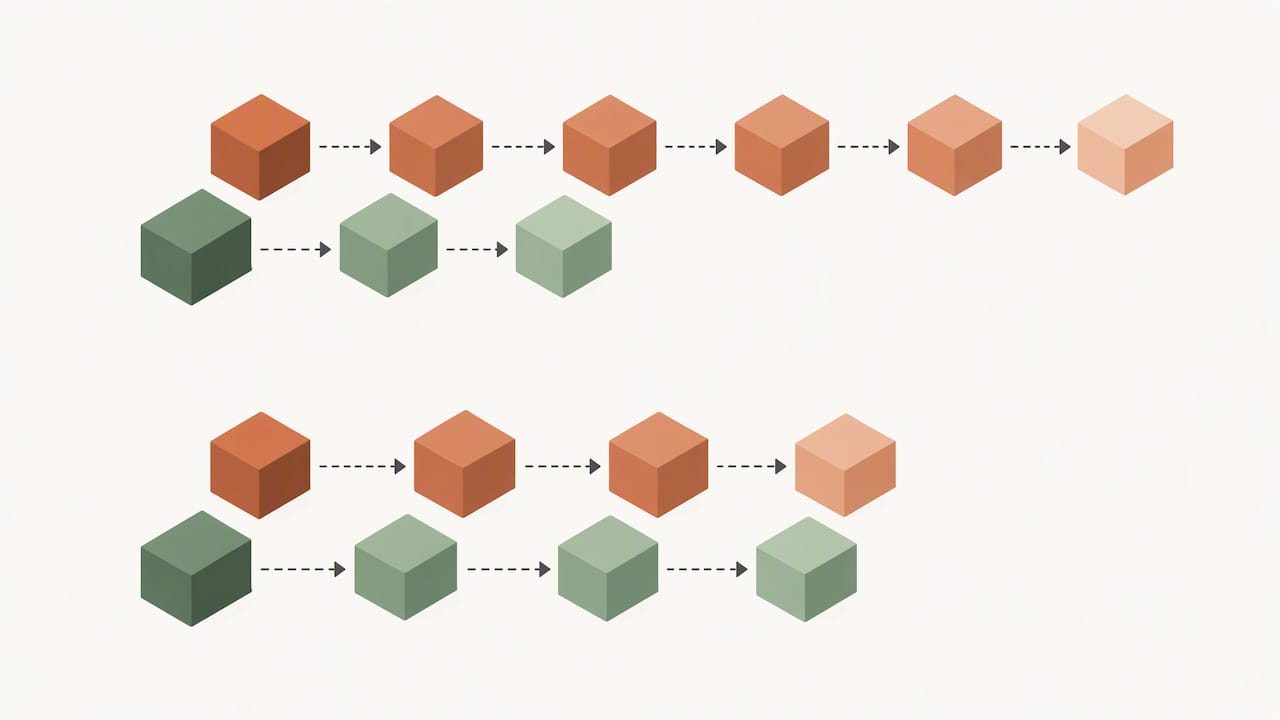
A good tutor does not simply “do the homework with your child”. They should be able to tell you:
- where your child stands today (a short diagnostic is common);
- what will be worked on, in what order;
- how progress will be measured;
- how and when you will receive updates.
If the answer is “we will see as we go”, keep looking.
Familiarity with the Quebec curriculum
Quebec has its own programs, vocabulary and ministerial exams. A tutor who knows the Programme de formation de l’école québécoise, the way French is taught and tested, and the structure of entrance exams will save your child time. For exam years, our guide to ministerial examination schedules can help you plan.
Types of tutoring: which format suits your child?
| Format | Strengths | Watch-outs |
|---|---|---|
| Free homework help (hotlines, school programs) | No cost, good for quick questions | Limited continuity; no personal plan |
| University student, found independently | Often affordable, relatable for kids | Quality and reliability vary; you manage scheduling, follow-up and replacements |
| Tutoring organization | Screening, structure, replacement if it does not work | Rates are generally higher than an independent student |
| Certified or former teacher | Deep classroom experience | Highest hourly rates |
| Online vs. in person | Online saves travel and widens your choice of tutors | Needs a quiet spot, a stable connection and a child who can focus on screen |
If you are hesitating between online and home visits, our comparison of home tutoring and online tutoring explains the differences. And if you like to keep an eye on progress, see how online tutoring helps parents monitor academic progress.
Semi-private or one-on-one?
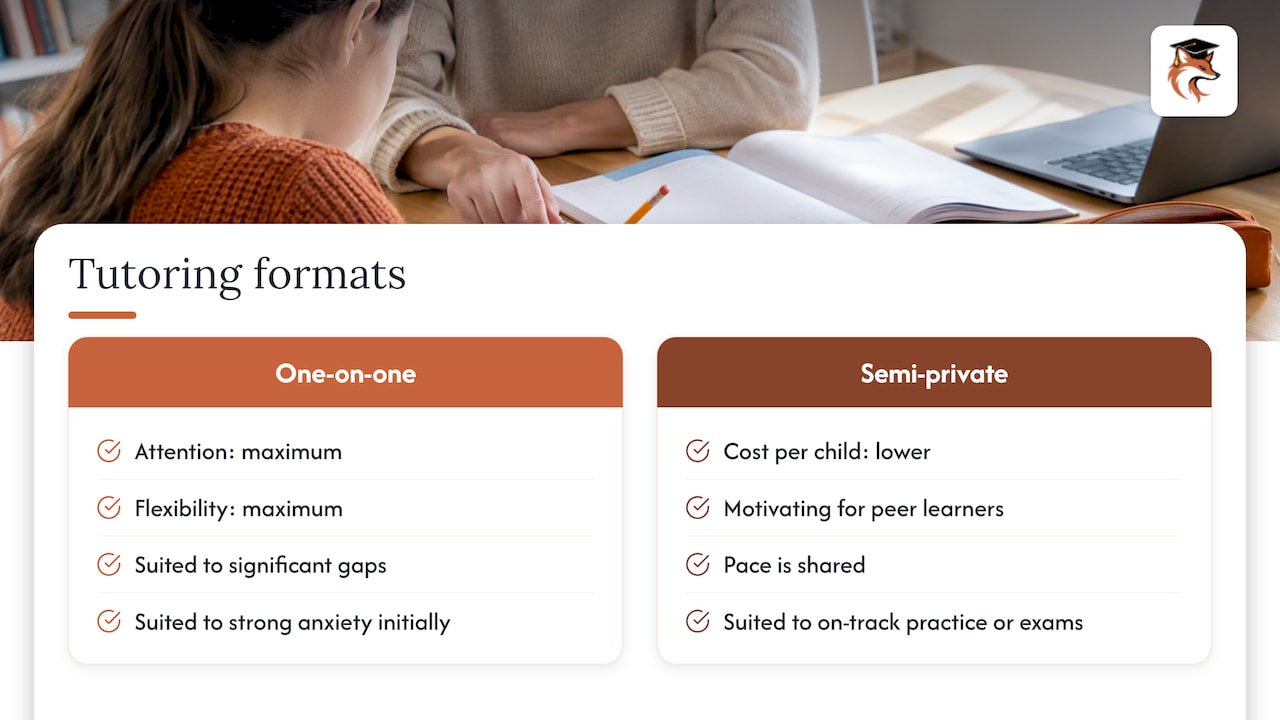
One-on-one sessions give maximum attention and flexibility. Small-group or semi-private sessions cost less per child and can motivate students who enjoy working alongside a peer. The trade-off is that the pace is shared. A child with significant gaps or strong anxiety usually benefits from one-on-one at the start. A child who is mostly on track and wants practice or exam training often does well in a small group. We explain the logic in more detail in our article on semi-private tutoring in Quebec.
What tutoring costs in Quebec
Prices vary widely. According to the 2026 figures in the Quebec guide we mentioned earlier:
| Tutor profile | Typical hourly rate in Quebec |
|---|---|
| University students | $20–$35 |
| Professional tutoring agencies | $35–$60 |
| Certified or former teachers | $40–$70 |
The same source adds that specialized subjects, such as advanced math or physics, can cost more because qualified tutors are scarce.
When you compare, look beyond the hourly rate:
- Registration or set-up fees. Are there any, and are they one-off?
- Minimum commitments. Do you have to buy a large package before you know it works?
- Materials. Is custom practice material included?
- Travel fees. Relevant for in-person tutoring, absent online.
- Cancellation policy and guarantees. What happens if the first session is not a good fit?
Is tutoring tax-deductible?
Generally not. The Quebec guide notes that private tutoring fees are usually not deductible in Quebec or federally. The usual exception involves a child with a learning disability: the Canada Revenue Agency’s back-to-school tax tips explain that tutoring costs for a child with a learning disability may be claimed as a medical expense in some conditions. That page dates from 2018, so confirm the current rules with an accountant or the CRA before you claim anything, and ask your child’s doctor or the relevant practitioner about the required certification.
Questions to ask before you commit
A short call or consultation tells you a lot. Bring this mini-checklist:
- How do you assess my child’s level at the start?
- What will a typical session look like?
- How will I know if my child is progressing, and how often will I hear from you?
- Which tutor will work with my child, and what is their background with this age group?
- What happens if the tutor is not a good match?
- What is the total cost for the first month, with every fee included?
- What are the available time slots, and can they be kept all year?
We have also prepared a printable checklist of tutoring consultation questions so you can take notes during the call.
Watch your calendar: the 3 p.m. to 6 p.m. rush
Weekdays between 3 p.m. and 6 p.m. are the most requested slots, according to the Quebec tutoring guide, and many families struggle to find tutors for those hours. The same source advises securing your preferred tutor early in the school year. Practically, that means:
- ask about alternatives such as early evening, weekends or a fixed weekly slot;
- avoid scheduling right after a long day if your child is exhausted at 5 p.m.;
- if an exam is coming, book the slots before the calendar fills up.
It is now late October, so the first report card is not far away. This is a very good moment to start: your child has had a few weeks to show where the gaps are, and there is still time to build a steady routine.
How to judge the first sessions
Give it three sessions before you conclude anything, and look at the following.
After session one
- Was your child at ease, or tense and silent?
- Did the tutor start by finding out what your child knows?
- Did you get a short summary of what was covered?
After session two or three
- Does your child know what the next session will cover?
- Is there practice material tailored to the exact difficulty, not generic worksheets?
- Is your child willing to log on, or is every session a struggle?
After six to eight weeks
- Do school results, homework confidence or test performance show a trend?
- Is the tutor adjusting the plan, or repeating the same routine?
A tutor who fits is not necessarily the one who makes your child say “it was fun” on day one. It is the one who makes your child say “I understand now” a few weeks later.
Our perspective: what we have learned in 25 years
We have supported more than 3,500 students in elementary and secondary school across Quebec, and a few lessons keep coming back.
First, one-size-fits-all does not work. Two children can struggle in math for opposite reasons: one lacks foundations, the other rushes and misreads questions. That is why every student of ours starts with a customised learning plan built around strengths, challenges, pace and goals.
Second, confidence comes before results. A child who believes they are “bad at French” will avoid trying. Small, well-chosen wins in the first weeks change that more than any pep talk.
Third, progress must be visible. We monitor progress continuously, so that you can see what is improving and what still needs work, rather than guessing.
Fourth, the tutor matters enormously. Our tutors are selected at the university level for academic excellence, teaching ability and commitment to students, and compatibility with the child remains the deciding factor.
Finally, you should be able to walk away. That is why we offer a refund for the first session if you are not satisfied.
— Réussite A+
Our online tutoring, if you would like to see how it works
We offer online tutoring for elementary and secondary students in Quebec, with a focus on French and math, delivered by university-level tutors with custom educational material and flexible schedules. Families in Montreal, Laval, Longueuil, Brossard and across the province use it, with no travel involved.
Our sessions are published at $30–$35 per hour, and registration is a one-off $65 fee (see our rates). Depending on your child’s need, you can choose among:
- the regular session, for steady support throughout the school year;
- homework help and tutoring, for day-to-day difficulties;
- school exam preparation and high school entrance exam preparation;
- the summer session, to catch up or stay sharp;
- our French tutoring programs.
When you are ready, you can register for tutoring and academic support, or start from our home page to learn more.
Red flags to avoid
Some warning signs are worth knowing, whoever you hire:
- Guaranteed grades. Nobody can promise a specific mark. Look for a transparent process instead.
- Pressure to buy a large package immediately. A fair provider lets you test the fit first.
- No information about the tutor. You should know who will work with your child.
- No communication with parents. If you never hear what is going on, you cannot support your child at home.
- Sessions that only complete homework. Finishing the worksheet tonight is useful, but the aim is for your child to need less help over time.
- A tutor who talks more than your child. Learning happens when the child tries, explains and corrects.
Putting it together: a simple five-step method
- Define one goal with your child’s teacher.
- Try free help for a few weeks if the need is occasional.
- Shortlist two or three options by tutor profile, format and total cost.
- Hold a short consultation with each, using your checklist.
- Start with a trial period, review after three sessions and again after six to eight weeks.
If you are comparing providers across the province, our comparison of tutoring offers in Quebec and our article on where to start with tutoring in Quebec give more detail. Living south of Montreal? See our practical list for choosing tutoring in Longueuil. And if you wonder whether the investment pays off, read Is tutoring worth it?
FAQ
How do I know my child needs a tutor?
Watch for repeated gaps rather than one bad mark: homework that takes far too long, avoidance of a subject, or a growing gap between your child’s effort and results. Speak with the teacher first, since they can name the exact skills that are weak. If free help does not close the gap, a tutor is the logical next step.
How much should I expect to pay per hour in Quebec?
According to 2026 figures, university students typically charge $20–$35 per hour, agencies $35–$60 and certified or former teachers $40–$70. Our sessions are $30–$35 per hour, plus a one-off $65 registration fee. Always ask for the total cost of the first month.
Does a tutor need to be a certified teacher?
No, a teaching degree is not mandatory for private tutors in Canada. What counts is subject mastery, clear communication and the ability to adapt to your child. Ask about their experience and have them explain a concept in a trial session.
Is online tutoring as effective as in-person?
It can be, if your child has a quiet space, a reliable connection and a tutor who keeps them actively involved. Online also gives you a wider choice of tutors and removes travel. If your child struggles to stay focused on a screen, try a few sessions and watch the engagement before deciding.
What if the tutor is not a good fit?
Say so early, and ask for a change. A serious provider will discuss it openly. With us, you are covered by a refund for the first session if you are not satisfied.
Sources
- Trouver un tuteur ou de l’aide aux devoirs au Québec (SOS Nounou)
- Comment trouver du tutorat gratuit pour mon enfant (Alloprof)
- Ressources pour les familles (Learn Quebec)
- Back to school tax tips for parents (Canada Revenue Agency)