


Synchronous learning happens live: your child and a teacher or tutor are online at the same time, talking, asking questions and solving problems together. Asynchronous learning happens on your child’s own time: recorded lessons, readings and exercises that can be opened whenever it suits the family. Neither one is better in every case. For most elementary and secondary students, the strongest plan uses live time for what needs a human and self-paced time for what needs quiet repetition.
Below, we explain the difference in plain words, show where each mode works and where it struggles, and explain why “learning styles” should not decide which one you choose. You will also find a simple checklist to use before you sign up for any online program.
TL;DR
- Synchronous means live and scheduled. Asynchronous means self-paced, with no fixed meeting time.
- Live sessions are best for questions, feedback and building a relationship. Self-paced work is best for reading, practice and review.
- Asynchronous is not “easier”. It usually asks for more self-discipline and planning than a live session.
- Research on blended approaches suggests that a mix of both generally serves students better than one mode alone.
- Matching lessons to a child’s “learning style” is not supported by the evidence. Match the mode to the task instead.
Table of Contents
- What the two terms actually mean
- Where synchronous learning works best
- Where asynchronous learning works best
- What about hybrid and blended learning?
- Learning styles: why they should not decide this
- How to choose: a checklist for parents
- Our perspective: live first, independent practice second
- Getting started with live online tutoring
- Common mistakes to avoid
- FAQ
- Sources
What the two terms actually mean
The words come from timing, not technology. Concordia University’s teaching centre notes that the terms became common with online course design, but they also exist in in-person courses. A classroom lesson is synchronous. A homework sheet completed on Tuesday night is asynchronous.
McGill’s teaching knowledge base describes asynchronous teaching as materials and activities prepared in advance that students access at a time of their choosing, sometimes within a set time frame.
Here is the difference at a glance:
| Synchronous | Asynchronous | |
|---|---|---|
| Timing | Everyone is present at the same time | Your child chooses when to work |
| Typical format | Video session with a tutor | Recorded explanation, worksheet, online exercise |
| Feedback | Immediate | Delayed, often within a day or more |
| Schedule | Fixed appointment | Flexible, sometimes with deadlines |
| Main strength | Questions, dialogue, accountability | Flexibility, repetition, working at one’s own speed |
| Main risk | Fixed times can be hard for busy families | Procrastination, isolation, no one to catch a misunderstanding |
Is synchronous the same as face to face?
No. A live session can take place entirely in a virtual classroom. “Synchronous” tells you that people are together in time, not together in the same room. Our guide to how an online tutoring session works walks through what a live session looks like from your child’s side of the screen.
How to tell which one a program is
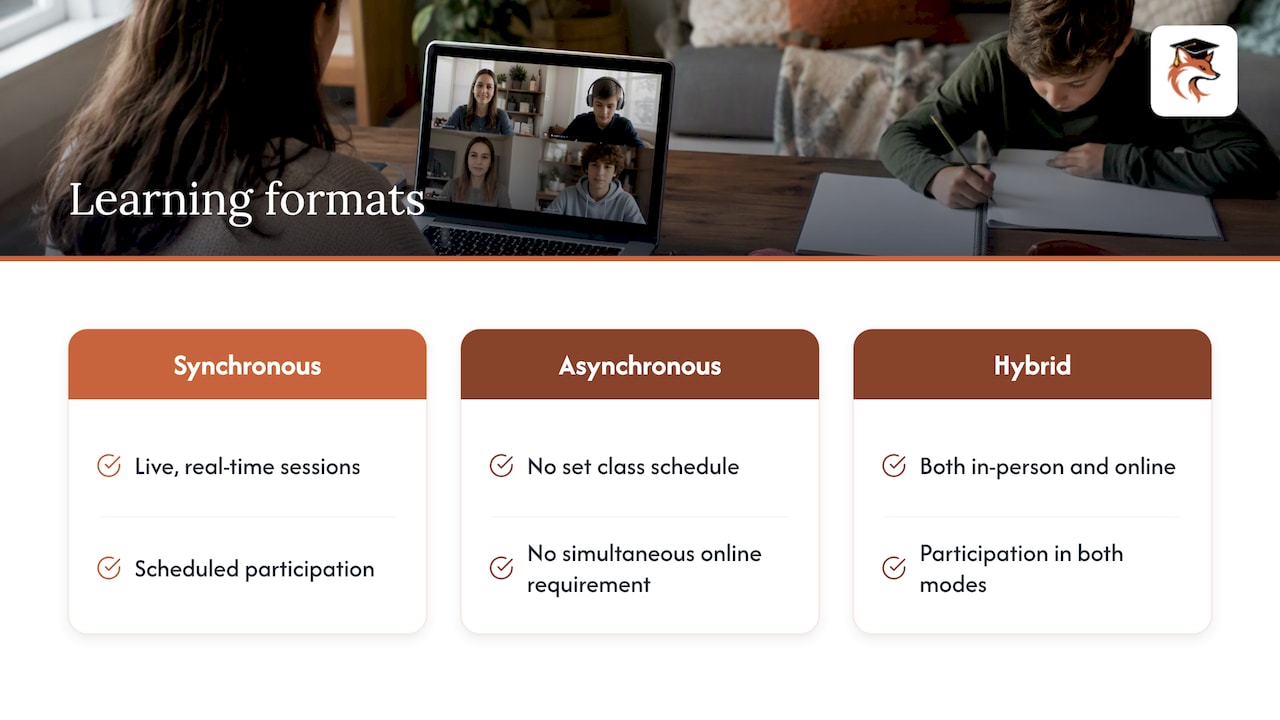
Read the description closely. If it says “no set class schedule” or does not require your child to be online at the same time as the instructor, it is asynchronous. If it mentions live, real-time or scheduled sessions, it is synchronous. If it mentions both, it is probably hybrid or blended. The registrar’s page at the University of Alberta, for example, explains that in a hybrid class students must take part in both in-person and online delivery. Many elementary and secondary programs use the same logic with different words.
Where synchronous learning works best
Live time is the most valuable part of any tutoring week, because it is the only time a child can get an answer in the moment. Concordia’s guidance recommends reserving synchronous sessions for tasks that need real-time social engagement, such as question-and-answer, discussion and working through a difficulty together.
In practice, with a student in Grade 4 to Secondary 5, that means:
- Questions that cannot wait. A child stuck on a fraction problem at 5 p.m. should not wait until tomorrow to learn that the first step was wrong.
- Spotting the real obstacle. A tutor watching your child work can see where the reasoning breaks. In French, that might be a mot-piège in a question, a verb agreement rule applied to the wrong subject, or an instruction that was read too fast.
- Building trust. Children who feel comfortable with a tutor ask more questions and admit confusion sooner.
- Accountability. A fixed appointment gets kept more often than an open-ended “do it when you can”.
The common mistake is spending live time on a lecture. If a tutor spends half an hour explaining a concept that a short recorded demo could cover, the family pays for the most interactive minutes of the week and uses them passively.
The limits of live sessions
Fixed times can clash with hockey, a parent’s shift or a sibling’s schedule. Some children also need more processing time than a live conversation allows. Others tire quickly in a long video call. That is why a good live session is focused, active and not stretched beyond what your child can handle.
Where asynchronous learning works best
Self-paced work suits tasks that benefit from time: reading a passage twice, redoing ten similar multiplication problems, reviewing a recorded demonstration, or writing a first draft. Concordia recommends keeping asynchronous time for activities that need extra processing time.
The case for it is real. Material is available whenever your child is ready, can be replayed, and does not depend on a shared calendar. Some Canadian programs are built mostly this way. The Canadian Defence Academy’s distance-learning phase, for example, is delivered primarily in an asynchronous format with a limited number of synchronous activities. That program is for adults, but the design logic carries over: a self-paced base, with live moments placed where they matter.
The hidden cost: self-discipline
Many families assume that asynchronous means less work. Concordia’s teaching guidance points the other way: students in purely asynchronous settings often struggle with motivation and isolation, and success depends on structure and a visible teaching presence.
For a younger child, a self-paced course asks for planning, focus and the ability to notice “I did not understand that”. These are executive functions that are still developing in elementary school and often well into secondary. A parent can fill the gap, but that turns your evening into supervision. If you are already dealing with that, our parent action plan for homework battles may help.
What about hybrid and blended learning?
Hybrid or blended learning deliberately combines modes. McGill’s definitions explain that, unlike a format where students pick how to attend, a hybrid course requires participation in all of its designated modes. Transport Canada’s guidance on course delivery notes that blended learning may combine online and in-person instruction, and that the online part can be synchronous or asynchronous.
On effectiveness, a Canadian evidence brief funded through the Social Sciences and Humanities Research Council reviewed studies of online learning, with a focus on post-secondary students. It found that fully online instruction was comparable to, but not significantly better than, in-class instruction for academic achievement, and it highlighted social presence as a key factor in keeping students engaged. Keep in mind that this research looks at university students, not at children in elementary school. Treat it as a useful signal, not a guarantee for your child.
The “bichronous” idea in tutoring
In tutoring, the practical version of a blend is simple. Your child watches or reads a short explanation on their own, then uses the live session to solve problems with a tutor, ask questions and get corrected. The live hour goes to problem-solving and personalised support, not to content delivery.
Learning styles: why they should not decide this
Parents often ask whether a “visual” or “auditory” child should choose one mode over the other. It is a fair question, and the honest answer is that the learning-styles idea has not held up. The theory says children learn better when taught in their preferred style. When researchers test that claim, it does not hold: a recent summary of the literature reports that four meta-analyses of matching teaching to styles found an average effect size of 0.04, which is essentially zero.
Children do have preferences, and those matter for motivation. A child who enjoys short videos will probably watch more of them. But a preference is not a need. What helps far more than a label is:
- The task. A new concept usually benefits from a live explanation and quick checks. Memorising verb conjugations benefits from spaced practice on one’s own.
- The child’s current level. A student who is behind needs more live guidance. A student who is confident can handle more independent work.
- The child’s stamina and routine. Some children focus best right after school. Others need a break first.
So do not ask “What is my child’s style?” Ask “What does this task need, and how much support does my child need right now?”
How to choose: a checklist for parents
Use these questions before you commit to a program of any type.
- What is the goal? Catching up, exam preparation, getting ahead, or building daily habits?
- How independent is my child? Can they start work without reminders and tell when they are lost?
- How fast does feedback arrive? Same minute, same day or next week?
- Who sees the work? Is there a real person who looks at your child’s mistakes and adjusts the plan?
- What does the schedule ask of us? Can we keep a weekly fixed time? If not, is there a flexible option?
- How is progress reported to you? Look for regular, specific updates, not just a grade at the end.
Quick guide by situation
| Situation | Suggested balance |
|---|---|
| Child is behind in math or French | Mostly live, with short practice tasks between sessions |
| Preparing for secondary school entrance exams | Live sessions for strategy and corrections, self-paced practice tests in between |
| Strong student who wants enrichment | More self-paced work, with live check-ins to extend ideas |
| Summer catch-up | Intensive live sessions with light daily practice |
| Child who gets distracted easily | Shorter, more frequent live sessions |
For exam preparation specifically, our article on why exam simulations matter explains how timed practice fits between live sessions. You can also read our high school entrance exam preparation plan.
Our perspective: live first, independent practice second
We have worked in education for more than 25 years and have helped more than 3,500 students. Here is what shapes how we work.
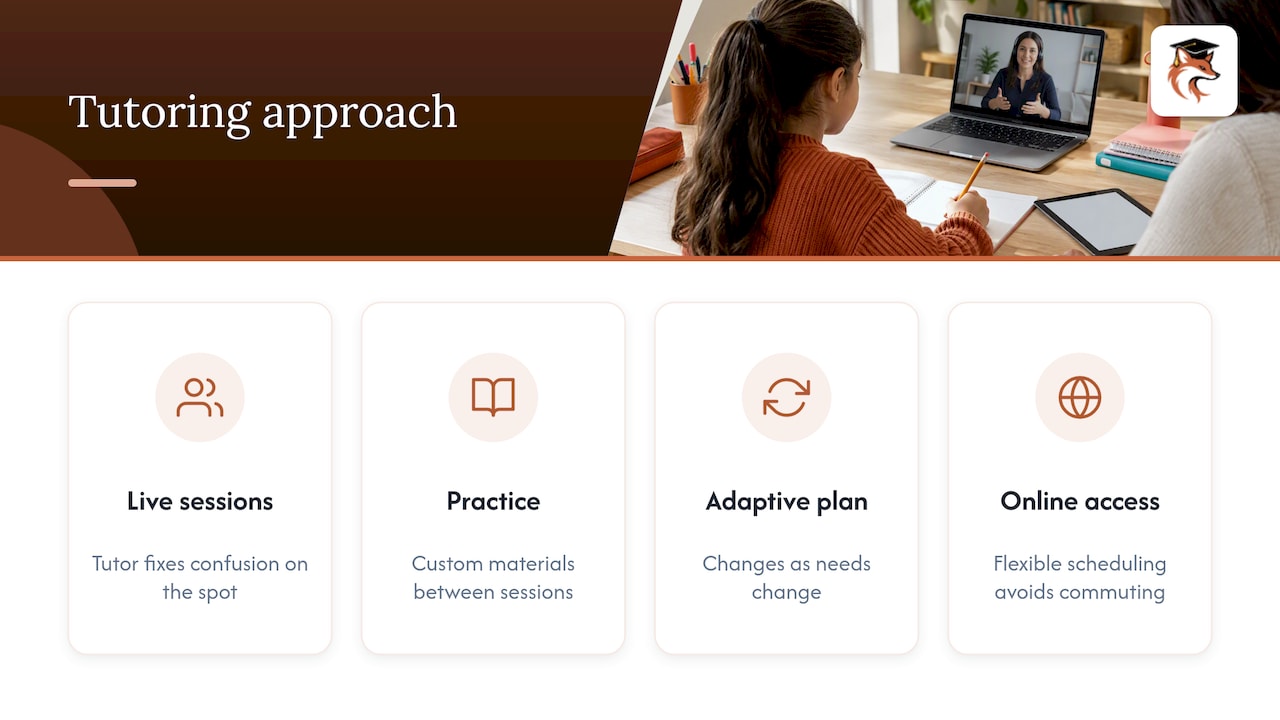
We believe the live session is the part of tutoring that cannot be replaced. That is where a university-level tutor notices that your child rushes through instructions, or confuses two rules, and fixes it on the spot. So we keep sessions interactive and personal, and we avoid using them to lecture.
We also believe that independent practice matters. Each student has a customised learning plan built around strengths, challenges, pace and goals, and that plan includes work between sessions, with custom educational material and continuous progress monitoring. The aim is a child who gradually needs less help, not one who depends on us.
And we would tell any parent: be careful with labels. A child is not “a visual learner” who can only be taught one way. A child is a person who, this month, needs more explanation of fractions, or more practice with agreement of the past participle. The plan should change as that need changes.
Our approach is online, with live sessions and flexible scheduling, so families across Quebec do not need to commute. If you want to compare formats, see home tutoring vs. online tutoring.
— Réussite A+
Getting started with live online tutoring
If you would like a live, personalised plan for your child in math or French, our regular session runs throughout the school year. Rates are $30-35 per hour, plus a one-off registration fee of $65. If your child is not satisfied after the first session, we offer a refund for that session. For a summer catch-up, see our summer session, and for entrance exams, our school exam preparation. You can register through our registration page.
To see how families follow progress, read about how online tutoring helps parents monitor academic progress.
Common mistakes to avoid
- Choosing on convenience alone. Flexible is attractive, but a child who does not log in learns nothing.
- Treating live time as a lecture. If a session is mostly one person talking, ask for more problem-solving.
- Leaving a young child alone with self-paced work. Younger students usually need a structured routine and an adult nearby.
- Switching style labels. Changing the whole approach because of a quiz result online rarely helps. Adjust based on the task and on how your child responds.
- Ignoring feedback. Without regular updates, you cannot tell whether the format is working. Ask what changed after four weeks.
FAQ
What is the main difference between synchronous and asynchronous learning?
The difference is timing. In synchronous learning, everyone takes part at the same time, for example in a live video session. In asynchronous learning, your child accesses materials and completes tasks whenever it suits them, within any deadlines set.
Is synchronous learning better for young children?
Usually, yes, at least for new or difficult content. Younger students tend to need immediate feedback and an adult to guide them. Self-paced practice still has a place, but in short, structured doses.
What is hybrid learning?
Hybrid, or blended, learning deliberately combines modes, such as live sessions plus self-paced work, and requires the student to take part in each. In tutoring, it often means short independent practice between live sessions.
Do learning styles exist?
Children have preferences, but the claim that teaching to a preferred style improves learning has not been supported by meta-analyses. It is more useful to match the method to the task and to your child’s current level.
Sources
- Synchronous and asynchronous learning, Concordia University Centre for Teaching and Learning
- McGill definitions of modalities of teaching
- TP 15595, Delivery of distance, online, and blended learning courses, Transport Canada
- Course listings and class schedules, University of Alberta Office of the Registrar
- Training, Canadian Defence Academy, Canada.ca
- Systematic reviews of online learning and its effectiveness, SSHRC evidence brief
- The Learning Styles Illusion: Debunking Education’s Most Persistent Myth