




If your child’s grades are slipping, homework ends in tears, or confidence seems to be fading, those are real signs tutoring could help. The first step is simple: talk to the teacher this week and book a short trial session to see where the gaps actually are. We offer that kind of starting point, alongside the checklist below.
TL;DR:
- Tutoring led by trained professionals and conducted three or more times weekly produces significantly better academic results than sporadic or informal help.
- Watch for patterns such as consecutive report card declines, homework avoidance, or decreased confidence, which indicate a likely need for tutoring.
- Seek formal assessment early if a child shows persistent language delays, severe organizational difficulties, or does not respond to basic teaching, as those signals suggest learning differences.
- When choosing a tutor, verify subject expertise and teaching experience, request references or a trial session, and ensure clear progress tracking and flexible scheduling.
- Combining tutoring with active parental engagement, like reading together or practicing numeracy, boosts student performance by up to 35 points on assessments.
Table of Contents
- 1. Clear signs your child may need tutoring
- 2. Why tutoring works and what makes it effective
- 3. When to seek a formal assessment instead
- 4. How to choose a tutor: a simple decision rubric
- 5. What Réussite A+ brings to a first session
- 6. A partnership built on shared goals, not blame
- Ready to find out where your child actually stands?
- FAQ
- Sources
1. Clear signs your child may need tutoring
Some signs are loud. Others creep in quietly over a few report cards. Here is what we tell parents to watch for, roughly in order of urgency.
- Grades sliding over two or more reporting periods, not just one rough test.
- Homework battles: avoidance, tears, or hours spent on work that should take twenty minutes.
- Confidence dips: your child says “I’m bad at math” or stops raising a hand in class.
- Trouble focusing or organising: missed deadlines, lost worksheets, a backpack that’s a disaster zone.
- Falling behind peers in reading, numeracy, or French fundamentals that classmates seem to have mastered.
A single bad quiz rarely means much. A pattern across two report cards, or a child who used to enjoy a subject and now dreads it, is worth acting on. To check at home, try three quick things: ask your child to read a grade-level paragraph aloud and see if it’s smooth or choppy, time how long a typical homework assignment actually takes compared to what the teacher expects, and ask one open question like “what’s the hardest part of class this week” and listen for specifics versus a shrug.
Pro Tip: Keep a simple two-week log of homework time and mood. Patterns show up faster on paper than in memory.
For a closer look at the emotional and academic signals Quebec parents often notice first, see our signs a child needs support guide.
2. Why tutoring works and what makes it effective
Tutoring has a solid track record, but not all tutoring delivers the same results. A systematic review and meta-analysis of preK-12 tutoring found pooled effect sizes of roughly 0.288 to 0.37 standard deviations, a meaningful academic boost, with the biggest gains tied to two factors: who delivers the tutoring and how often.
Sessions led by teachers or trained paraprofessionals consistently outperform informal, nonprofessional help. Frequency matters just as much. A related Stanford research brief found that programs running three or more times a week produce noticeably stronger results than once-weekly sessions. The takeaway for parents: prioritize a qualified tutor and a consistent schedule over sporadic, as-needed help.
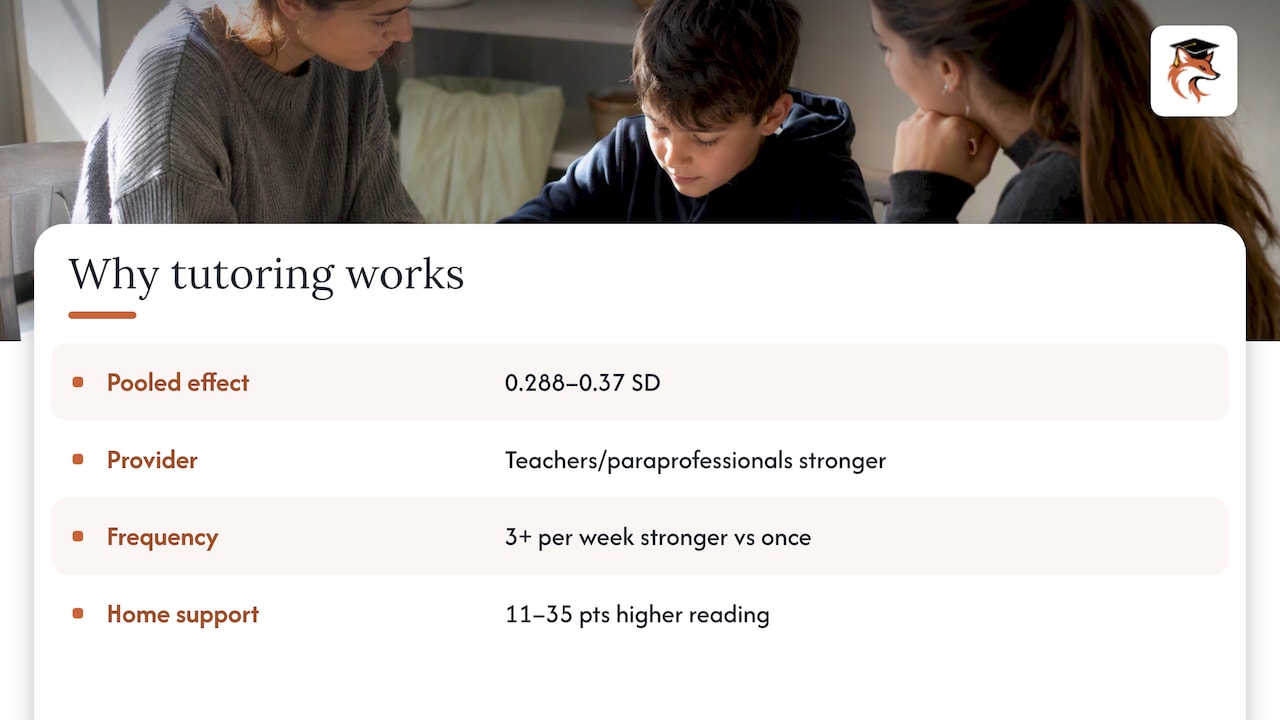
Home support amplifies all of this. Parental engagement research links everyday activities like reading together and early numeracy practice to measurable advantages on national assessments, sometimes 11 to 35 points higher on reading scores. Tutoring and a supportive home routine work best together, supporting each other to improve outcomes.
3. When to seek a formal assessment instead
Some signs point beyond typical academic struggle and toward a possible learning difference. These deserve a conversation with the school or a health professional before, or alongside, starting tutoring.
- Persistent language delays or regression in skills your child previously had.
- Severe organisational or processing difficulties that don’t improve with structure or routine.
- No response to repeated, patient teaching of basic skills at an age-appropriate level.
- Social or communication differences that concern you beyond typical shyness.
If you notice these, ask the school directly for a screening referral or an individualized support plan, the Quebec equivalent of an IEP. A formal diagnosis can open the door to specialist tutors, speech or occupational therapy, and assistive technology that general tutoring won’t provide on its own. Public health guidance on developmental signs recommends raising concerns early rather than waiting to see if a child “grows out of it.” The earlier a persistent or severe gap is flagged, the more options stay open.
4. How to choose a tutor: a simple decision rubric
Once you’ve decided tutoring makes sense, picking the right tutor matters almost as much as deciding to start. Work through these steps.
- Confirm subject knowledge and teaching experience, not just a strong report card from the tutor’s own school days.
- Ask for references or a trial session before committing to a longer package.
- Check how lessons get tailored to your child’s pace, not a one-size-fits-all script.
- Ask how progress gets tracked and reported to you, and how often.
- Review scheduling, cancellation, and refund terms before signing anything.
On a first call, ask directly: how do you adjust a lesson plan when a concept isn’t clicking, how often will I hear about progress, and what happens if the first session isn’t a fit? Treat qualified instruction and clear communication as must-haves; a fancy app or bonus materials are nice-to-haves at best.
Pro Tip: If a tutor can’t describe how they’d handle a stuck, frustrated student in the first five minutes of a call, keep looking.
For more detail on vetting credentials and fit, our guide on choosing the right tutor walks through it step by step. Red flags include vague answers about progress tracking or pressure to commit to a long package before a trial.
5. What Réussite A+ brings to a first session
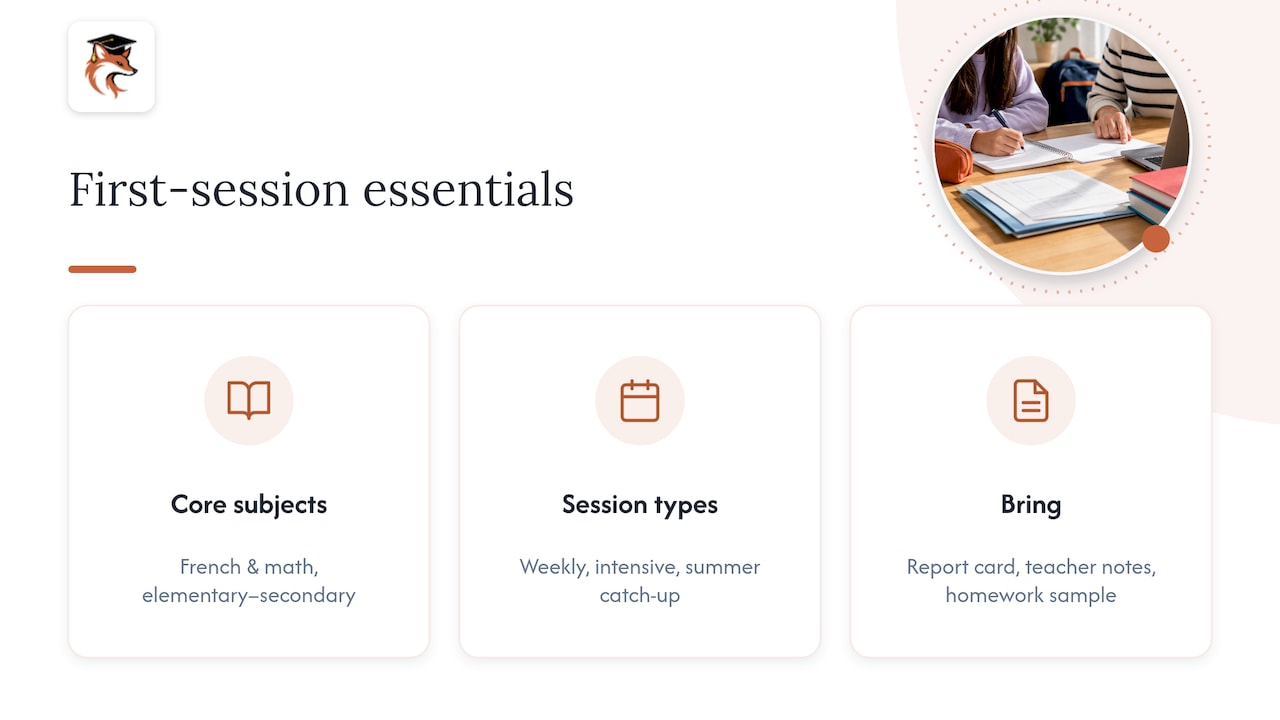
With extensive experience in education, we focus specifically on French and math for elementary and secondary students, two subjects where early gaps tend to compound quickly. Our tutors are chosen for academic strength and teaching skill, and every student gets a learning plan built around their own pace and goals rather than a generic curriculum.
We run weekly support for ongoing coursework, intensive sessions ahead of exams, and summer catch-up programs for skills that slipped over the break. For a first session, we ask parents to have recent report cards, teacher comments, and a sample of recent homework on hand so we can map the actual gap, not a guess at one. Our local Quebec guidance covers what to expect from that first meeting in more detail.
6. A partnership built on shared goals, not blame
The most useful progress we see comes from parents, tutors, and teachers sharing the same specific goals, say, finishing math homework independently within thirty minutes, rather than vague hopes for “doing better.” Real improvement usually takes a full term of consistent sessions and home practice, not a few weeks.
When a child struggles, the instinct to assign blame, to themselves or to a teacher, rarely helps. What helps is steady encouragement and a clear plan everyone can follow.
— Réussite A+
Ready to find out where your child actually stands?
Booking a trial session costs little in time and tells you more than another week of guessing. Before your first session, pull together recent report cards, teacher comments, and a sample of homework so we can see the real gap right away.

- Regular weekly support: Session régulière for ongoing coursework.
- Exam preparation: Préparation aux examens scolaires for entrance or year-end exams.
- Summer catch-up: Session d’été to rebuild skills before fall.
- Pricing details: our fees page outlines registration costs and hourly rates.
FAQ
How do you know if your child needs a tutor?
Watch for grades slipping across two or more report cards, homework that triggers tears or avoidance, and a child who seems less confident about school than before. A short trial session with a qualified tutor is usually the fastest way to confirm whether the gap is temporary or needs ongoing support.
When should you consider a tutor for your child?
Consider tutoring as soon as a pattern appears rather than waiting for a crisis: two consecutive weak test results, consistent homework struggles, or a teacher raising concerns at a parent meeting are all reasonable triggers. Earlier action tends to prevent small gaps from becoming bigger ones, particularly in foundational reading and math skills.
What age should a child have a tutor?
There’s no fixed starting age: tutoring can help as early as elementary school when foundational reading or numeracy skills are shaky, and it remains useful through secondary school for exam preparation and subject-specific support. The right time depends on the specific signs your child shows, not a calendar age.
What do parents look for in a tutor?
Parents generally prioritize subject expertise, teaching experience, and the ability to adjust lessons to a child’s pace rather than following a fixed script. Clear communication about progress, a trial session before committing, and transparent pricing and scheduling also rank high on most parents’ checklists.
Can tutoring costs be claimed on taxes in Canada?
Tutoring costs may be claimed as a medical expense only when a medical practitioner certifies the tutoring is necessary due to a mental impairment, and payments go to a provider who is not related to the child. The Canada Revenue Agency’s guidance outlines the documentation and eligibility rules in detail.
Sources
- The impressive effects of tutoring on preK–12 learning: a systematic review and meta-analysis of the experimental evidence
- Assessment matters — parental engagement research (CMEC)