


Secondary 2 math is the year your child consolidates fractions, ratios, basic algebra and introductory geometry before choosing a sequence in Secondary 3. The three priorities that matter most right now are proportional reasoning, solving simple equations, and angle and area relationships. The best next step is a short diagnostic quiz this week, followed by a focused six-week study plan that rotates those topics in daily 20-minute sessions.
TL;DR:
- Focusing on fractions, ratios, and basic algebra is crucial, as these areas directly impact the student’s ability to progress into Secondary 3 topics.
- A short diagnostic quiz followed by focused six-week study sessions improves mastery of key topics with minimal daily practice.
- Prioritizing reasoning and explanation during practice helps maximize exam performance since Quebec grades heavily weight mathematical reasoning.
- Using curriculum-aligned resources like Alloprof and Sigma Challenge ensures practice is relevant and effective for Quebec’s math standards.
- Consistent pacing of 20-30 minute daily reviews and targeted review of errors boosts student confidence faster than extensive, infrequent sessions.
Table of Contents
- Curriculum at a glance: Secondary 2 in Quebec
- Key topics and study priorities for the year
- How grading and final results work in Quebec
- Where to find practice material that matches the curriculum
- A practical six-week study plan for Secondary 2
- What experienced tutors notice about Secondary 2 students
- How Réussite A+ supports Secondary 2 math
- Sources
- FAQ
Curriculum at a glance: Secondary 2 in Quebec
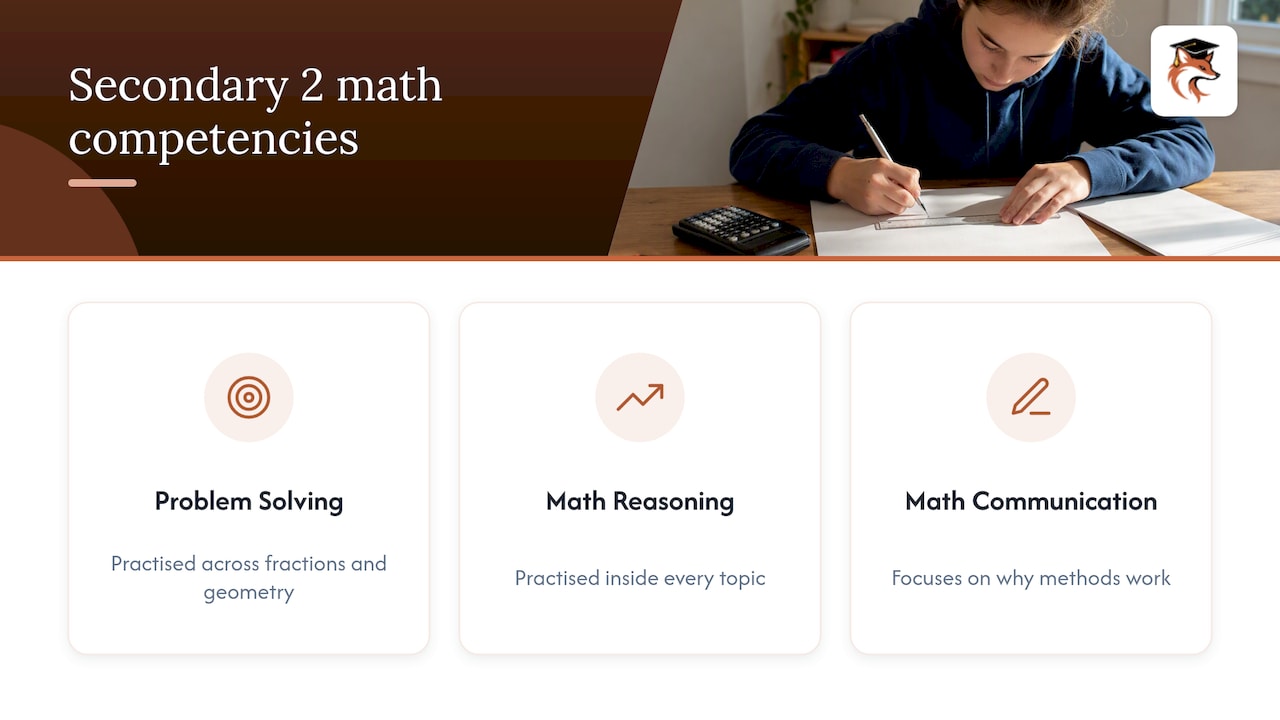
Quebec’s mathematics programme, known as the PFEQ, is built around three competencies: solving a situation problem, deploying mathematical reasoning, and communicating with mathematical language. These aren’t separate units to memorize. They’re skills your child practises inside every topic, from fractions to geometry, so a good study session always asks “why does this work” rather than just “what’s the answer.”
Secondary 2 sits inside the first cycle of secondary school, which runs through Secondary 1 and 2 as a shared foundation. Students don’t yet split into the differentiated sequences, Cultural Society and Technical (CST), Technical and Scientific (TS), or Science and Natural (SN), that begin in Secondary 3. That makes Secondary 2 a consolidation year: gaps in fractions, ratios or basic equation solving tend to resurface quickly once the sequences diverge and the pace increases.
The full scope of what’s taught, field by field, is laid out in the official Secondary mathematics programme published by the Gouvernement du Québec. It’s worth a look if you want to see exactly which competencies and content areas apply to your child’s grade, rather than relying on a workbook’s table of contents.
Key topics and study priorities for the year
Five topic groups carry most of the weight in Secondary 2. Treat each one as a short, repeatable practice loop rather than a single study session.
- Numbers and proportional reasoning: convert between fractions, decimals and percentages, then solve ratio and proportion word problems. Our fractions guide walks through the common sticking points step by step.
- Algebra basics: simplify algebraic expressions, isolate a variable in one-step and two-step equations, and translate a word problem into an equation before solving it.
- Geometry and spatial reasoning: practise angle relationships (complementary, supplementary, vertically opposite), basic constructions, and area and perimeter formulas; Alloprof’s concept sheets on projections and perspective are a useful refresher for drawing tasks.
- Measurement and units: convert between units of length, area and volume, and apply the right formula without mixing up dimensions.
- Statistics and probability: read and interpret charts, calculate mean, median and mode, and work through simple probability situations.
For each topic, aim for two to four short practice tasks a week rather than one long cram session. A 15-minute drill on unit conversions done three times beats a single 45-minute session that covers everything at once. If mental math fluency is the real bottleneck, our quick calculation techniques guide offers drills that speed up the numbers work underneath all five topics.
How grading and final results work in Quebec
Quebec weighs two of the three math competencies for most report card calculations: solving a situation problem and deploying mathematical reasoning, with a weighting breakdown that the ministry publishes directly. The official weighting and report card rules show how these competencies combine into a final mark, and most secondary courses use a 60% threshold to pass.
In later cycles, the ministry’s own assessments can factor into or adjust a student’s school-based results through the relevé des apprentissages, so school marks aren’t always the final word. For Secondary 2 specifically, the practical takeaway is simple: during the term, prioritize understanding and showing reasoning on every problem, since that’s the competency weighted most heavily; closer to exam periods, shift toward timed practice that mirrors the actual test format.
Where to find practice material that matches the curriculum
Not every workbook or app lines up with what Quebec actually tests, so it helps to know which resources are built for this curriculum specifically.
- Alloprof publishes free concept sheets for Secondary mathematics, with worked examples that mirror classroom vocabulary and notation, useful for a quick refresher before homework or a quiz.
- Sigma Challenge MathQuiz offers topic quizzes, including a dedicated geometry quiz bank covering lines, angles, perimeter, area and volumes, which suits short timed practice once the concept is understood.
- Print workbooks such as the series listed in our best math workbooks roundup give extra question volume for topics that need repetition, like fraction operations or equation solving.
The order matters more than the resource itself. Start with a short diagnostic to find the weak spot, use a concept sheet to re-teach that specific idea, move to a quiz for timed repetition, then have a parent or tutor review the errors together. Skipping straight to quizzes without the concept review step is the most common reason practice doesn’t translate into better marks.
A practical six-week study plan for Secondary 2
Six weeks is enough time to close most gaps without turning every evening into a math battle. The plan below rotates topics so nothing gets forgotten between sessions.
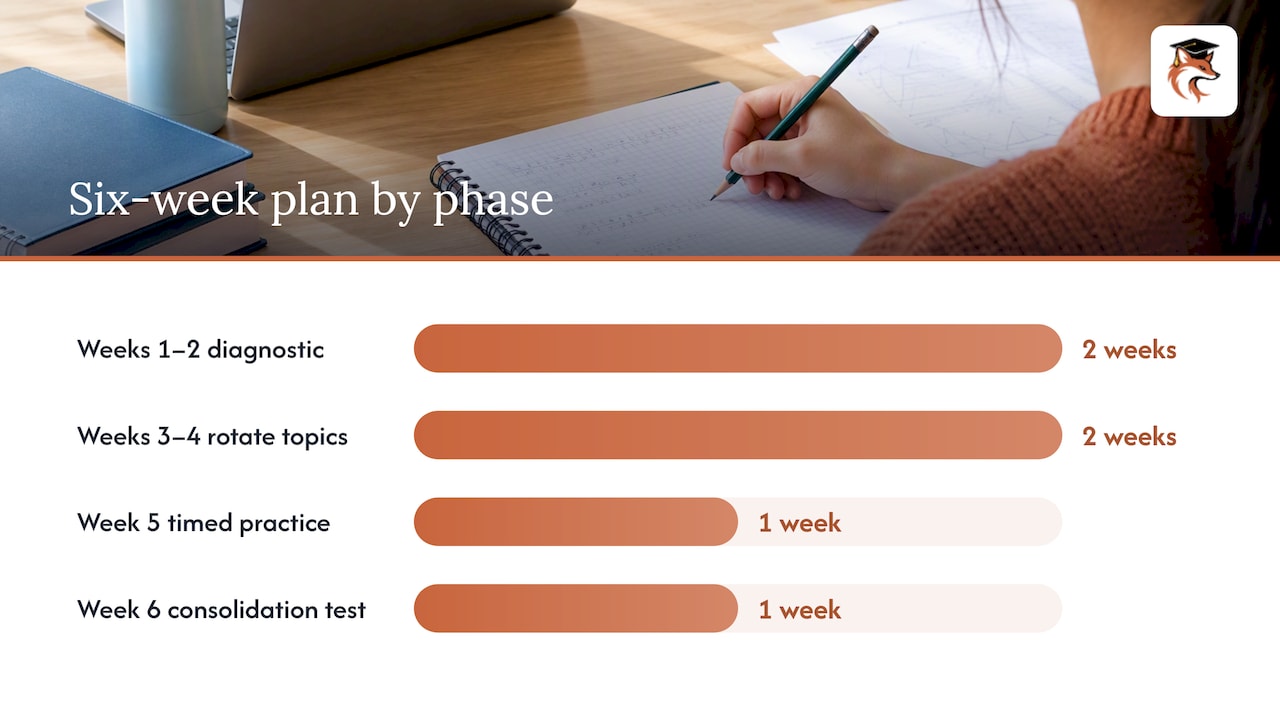
- Weeks 1 to 2: run a short diagnostic, then spend 20 to 30 minutes daily on the single weakest topic identified, usually fractions, ratios or equation solving.
- Weeks 3 to 4: rotate through all five topic groups with mixed problem sets, adding one short timed quiz every few days and one lighter review day each week.
- Week 5: switch to fully timed practice and spend extra time analyzing wrong answers instead of just redoing the correct version.
- Week 6: write a consolidation test under exam conditions, review every mistake line by line, and decide whether extra tutoring support is needed before the next term.
Pro Tip: Have your child explain out loud why each step works, not just what the answer is. Quebec’s grading weighs reasoning heavily, so practising the explanation is practising the mark.
Parents and tutors can track progress with a simple checklist: can the student solve a two-step equation without help, convert units without a formula sheet, and justify an answer in a full sentence. Improvement shows up as fewer hesitations and shorter solving time, not just correct final answers. For families who want a longer runway, our 12 week timeline extends this same structure.
What experienced tutors notice about Secondary 2 students
Most students who struggle in Secondary 2 aren’t missing ability, they’re missing a consistent routine and a clear sense of which gap to fix first. Over more than 25 years of tutoring Quebec students, our tutors have found that pacing the plan to the child, rather than the calendar, is what turns frustration into steady confidence.
— Réussite A+
How Réussite A+ supports Secondary 2 math
Following a study plan on your own works for many families, and for others, a second set of eyes catches gaps faster. Réussite A+ pairs each student with a university-level tutor through a session régulière for ongoing weekly support, or a shorter exam preparation session when the goal is a specific upcoming test.
Every plan is adjusted to the student’s pace rather than a fixed curriculum script, which is why our tutoring has supported a large number of students across Quebec with a high client satisfaction rate. A registration fee of $65 applies to new families, and sessions run $30 to $35 per hour, with pricing details available on our rates page. Book a first session and see where your child’s plan should start.
Sources
- Programmes de mathématique au secondaire | Gouvernement du Québec
- Geometry Quiz — Secondary Math – Sigma Challenge MathQuiz
FAQ
What topics should a Secondary 2 student focus on most?
Fractions, ratios, basic algebraic equations and angle relationships in geometry carry the most weight because they feed directly into Secondary 3 sequences. A student who is solid in these areas usually adapts faster once CST, TS or SN options begin.
What mark do you need to pass Secondary 2 math in Quebec?
Most secondary math courses in Quebec use a 60% passing threshold, based on the ministry’s weighting rules. The final mark combines the weighted competencies rather than a single test score.
How long should a daily study session be?
Twenty to thirty minutes of focused daily practice tends to work better than one long weekend session, since short repeated sessions build fluency without causing fatigue. The six-week plan in this guide uses that pacing throughout.
Are Alloprof and Sigma Challenge free to use?
Alloprof’s concept sheets are a free resource that many Quebec students already use for homework help. Sigma Challenge MathQuiz offers topic-based quizzes, including a geometry quiz bank, suited to short timed practice sessions.
How much does tutoring with Réussite A+ cost?
Réussite A+ tutoring sessions run $30 to $35 per hour, with a one-time $65 registration fee for new students, detailed on the rates page. Pricing applies whether a family chooses regular sessions, exam preparation or summer catch-up support.