



The most defensible baseline is 30 to 60 minutes, but the exact number matters less than you might think. A working paper reviewing tutoring programme designs found most evaluated programmes fall in that range, with no single “magic” length. At Réussite A+, experience with families confirms that how often a child practises, and how focused each session is, tends to shape progress more than the minutes on the clock.
TL;DR:
- Shorter, frequent sessions generally lead to better progress than longer, infrequent lessons, especially when delivered three or more times weekly.
- Younger children benefit from 20 to 30-minute sessions, while older students can sustain 30 to 60-minute periods depending on the task and focus.
- The right session length depends on task type, attention span, group size, and clear learning goals rather than fixed age-based formulas.
- Starting with shorter sessions and adjusting based on the child’s response is recommended before committing long-term to a specific schedule.
- Regular review of progress and flexibility in session timing can optimize learning outcomes and keep engagement high.
Table of Contents
- What session length works best at each age and grade
- What actually determines the right session length
- Sample agendas for 30, 45, and 60-minute lessons
- Why frequency often beats extra minutes
- How Réussite A+ puts these principles into practice
- A short checklist before you commit to a schedule
- How Réussite A+ can support your family’s schedule
- Sources
- FAQ
What session length works best at each age and grade
A five-year-old and a Grade 10 student do not learn the same way, so their sessions should not look the same either. Younger children run out of focus fast, while older students can sustain longer, more demanding work if the content justifies it. These general ranges can be paired with direct observation, adjusting up or down based on how a specific child responds, not just their birth year. Our guide on tutoring hours by age breaks this down further for parents planning a weekly schedule.
As a starting point:
- Early elementary (kindergarten to Grade 2): 20 to 30 minutes, since attention spans are short and new skills need frequent, brief exposure.
- Late elementary (Grade 3 to 6): 30 to 45 minutes, long enough for a full teach-practice-feedback cycle.
- Middle school (Grade 7 to 9): 30 to 50 minutes, depending on whether the goal is a quick skill fix or deeper concept work.
- High school: 45 to 60 minutes or more, especially for subjects like math or science that require worked examples and layered practice.
Resist the temptation to apply a strict formula, such as adding a set number of minutes per grade level. A meta-analysis and working paper on tutoring dosage notes that evaluated programmes vary widely, from 10-minute drills to hour-long lessons, and the right length depends on the child in front of you, not a chart.
What actually determines the right session length
Age gives you a starting range, but four other factors decide whether that range fits a particular child on a particular day.
- Task type: Introducing a brand new concept demands more sustained focus than reviewing homework or drilling flashcards.
- Attention and stamina: Watch for fidgeting, slower responses, or repeated mistakes: these are cues to wrap up, not push through.
- Format and group size: One-to-one sessions can move faster and shorter than small-group formats, where explanations often take longer to land for everyone.
- A clear goal: Every session should aim at one measurable outcome, whether that is mastering long division or writing a five-sentence paragraph independently.
Pro Tip: If you are unsure how long to book, start shorter than you think you need. It is easier to extend a session that is going well than to salvage one that has run past a child’s limit.
Sample agendas for 30, 45, and 60-minute lessons
A well-structured half hour can outperform a poorly planned hour. The Stanford NSSA session-structure guide outlines a simple sequence, opening check-in, focused teaching, guided practice, feedback, and a short close, that scales across durations.
- 30 minutes: A two-minute check-in, 10 to 15 minutes of focused teaching on one skill, 10 minutes of guided practice with immediate feedback, and a one to two-minute wrap-up naming what was learned.
- 45 minutes: Five minutes to set the goal, 15 to 20 minutes of teaching, 15 minutes of guided practice with feedback, and 5 to 10 minutes of independent practice or review.
- 60 minutes: Extended teaching and modelling, a longer guided-practice block, a few minutes of reflection on what worked, and time to plan the next homework step.
For online sessions, build in deliberate transition points and short independent-work windows rather than filling every minute with tutor talk. Our guide to running an online tutoring session and our notes on managing screen time during virtual lessons cover this in more detail. Canadian procurement guidance for virtual tutoring specifications even sets different minimums for individual versus group formats, a reminder that delivery mode changes the ideal structure.
Why frequency often beats extra minutes
Adding sessions per week frequently does more for a child’s progress than adding minutes to a single session. A Canadian evidence review found that programmes delivered three or more times weekly were almost twice as effective as those delivered once a week or less. That gap is one reason Réussite A+ often recommends a shorter, more frequent schedule over a single long weekly block.
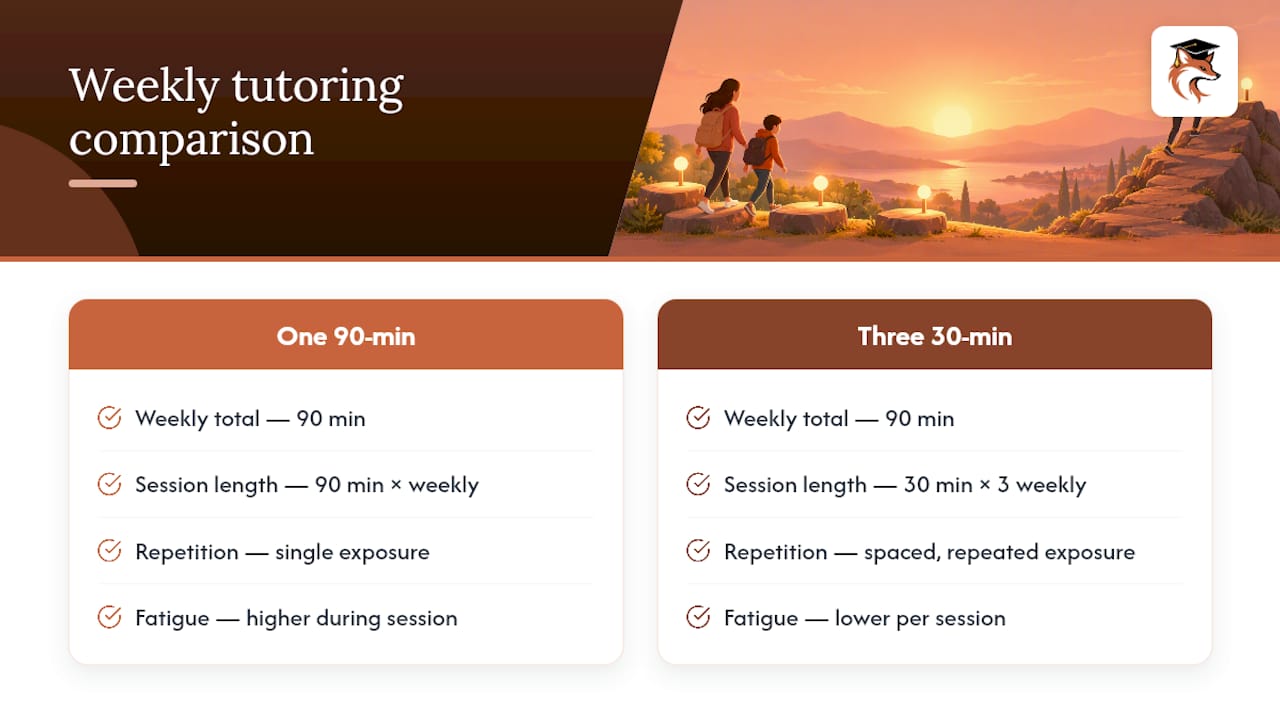
In practice, this means three 30-minute sessions a week can outperform one 90-minute session, even though the total time is identical. Shorter, repeated exposure keeps skills fresh and reduces the fatigue that creeps in during marathon lessons. When planning a schedule, set a review checkpoint every three to four weeks and track a concrete indicator, like accuracy on practice problems or fluency on a reading passage, to see whether the current dosage is working before changing it.
How Réussite A+ puts these principles into practice
With more than 25 years of experience and over 3,500 students supported, Réussite A+ has refined how session length and frequency work together in real family schedules.
- A typical first session runs 45 to 60 minutes and includes a brief assessment, a clear goal for the coming weeks, and a small homework task to gauge independent progress.
- Progress is reviewed regularly, and length or frequency is adjusted based on how the student responds, not on a fixed template.
- Many families see stronger results moving from a single weekly hour to two or three shorter sessions, mirroring the frequency effect found in Canadian tutoring research.
- Our first-session framework, built from work with thousands of students, gives parents a concrete starting point.
Réussite A+ maintains a very high client satisfaction rate, a reflection of their willingness to adjust the plan rather than force every child into the same schedule.
A short checklist before you commit to a schedule
Before locking in a session length for months, run a small trial and let the results guide you.
- Agree on one narrow, measurable goal with a quick baseline check before the first session.
- Pick a starting length based on age and subject, then commit to three or four sessions before judging it.
- Track attendance, practice accuracy, and the child’s energy level at the end of each session.
- If engagement drops noticeably partway through, shorten the session before you add more minutes.
- When progress stalls, try increasing frequency first, then reconsider length.
— Réussite A+
How Réussite A+ can support your family’s schedule
Once you know roughly how long and how often your child needs support, the next step is finding a tutor who can hold that schedule consistently.
Réussite A+ builds programs around the same principles covered here. The Session régulière fits a recurring weekly or twice-weekly schedule at $30 to $35 per hour. For students facing entrance exams, the exam-preparation program uses longer or more frequent sessions to concentrate practice before test day, at the same hourly rate. Families looking for a short, intensive push can consider the Session d’été for concentrated dosage over the summer. A one-time registration fee of $65 applies to new programs, detailed on our pricing page. If you are not sure which length or frequency fits your child, a short trial plan is the easiest way to find out.
- Regular weekly support: Session régulière.
- Concentrated exam preparation: Préparation aux examens scolaires.
- Short-term summer catch-up: Session d’été.
- Frequent, shorter homework support: Tutorat et aide aux devoirs.
Sources
- Working Paper 27476 (NBER) — tutoring programme dosages and session lengths
- The evidence for tutoring to accelerate learning and address educational inequities (Toronto Metropolitan University report)
- Example tutoring session structure (Stanford NSSA)
- Canada
FAQ
How long is a normal tutoring session?
Most tutoring sessions run between 30 and 60 minutes, depending on the student’s age and the subject. A tutoring dosage working paper found this range covers most evaluated programmes, with younger children typically at the shorter end.
How long is an effective tutoring session?
An effective session is less about a fixed number of minutes and more about having one clear goal, focused teaching, and guided practice with feedback. The Stanford NSSA structure guide shows this sequence works across 30, 45, and 60-minute formats.
How many hours would tutoring be?
Weekly hours depend on the child’s needs, but a schedule of two to three shorter sessions per week is often more effective than one long session. A Canadian evidence review found programmes delivered three or more times weekly nearly doubled the impact of once-weekly programmes.
Is one hour of tutoring enough?
One hour can be enough when the session has a narrow objective and includes real practice time, not just instruction. For ongoing skill-building, though, splitting that hour into two or three shorter weekly sessions tends to produce steadier progress, based on the frequency effects seen in Canadian tutoring research.