



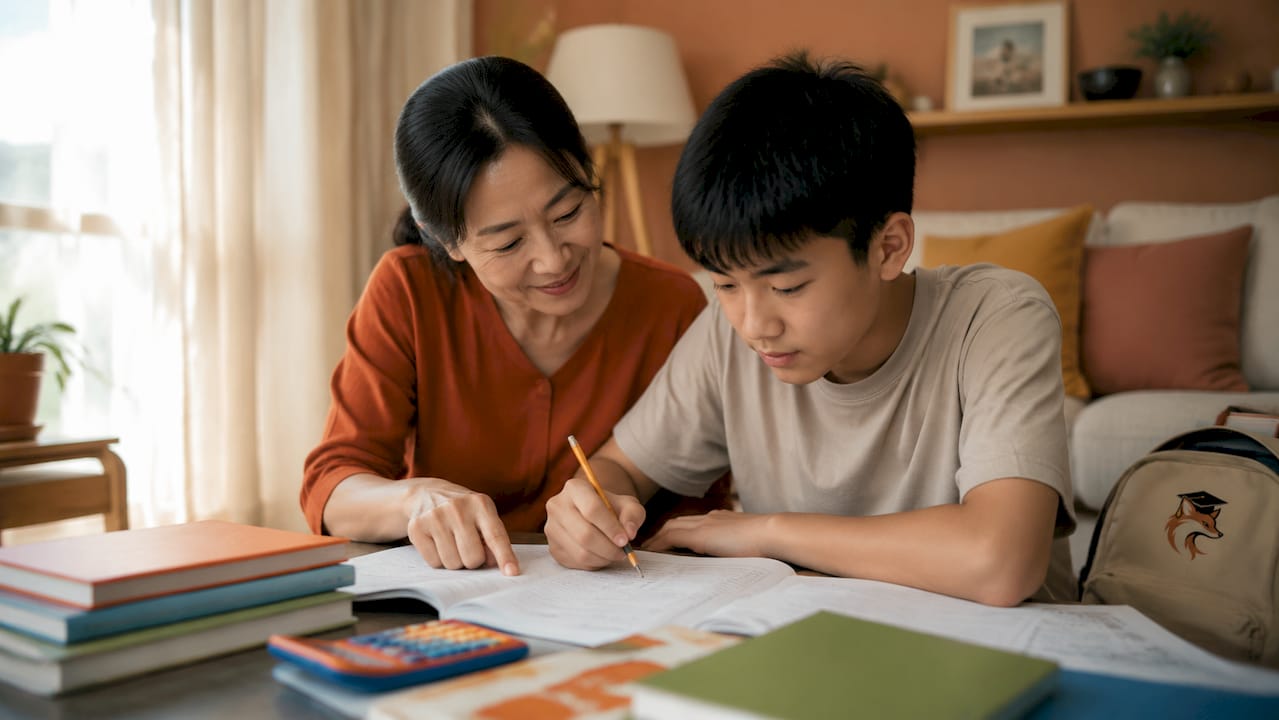
Secondary 1 math is defined as the first year of secondary school mathematics, covering arithmetic, algebra, geometry, and statistics to build the foundation for all future math learning. Known formally as the Secondary 1 mathematics program under Quebec’s PFEQ curriculum framework, this year marks a genuine turning point. Your child moves from concrete elementary concepts to more abstract reasoning, and your role as a parent shifts too. You are no longer expected to solve problems alongside them. You are expected to guide, encourage, and know when to step back. This guide gives you the tools to do exactly that.
What are the core topics in math Secondary 1?
The Secondary 1 math program is built on three pillars: arithmetic and algebra, geometry, and statistics and probability. Each pillar introduces concepts that students will build on for the next five years of secondary school. Understanding what your child is studying helps you ask better questions and spot early signs of struggle.
Arithmetic and algebra cover integers (including negative numbers), fractions, percentages, ratios, and basic linear equations. Students learn proportional reasoning, which means understanding how quantities relate to each other. For example, your child might calculate that a 15% discount on a $60 item saves $9. That single exercise combines percentages, multiplication, and real-world context.
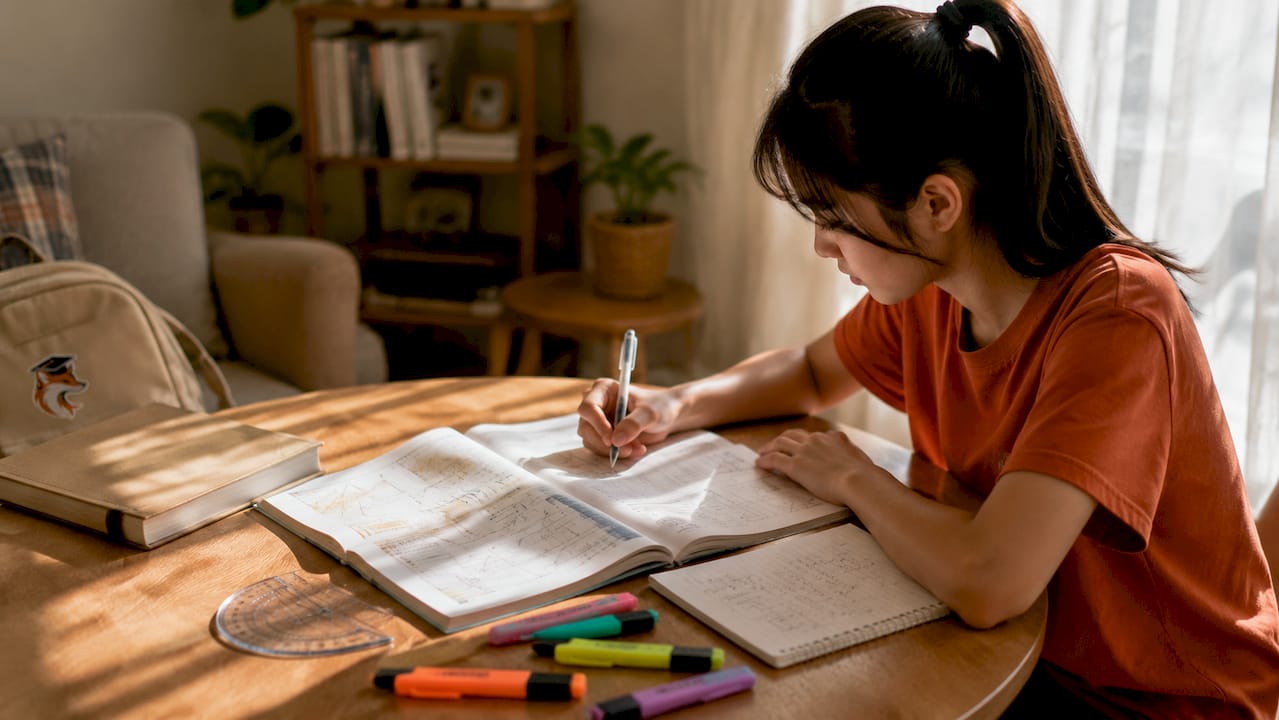
Geometry introduces polygons, measurements of length, area, and volume, and geometric transformations: translation, rotation, and reflection. These are not just drawing exercises. Transformations teach students to think spatially and logically, skills that transfer directly to science and technology courses.
Statistics and probability round out the year. Students collect and represent data using tables and graphs, then calculate simple probabilities for random events. This pillar builds critical thinking. A student who understands that flipping a coin gives a 50% chance of heads is learning to question assumptions, not just memorize formulas.
The table below summarizes the three pillars with typical topics and the student age range for Secondary 1 in Quebec.
| Pillar | Key topics | Typical student age |
|---|---|---|
| Arithmetic and algebra | Integers, fractions, percentages, ratios, linear equations | 12–13 years |
| Geometry | Polygons, transformations, area, volume | 12–13 years |
| Statistics and probability | Data collection, graphs, simple probability | 12–13 years |
Secondary 1 is a transitional year that consolidates elementary knowledge while carefully introducing new abstract concepts. When your child struggles, the cause is often a gap in foundational knowledge, not a lack of ability. That distinction matters enormously for how you respond.
How can parents support their child’s math learning without doing the work?
The most effective parental role in secondary math is guide, not solver. Supporting autonomy helps children become responsible learners and builds the confidence they need to tackle harder problems independently. The goal is to stay close enough to help, but far enough back to let your child think.
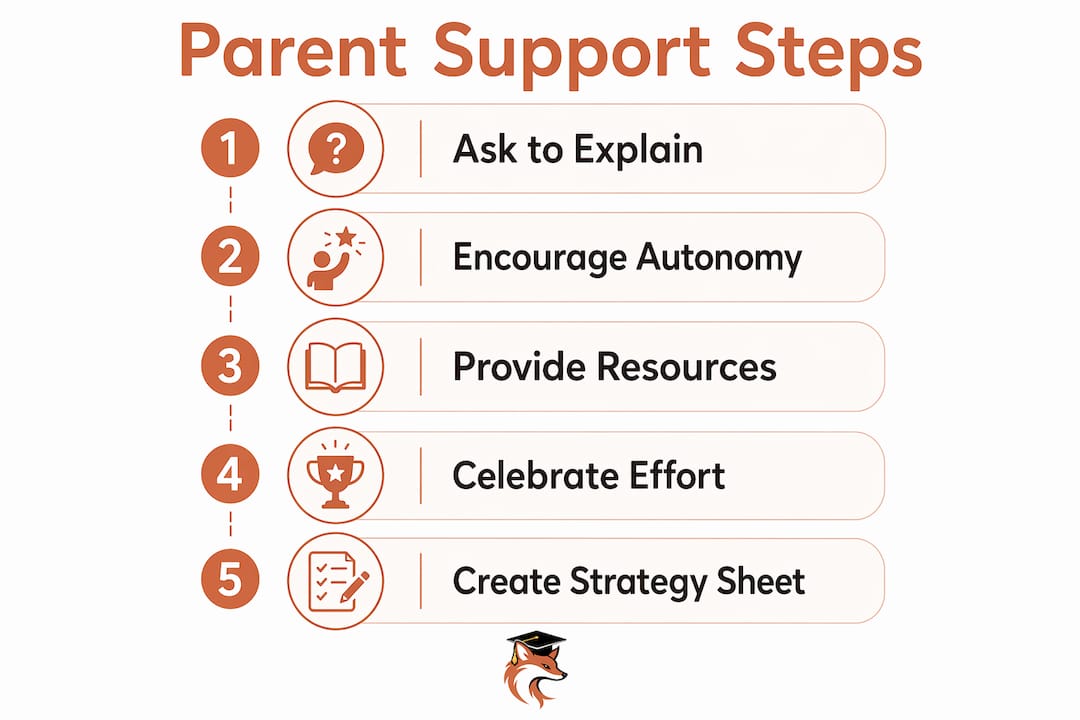
The single most powerful technique is asking your child to explain the problem in their own words. Prompting children to explain tasks in their own words deepens understanding and reveals exactly where confusion starts. If your child cannot explain what the question is asking, that is the real problem to solve, not the calculation itself.
Anticipatory intervention by parents, jumping in before a child asks for help, actively hinders learning. Productive struggle is not a sign that your child is failing. It is the process through which real understanding forms. Wait for your child to ask. Then ask a question back before giving an answer.
Here are practical ways to support without taking over:
- Ask before acting. Wait until your child requests help. Then ask: “What have you tried so far?”
- Use the explain-it-back method. Ask your child to read the problem aloud and tell you what it is asking.
- Build a help plan together. Write down three steps your child can take before asking you: check their notes, reread the textbook example, or look up a learning strategy guide.
- Separate emotion from math. If frustration rises, take a five-minute break. Anxiety blocks working memory and makes problems feel harder than they are.
- Celebrate effort, not just answers. Say “I can see you worked hard on that” rather than “Good job getting it right.”
Pro Tip: Create a simple help strategy sheet with your child at the start of the school year. List their go-to resources: class notes, a trusted website, and their teacher’s office hours. Structured help plans reduce stress and prepare students to tackle difficulties independently, without waiting for a parent to rescue them.
What strategies help Secondary 1 students master challenging math concepts?
Mastery in secondary one math comes from consistent practice, real-world connection, and the right mix of resources. Abstract concepts become concrete when students see them in daily life. Using routine tasks like budgeting and cooking makes math relatable and directly supports comprehension of Secondary 1 topics. When your child helps calculate the grocery bill or measures ingredients for a recipe, they practice fractions, ratios, and proportional reasoning without opening a textbook.
Here is a numbered approach you can build into your child’s weekly routine:
- Connect math to real life daily. Ask your child to calculate a tip at a restaurant, compare unit prices at the grocery store, or measure a room’s area. These tasks reinforce arithmetic and geometry in context.
- Use structured revision sessions. Short, focused sessions of 20–30 minutes work better than long cramming blocks. Review one topic per session and end with two or three practice problems.
- Try math games and apps. Digital tools that present math as a challenge or puzzle reduce anxiety and build fluency. Look for apps that cover the secondary math curriculum topics your child is currently studying.
- Practice with past exercises. Work through previous quizzes and chapter exercises before tests. Repetition builds pattern recognition, which is the core skill in algebra and geometry.
- Seek targeted support when needed. If your child consistently struggles with one topic after two weeks of practice, that is the signal to bring in extra help. A tutor who specializes in secondary mathematics can identify the exact gap and address it directly.
Pro Tip: Incorporating everyday math experiences into learning helps students see beyond abstraction and increases motivation. The next time your child complains that math is useless, hand them the grocery receipt and ask them to check the change.
Fostering a growth mindset means focusing on effort and strategies, not just correct answers. When your child gets a problem wrong, the question to ask is “What would you try differently?” not “Why did you get that wrong?” That single shift in language builds resilience over time.
What should parents expect in Secondary 1 math assessments?
Secondary 1 math evaluations measure three disciplinary competencies, not just calculation accuracy. Students are assessed on their ability to solve math problems, reason mathematically, and communicate their results clearly. Each competency appears on report cards and carries weight in the final grade. Understanding this helps you interpret your child’s results more accurately.
The three competencies break down as follows:
- Problem solving: The student applies a math process to an unfamiliar situation. This is tested through situational problems, which are multi-step scenarios that require planning, not just formula recall.
- Mathematical reasoning: The student justifies their approach, identifies patterns, and makes logical connections between concepts. This competency rewards students who show their thinking, not just their answer.
- Communication of results: The student presents their solution clearly, using correct mathematical language, notation, and organized steps. A correct answer with no explanation earns partial credit at best.
Evaluations in Secondary 1 include quizzes, chapter tests, situational problem tasks, and continuous observation by the teacher. Situational problems are the format that surprises most parents. They look less like traditional math tests and more like short written tasks that require students to explain their reasoning in full sentences. Preparing your child for this format means practicing written explanations at home, not just mental math.
Encourage resilience over perfection. A grade that reflects incomplete reasoning is more useful than a perfect score achieved by memorizing steps without understanding them. Use each assessment as a diagnostic tool for exam prep, not a verdict on your child’s ability.
Key Takeaways
Secondary 1 math success depends on understanding the three-pillar curriculum, supporting your child’s autonomy, and using assessments as learning tools rather than performance judgments.
| Point | Details |
|---|---|
| Three-pillar curriculum | Secondary 1 covers arithmetic and algebra, geometry, and statistics as equal, interconnected areas. |
| Autonomy over intervention | Waiting for your child to ask for help builds independence and stronger problem-solving habits. |
| Real-life math practice | Connecting math to daily tasks like budgeting reinforces concepts and increases motivation. |
| Competency-based assessment | Schools evaluate problem solving, reasoning, and communication, not just correct answers. |
| Early support matters | Persistent struggle with one topic after two weeks signals a need for targeted, personalized help. |
What working with Secondary 1 math families has taught us at Réussite A+
The pattern we see most often is this: a parent sits down with their child, spots the confusion immediately, and explains the solution step by step. The child nods. The homework gets done. Two weeks later, the same problem appears on a test and the child draws a blank. The parent helped, but the child did not learn.
The hardest thing to accept is that confusion is the learning. When a student sits with a problem they cannot immediately solve, their brain is doing the most important work of the year. Parents who interrupt that process with good intentions are, without realizing it, taking the learning away.
What actually works is asking one question and then going quiet. “What does the problem want you to find?” That single question redirects the child’s attention without giving anything away. It is not passive. It is the most active form of support a parent can offer.
We have also observed that the parents who stay connected to their child’s teacher make the biggest difference. Collaboration between parent, child, and teacher is the most reliable way to adapt support to a student’s specific needs. A five-minute conversation with the teacher after a poor test result tells you more than three hours of re-teaching at home.
Secondary 1 is not the year to panic. It is the year to build habits. The students who arrive in Secondary 2 with confidence are almost never the ones who had the most help. They are the ones who learned to ask for help at the right moment, from the right person, in the right way.
— Réussite A+
How Réussite A+ supports your Secondary 1 math learner
Your child does not need to struggle alone through secondary mathematics. Réussite A+ offers personalized online math tutoring built around each student’s specific gaps, pace, and goals. Every session is led by a university-level tutor selected for both academic excellence and teaching ability.
With more than 25 years of experience and a 99% client satisfaction rate across more than 3,500 students, Réussite A+ designs a custom learning plan for each child, whether they need to catch up on foundational concepts, build confidence before exams, or work ahead of grade level. Flexible scheduling means sessions fit around your family’s routine. If you are weighing your options, the benefits of online tutoring are worth reviewing before you decide.
FAQ
What topics are covered in Secondary 1 math?
Secondary 1 math covers three core areas: arithmetic and algebra (integers, fractions, percentages, ratios, linear equations), geometry (polygons, transformations, measurements), and statistics and probability (data collection, graphs, simple probability).
How can I help my child with math without doing it for them?
Ask your child to explain the problem in their own words before offering any help. This technique reveals where confusion starts and keeps the thinking where it belongs: with your child.
What are the three math competencies assessed in Secondary 1?
Schools assess problem solving, mathematical reasoning, and clear communication of results. Each competency appears on the report card and reflects how a student thinks, not just whether they get the right answer.
When should I consider a math tutor for my Secondary 1 child?
If your child struggles with the same concept for more than two weeks despite regular practice and teacher support, a tutor who specializes in secondary mathematics can identify the exact gap and address it directly.
Is Secondary 1 math significantly harder than elementary math?
Secondary 1 introduces more abstract thinking, particularly in algebra and geometry, but it builds directly on elementary concepts. Gaps from elementary school often surface here, making early identification and targeted review the most effective response.